This article contains advertising. Our booking links are routed through a partner that adds commission tracking automatically, so if you book through one we earn a commission from the provider, at no extra cost to you. It never affects what we recommend. Affiliate disclosure
Palazzo Vecchio has been the political nerve-centre of Florence since 1299. It has hosted the medieval Signoria of merchants, the brief theocracy of Savonarola, the absolutist court of Cosimo I de’ Medici, the brief capital of unified Italy (1865–1871), and today the Florentine city council. Inside its battlemented walls are the 54-metre Salone dei Cinquecento, Vasari’s frescoed apartments, Francesco I’s miniature Studiolo, the Map Room, and a 233-step climb up the Arnolfo Tower with the city’s most theatrical view of the Cathedral. This 2026 guide covers tickets, the Secret Passages tour, what to see in the museum, the Tower climb, the Studiolo, the Map Room, and how to fit it all into a half-day visit.
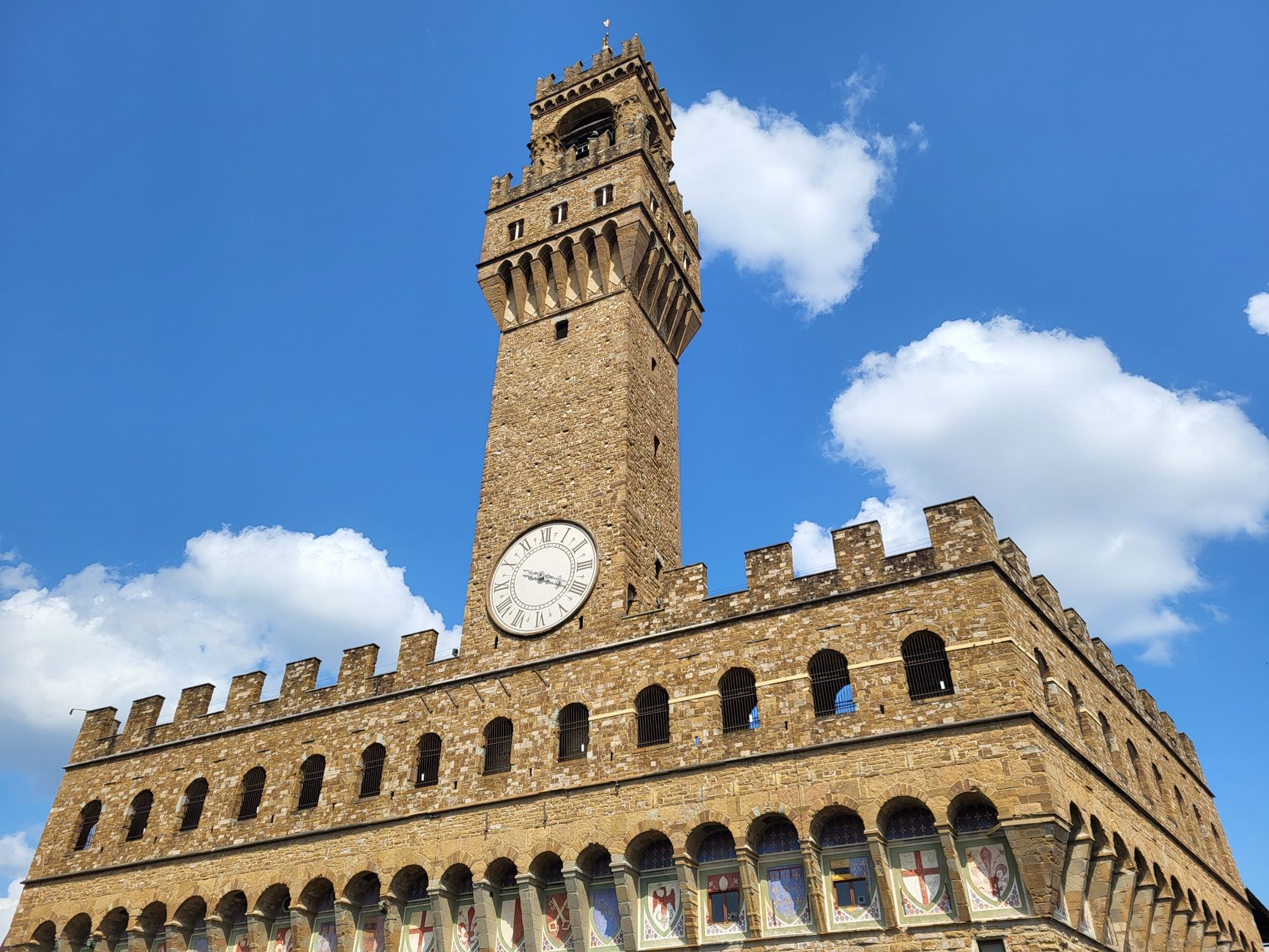
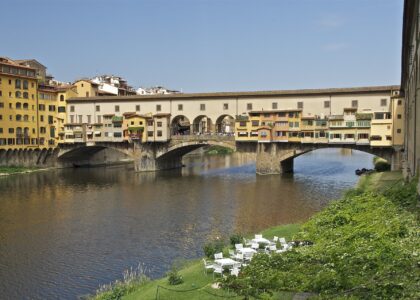
The palace still works as Florence’s town hall, and its tower gives one of the best views in the city. It opens directly onto Piazza della Signoria, and the Vasari Corridor that runs from it crosses the Ponte Vecchio on its way to Pitti.
What Is Palazzo Vecchio?
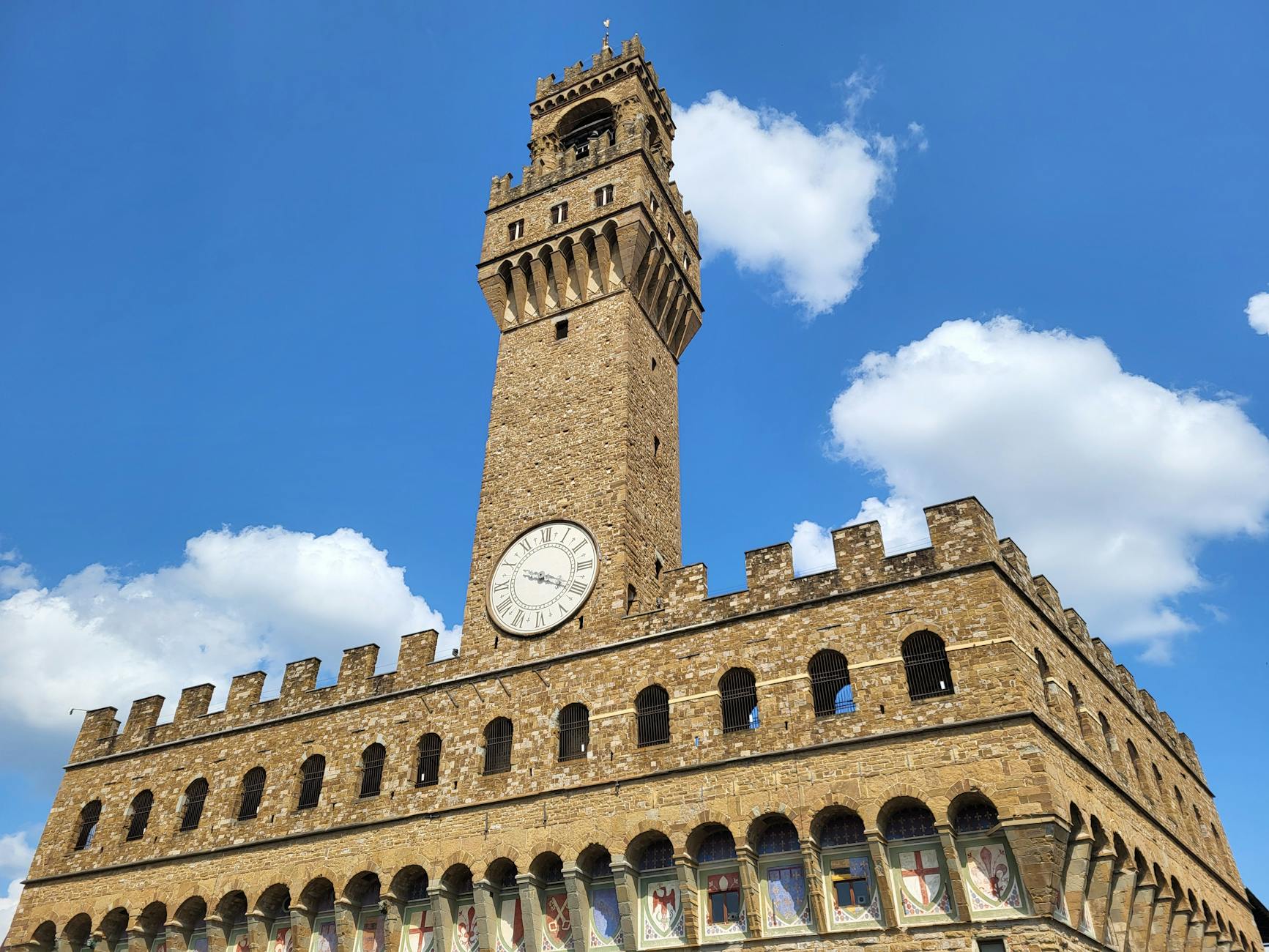
Palazzo Vecchio (literally “Old Palace”) is the seat of Florence’s city government, on the south side of Piazza della Signoria opposite the Uffizi Gallery. The fortified Gothic exterior — rusticated stone walls, a 94-metre asymmetric tower, projecting battlements — has barely changed since Arnolfo di Cambio designed it in 1299. The interior, however, was transformed in the 1560s by Giorgio Vasari for Cosimo I de’ Medici, and what visitors see today is overwhelmingly Vasari’s Mannerist Renaissance interpretation of a medieval town hall.
The palace combines three distinct visitor experiences: the museum (state apartments, Map Room, Studiolo), the Arnolfo Tower climb (separate ticket), and the optional Secret Passages tour (timed guided experience). Most visitors do the museum alone; ambitious travellers add the tower; specialists add the Secret Passages.
Tickets, Hours & Practical Info (2026)
| Detail | 2026 Information |
|---|---|
| Address | Piazza della Signoria, 50122 Florence |
| Museum-only ticket | €12.50 |
| Tower-only ticket | €12.50 |
| Museum + Tower combo | €19.50 |
| Museum + Tower + Archaeological Site | €21.50 |
| Secret Passages tour | €4 in addition to museum entry; 75 minutes |
| Children 0–17 | Free (museum); Tower requires age 6+ |
| Hours (April–September) | Daily 09:00–23:00 |
| Hours (October–March) | Daily 09:00–19:00 |
| Tower closing weather | Closes in heavy rain or thunderstorms |
| Average museum visit | 2 hours |
| Tower climb time | 30 minutes return (233 steps) |
Palazzo Vecchio sets its own ticketing policy independently from the state museums (Uffizi/Accademia/Pitti), which means tickets are not on tickets.uffizi.it. Buy at museumsinflorence.com for the cleanest official option, or in person at the entrance ticket office. Booking is sensible but not as critical as at the Uffizi — peak summer queues at the door rarely exceed 30 minutes.
The Tower has the strictest schedule. It closes one hour before the museum, last admission for the climb is 30 minutes before that, and it shuts entirely in bad weather. There’s also a 25-person-per-15-minutes capacity, so summer Tower-only tickets often sell out for sunset slots — book sunset tower at least three days ahead.
A Quick History of the Palace
Palazzo Vecchio was built between 1299 and 1314 to house Florence’s republican government, the Signoria — a council of nine “Priors” elected from the major guilds, each serving two-month terms. The fortress-like exterior reflected the new building’s defensive role: Florentine government in the 14th century was a contentious affair, with rival factions (Guelphs vs Ghibellines, Black vs White Guelphs) regularly attempting to seize the palace by force. The crenellated facade, the bell tower for emergency alarms, and the watch posts on the ramparts were all functional.
In 1494, after the expulsion of the Medici, Savonarola’s republic remodelled the second floor for the Great Council and built the Salone dei Cinquecento (the “Hall of the Five Hundred”) to house its 500 representatives. In 1503, the new republic commissioned Leonardo da Vinci to fresco one wall of the Salone with the Battle of Anghiari and Michelangelo to fresco the opposite wall with the Battle of Cascina — both projects abandoned, both lost (though Leonardo’s may survive beneath Vasari’s later frescoes, a contested theory still being investigated by scientific imaging).
In 1540, Cosimo I de’ Medici moved his court into the palace and renamed it the Palazzo della Signoria (later “Vecchio” — old — when he relocated to the new Pitti Palace in 1565). Cosimo hired Giorgio Vasari to convert the medieval interior into a Renaissance ducal residence. Vasari raised the Salone dei Cinquecento ceiling by 7 metres, frescoed the new ceiling and walls with the Florentine military victories, designed the private apartments of Cosimo and his wife Eleonora di Toledo, and created Francesco I’s Studiolo. The 1560s renovation defined the palace’s interior identity ever since.
The palace was Italy’s provisional capital from 1865 to 1871, when Florence served as capital of newly unified Italy before the role transferred to Rome. The Salone dei Cinquecento hosted the Italian Chamber of Deputies during those six years.
The Salone dei Cinquecento

The single most impressive room in Palazzo Vecchio is the Salone dei Cinquecento — 54 metres long, 23 metres wide, with a coffered painted ceiling 18 metres overhead. Built in 1494 by Savonarola’s republican government, the Salone was redesigned in 1563–1565 by Vasari and Cosimo I as a pure Medicean propaganda statement. The ceiling holds 39 painted panels celebrating Cosimo I’s military victories — the conquest of Siena (1555), the wars in Pisa, the Tuscan navy, the agriculture and trade of Florence — culminating in the central panel depicting Cosimo I being crowned by an angel.
The walls feature six enormous battle scenes, each ten metres wide: the Florentine victories over Pisa (1494, 1498) and Siena (1554, 1555). On opposite ends of the room, two stone niches house Michelangelo’s Genius of Victory (1532–34, originally intended for Pope Julius II’s tomb in Rome) and a series of statues by Vincenzo de’ Rossi depicting the Labours of Hercules.
The east wall (with the doorway visitors enter from) contains a hidden mystery: in 1503 Leonardo da Vinci began the Battle of Anghiari here, an enormous fresco that he abandoned uncompleted in 1505 after his experimental wax-and-oil technique failed catastrophically (the wet plaster wouldn’t hold his paint, and his attempt to dry it with a charcoal brazier melted everything that had stuck). Vasari, decades later, painted his own Battle of Marciano over Leonardo’s failed attempt — but on his fresco he included a Florentine soldier carrying a green flag with the words cerca trova (“seek and you shall find”). Some art historians believe Vasari built a hollow wall in front of Leonardo’s painting to preserve it underneath, with the inscription as a hidden clue. Endoscopic investigations in 2002 and 2012 found pigments matching Leonardo’s, but the search has been controversial and is currently paused.
The Studiolo of Francesco I

Behind a small door tucked into a corner of the Salone dei Cinquecento, the Studiolo of Francesco I is the most extraordinary single room in Palazzo Vecchio. Designed by Vasari for Cosimo’s son Francesco I, the Studiolo is a tiny windowless chamber barely 8 by 5 metres — Francesco’s personal study and laboratory, where he kept his collection of curiosities, alchemical experiments and the secret passions of a Mannerist prince.
Every wall is covered in paintings by 30+ artists working under Vasari’s direction (1570–1575), each panel illustrating a theme connected to the four classical elements: Earth, Water, Air and Fire. Bronzino, Allesandro Allori, Santi di Tito and Giovanni Stradano each contributed. The paintings function as the door panels of hidden cupboards in which Francesco kept his actual collection — gold and silver vessels, rare gemstones, Etruscan bronzes, exotic naturalia. Two bronze portraits in niches face each other: Francesco’s parents Cosimo I and Eleonora di Toledo, by Vincenzo Danti and Bronzino respectively.
The Studiolo is a single visit’s worth of art history compressed into one small space. It is also a portrait of an eccentric — Francesco I was a withdrawn ruler obsessed with alchemy, glassmaking and rock crystal, more comfortable in his Studiolo than in his throne room. He died in 1587 alongside his second wife Bianca Cappello in still-debated circumstances (long held to be malaria, recent toxicology suggests possible arsenic poisoning).
State Apartments: Eleonora & Cosimo
The first floor’s Quartiere degli Elementi (Cosimo’s private apartments) and second floor’s Quartiere di Eleonora (his wife’s apartments) make up the bulk of the museum visit after the Salone.
Cosimo’s apartments (Quartiere degli Elementi) begin with a series of allegorical halls each dedicated to one of the four elements (water, air, fire, earth) and to Greek mythology — the Sala di Giove, Sala di Cibele, Sala di Cerere, Sala di Ercole, and the Loggia di Saturno opening onto a small terrace with one of the best Cathedral views in Florence. The apartments connect via the Sala di Penelope and Sala di Ester to Eleonora’s quarters.
Eleonora’s apartments (Quartiere di Eleonora di Toledo) are the more intimate of the two. The Cappella di Eleonora — Eleonora’s personal chapel — is frescoed by Bronzino with one of his most jewel-like cycles: scenes from the life of Moses, the four evangelists, and a Pietà above the altar (1545). The colours are unusually well preserved. Adjacent rooms include the Sala delle Sabine, Sala di Ester, Sala di Penelope and the dressing rooms.
The Sala delle Mappe Geografiche (Map Room)
One of the unsung treasures of the palace, the Sala delle Mappe is a cabinet-of-curiosities room lined with 53 painted maps of the known world as Florentines understood it in the 1560s. Cosimo I commissioned the room as a personal geographic encyclopaedia: each map was painted on a wood panel by the cartographer-priest Egnazio Danti and the geographer Stefano Bonsignori. The maps are remarkable historical documents — Africa is partly imagined, the Americas are sketchy, but Europe and the Mediterranean are precisely drawn from the latest navigational reports.
At the room’s centre: a 3-metre-diameter armillary sphere (a mechanical model of the planetary system) made by Antonio Santucci in 1593, depicting the Ptolemaic universe with Earth at the centre. The sphere is wood and copper, gilded, with tiny mechanical models of planets that once moved when wound. It was decommissioned in the 19th century but the case remains beautiful.
The Secret Passages Tour (Percorsi Segreti)

The 75-minute Secret Passages tour, available in English and Italian several times daily, is the most rewarding optional add-on at Palazzo Vecchio. The tour costs €4 in addition to the museum ticket and is capped at 12 people per slot — book ahead at museumsinflorence.com.
The tour itinerary varies but typically includes:
- The hidden staircase of Cosimo I — a narrow stone spiral cut into the wall thickness, used by the Grand Duke to move between his private apartments and the Salone unseen
- The wooden trusses above the Salone dei Cinquecento — the attic between Vasari’s painted ceiling and the actual roof, where you stand among the 500-year-old chestnut beams that hold the entire ceiling up
- The Studiolo of Francesco I entered through its hidden trapdoor route rather than the public door
- The Tesoretto of Cosimo I — Cosimo’s tiny private treasure room beside the Studiolo, frescoed by Vasari with images of the Florentine countryside
- The hidden corridor connecting Bianca Cappello’s dressing room to Francesco’s quarters — the love affair turned-second-marriage that scandalised 1570s Florentine society
Tour guides are typically art-history graduates and the storytelling is excellent. Children 6+ enjoy the tour; under-6s are not permitted because of the steep narrow stairs. Photography is permitted on most parts of the route.
Climbing the Arnolfo Tower

The Arnolfo Tower (Torre di Arnolfo) is the 94-metre crenellated tower that dominates the Florence skyline alongside the Cathedral. The tower is asymmetrically placed on the front of the palace because Arnolfo di Cambio integrated an existing 13th-century tower (the Torre della Vacca, named for the cow-bell that hung in it) into the palace structure. The bell at the top — the Vacca herself, replaced several times since — was the alarm bell for the city, rung to summon the militia, signal fires, declare emergencies, and announce executions.
The climb is 233 steps through narrow stone staircases — straightforward but tight — to a viewing platform with battlements at the top. The panorama is the best non-Brunelleschi-Dome view in Florence: the Cathedral fills almost the entire foreground, the Bargello tower below, the Arno snaking westward, and the Tuscan hills behind. Sunset is the prize slot; midday is hot in summer.
Halfway up the climb, the Camera dell’Alberghetto (“the little inn cell”) is a small windowed cell where political prisoners were held — including Cosimo il Vecchio de’ Medici (1433, before his exile and triumphant return) and Girolamo Savonarola (1498, the night before his execution).
The tower has age and weather restrictions: minimum age 6, no entry in heavy rain or thunderstorms, capacity-limited to 25 people per 15-minute slot. Book a specific time online; tower-only tickets are €12.50, the museum-tower combo €19.50.
The First Courtyard & Putto with Dolphin
The first courtyard, just inside the main entrance, is free to walk through (no ticket needed). Designed by Michelozzo in the 1450s, the courtyard is one of the most fully realised early Renaissance domestic courtyards in Florence — slim columns of pietra serena, a central fountain, frescoed lunettes (added by Vasari in the 1560s) showing views of Hapsburg cities to celebrate the marriage of Francesco I to Joanna of Austria.
At the centre of the fountain stands a copy of Verrocchio’s Putto with Dolphin (the original is upstairs in the museum) — a small bronze of a child wrestling a fish, made for the Medici villa at Careggi and considered one of the most charming Renaissance bronzes. The free courtyard alone is worth a five-minute pause if you’re walking past Piazza della Signoria.
For Families: The Children’s Programme
Palazzo Vecchio runs Florence’s most ambitious children’s museum programme — a full series of guided tours and workshops in English and Italian designed for ages 4–12. Themes include “Life at Court” (children dress as Renaissance courtiers and learn etiquette), “The Painters’ Workshop” (mixing pigments and copying Vasari panels), and “The Mysteries of Palazzo Vecchio” (a treasure-hunt tour through the palace’s hidden rooms).
Programmes run roughly hourly during school holidays and weekends; book at musefirenze.it. Cost is €4–6 per child plus museum entry. The “Mysteries” tour overlaps with the Secret Passages route at child-appropriate level. Many families consider Palazzo Vecchio the most child-friendly major museum in Florence; the guided storytelling makes the 500-year-old palace genuinely fun for under-12s.
Recommended Route Through Palazzo Vecchio (2 Hours)
This route visits all the museum highlights without rushing.
0–10 minutes — First Courtyard: Michelozzo’s columns, Verrocchio’s Putto, the fountain. Free, sets the mood.
10–40 minutes — Salone dei Cinquecento: walk the perimeter, find the cerca trova Vasari inscription, study Michelangelo’s Genius of Victory and the Hercules statues.
40–60 minutes — Studiolo of Francesco I: the small door to the right of the entrance. Spend slow looking time on each wall.
60–90 minutes — Cosimo’s Apartments (Quartiere degli Elementi): Sala di Giove, Sala di Cibele, terrace with Cathedral view, Loggia di Saturno.
90–110 minutes — Eleonora’s Apartments + Bronzino Chapel: the chapel is the highlight; allow 15 minutes for it.
110–120 minutes — Map Room: the 53 painted maps and the armillary sphere.
If you have additional time: add the Tower (30 minutes for the climb) or the Secret Passages tour (75 minutes, requires advance booking).
Best Time to Visit Palazzo Vecchio
The palace is open 09:00 to 23:00 in summer (April–September), the longest hours of any major Florence museum. Evening visits after 18:00 are dramatic — the Salone dei Cinquecento under artificial lighting is more theatrical than under daylight, the smaller halls glow with lamp warmth, and the Tower at sunset is genuinely spectacular. Crowds are also lighter after 18:00, especially Tuesday–Thursday.
Morning visits (09:00–11:00) are the second-best slot, particularly in summer when the temperature inside the heat-retaining stone walls becomes oppressive after 14:00. Avoid the 11:00–13:00 weekday window — the highest tourist concentration of the day.
The palace doesn’t close on Mondays (unlike most Florence museums) — making it a smart Monday option when the Uffizi is shut.
Palazzo Vecchio vs Other Florence Museums
Palazzo Vecchio is fundamentally different from the Uffizi (a picture gallery), Accademia (a sculpture pilgrimage), or San Marco (a monastic museum) — it’s a working government building turned museum. The interior is therefore architectural and decorative rather than collection-driven. Visitors who came to Florence specifically for paintings tend to find Palazzo Vecchio underwhelming; visitors interested in interiors, history, design and storytelling find it among the city’s most rewarding.
Palazzo Pitti is the closest comparison — also a former Medici residence with state apartments — but Pitti is roughly five times the size and houses major art galleries. Palazzo Vecchio is the more intimate of the two; if you can only do one, choose Palazzo Vecchio if you’re interested in Renaissance government and the Medici, Pitti if you want art galleries.
Insider Tips
Tip 1: The Tower at sunset sells out 3–5 days ahead in summer. Book online before arriving in Florence if sunset matters to you.
Tip 2: The Secret Passages tour books up early too, especially the English-language slots — there are usually only 3–4 English tours per day. Reserve at the same time you buy your museum ticket.
Tip 3: The first courtyard is free 24/7. Walk through on your way to or from the Uffizi — the Verrocchio fountain in evening light is a small gift.
Tip 4: The Loggia di Saturno terrace on the second floor (off the Sala di Giunone) gives one of the best Cathedral views in Florence. Many visitors miss it because the door is small and unmarked.
Tip 5: The Camera dell’Alberghetto on the Tower climb deserves the 30-second pause — looking at the same window through which Savonarola spent his final hours is one of Florence’s most affecting historical encounters.
Tip 6: Free entry on Florentine Domenica Metropolitana days (first Sunday of each month) for residents of Florence Metropolitan Area only — visiting tourists pay normal price even on those days.
Palazzo Vecchio FAQ
Is Palazzo Vecchio worth visiting?
Yes — particularly for visitors interested in Renaissance interiors, Florentine history, the Medici, or the political backdrop to Florence’s art. The Salone dei Cinquecento alone is one of the most impressive halls in Italy. For travellers focused only on paintings or sculpture, Palazzo Vecchio is lower priority than the Uffizi or Accademia.
Do I need to book Palazzo Vecchio in advance?
Booking is recommended but not essential. Walk-up queues at the door rarely exceed 30 minutes. The exception is the Tower (especially sunset slots) and the Secret Passages tour — book those 3–7 days ahead at museumsinflorence.com.
How long does Palazzo Vecchio take?
Allow 2 hours for the museum alone, 2.5 hours with the Tower, 3.5 hours with the Secret Passages tour added. Half a day if you do all three.
Is the Arnolfo Tower climb worth it?
The 233-step Tower climb takes about 30 minutes round-trip. The Cathedral-foreground panorama is unmatched in Florence and rivals the Brunelleschi Dome. Worth doing if you have the time and the legs; skip if you’ve already done the Dome and a Tower view feels redundant.
Is the Secret Passages tour worth €4 extra?
Yes — for 75 minutes with a guide, plus access to spaces (the wooden trusses above the Salone, hidden staircases, the Tesoretto) you cannot see on a regular ticket, this is the single best add-on at Palazzo Vecchio. Skip if you’re short on time or travelling with under-6s (not permitted).
Is Palazzo Vecchio good for children?
Among the best in Florence. The dedicated children’s programme (“Mysteries of Palazzo Vecchio”, “Life at Court”) makes the palace memorable for ages 4–12. Strollers fit through most rooms; the Tower is for ages 6+.
Is Palazzo Vecchio on the Firenze Card?
Yes — the Firenze Card includes Palazzo Vecchio museum and Tower (with prior reservation for the Tower). The Secret Passages tour is not included; the €4 supplement applies separately.
Palazzo Vecchio is the only major Florence museum that gets better after dark in summer, the only one with a 30-minute family treasure-hunt tour, the only one where you can stand under 500-year-old roof timbers, and the only one whose tower window framed both Cosimo de’ Medici’s pre-exile imprisonment and Savonarola’s final night. It deserves more than the rushed lunch-break visit most package tours give it. Book the Tower or Secret Passages, give the Studiolo and the Map Room a slow look, and you’ll leave understanding the architecture of Medici power as something more than a postcard silhouette over Piazza della Signoria.