This article contains advertising. Our booking links are routed through a partner that adds commission tracking automatically, so if you book through one we earn a commission from the provider, at no extra cost to you. It never affects what we recommend. Affiliate disclosure
Florence is where the Renaissance happened — not metaphorically but mechanically, in specific workshops, with specific patrons, between roughly 1300 and 1600. This 2026 visitor’s guide to Renaissance art in Florence explains what the Renaissance actually was, how it began with Giotto and ended with Mannerism, the technical breakthroughs (linear perspective, oil paint, contrapposto, sfumato) that distinguish it from medieval art, the major artists you’ll meet at the Uffizi/Accademia/Bargello, the patron-and-workshop system that made it possible, and a five-museum walking tour that takes you through the whole 300-year arc in two days.

To see these works in a sensible order, follow our Florence itinerary for art lovers. Sculpture fans should not skip the Bargello Museum, which holds Donatello’s David and the Brunelleschi–Ghiberti competition panels.
What Is “Renaissance Art”?
The Renaissance — literally “rebirth” — is a label invented in the 19th century to describe the cultural shift in European art, literature, philosophy and science between roughly 1300 and 1600. The shift had three interrelated drivers: the rediscovery of classical antiquity (Greek and Roman texts, sculpture, architecture); the rise of humanism (a philosophical movement centring human experience rather than divine authority alone); and the development of new technical tools (linear perspective, oil paint, anatomical study from corpses, the printing press). Florence didn’t have a monopoly on these — Padua, Siena, Venice and Rome all contributed — but Florence in 1400 was the wealthiest small city in Europe, the home of an unusual concentration of artistic workshops, and the site of the foundational technical breakthroughs.
Art historians divide the Italian Renaissance into three phases: Proto-Renaissance (c. 1300–1400, Giotto and his followers); Early Renaissance (c. 1400–1495, Brunelleschi, Donatello, Masaccio, Botticelli); and High Renaissance (c. 1495–1525, Leonardo, Michelangelo, Raphael). After 1525, the late Renaissance shifts into Mannerism (1525–1600, Pontormo, Bronzino, the late Michelangelo) — a deliberately stylised, anti-naturalistic continuation that ends as Baroque begins.
For a Florence visitor, this means the city’s museums and churches map roughly onto the timeline: the Bargello, San Marco and Santa Maria Novella for Proto- and Early Renaissance; the Uffizi for Early and High; the Accademia and Medici Chapels for High and late; Pitti and Palazzo Vecchio for Mannerism.
Proto-Renaissance: Giotto, Cimabue, the 1300s
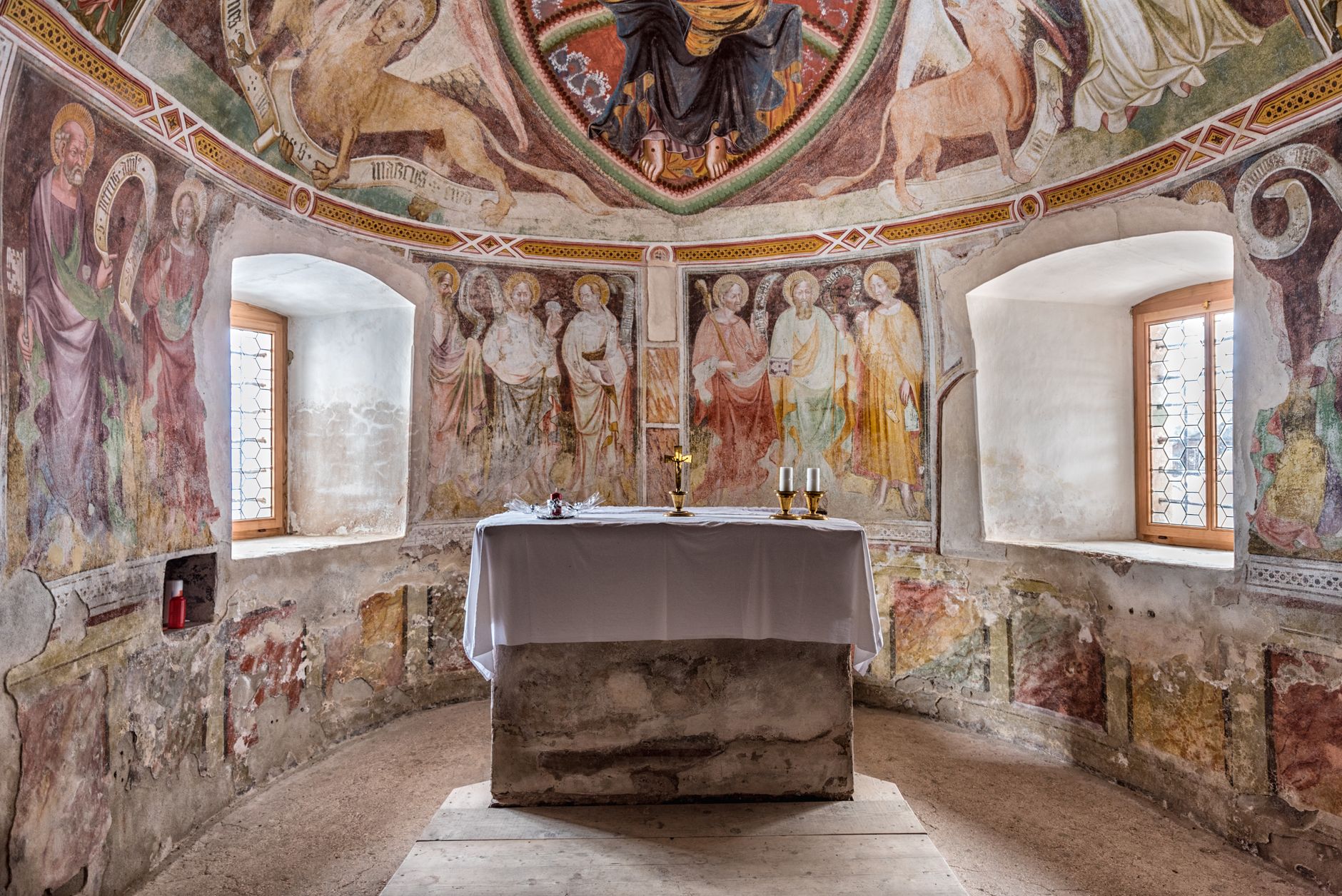
The Renaissance begins, by long-standing convention, with Giotto di Bondone (c. 1267–1337), a peasant-born painter from the Mugello hills north of Florence. Trained in the workshop of Cimabue (c. 1240–1302), Giotto’s innovation was the introduction of three-dimensional space into painting. Pre-Giotto painting was essentially Byzantine — figures floating against gold backgrounds, frontal poses, a flat hieratic style derived from Eastern Orthodox icons. Giotto put figures on a ground plane, shaded their bodies as if light were falling on them from a single direction, gave them faces with grief and weight, and arranged them in compositions that read as if they occurred in a real space. The shift seems modest in isolation; in the cumulative course of Western painting, it was revolutionary.
What to see in Florence: Giotto’s Maestà (c. 1310, Uffizi Room 2) — the massive enthroned Madonna with attendant angels, comparable to Cimabue’s Maestà hanging beside it. The two paintings are the textbook example of the shift from medieval to Renaissance technique: same subject, same scale, same destination church, but Giotto’s figures occupy space while Cimabue’s float. Also in Florence: Giotto’s frescoes in the Bardi Chapel and Peruzzi Chapel at Santa Croce (c. 1320s), the only Giotto fresco cycles in Florence (his more famous Padua work is at the Scrovegni Chapel).
Other Proto-Renaissance figures: Bernardo Daddi, Taddeo Gaddi (Giotto’s pupil, frescoed the Baroncelli Chapel at Santa Croce), Maso di Banco, and the slightly later Andrea Orcagna. The Sienese tradition (Duccio, Simone Martini, the Lorenzetti brothers) ran in parallel with a more lyrical, decorative style that visitors will see in Uffizi Rooms 3 and 4.
Early Renaissance: The 1401 Competition & The Trio
The mature Italian Renaissance is conventionally dated to 1401, when the Florentine wool guild held a competition to design the second pair of bronze doors for the Baptistery. Seven sculptors entered; two finalists’ competition panels survive in the Bargello (covered in our P04-C04 Bargello article): Filippo Brunelleschi’s and Lorenzo Ghiberti’s. Ghiberti won. Brunelleschi, defeated, abandoned sculpture and moved to Rome to study Roman architecture for the next decade. He returned with the principles that would generate Renaissance architecture and a working understanding of the maths of linear perspective.
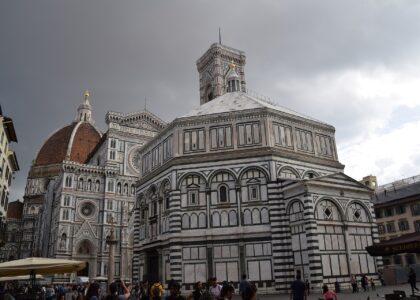
From 1413, Brunelleschi gave the famous tavoletta demonstration in front of the Cathedral: he had painted on a small wooden panel a perfectly perspectival view of the Baptistery as seen from Cathedral’s main door, and at the painting’s vanishing point he drilled a small hole. Visitors stood the painting up holding it backwards in front of their face, looking through the hole at a mirror reflecting the scene back at them — the painted Baptistery and the actual Baptistery aligning exactly. The demonstration showed that the rules of perspective could be reduced to mathematics, and any painter could now make spatially convincing images.
The rules spread fast. Three Florentines defined the next 50 years of Italian art: Brunelleschi (architecture: the Cathedral dome, the Foundling Hospital, the Old Sacristy of San Lorenzo, the Pazzi Chapel); Donatello (sculpture: the bronze David, the marble David, the Habakkuk, the Magdalene); and Masaccio (painting: the Brancacci Chapel, the Trinity at Santa Maria Novella).
Masaccio’s Trinity
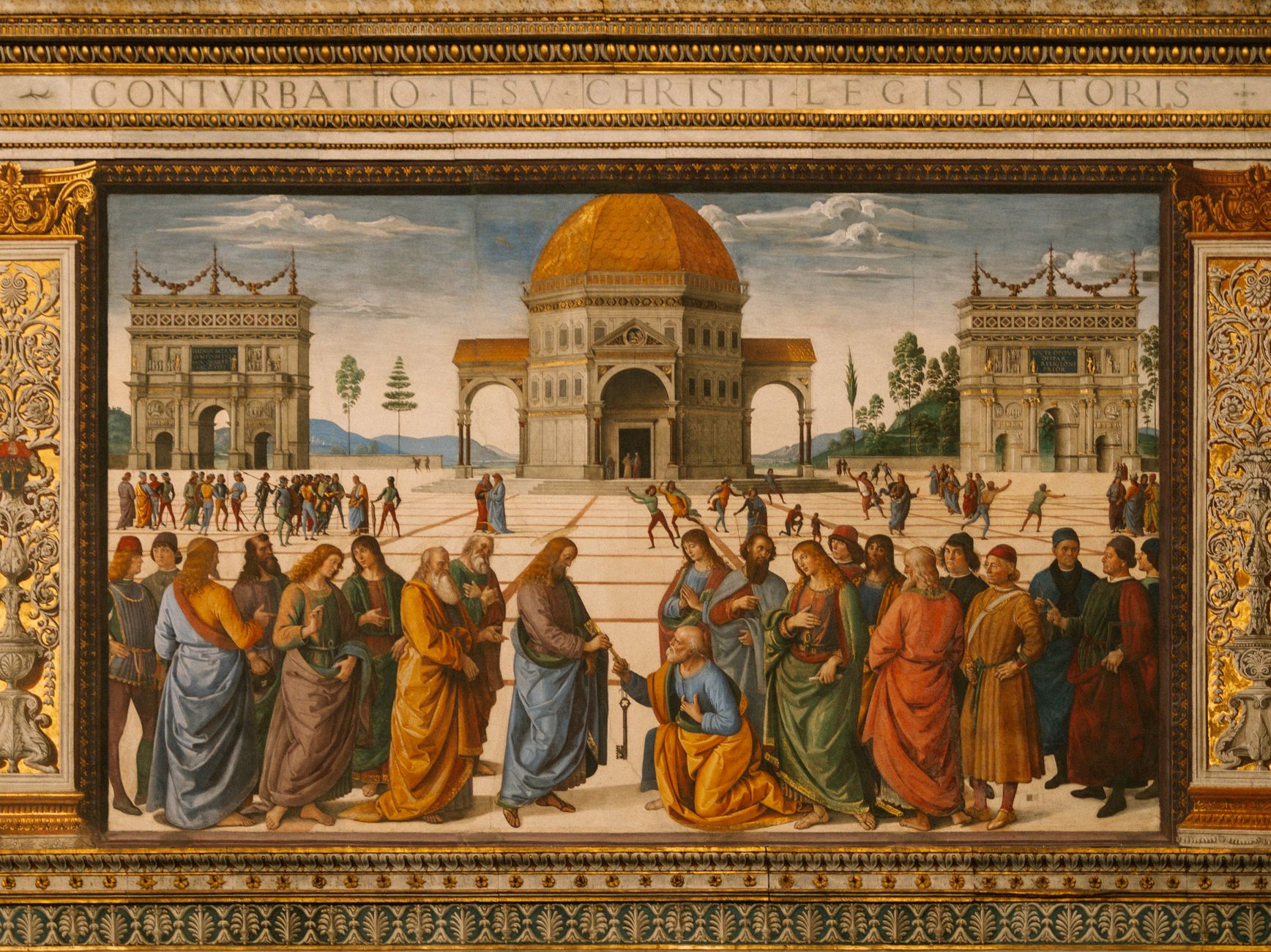
Masaccio’s Trinity (c. 1425, in the basilica of Santa Maria Novella) is the textbook example of the new technology: a painted altarpiece showing the Holy Trinity in a deeply receding barrel-vaulted chapel, with Mary and St. John flanking the cross, the donors kneeling on the architectural threshold, and a skeleton on the lower step holding the inscription “I once was what you are; what I am you shall become.” The painting is a perspective-construction tour de force — the chapel’s coffered vault demonstrably runs to a single vanishing point at viewer’s eye level. It is also a meditation on death disguised as a religious commission.
Masaccio (1401–1428) died at 27 in Rome — possibly poisoned by professional rivals, possibly of plague — but in his five working years he produced the Brancacci Chapel at Santa Maria del Carmine in Oltrarno (the most influential Florentine fresco cycle of the 1420s; covered in detail in our hidden gems article), the Trinity, and the Pisa altarpiece (now scattered between Pisa and London).
Donatello and the Bronze David
Donatello (c. 1386–1466) is Florence’s most prolific Early Renaissance sculptor. His Bronze David (c. 1440s, Bargello) was the first freestanding male nude in monumental sculpture since antiquity — an extraordinary act of pagan revival that no other patron in Christian Europe would have allowed. Donatello’s other Florence works span six decades and three styles: the spiritual marble St. George (Bargello, originally Orsanmichele), the brutally realist Habakkuk (Cathedral Museum), the harrowingly emaciated wooden Mary Magdalene (Cathedral Museum) made in his late seventies. Each represents a different solution to a different problem: classical revival in the David, psychological introspection in the George, prophetic intensity in the Habakkuk, ascetic suffering in the Magdalene.
The Medici and the Patronage System
Renaissance art could not have happened without patronage, and Florentine patronage was unusual for two reasons. First, it was funded by banking and textile-trade money rather than by aristocratic land wealth — meaning the patrons (Medici, Strozzi, Tornabuoni, Rucellai, Pazzi) had the capital to commission and the urban-residential infrastructure (palaces, family chapels) to display the results. Second, it was channelled through religious patronage: most major Renaissance commissions are altarpieces and frescoes for family chapels in Florentine churches, sponsored as acts of conspicuous piety.
The Medici family — bankers who became dukes who became grand dukes who eventually died out in 1737 — were the most important single patron from the 1430s onward. Cosimo il Vecchio (1389–1464) sponsored Brunelleschi, Donatello, Fra Angelico (San Marco) and Michelozzo. Piero il Gottoso (Cosimo’s son) sponsored Benozzo Gozzoli’s Magi Chapel. Lorenzo il Magnifico (1449–1492) sponsored Botticelli (Birth of Venus, Primavera), the young Michelangelo (whom he housed in his palace garden alongside the family’s antique sculpture collection), and Verrocchio’s workshop where Leonardo trained.
After Lorenzo’s death and the brief Savonarola theocracy, the Medici returned (1512) and continued patronage through Medici popes (Leo X, Clement VII), the Grand Dukes Cosimo I, Francesco I, Ferdinand I, and so on. The pattern of commissioning art as a public-relations exercise — and the resulting concentration of artists in Florence — produced the city’s extraordinary cultural deposit.
Early Renaissance Painting: Botticelli, Lippi, Ghirlandaio
The second half of the 15th century saw Florentine painting move from Masaccio’s monumental gravity into a more lyrical, ornamental, mythological direction. Sandro Botticelli (c. 1445–1510) is the central figure. Trained in Filippo Lippi’s workshop, working under Medici patronage, Botticelli produced the Birth of Venus and Primavera — the two most famous secular paintings of the Italian Renaissance — as well as a dozen tender Madonnas and the moralising Calumny of Apelles. Both Venus and Primavera hang in Uffizi Room 10/11/12 (the Botticelli rooms).
Filippo Lippi (c. 1406–1469) preceded Botticelli and was his teacher. A friar who had a famous affair with a young nun (Lucrezia Buti, mother of his son Filippino), Lippi developed a tender, intimate Madonna style — the Madonna and Child with Two Angels in the Uffizi is his most reproduced work.
Domenico Ghirlandaio (1448–1494) ran the busiest workshop in 1480s Florence — the workshop in which the teenage Michelangelo apprenticed. Ghirlandaio’s signature style placed Biblical scenes in recognisably contemporary Florentine settings (the Sassetti Chapel at Santa Trinita, the Tornabuoni Chapel at Santa Maria Novella) and produced extremely accurate portraits of patrons mixed into religious crowds. The result is a kind of double-image where the religious scene is simultaneously a contemporary Florentine social document.
Other Early Renaissance painters worth seeking out in Florence include Andrea del Verrocchio (sculptor and painter, ran the workshop where Leonardo da Vinci trained), Piero della Francesca (his Duke of Urbino diptych is in the Uffizi), Benozzo Gozzoli (the Magi Chapel at Palazzo Medici Riccardi), Antonio del Pollaiuolo, and Domenico Veneziano.
High Renaissance: Leonardo, Michelangelo, Raphael
By the 1490s, the third generation of Renaissance artists arrived. The High Renaissance — a brief, intense period roughly 1495–1525 — synthesised the technical achievements of the previous century into a kind of effortless naturalism, then began to push beyond toward the deliberate strangeness of Mannerism.
Leonardo da Vinci (1452–1519), born outside Florence, trained in Verrocchio’s workshop. His Florentine works are sparse — most of Leonardo’s Florentine career was preparatory drawings and unfinished paintings. The Uffizi holds his Annunciation (a youthful work from Verrocchio’s shop), the Adoration of the Magi (unfinished, c. 1481), and the small Baptism of Christ by Verrocchio with a Leonardo angel that, according to Vasari, made Verrocchio give up painting on the spot. Leonardo’s Battle of Anghiari for Palazzo Vecchio (1503–1505) was abandoned and may survive beneath Vasari’s later fresco.
Michelangelo Buonarroti (1475–1564) is Florence’s most monumental son. Born in Caprese (Tuscany), apprenticed to Ghirlandaio, raised by Lorenzo de’ Medici in his palace garden where he had access to the family’s antique sculpture collection, Michelangelo produced his most famous Florentine works between 1500 and 1534: the David (1501–1504, Accademia), the Doni Tondo (c. 1506, the only finished panel painting by Michelangelo, Uffizi), the four Prisoners for the Tomb of Pope Julius II (Accademia), the New Sacristy of San Lorenzo (1521–1534), and the Laurentian Library. After 1534 he moved permanently to Rome.
Raffaello Sanzio (Raphael) (1483–1520) lived in Florence between 1504 and 1508 — the most formative four years of his short career. The Pitti Palace’s Palatine Gallery holds 11 Raphaels including the Madonna of the Chair, the Madonna of the Grand Duke, the portrait of Cardinal Bibbiena, and the famous double portrait of Agnolo Doni and his wife Maddalena Strozzi (made at the same moment as Michelangelo’s Doni Tondo, for the same patrons).
Mannerism: After the High Renaissance
By 1520 the High Renaissance synthesis was complete and a generation of younger artists pushed deliberately past it into Mannerism — a style of intentional artificiality, elongated figures, twisted poses, acidic colour, ambiguous space. Mannerist artists felt that Leonardo, Michelangelo and Raphael had perfected naturalism so thoroughly that there was no further room within naturalism for innovation; the only path forward was deliberate distortion.
Florentine Mannerists included Pontormo (1494–1557, his Deposition at the Capponi Chapel in Santa Felicita is the masterpiece), Rosso Fiorentino (similarly intense, see his Uffizi works), Bronzino (court painter to Cosimo I; the Eleonora di Toledo portrait at the Uffizi, the Bronzino Chapel at Palazzo Vecchio), and the late Michelangelo himself, whose unfinished Pietà Bandini (Cathedral Museum) is a brutal, broken-figured Mannerist work made when he was nearly 80.
Vasari’s frescoes of Cosimo I’s victories in the Salone dei Cinquecento at Palazzo Vecchio (1563–1565) are also Mannerist, as is the entire Studiolo of Francesco I (1570–1575). By 1600 Florentine Mannerism had run its course; the Baroque arrived from Rome, and Florence’s role as the engine of Italian art ended.
Renaissance Technical Breakthroughs
The art-history textbook lists five technical innovations that distinguish Renaissance from medieval painting and sculpture. Visitors who recognise them get more out of every museum.
1. Linear perspective
Brunelleschi’s mathematical perspective (1413), codified in writing by Alberti’s Della Pittura (1435). The single vanishing point on the horizon at viewer’s eye-level became the spatial backbone of every serious Florentine composition for the next two centuries. Look for it in Masaccio’s Trinity, in the floor tiles of Botticelli’s mythological paintings, in the architecture of Raphael’s Madonnas.
2. Oil painting
Imported from Flanders in the 1450s and gradually replacing tempera (egg-yolk-based paint) over the second half of the 15th century. Oil paint dries slowly, allowing blending and layering, and it produces deeper, more luminous colour than tempera. Leonardo’s sfumato (his soft, smoky transitions between colours) was only possible with oil. Look for the change between Botticelli’s mostly-tempera Birth of Venus (1485) and Leonardo’s oil-on-panel Annunciation (1472–75) in adjacent Uffizi rooms.
3. Anatomy from dissection
Leonardo, Michelangelo, Pollaiuolo and others all dissected human corpses — usually obtained illegally from hospitals — to study muscles, bones and organs from the inside. The result is the unprecedented anatomical accuracy of Michelangelo’s male nudes, Leonardo’s écorché drawings, and the visible-musculature studies in Pollaiuolo’s Battle of the Nudes engraving.
4. Contrapposto
The classical sculptural pose in which a standing figure rests its weight on one leg, throwing the opposite hip up and the opposite shoulder down — making the figure look natural and animated rather than rigidly symmetrical. Donatello’s bronze David, Michelangelo’s marble David, and most Florentine Renaissance sculpture from 1420 onward use it. The pose came directly from Roman copies of Greek 5th-century BCE sculpture.
5. Sfumato and chiaroscuro
Sfumato (Italian for “smoky”) is Leonardo’s signature soft transition between tones, used to create dreamlike, atmospheric Madonnas and the famous unidentifiable smile of the Mona Lisa. Chiaroscuro (light-dark) is the broader technique of using strongly contrasted shadow to model figures three-dimensionally. Both techniques require oil paint and patient layering.
Inside the Renaissance Workshop
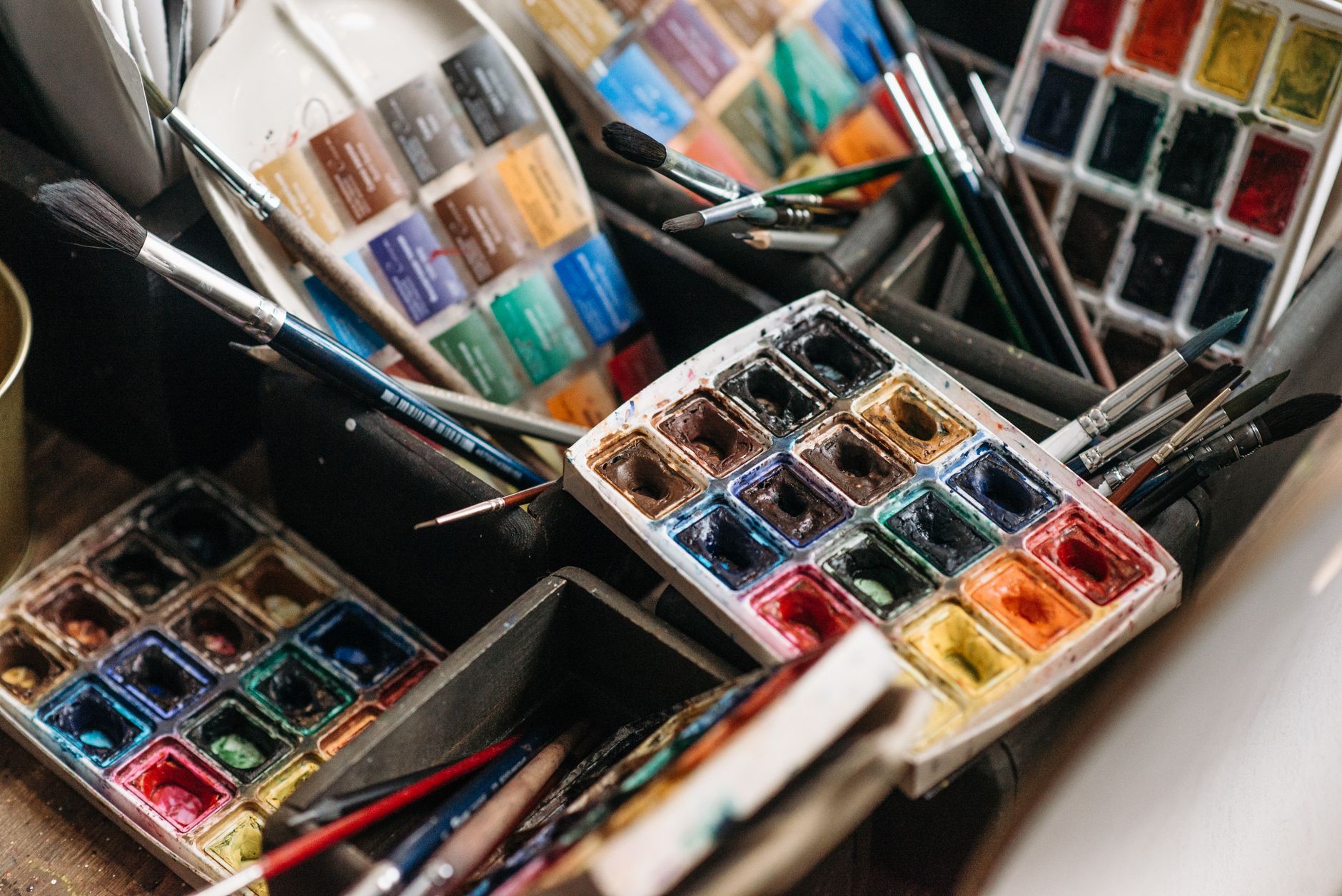
Renaissance painters did not paint alone. Most worked in workshops (botteghe) of 5–20 people: a master, several journeymen, multiple apprentices. Apprentices typically arrived between ages 8 and 14, signed contracts that lasted 5–7 years, and learned by performing menial tasks — sweeping the studio, grinding pigments, preparing wood panels with gesso, copying drawings — before being allowed to paint. By their late teens, talented apprentices contributed to commissions; the master signed and oversaw.
The workshop system explains many of Florentine painting’s odd features. Why are so many Renaissance paintings unsigned? Because the workshop, not the individual, was the legal contractor. Why do major paintings often have a single magnificent face surrounded by mediocre passages? Because the master painted the face and the workshop painted the rest. Why are dates and attributions disputed? Because the master often did the conceptual design (the cartoon) but the actual paint was applied by assistants over months or years.
Famous Florentine workshops included those of Filippo Lippi (which produced Botticelli), Verrocchio (which produced Leonardo, Lorenzo di Credi and Perugino), Ghirlandaio (which produced Michelangelo), and Andrea del Sarto (whose pupils included Pontormo and Rosso). The lineages cross-pollinate: tracing a single artist’s training tree usually leads back to one of three or four 15th-century masters.
A Two-Day Renaissance Walking Tour
This tour visits the city’s Renaissance art chronologically across two days.
Day 1 — Proto and Early Renaissance
09:00 Santa Maria Novella basilica: Masaccio’s Trinity, Ghirlandaio’s Tornabuoni Chapel. (€7.50, 60 minutes)
10:30 Bargello Museum: Donatello’s marble and bronze Davids, Ghiberti and Brunelleschi’s competition panels, Verrocchio’s David, Michelangelo’s Bacchus and Brutus. (€9, 90 minutes)
13:00 Lunch near Piazza della Signoria.
14:30 Brancacci Chapel (Santa Maria del Carmine, Oltrarno): Masaccio’s frescoes (book ahead, €10, 30 minutes inside).
16:00 Santo Spirito basilica (Brunelleschi’s last great church, free): see the architecture-as-painting that defined Florentine ecclesiastical interiors.
17:30 San Marco Museum: Fra Angelico’s frescoed cells. (€10, 90 minutes — but check the closing time, often 13:50.) Alternative if San Marco closed: Cathedral interior + Cathedral Museum for Donatello’s Habakkuk and Magdalene.
Day 2 — High Renaissance and Mannerism
08:30 Galleria dell’Accademia: Michelangelo’s David, the Prisoners, the St. Matthew. (€16–25, 90 minutes)
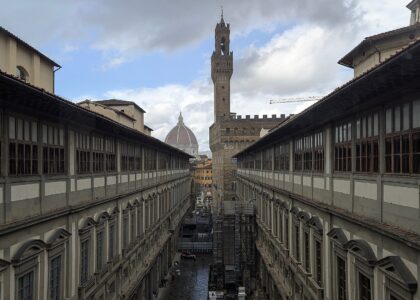
11:00 Uffizi Gallery: Botticelli (Rooms 10–14), Leonardo (Room 15), Michelangelo’s Doni Tondo (Room 35), Raphael’s Doni portraits (Room 41), the Medici Venus (Tribuna). (€25–29, 3+ hours)
15:00 Lunch near Pitti.
16:00 Palazzo Pitti — Palatine Gallery: 11 Raphaels, the Doni double portrait, Pitti Mannerist galleries. (€16–22, 90 minutes minimum)
18:00 Santa Felicita on the way back: Pontormo’s Deposition (free, 15 minutes).
If you have a third day available: Medici Chapels (Michelangelo’s New Sacristy), Palazzo Vecchio (Salone dei Cinquecento + Studiolo), and Palazzo Medici Riccardi (Gozzoli’s Magi Chapel) round out the Mannerist and grand-ducal phases.
How to Read a Renaissance Painting
Five questions that unlock most Renaissance compositions:
1. What’s the subject? Sacred (Madonnas, Annunciations, Crucifixions, saints’ lives) is roughly 70% of all Florentine work. Mythological (Venus, Mars, the Three Graces, Olympian gods) is 15%, mostly post-1480. Portraits another 10%, secular history (battles, civic events) the remainder. Wall labels usually identify the subject; the museum audioguide explains why this subject was commissioned.
2. Where’s the vanishing point? Trace the lines in any architecture or floor tiles. They will all converge on a single point, usually at viewer’s eye-level. The vanishing point reveals the painter’s intended viewing position — often deliberately calibrated to the chapel altar where the painting was placed.
3. Who’s looking at whom? Renaissance compositions use eye-lines as compositional armature. Tracing where each figure’s gaze points reveals the painting’s hierarchy of attention. In Botticelli’s Birth of Venus, three sets of eye-lines all converge on Venus.
4. Where are the donors? Patrons typically appear at the painting’s edges, often kneeling or smaller than the religious figures. Identifying them in the corner of an altarpiece tells you who paid for it. The Tornabuoni Chapel at Santa Maria Novella is a masterclass: the entire Tornabuoni family appears as bystanders to the life of John the Baptist and the Virgin.
5. What’s the technique? Tempera (until ~1480) has flat, vivid colour and visible brushstrokes. Oil (after ~1480) has soft transitions and luminous depths. Fresco (wall painting) has matte, slightly chalky colour. Knowing the technique tells you roughly when and how the work was made.
Renaissance Art FAQ
What’s the best museum for Renaissance art in Florence?
The Uffizi Gallery is the single best Renaissance painting collection in the world. For sculpture, the Bargello is unrivalled. For Michelangelo specifically, the Accademia (David and Prisoners) and the Medici Chapels (New Sacristy) are essential. For frescoes, visit Santa Maria Novella, San Marco, and the Brancacci Chapel — none of them in the major museum complexes.
When did the Italian Renaissance happen?
Conventionally 1300–1600. Proto-Renaissance c. 1300–1400 (Giotto), Early Renaissance 1400–1495 (Brunelleschi, Donatello, Botticelli), High Renaissance 1495–1525 (Leonardo, Michelangelo, Raphael), Mannerism 1525–1600 (Pontormo, Bronzino, late Michelangelo).
Who was the most important Renaissance artist?
The “big three” of the High Renaissance are Leonardo da Vinci, Michelangelo, and Raphael. For Florentines, Michelangelo is the local hero (born in Tuscany, trained in Florence, buried in Santa Croce). Earlier giants include Giotto, Brunelleschi, Donatello, Masaccio and Botticelli. There is no “most important” — the Renaissance is a cumulative achievement of dozens of major figures across three centuries.
Where can I see the Mona Lisa in Florence?
You can’t — the Mona Lisa is at the Louvre in Paris. Leonardo painted it in Florence (begun c. 1503) but he kept it with him until his death and the painting passed to his French royal patron. Florence holds Leonardo’s earlier Annunciation, the unfinished Adoration of the Magi, and his contributions to Verrocchio’s Baptism of Christ at the Uffizi.
How long does the Florence Renaissance trail take?
A serious Renaissance-art trip needs 3–4 days. The Uffizi alone is half a day; the Accademia, Bargello, San Marco, Medici Chapels and Pitti are each 1.5–2 hours. Add Santa Maria Novella, Santa Croce, the Brancacci Chapel, the Cathedral Museum, the Cathedral itself and Palazzo Vecchio for a full picture.
What’s the best book on Renaissance art for visitors?
Frederick Hartt’s History of Italian Renaissance Art is the most comprehensive single-volume survey. For a shorter, more readable introduction, Andrew Graham-Dixon’s Renaissance (BBC tie-in book) is excellent. Vasari’s own Lives of the Artists (1568) is the original primary source — gossipy, partial, but irreplaceable for Florentine perspective.
Florence’s Renaissance art rewards visitors who arrive with a chronological framework and walk the city’s museums and churches in roughly historical order — Giotto first, Mannerism last. Three days at this pace will leave you with a working sense of how a single small Tuscan city, between roughly 1400 and 1525, produced the bulk of the Western art tradition’s most enduring images. Pair this guide with our museum-by-museum articles (Uffizi, Accademia, Bargello, San Marco, Medici Chapels, Palazzo Vecchio, Pitti) and you’ll have a structured route through the world’s most concentrated Renaissance experience.