This article contains advertising. Booking links on this site can be turned into paid links automatically by our partner Travelpayouts: if you book through one, we earn a commission from the provider, at no extra cost to you. It never affects what we recommend. Affiliate disclosure
The Medici Chapels are the dynastic mausoleum of the family that ruled Florence for three centuries — and they contain Michelangelo’s most extraordinary architectural commission and four of the most famous allegorical sculptures of the Renaissance. Tucked behind the Basilica of San Lorenzo, the chapels combine the gold-and-marble grandeur of the 17th-century Princes’ Chapel with the spare, brooding genius of Michelangelo’s New Sacristy. This 2026 guide covers tickets, hours, the New Sacristy’s Day, Dusk, Dawn and Night, the Princes’ Chapel and its semi-precious stone inlay, the recently rediscovered Michelangelo charcoal drawings in the secret crypt, and how to make the most of a 60–90 minute visit.
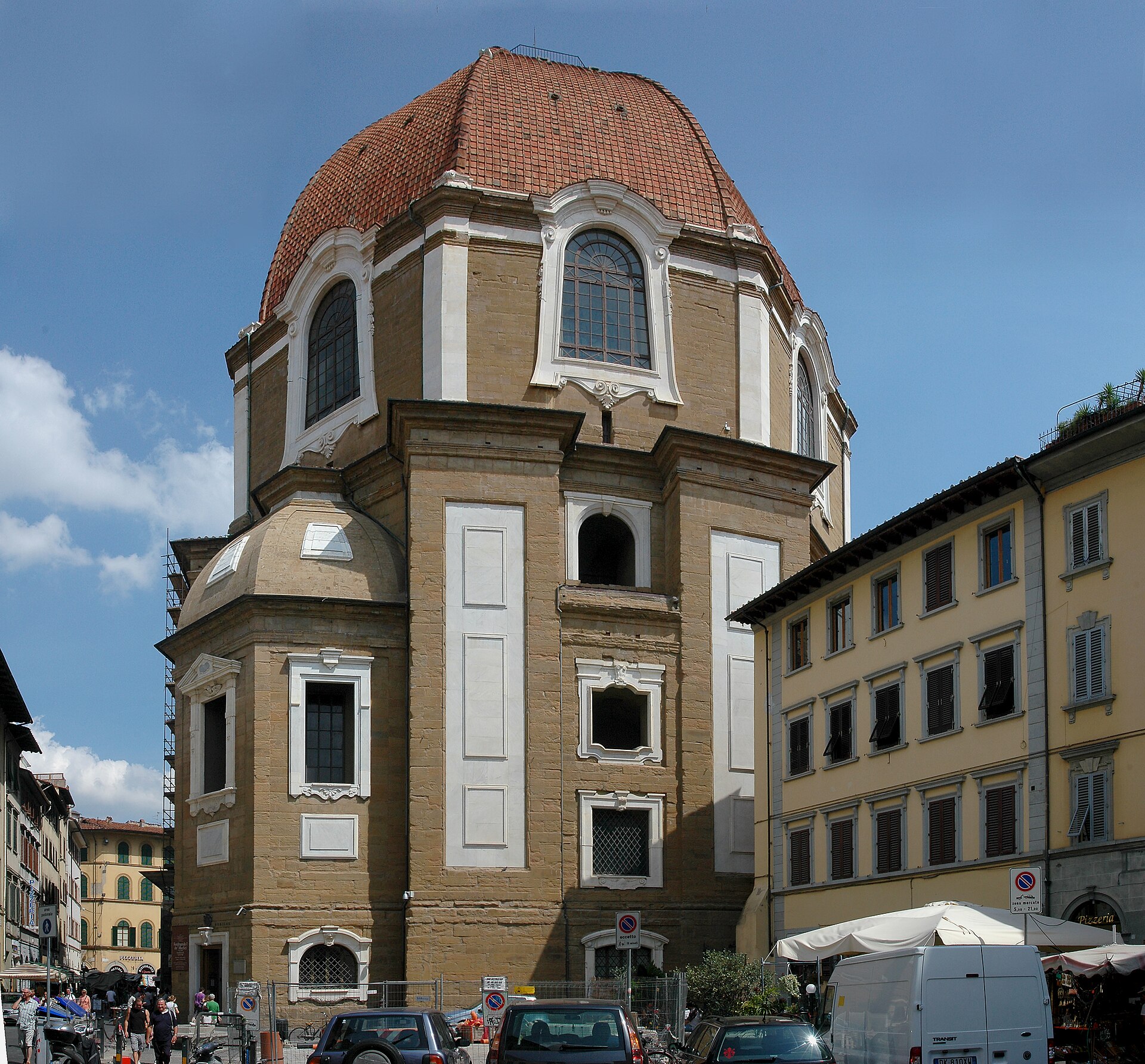
The New Sacristy is Michelangelo’s, the Chapel of the Princes is the family’s statement of wealth, and both make more sense after reading our Medici family history. The complex adjoins San Lorenzo and the Mercato Centrale, and features in our Renaissance walking route.
What Are the Medici Chapels?
The Medici Chapels (Cappelle Medicee) are a state museum housed in two purpose-built chapels attached to the rear of the Basilica of San Lorenzo, the Medici family church. They contain the tombs of approximately 50 members of the Medici family — from Lorenzo the Magnificent’s father Piero il Gottoso to the last Medici Grand Duke Gian Gastone (died 1737). Two distinct architectural projects make up the complex:
- The Sagrestia Nuova (New Sacristy) — designed by Michelangelo Buonarroti from 1521. A small but architecturally radical chapel containing the tombs of Lorenzo Duke of Urbino and Giuliano Duke of Nemours, with Michelangelo’s marble figures of Day, Dusk, Dawn and Night.
- The Cappella dei Principi (Princes’ Chapel) — designed by Matteo Nigetti and begun in 1604, completed only in the 20th century. A vast octagonal mausoleum decorated entirely in semi-precious stone (pietre dure) inlay, with the tombs of six Medici Grand Dukes.
- The Crypt — the lower chamber housing the simpler tombs of dozens of family members, including the recently rediscovered secret room with Michelangelo’s wall drawings.
The basilica of San Lorenzo (front of the building, separately ticketed at €9) and the Laurentian Library (Michelangelo’s other San Lorenzo masterpiece, €4) are administered separately from the Chapels — three different ticket offices for one building complex.
Tickets, Hours & Practical Info (2026)
| Detail | 2026 Information |
|---|---|
| Address | Piazza Madonna degli Aldobrandini 6, 50123 Florence |
| Adult ticket | €11, plus an optional €3 booking fee |
| EU citizens 18–25 | €2 reduced |
| Children 0–17 | Free |
| Hours (March–October) | Tuesday–Sunday 08:15–18:50 |
| Hours (November–February) | Tuesday–Sunday 08:15–13:50 |
| Closed | Mondays (from mid-March 2026); 1st Sunday (Domenica al Museo, free); 1 January, 1 May, 25 December |
| Booking | tickets.uffizi.it; +€3 booking fee but worth it in summer |
| Average visit | 60–90 minutes |
| Firenze Card | Included |
The Medici Chapels generally need no advance booking — walk-up queues at the ticket office (entrance on Piazza Madonna degli Aldobrandini, on the rear side of San Lorenzo) typically run 0–20 minutes. The exception is the secret-room visit (see below) which has limited daily slots and must be booked weeks ahead.
The chapels close on Mondays as of mid-March 2026 (the standard state-museum closure day) — historically they closed on Tuesday and many older guidebooks still say so. Check before visiting. The first Sunday of each month is free entry under Domenica al Museo; queues are then 30–90 minutes.
Why the Medici Chapels Exist
The Medici dynasty needed monumental tombs commensurate with their political stature. The first generation of important Medici — Cosimo il Vecchio (died 1464) and his sons Piero and Giovanni — were buried under the Old Sacristy of San Lorenzo, which Brunelleschi had designed for the family in the 1420s. By 1520, the Medici were popes (Leo X and Clement VII) and the dynastic ambitions had outgrown the modest old sacristy. Pope Leo X commissioned Michelangelo to design a New Sacristy that would mirror Brunelleschi’s old one across the basilica’s apse.
By the 1600s, the Medici were Grand Dukes of Tuscany, their pope-cousins long dead, their political networks pan-European. Cosimo I’s son Ferdinand I (1549–1609) commissioned the immense Princes’ Chapel, an octagonal mausoleum on a scale that would rival the Imperial mausoleums of ancient Rome and the Spanish Habsburg pantheon at El Escorial. Construction lasted 300+ years; the chapel’s cupola wasn’t completed until 1962, and even today the floor pattern is unfinished.
The chapels’ ambition is therefore double: Michelangelo’s New Sacristy is Renaissance austerity at its most refined, while the Princes’ Chapel is Baroque triumphalism at its most maximalist. Visiting both back-to-back is a 200-year crash course in Italian taste.
The Princes’ Chapel (Cappella dei Principi)
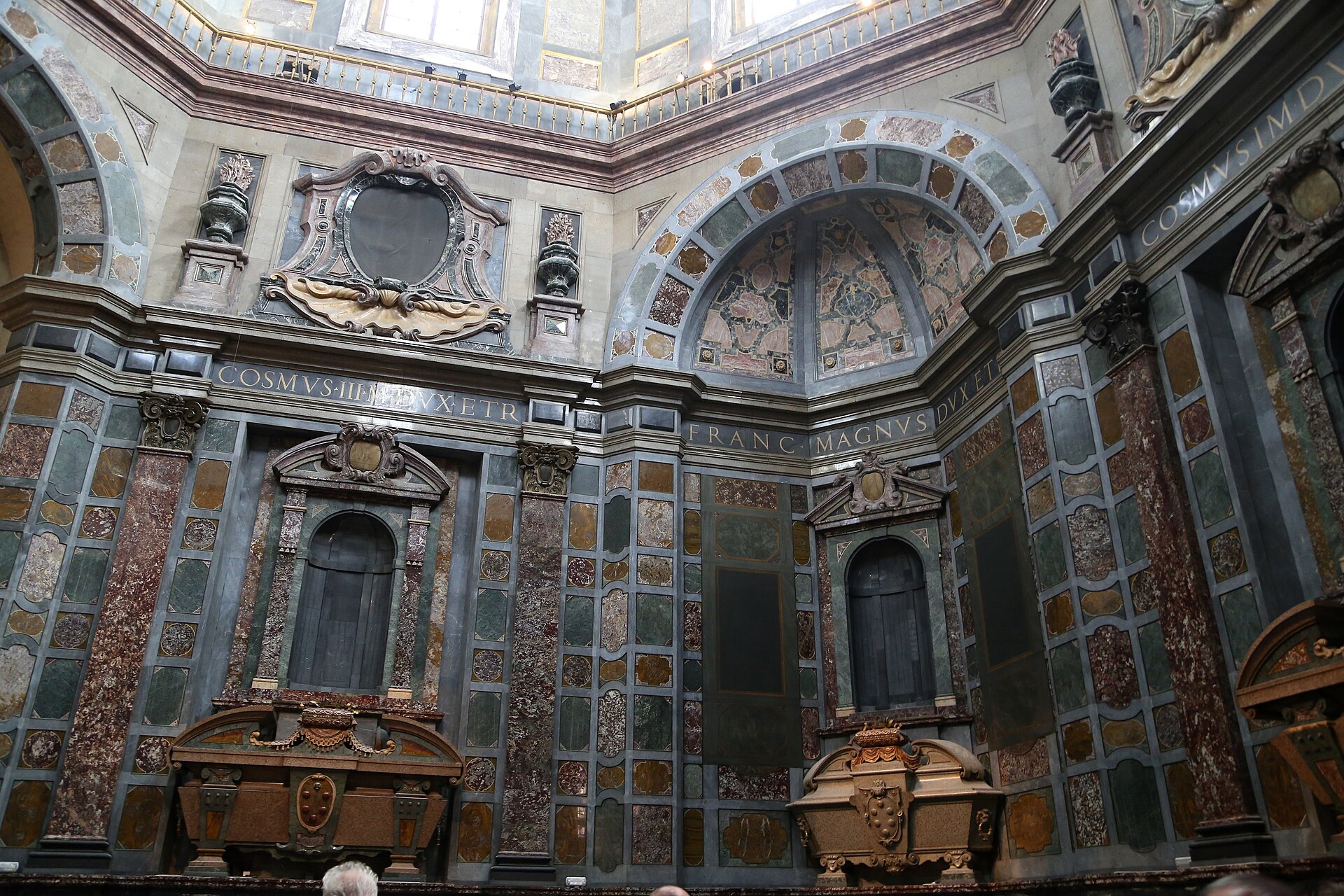
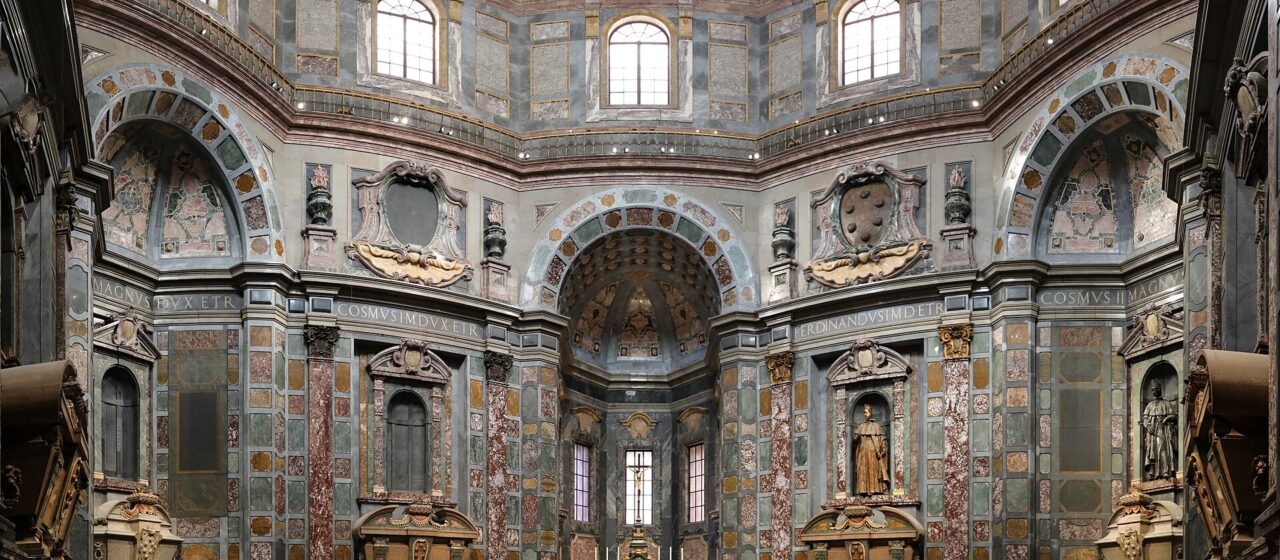
The visitor route enters the Princes’ Chapel first — an octagonal hall 28 metres in diameter, rising 59 metres to a coffered cupola painted in 1828 with frescoes by Pietro Benvenuti depicting scenes from Genesis. Every surface — walls, columns, floor, dado, niches — is covered in pietre dure, the Florentine technique of inlaying semi-precious stones (lapis lazuli, jasper, agate, malachite, coral, mother-of-pearl) into a black marble matrix to create monumental polished pictures.
Six niches hold the sarcophagi of the Medici Grand Dukes — Cosimo I, Francesco I, Ferdinand I, Cosimo II, Ferdinand II and Cosimo III — each in red Egyptian granite topped with a bronze portrait. Two of these portraits (Ferdinand I and Cosimo II) are by Pietro Tacca, Giambologna’s most talented pupil. The Grand Dukes’ sons, daughters and wives are buried in the crypt below.
The room’s centrepiece is the Medici coats of arms in pietre dure on the walls — sixteen of them, one for each Tuscan town under Medici rule, each crest assembled from hundreds of tiny stones. The dado runs around the room in a single 180-metre band of inlay, the longest continuous pietre dure work in Europe.
The Princes’ Chapel divides visitors. Some find it the most lavish space in Florence — an interior that visualises Tuscan sovereignty in a way no Renaissance painting could. Others find it cold, oppressive, even gauche. Both responses are reasonable; what’s undeniable is its ambition. The pietre dure technique reached its highest artisanal level in the dedicated workshop the Medici founded specifically to build this chapel — the Opificio delle Pietre Dure, still active today as Italy’s premier art-restoration laboratory.
The New Sacristy (Sagrestia Nuova)
From the Princes’ Chapel, a small corridor leads into the New Sacristy — a complete tonal reset. Where the Princes’ Chapel screams gold and lapis, the New Sacristy whispers white and grey: white marble sculptures against rough grey pietra serena pilasters and a coffered cream-stucco dome. Every surface and proportion is the work of Michelangelo, including the architecture itself (his only fully realised architectural commission of his career, alongside the unfinished Laurentian Library next door).
The chapel is square in plan, with three monumental tombs ranged around three of the walls. The fourth wall (the entrance) opens onto the basilica. The dome is a half-sphere on pendentives, more controlled than Brunelleschi’s looser dome of the old sacristy on the opposite side of the church. Michelangelo’s restraint here — the sober use of pietra serena, the simplicity of the dome — would influence the whole subsequent course of Italian architecture.
Tomb of Lorenzo, Duke of Urbino
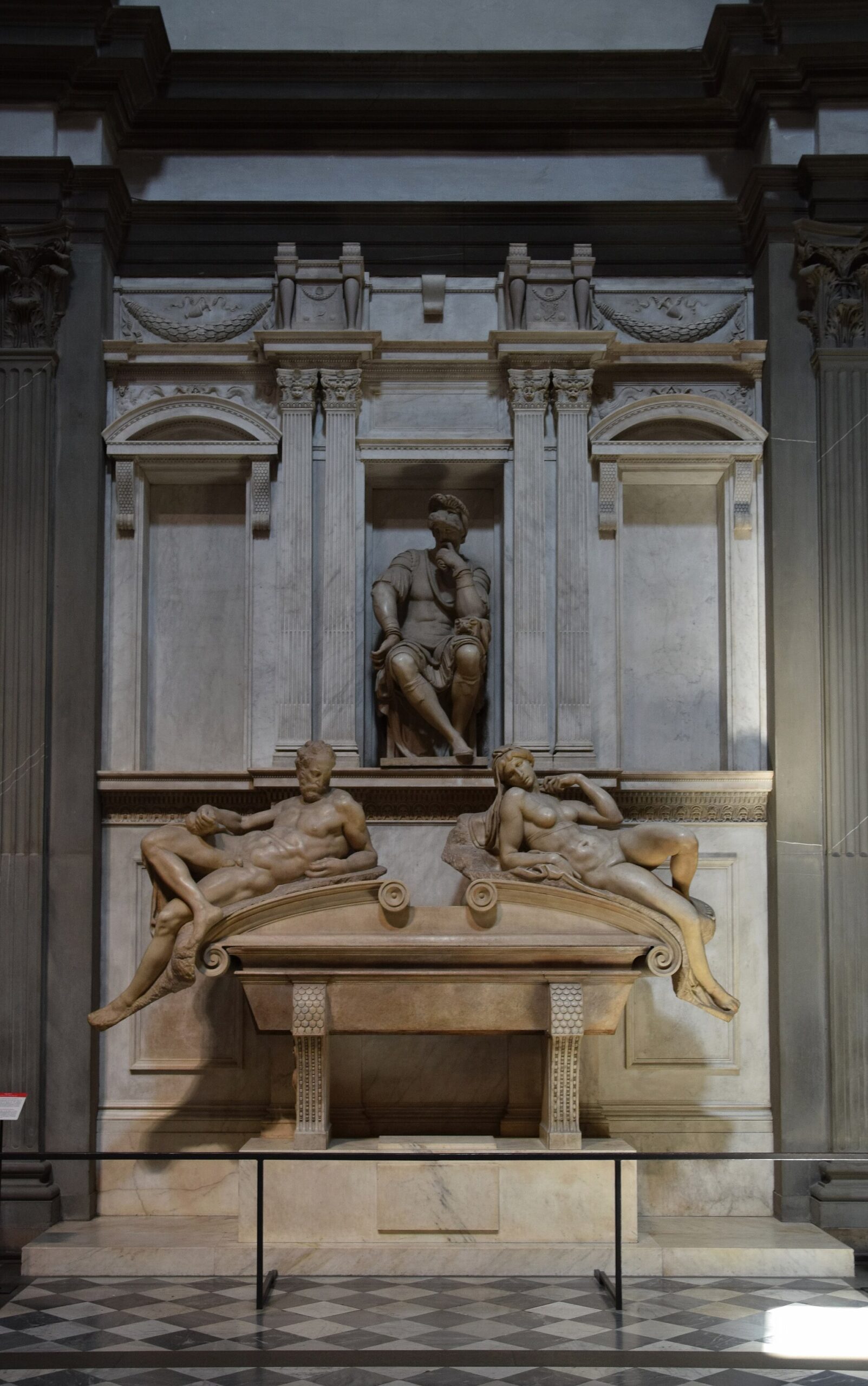
On the left wall as you enter, the tomb of Lorenzo Duke of Urbino (1492–1519, grandson of Lorenzo the Magnificent) carries a portrait sculpture of Lorenzo seated above the sarcophagus, his head resting on his left hand in the gesture of melancholy meditation. He wears Roman armour rather than 16th-century dress — Michelangelo deliberately turned his Medici sitters into idealised classical figures rather than likenesses. Lorenzo’s mother Maddalena famously complained that the statue did not look like her son; Michelangelo replied that “in a thousand years no one will care.”
Beneath Lorenzo, on either side of the sarcophagus, recline the marble figures of Dawn (Aurora) and Dusk (Crepuscolo). Dawn is a young woman waking from sleep, her face troubled, her body stretching to greet a difficult day. Dusk is an older man slumping into rest, his musculature unfinished by Michelangelo’s deliberate choice — the rough surface evoking the heaviness of evening fatigue.
Tomb of Giuliano, Duke of Nemours
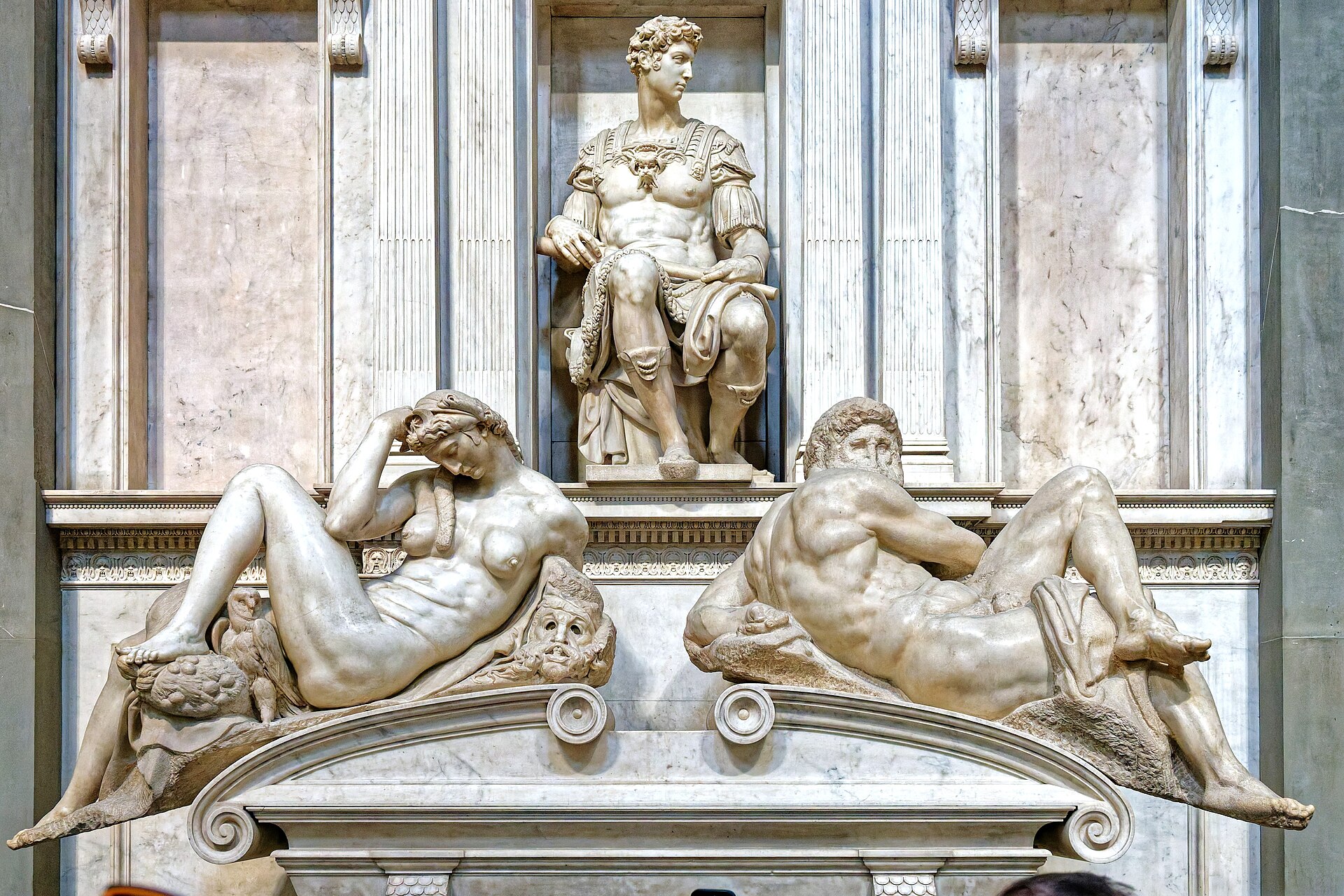
Opposite, on the right wall, Giuliano Duke of Nemours (1479–1516, son of Lorenzo the Magnificent) sits enthroned in Roman armour, more active and military than the contemplative Lorenzo. Michelangelo gave him a baton of command and a head turned in alert profile.
The two reclining figures here are Day (Giorno) and Night (Notte). Day is the most physically violent of the four — a male nude twisted into a coil, head turned back over his shoulder, the face barely emerging from the rough block. Michelangelo left this face deliberately unfinished — visitors stand in front of it for whole minutes trying to see whether it’s a face or just suggestion. Night, opposite, is the most resolved of the four: a woman in a death-like sleep, head bowed onto her left hand, her right foot resting on a heap of poppies and nocturnal symbols (an owl, a crescent moon, a mask). The 16th-century poet Giovanni Strozzi praised Night’s sleep as so peaceful that the figure must be alive; Michelangelo replied with a poem that has become one of the most famous in Italian: “Caro m’è ‘l sonno, e più l’esser di sasso…” (“Dear to me is sleep, and dearer still to be of stone…”).
Madonna and Child + Saints Cosmas & Damian
The third wall (opposite the entrance) holds a less-discussed but equally important group: Michelangelo’s Madonna and Child seated in the centre, flanked by sculptures of Saints Cosmas (by Giovan Angelo Montorsoli) and Damian (by Raffaello da Montelupo) — the Christian-physician saints who were patrons of the Medici (the family name Medici means “doctors”). The Madonna is one of Michelangelo’s most beautiful late Madonnas: tender, monumental, with Christ twisting on her lap to reach toward an absent figure outside the frame.
Beneath this Madonna group rest the simpler tombs of Lorenzo the Magnificent (1449–1492) and his murdered brother Giuliano (1453–1478), the family’s two most beloved sons. The tombs themselves are unornamented — Michelangelo’s plan for elaborate sculptural tombs for these two was abandoned after his patron Pope Clement VII died in 1534.
What Do the Allegories Mean?
The four reclining figures — Dawn, Dusk, Day, Night — are an allegory of time itself: the four divisions of the day flanking the two Dukes, signifying that time will pass and the Medici glory will outlast it. But the figures are also famously melancholy. None of them looks at peace. Dawn waking, Dusk slumping, Day twisting into himself, Night drugged into deathlike sleep — each represents a different moment of struggle against time’s passage. The art historian Erwin Panofsky read them as a Neoplatonic cycle: the soul’s descent into mortal flesh and its eventual return to eternity.
Michelangelo himself worked on the chapel intermittently between 1521 and 1534, leaving Florence permanently for Rome before completing the project. Several of the figures (most famously Day’s face) are visibly unfinished — whether deliberately, in keeping with his late non-finito philosophy, or because of his rushed departure, scholars still debate.
The Secret Room: Michelangelo’s Hidden Drawings
One of the great Renaissance discoveries: in 1975, the museum’s then-director Paolo Dal Poggetto noticed a small ceiling-trapdoor under a piece of furniture in a back room of the New Sacristy. Climbing through, he found a 4-by-2-metre rectangular chamber whose walls were covered in charcoal drawings attributed to Michelangelo himself. The room — initially used for storing coal, later for whitewashed obscurity — appears to have been the place Michelangelo hid in 1530 during the Sieg of Florence, when he was politically wanted by Pope Clement VII for siding with the Florentine Republic against the returning Medici.
The walls hold approximately 50 drawings — sketches of nude figures, anatomical studies, partial heads, references to figures from the Sistine Chapel ceiling and from earlier Florentine works. Most appear to be Michelangelo’s own; some are attributed to his apprentices.
From late 2023, the secret room has been periodically opened to small groups of visitors (max 4 people at a time, 15-minute visits, advance booking essential, separate ticket €32 in addition to museum entry). The room’s microclimate is fragile, so daily capacity is around 100 people total. Slots release roughly two months in advance and sell out within hours. Search “Stanza Segreta Michelangelo” or check the museum website for the current booking portal.
If you can’t book the secret room, the museum displays high-quality reproductions of the drawings in a small gallery near the New Sacristy entrance — well worth 10 minutes for visitors interested in Michelangelo’s drawing technique.
The Crypt
The Medici Chapels’ visit begins in the crypt — the lower chamber under the Princes’ Chapel, where dozens of less-famous Medici family members are buried. The crypt’s walls hold simple stone slabs marking grandchildren, daughters and minor cousins. The space is austere and cold, with low brick vaults — a sober prologue to the spectacle of the Princes’ Chapel above.
The crypt also displays a small collection of reliquaries: gold and silver containers commissioned by the Medici between the 14th and 17th centuries to hold body parts of Christian saints. Several were donated to San Lorenzo as parts of the Medici’s spiritual patronage; some were forfeited from suppressed convents in the 19th century. The reliquaries — many of them small Gothic and early-Renaissance jewel pieces — are an underappreciated highlight, especially the rock-crystal monstrance attributed to a 14th-century Sienese goldsmith.
Recommended Visit Route (60–90 Minutes)
The visit is one-way and takes most travellers 60–90 minutes.
0–10 minutes — Crypt: walk the perimeter, look at the reliquaries, read the family tree posted near the stairs.
10–35 minutes — Princes’ Chapel: look up at the cupola first, then scan the six Grand Duke tombs, then study the pietre dure dado and coats of arms. Read the small panel near the entrance about the Opificio delle Pietre Dure.
35–75 minutes — New Sacristy: sit on the wooden bench in the centre. Spend at least 8 minutes per tomb. Begin with Lorenzo (left) — Dawn and Dusk — then the Madonna group facing you, then Giuliano (right) — Day and Night. Walk the full perimeter twice. Note the unfinished surfaces, the architecture, the dome.
75–90 minutes — Drawings gallery + exit: stop briefly at the secret-room reproduction gallery before exiting via the bookshop.
Putting the Medici Chapels in Context
The Medici Chapels make most sense as part of a San Lorenzo complex day. Buy a separate ticket to the Basilica of San Lorenzo (€9, the front entrance on Piazza San Lorenzo) to see Brunelleschi’s Old Sacristy with the Medici tombs of the 1420s and Donatello’s two pulpits. Then add the Laurentian Library (full ticket €7 during the exhibition running 9 October 2026 to 9 January 2027, entrance from the cloister) for Michelangelo’s reading hall and theatrical staircase. The three together make Michelangelo’s two San Lorenzo commissions — New Sacristy and Library — legible as a single design statement, with the basilica that holds them both as the spine.
Practical tip: the basilica’s free portion (the nave, during Mass times) is always free. The €9 ticket adds the Old Sacristy, the cloister and the Laurentian Library access. The Medici Chapels (€10–15) is a different ticket entirely. Total: roughly €25 if you do all three on the same day, around 3–4 hours total.
Best Time to Visit the Medici Chapels
The chapels are at their most contemplative early on weekday mornings. Arrive at 08:15 opening on Tuesday, Wednesday or Thursday and you’ll often share the New Sacristy with fewer than ten other visitors — the only way to study Michelangelo’s non-finito surfaces in something close to silence. After 11:00 the small spaces get crowded; small Mediterranean tour groups dominate the New Sacristy from late morning onwards.
Avoid the first Sunday (free, very crowded), and any weekend afternoon in summer. Friday evenings are not an option — the chapels close at 18:50 and there is no Friday late opening.
Insider Tips
Tip 1: Sit on the central bench in the New Sacristy for 5+ minutes before standing in front of any individual tomb. Letting your eyes adjust to the room’s overall geometry — Michelangelo’s architectural dialogue between the tombs and the dome — makes the sculptures more legible.
Tip 2: Walk a slow circle of the Princes’ Chapel before looking up at the cupola. The pietre dure floor pattern (still partly unfinished after 400 years) is one of the chapel’s secret stories.
Tip 3: The face of Michelangelo’s Day is deliberately rough. Look at it from below and from above, and from different angles — the head materialises and dissolves.
Tip 4: Bring or use the museum’s audioguide for the New Sacristy specifically — the iconography of the four allegorical figures is dense, and a guide brings out details you’ll miss.
Tip 5: The bookshop sells a small monograph (around €15) on the secret room with high-quality reproductions of the drawings; this is the next-best thing to entering it.
Medici Chapels FAQ
Are the Medici Chapels worth visiting?
Yes, especially for visitors interested in Michelangelo, the Renaissance, or the Medici. The New Sacristy contains four of Michelangelo’s most famous allegorical sculptures (Dawn, Dusk, Day, Night), and the Princes’ Chapel is one of the most visually overwhelming Baroque interiors in Italy. The chapels are quieter than the Uffizi or Accademia and reward slow looking.
Do I need to book Medici Chapels tickets?
Walk-up is reliable in low-to-mid season. In peak summer (July–August), book a timed slot via tickets.uffizi.it for €3 extra. The Medici Chapels are also covered by the Firenze Card.
How long does it take?
60–90 minutes for a comfortable visit covering crypt, Princes’ Chapel and New Sacristy. Add 30 minutes if you visit the basilica of San Lorenzo and the Laurentian Library on the same day.
Is Michelangelo’s David at the Medici Chapels?
No — David is at the Galleria dell’Accademia, ten minutes’ walk away. The Medici Chapels’ Michelangelo holdings are different works: the four allegorical reclining figures (Day, Dusk, Dawn, Night), the seated figures of Lorenzo and Giuliano, and the Madonna and Child group — all in white marble, all dating from the 1520s and 1530s.
Can I visit Michelangelo’s secret room?
Limited slots have been available since late 2023. Maximum 4 visitors per 15-minute slot, around 100 visitors per day total, separate ticket €32 in addition to standard museum entry. Slots release roughly two months in advance and sell out fast — check the museum website periodically.
Are children free at the Medici Chapels?
Yes — children 0–17 enter free. For the secret room, children 12+ are permitted; under-12s are not allowed because of the room’s small size and microclimate.
Can I take photos in the Medici Chapels?
Yes (no flash, no tripod) in both the Princes’ Chapel and the New Sacristy. The crypt is sometimes restricted; check the signage.
The Medici Chapels reward visitors who treat them as a single concentrated experience rather than a checklist stop. Spend at least 90 minutes; sit on the bench in the New Sacristy until the room reveals itself; walk the Princes’ Chapel slowly enough to see the pietre dure dado as a continuous painting in stone. Do that, and you’ll leave with a deeper sense of the Medici’s three-century arc and of Michelangelo’s specific genius for charging architecture with the same emotional intensity as his figures — than any other half-day in Florence will give you.