This article contains advertising. Booking links on this site can be turned into paid links automatically by our partner Travelpayouts: if you book through one, we earn a commission from the provider, at no extra cost to you. It never affects what we recommend. Affiliate disclosure
The Museo Nazionale di San Marco is Florence’s quietest masterpiece. Tucked into the 15th-century Dominican convent that produced both the city’s most ethereal painter, Fra Angelico, and its most uncompromising preacher, Girolamo Savonarola, San Marco rewards visitors with frescoed monks’ cells, Michelozzo’s pioneering library, and a calm that makes Florence’s other museums feel like rush hour. This 2026 guide covers everything you need: tickets, hours, what to see in the cells, the Savonarola story, the Michelozzo library, comparison with Florence’s other Fra Angelico works, and a recommended 90-minute route through the museum.
Fra Angelico frescoed a cell for each friar here, which is why the museum feels unlike any other in Florence. It sits in the San Lorenzo and San Marco quarter, minutes from the Accademia, and its Savonarola rooms are the other side of the story told in our Medici family history.
What Is the San Marco Museum?
The Museo Nazionale di San Marco occupies the upper floors of the Dominican convent of San Marco on the piazza of the same name, ten minutes’ walk north of the Cathedral. The convent’s monastic life was suppressed in the 1860s during Italian unification, after which the religious building reopened as a public museum in 1869. The collection’s heart is its fresco cycle by Fra Angelico (Beato Angelico), painted directly onto the walls of the friars’ dormitory cells in the 1440s. It is the largest single concentration of Fra Angelico’s work anywhere in the world.
Beyond Fra Angelico, the museum preserves the apartments of Girolamo Savonarola (the firebrand preacher who briefly ruled Florence in the 1490s and was burned in Piazza della Signoria in 1498), the Michelozzo Library — the first public library of the Italian Renaissance — Cosimo il Vecchio de’ Medici’s private cell, an extensive collection of detached frescoes and altarpieces by Fra Bartolomeo and Ghirlandaio, and the convent’s own atmospheric Cloister of Sant’Antonino, also frescoed by Fra Angelico.
Tickets, Hours & Practical Info (2026)
| Detail | 2026 Information |
|---|---|
| Address | Piazza San Marco 3, 50121 Florence |
| Standard adult ticket | €11 |
| EU citizens 18–25 | €2 reduced |
| Children 0–17 | Free |
| Hours (Tue–Sat) | 08:15–13:50 |
| Hours (Sun) | 08:15–13:50 (1st, 3rd, 5th Sundays only) |
| Closed | Most Mondays; 2nd & 4th Sundays of each month; 1 January, 1 May, 25 December |
| Last admission | 13:20 |
| Booking | Walk-in usually possible; advance booking via tickets.uffizi.it |
| Average visit | 90 minutes |
| Free days | Domenica al Museo (1st Sunday of every month, when the museum is open that Sunday) |
San Marco’s morning-only schedule (closing at 13:50) catches many visitors out — plan your day around it. Tuesday through Saturday are reliable; Sunday opens only on the 1st, 3rd and 5th Sundays of each month, and Mondays are mostly closed. Ticket lines are typically zero, even in July, because it isn’t on most package-tour itineraries. The Firenze Card includes San Marco.
Why San Marco Matters
Three intertwined Renaissance stories run through this single building. First, Cosimo il Vecchio de’ Medici commissioned the convent’s renovation in the 1430s as a personal devotional project — paying the architect Michelozzo and the painter Fra Angelico from his own purse. The result was the most architecturally ambitious religious complex in mid-15th-century Florence and the laboratory for what we now call Renaissance monastic design.
Second, Fra Angelico (born Guido di Pietro, c.1395–1455) lived and painted in this building. His frescoes here are not commissioned masterpieces hanging in chapels but devotional aids he made for his fellow Dominican brothers, designed to focus their prayer in their own private cells. They are the most personal and accessible of Fra Angelico’s mature works.
Third, Girolamo Savonarola arrived as a young friar in 1482 and rose to become Prior in 1491. From his cell at San Marco he preached against the moral corruption of Florence and the Medici, helped overthrow the family in 1494, established a brief theocratic republic, organised the Bonfire of the Vanities (1497), was excommunicated by Pope Alexander VI, and was burned alive in Piazza della Signoria on 23 May 1498. His preserved cell at San Marco is the most direct surviving link to one of Florentine history’s most extraordinary careers.
The Museum Layout
San Marco is laid out on two main floors plus the church (now a separate parish, free of charge to visit during Mass times).
Ground floor: the Cloister of Sant’Antonino, the Pilgrims’ Hospice (now displaying altarpieces by Fra Angelico), the Refectory with Domenico Ghirlandaio’s Last Supper, the Sala Capitolare (Chapter House) with Fra Angelico’s monumental Crucifixion, and the Foresteria room of guests.
Upper floor: the dormitory of monks’ cells with their frescoes, the Annunciation at the top of the dormitory stairs, the Michelozzo Library, Savonarola’s quarters, Cosimo’s private cell.
Ground Floor: The Must-Sees
Cloister of Sant’Antonino
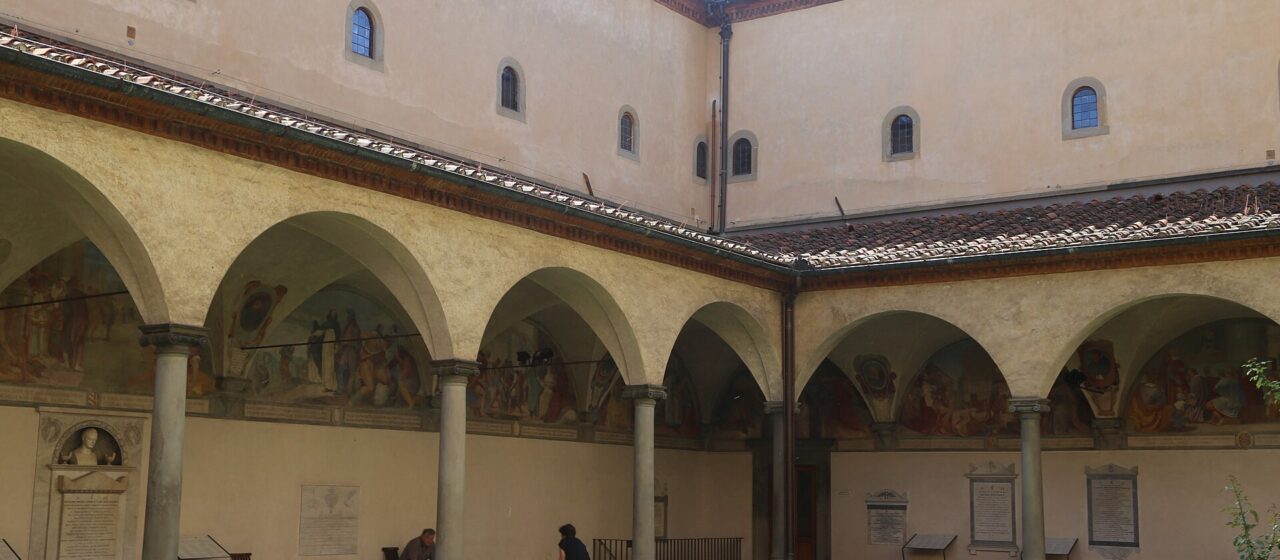
The first space you enter — a serene, Brunelleschi-inspired cloister with arched walks around a central garden. Fra Angelico himself painted the lunettes above each side of the cloister, including a St. Dominic Embracing the Cross opposite the entrance. Pause here for two minutes to let the noise of Florence drop away — most visitors rush past, but the cloister’s geometry is the architectural mood-setter for everything that follows.
Pilgrims’ Hospice (Sala dell’Ospizio)
Originally where the convent housed travelling pilgrims, this long room now displays roughly 20 of Fra Angelico’s most important altarpieces and panel paintings, gathered from churches across Tuscany. Highlights include the San Marco Altarpiece (1438–43, originally the high altar of the church), the Annalena Altarpiece, the Bosco ai Frati Altarpiece, and most extraordinarily, the Last Judgement (1431) — a tondo with the saved on Christ’s right and the damned on his left, suffused with the gold-leaf radiance for which Fra Angelico became famous.
The room also holds the Naming of the Baptist, a small early panel demonstrating Fra Angelico’s debt to Masaccio, and the Madonna of the Star, a particularly tender Marian devotional image.
Ghirlandaio’s Last Supper (Refectory)
The convent’s refectory, where the friars ate in silence, was frescoed in 1480 by Domenico Ghirlandaio with a Last Supper of unusual freshness. Ghirlandaio’s signature trick — placing the Biblical scene in a recognisably Florentine setting with peacocks, oranges, glassware and a Tuscan landscape painted as if visible through windows — would later be borrowed by his most famous workshop apprentice: the teenage Michelangelo. Ghirlandaio’s three Florence cenacoli (this one, Ognissanti, and a now-lost work) are the major cenacoli of the early 1480s.
The Chapter House Crucifixion
The Sala Capitolare — where the friars met for daily prayers and convent business — features Fra Angelico’s monumental Crucifixion with Saints (1441–42), one of the largest frescoes he ever produced. Christ on the cross is flanked by Mary, John, Mary Magdalene, and a procession of Dominican saints (Dominic, Aquinas, Peter Martyr) plus the convent’s patron saints (Cosmas and Damian, the patron saints of physicians and of the Medici). The fresco’s monumental composition is unusually severe for Fra Angelico, who was working under the spiritual direction of San Antonino — and the painting served as the visual focal point for the friars’ daily community gatherings for the next four centuries.
Upper Floor: The Cells & The Annunciation
Fra Angelico’s Annunciation (1440s)
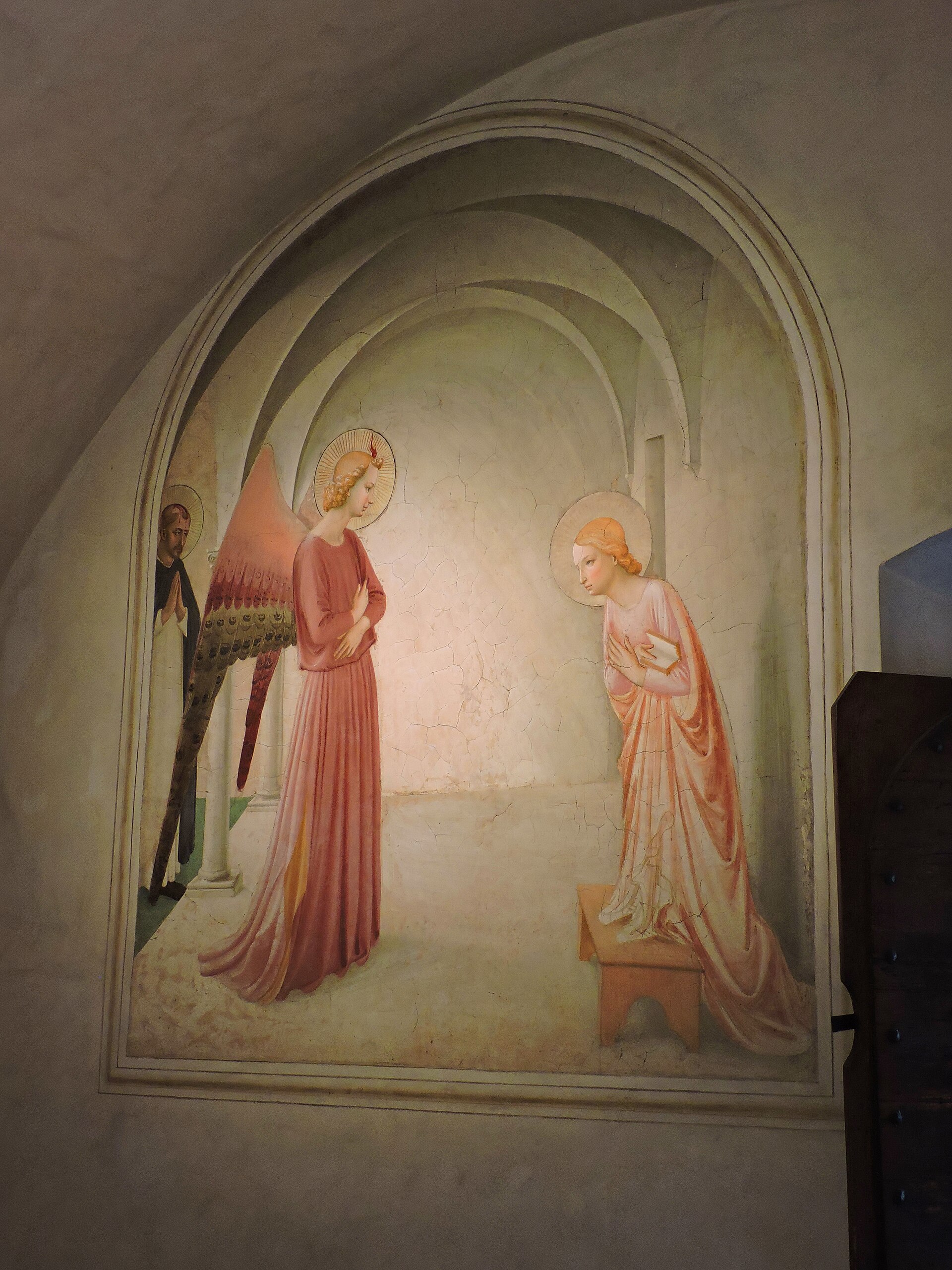
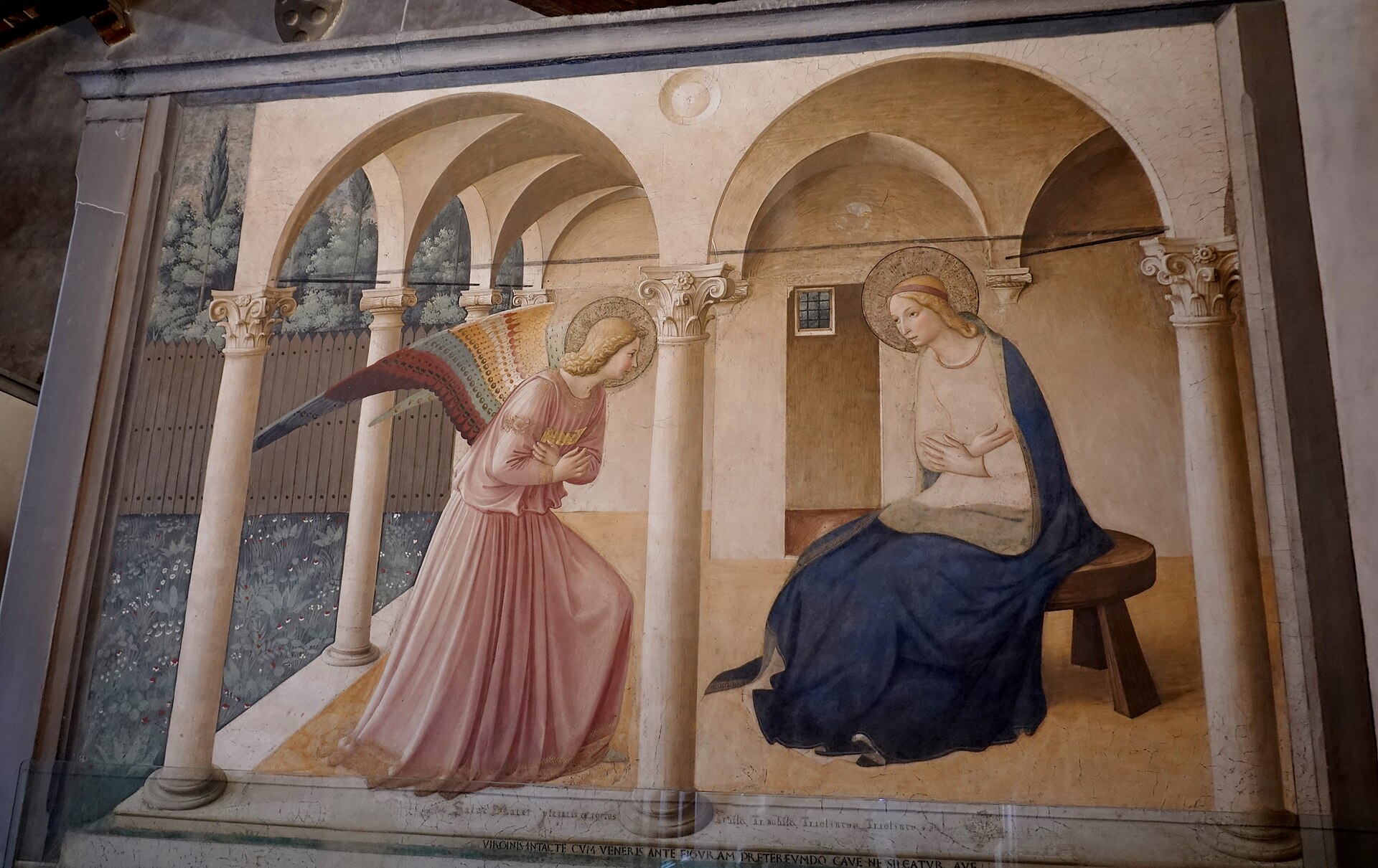
At the top of the dormitory stairs, Fra Angelico’s Annunciation faces every friar climbing to bed each night. The Archangel Gabriel kneels in a Brunelleschian loggia of slender columns and ribbon-thin arches; the Virgin Mary, seated on a wooden bench, bows her head with palms crossed in restraint. Fra Angelico has stripped away every distracting flourish — there is no garden symbolism, no architectural ornament beyond the bare classicism of the columns, and the colour palette is reduced to pinks, golds, blues and the white of Mary’s seat. The result is the calmest, most contemplatively constructed Annunciation in Italian art.
Note the inscription beneath the fresco: a Latin instruction telling friars to greet the Virgin with a Hail Mary as they ascend the stairs. The fresco was a working aid to monastic life, not an artwork meant for outside visitors.
The Dormitory Cells (Cells 1–43)
The genius of San Marco is the cells themselves — 43 small whitewashed monastic cells arranged in three corridors around the upper floor, each containing a single Fra Angelico fresco painted on the wall opposite the doorway, designed for the friar who slept there to use as the focus of his daily meditations. Most of the frescoes were executed by Fra Angelico himself; a handful are by his pupils (notably Benozzo Gozzoli) under his direct supervision.
The cells span the entire mystery of Christ’s life. Cell 1: Noli Me Tangere (Christ’s appearance to Mary Magdalene) — the resurrected Christ, a small spade-bearing gardener, gently denying touch. Cell 3: Annunciation — a more intimate, conversational version of the corridor masterpiece. Cell 6: The Transfiguration — Christ blazing white above three shielding apostles. Cell 7: The Mockery of Christ — extraordinary in its compression: a blindfolded Christ, the symbolic disembodied head spitting and hand striking him, the praying figures of Mary and St. Dominic in the foreground.
Cell 9: The Coronation of the Virgin. Cell 26: The Crucifixion with St. Dominic. Cell 31: Christ in Limbo — Christ rescuing Adam, Eve and the patriarchs from Hell, with a single fallen demon underneath. The frescoes’ deliberate restraint — single figures, simplified backgrounds, soft natural light — reflects Fra Angelico’s belief that meditation is best supported by uncluttered images that the mind can rest on without distraction. They are also early experiments in linear perspective, the new visual technology Brunelleschi had demonstrated only twenty years earlier.
How to Read the Cells (Don’t Rush)
The single tourist failure mode at San Marco is rushing. Each cell takes about 60 seconds to “see,” but each fresco was designed for a friar to spend hours in front of, day after day. Pick three cells you find personally compelling — many visitors single out 1, 3, 7, 9 and 26 — and stand in front of each for at least three full minutes before moving on. The frescoes reveal additional structure (the figures’ eye-lines, the painted architecture, the use of warm vs cool colour for sacred vs profane) on slow looking.
Cosimo’s Private Cell (Cells 38–39)
At the far end of the dormitory’s east corridor, two larger cells — much grander than the rest — were reserved for Cosimo il Vecchio de’ Medici. Cosimo, who funded the entire San Marco project, would withdraw to these cells for solitary meditation when he wanted to escape Florentine politics. The frescoes here are correspondingly more elaborate: cell 39 contains a large Adoration of the Magi by Fra Angelico and Benozzo Gozzoli, with three magi who may include portraits of Cosimo himself and his sons Piero and Giovanni — the same Medici-as-magi conceit Gozzoli would later perfect in the Magi Chapel of Palazzo Medici Riccardi a decade later.
The Savonarola Quarters (Cells 12–14)
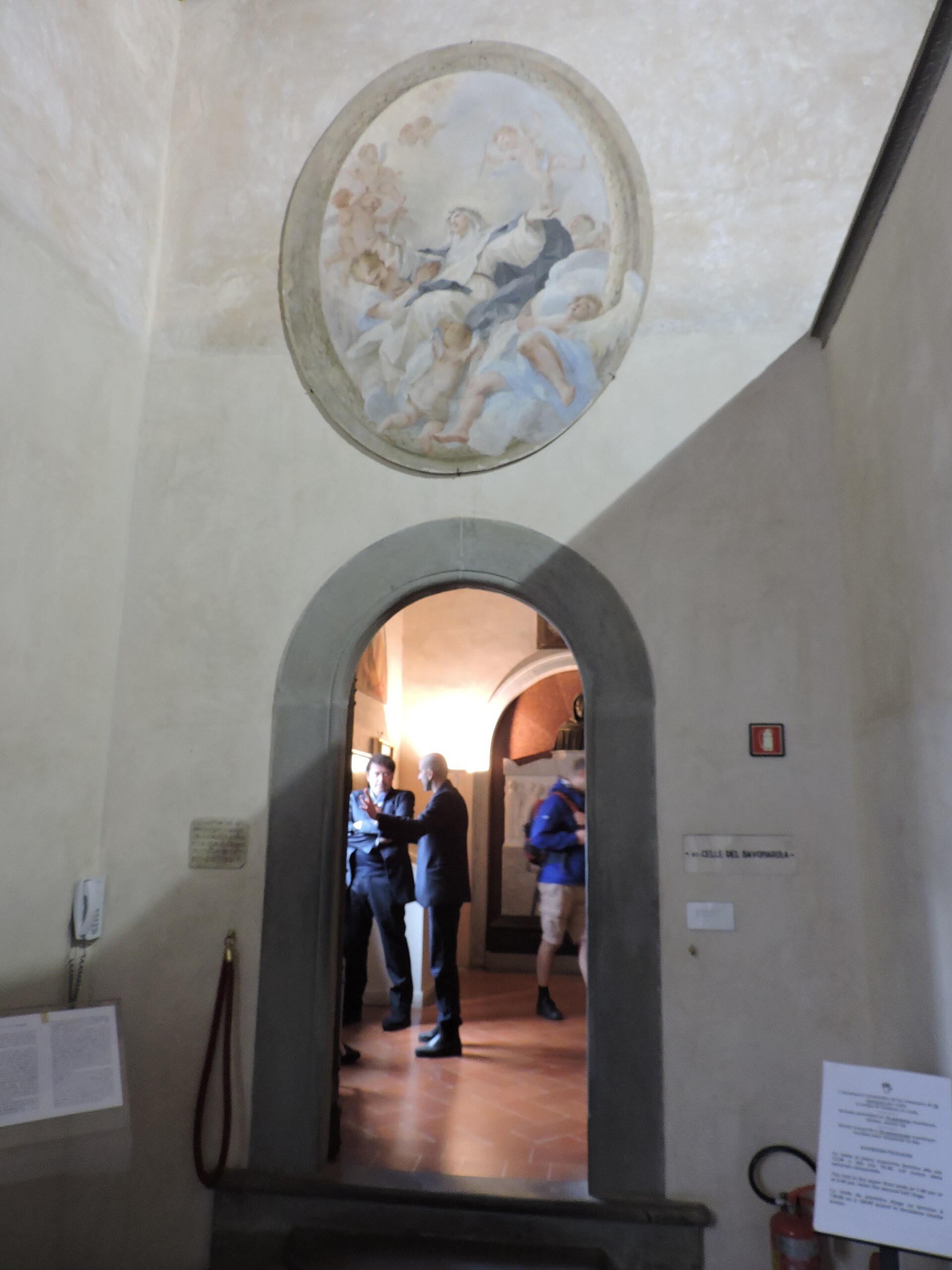
The Prior’s quarters at the corner of the corridor were occupied by Girolamo Savonarola from 1491 to 1498. Three rooms remain on view: a small antechamber, his sleeping cell, and the study where he wrote his sermons. Personal objects survive — Savonarola’s wooden writing desk, one of his Dominican habits, the rosary said to have been with him at his execution, and the famous Fra Bartolomeo portrait of Savonarola in profile, painted from life.
Most affecting is the small painting The Burning of Savonarola in Piazza della Signoria, a contemporary 16th-century panel that records the May 1498 execution: three friars hanging on a gibbet over a fire, the watching Florence crowd, the Palazzo Vecchio in the background. Savonarola was condemned by a tribunal under Pope Alexander VI on charges of heresy and schism. The panel survives because Savonarola’s followers — known as Piagnoni — preserved relics of the martyrdom for centuries, including his bones (now lost) and the chair from which he allegedly preached his most famous sermon.
The Bonfire of the Vanities — the public destruction in February 1497 of “vanities” (cosmetics, lewd books, secular paintings, gambling tables, fine clothing, even Botticelli paintings allegedly thrown into the flames by Botticelli himself, though this story is disputed) — was orchestrated from these very rooms. The historian’s pause at Savonarola’s quarters is a useful counterweight to the Renaissance’s typical narrative of expanding humanism: the Renaissance also produced its puritan, and he ran Florence for four years.
The Michelozzo Library
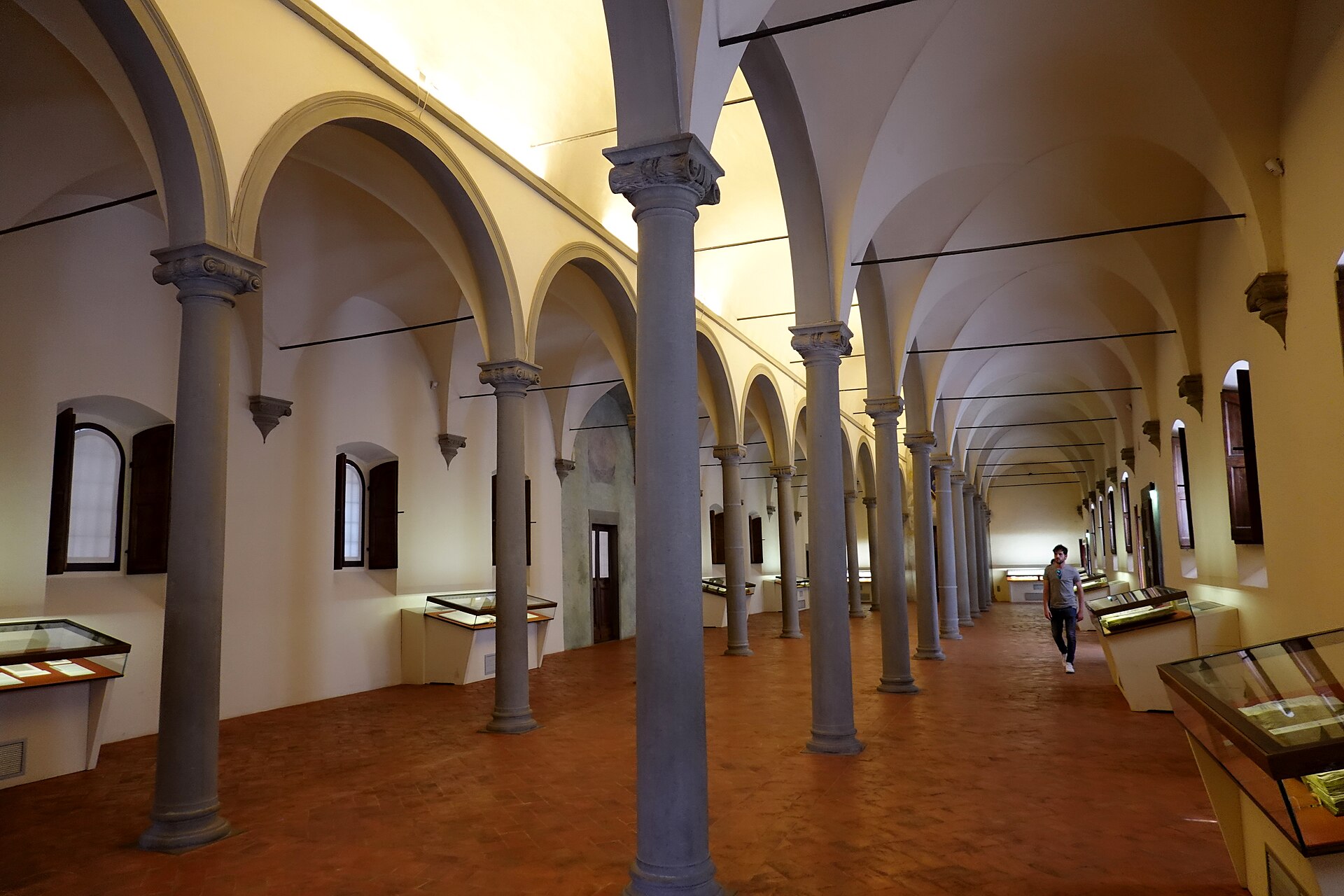
Halfway along the upper floor, an unmarked door opens into one of the most important rooms in Renaissance architecture. The Michelozzo Library, completed in 1444, is a long basilica-shaped hall of three aisles divided by slim Ionic columns of pietra serena. The proportions, the cool grey-and-white palette, the arched vaults — every classical detail of the Italian Renaissance library style was set here, and the design directly influenced Michelangelo’s Laurentian Library at San Lorenzo eighty years later.
The library was the first public library of the Renaissance: Cosimo il Vecchio donated 400 manuscripts collected by humanist Niccolò Niccoli to launch it, and decreed that the books be available to scholars rather than locked away. Lorenzo the Magnificent later expanded the holdings to over 1,000 volumes — including manuscripts owned by Pico della Mirandola and Angelo Poliziano. Many of the most important manuscripts were transferred to the Biblioteca Medicea Laurenziana when Cosimo I de’ Medici reorganised the collection in the 1570s, but San Marco still displays a rotating selection of illuminated antiphonaries (large choir books with painted miniatures), Greek and Latin classics, and Dominican theological works.
The room itself is the destination as much as the books. Pause to notice the way Michelozzo’s pier-and-arch system creates three near-equal aisles like a basilica, the sober pietra serena that becomes the Renaissance signature for Florence’s libraries and chapels, and the way the library’s quiet contrasts with the dramatic frescoes of the cells next door.
Other Collections at San Marco
Fra Bartolomeo Room: the museum holds substantial works by Fra Bartolomeo (1472–1517), the Dominican painter who became the convent’s most famous resident artist after Fra Angelico. His Madonna and Child with Saints shows the High Renaissance refinement of monastic painting; his portrait of Savonarola is the most authentic surviving likeness of the friar.
Refectory frescoes and detached fresco fragments: The museum was used in the 19th and 20th centuries as a holding institution for detached frescoes salvaged from demolished Florentine churches. Several lunettes by Andrea del Sarto, Pontormo and lesser masters hang in the rooms off the upper corridor.
The Sala Greca (Greek Hall): a small specialist room for the museum’s collection of Greek liturgical icons and post-Byzantine works donated to the convent over centuries.
A 90-Minute Route Through San Marco
This route covers the museum without rushing.
0–10 minutes — Cloister of Sant’Antonino: walk a slow lap, look at Fra Angelico’s lunettes, sit on the bench. Set the mood.
10–35 minutes — Pilgrims’ Hospice: the altarpieces. Spend the most time on the San Marco Altarpiece, the Last Judgement and the Annalena Altarpiece. These are dense, elaborate, and worth the slow look.
35–45 minutes — Refectory + Chapter House: Ghirlandaio’s Last Supper, then Fra Angelico’s Crucifixion. Both have benches.
45–50 minutes — Climb stairs: stop at the Annunciation. Stand in front of it for the recommended three minutes.
50–75 minutes — Dormitory cells: walk all three corridors. Pause in front of cells 1, 3, 7, 9, 26, 31 (your essential six). Skim the rest as you walk.
75–82 minutes — Savonarola’s quarters: the writing desk, the burning panel, the Fra Bartolomeo portrait.
82–90 minutes — Michelozzo Library + Cosimo’s cells: end on architecture and on Cosimo’s Adoration of the Magi.
San Marco vs Other Florence Museums
If you’ve already seen the Uffizi and Accademia, San Marco is the smartest “what next?” option for a typical traveller. It is roughly 30% the size of the Bargello and 10% the size of the Uffizi, but visitor numbers are even lower than that ratio suggests — most tour groups skip it entirely.
Compared with the Uffizi, San Marco is monastic and intimate where the Uffizi is regal and overwhelming. Compared with the Accademia, San Marco is contemplative where the Accademia is a one-masterpiece pilgrimage. Compared with the Bargello, San Marco is painted where the Bargello is sculptural. Compared with Palazzo Pitti, San Marco is religious where Pitti is courtly.
For travellers with a Renaissance art interest, San Marco is essential — it shows what Florentine painting looked like as a working religious technology, before it became Uffizi-grade public spectacle. For travellers with limited time and a casual interest, San Marco is optional — its rewards depend on slow looking.
Best Time to Visit San Marco
Best slot: Tuesday, Wednesday, Thursday between 09:00 and 11:00 — most cells are empty of other visitors. The 08:15 opening is even quieter but you’ll see fewer caretakers (some cells unlock progressively as staff arrive).
Avoid: the first Sunday of any month (free Sunday brings local crowds) and the half-hour before closing (rushed). Saturdays are slightly busier than weekdays but still very manageable.
Closed days reminder: Mondays (mostly), the second and fourth Sundays of each month. Always check the official calendar for the date you plan to visit; the schedule occasionally shifts for special exhibitions.
Getting to San Marco
The museum is on Piazza San Marco, ten minutes’ walk north of the Cathedral via Via dei Servi → Via Cesare Battisti. Bus C1, 6, 14, 17 and 20 all stop at the piazza. The Accademia Gallery (Michelangelo’s David) is two minutes’ walk south of San Marco — a logical pairing for a single morning, finishing at San Marco for 09:30 and continuing to the Accademia for an 11:00 timed slot. Many visitors do them in reverse, but San Marco closes at 13:50 while the Accademia stays open until 18:50, so doing San Marco first is more flexible.
San Marco Museum FAQ
Is the San Marco Museum worth visiting?
Yes, especially if you have a serious interest in Renaissance painting, monastic architecture, or Florentine history. It’s the world’s largest collection of Fra Angelico, includes Savonarola’s preserved cell, and is among Florence’s most peaceful museums. For travellers with very limited time and only a casual interest, it can be skipped without major regret.
Do I need to book San Marco tickets in advance?
No — walk-in is reliable even in summer. Tickets are €8–10 at the door. Advance booking via tickets.uffizi.it costs the same plus a small fee, useful only if you want to lock in a specific entry slot.
How long does it take?
Allow 90 minutes for a comfortable visit covering the cloister, altarpieces, refectory, dormitory cells, library and Savonarola’s rooms. A rushed visit is possible in 45 minutes; serious art-history visits run 2.5–3 hours.
Can I take photos at San Marco?
Yes (no flash, no tripod). Photography is allowed throughout the museum including the dormitory cells. Some smaller cells are dim, so a steady hand or a slow phone shutter helps.
Is San Marco interesting for children?
For very young children (under 8), San Marco is too quiet and reflective. For older children with an interest in art or history, the Savonarola story (especially the Bonfire of the Vanities and his execution) makes a vivid hook, and the small monastic cells are easier to digest than the cavernous Uffizi galleries.
Is San Marco on the Firenze Card?
Yes — the €85 Firenze Card includes admission to San Marco. Children 0–17 are always free.
What’s the best museum to combine with San Marco?
The Galleria dell’Accademia (Michelangelo’s David) is two minutes’ walk south. A natural morning combines San Marco at 08:30–10:30, an espresso break, then the Accademia at 11:00–12:30. The Cenacolo di Sant’Apollonia (Andrea del Castagno’s Last Supper, free) is a five-minute walk and slots neatly into the same area.
San Marco rewards travellers who slow down. Where the Uffizi demands four hours of standing through 80+ rooms, San Marco asks for 90 minutes of contemplation in front of a small number of perfectly placed paintings. Walk through the cells without checking your phone, sit for five minutes in the Michelozzo Library, and you’ll leave the most peaceful museum in Florence understanding the Renaissance as a religious as well as artistic project.