This article contains advertising. Booking links on this site can be turned into paid links automatically by our partner Travelpayouts: if you book through one, we earn a commission from the provider, at no extra cost to you. It never affects what we recommend. Affiliate disclosure

Street food in Florence Italy is a deep, working-class tradition that runs alongside the city’s restaurant culture. The two centrepieces are the lampredotto sandwich (slow-stewed cow’s stomach in a broth-dipped bread roll, €5) and the schiacciata (a flat oil-and-salt-baked bread split open and stuffed, €5–€10 at All’Antico Vinaio). Around them, Florence has porchetta carts, market-counter lunches, lampredotto carts, focaccia bakers, gelato stops and the upstairs Mercato Centrale food hall. This 2026 guide rounds up everything to know about Florence street food — what to eat, where to find the best version of each, what it costs, and where to eat your sandwich around the busiest queues.
For broader food context see our Florence Food Guide pillar; for restaurant lists see Best Restaurants in Florence.
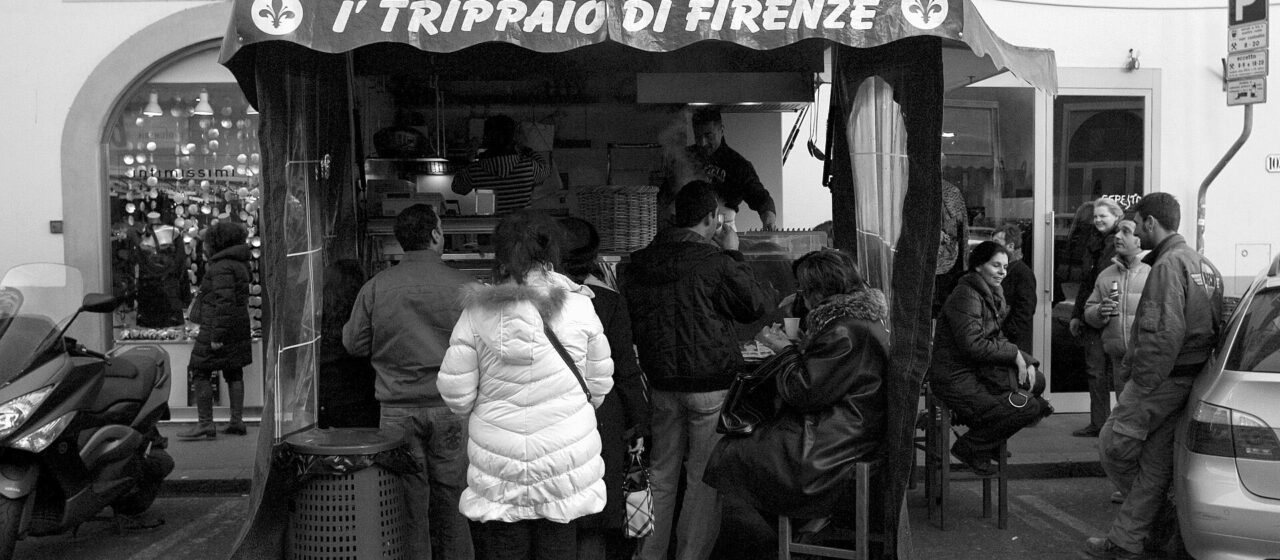
Florentine street food is a lunchtime tradition, not a tourist novelty: the tripe carts predate the restaurants around them. Pair it with a standing espresso, a browse through the city markets, or the food halls upstairs at the Mercato Centrale.
You can eat your way round the city without a guide for about €25, which is roughly a third of what a tour costs. Our Florence food tours guide is honest about what the guide adds and when it is worth paying for.
What is Florence street food?
Florence’s street-food tradition is rooted in cucina povera — the centuries-old Tuscan habit of making excellent food from cheap ingredients. The lampredotto cart is the perfect expression: the fourth stomach of a cow, cooked slowly in broth with vegetables and tomato, sliced thin and served in a bread roll. It costs €5 and tastes far better than its description suggests.
The format is mostly standing-up eating: at the cart, on a piazza step, leaning on a wall. Florentine street food is not gourmet sit-down cuisine; it’s lunch eaten quickly between meetings, a sandwich on the way home, a lampredotto from the cart on a Sunday morning. The portion sizes are working-class generous; the prices are accordingly low; the quality at the better stops genuinely competes with sit-down restaurants.
Two practical notes for travellers: (1) on the busiest streets, step out of the queue before you eat (more on this below); (2) lunch is the main event for carts and counters, and some close in the afternoon until early evening.
Lampredotto — Florence’s signature street food
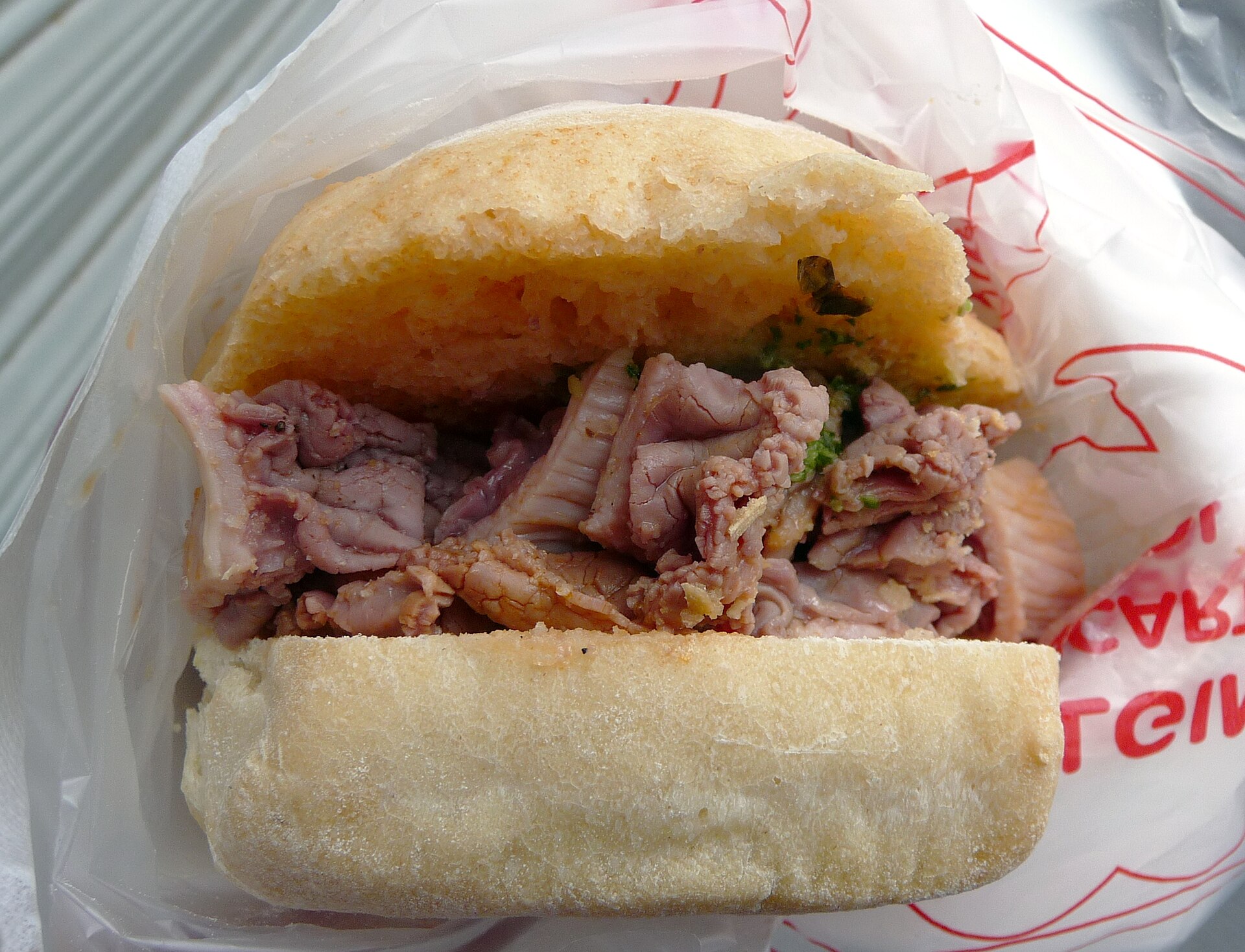
Lampredotto is the lining of a cow’s fourth stomach (the “abomasum”) — distinct from regular tripe (which comes from the first three stomachs). The lining is cooked slowly in broth with onion, parsley and tomato until tender and savoury. Sliced thin and served in a “semella” — a sesame-topped Florentine bread roll whose top half is briefly dipped in the cooking broth before assembly, making it lusciously soft.
The classic toppings: green sauce (parsley, garlic, capers, olive oil) and red sauce (chilli oil with paprika). Both are usually offered; locals typically order both. Salt, pepper and a squeeze of lemon are standard finishers. €5 a sandwich. Eaten standing up at the cart, with a small paper napkin.
Best lampredotto carts in Florence
- Trippaio del Porcellino — Mercato Nuovo (the Porcellino loggia), Piazza Mercato Nuovo. The most famous; central; reliable.
- L’Trippaio — Borgo La Croce (Sant’Ambrogio area). Equally good; less touristy; favourite of Santa Croce locals.
- Trippaio di Sergio Pollini — Largo Annigoni (just east of Sant’Ambrogio). Cult-status among locals; the broth is reportedly the city’s best.
- Da Nerbone — inside Mercato Centrale, ground floor. €6 lampredotto plus the famous boiled-beef sandwich (panino di bollito).
- Trippa Pollini — second-rank cart with a strong following; near Piazza dei Ciompi.
Lampredotto for first-timers
If you’ve never eaten cow stomach: order it. Tell the trippaio “una lampredotto, con salsa verde e un po’ di salsa rossa, sale, pepe, limone” and stand back. The texture is tender and slightly chewy; the flavour is deeply savoury with herbal and peppery notes from the green sauce. Most travellers who try it become converts. €5 for the experience.
Schiacciata — the queue-defining sandwich
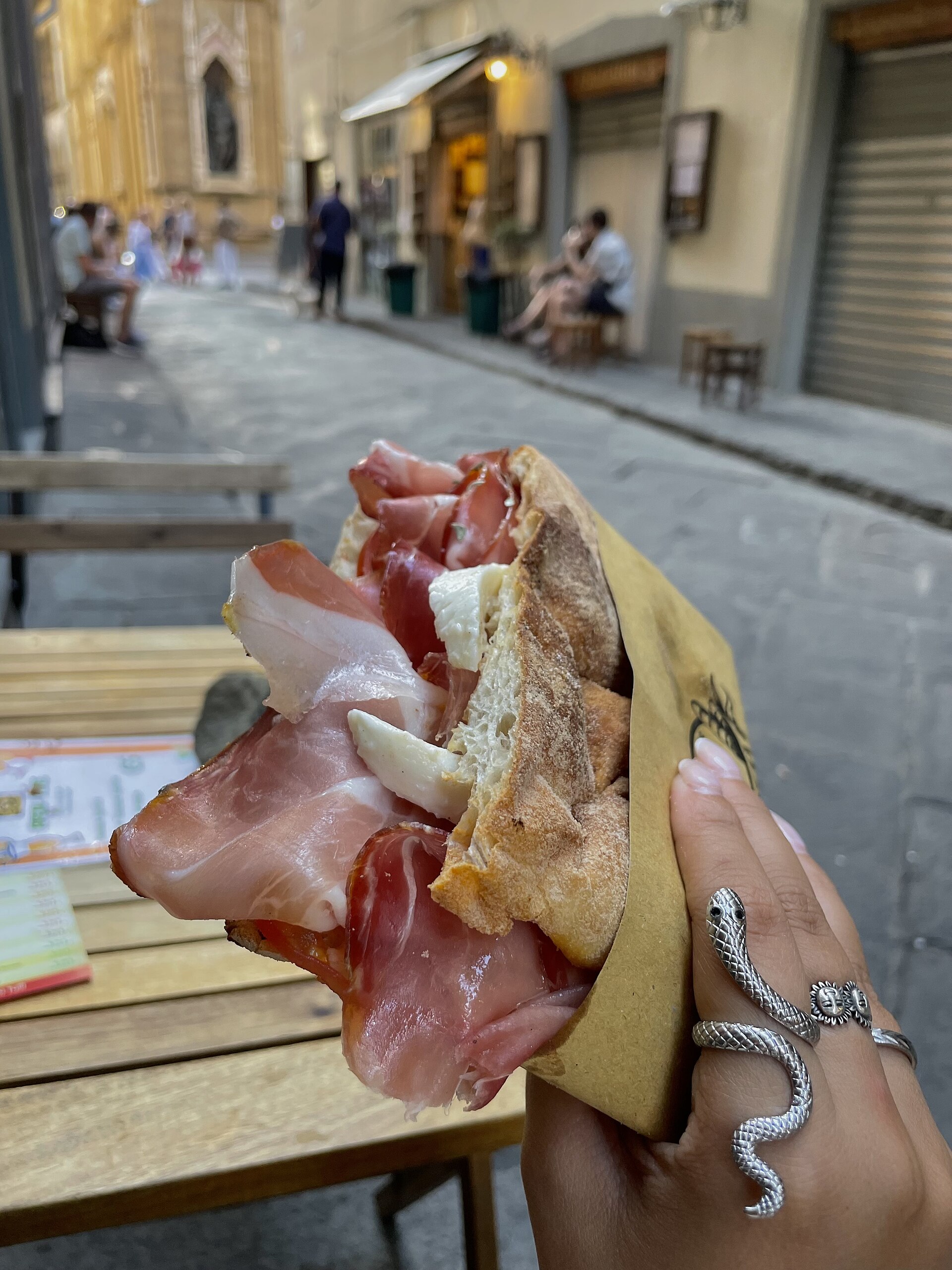
“Schiacciata” means “squashed” or “pressed flat” in Italian — and the bread is named for the way the baker presses it flat with their fingers during baking, leaving distinctive dimples. Made with flour, water, olive oil, salt, yeast and time; baked in trays; the result is a low, dimpled, oily flatbread in the focaccia family.
The street-food version: the bread is split horizontally and stuffed with prosciutto, pecorino, truffle cream, sun-dried tomato, rocket, mortadella, marinated artichokes, etc. — generous fillings that the porous bread absorbs. Eaten cold; €5–€10 per sandwich depending on filling complexity.
Best schiacciata stops
- All’Antico Vinaio — see the dedicated section below. The queue institution.
- I’ Brindellone (Oltrarno) — €8 schiacciata sandwiches with creative fillings.
- Trippaio del Porcellino — also serves panini con bollito (boiled-beef rolls) alongside lampredotto.
- Pino’s Sandwich Shop — English-speaker-friendly; central; reliable schiacciata.
- Pegna (Via dello Studio) — premium deli; build-your-own schiacciata with high-end fillings; €10–€14.
- Sandwich (Via Faenza) — newer specialty schiacciata shop; €7–€10 sandwiches.
- Pasticceria Sieni — old-school pasticceria with schiacciata sandwiches as a sideline.
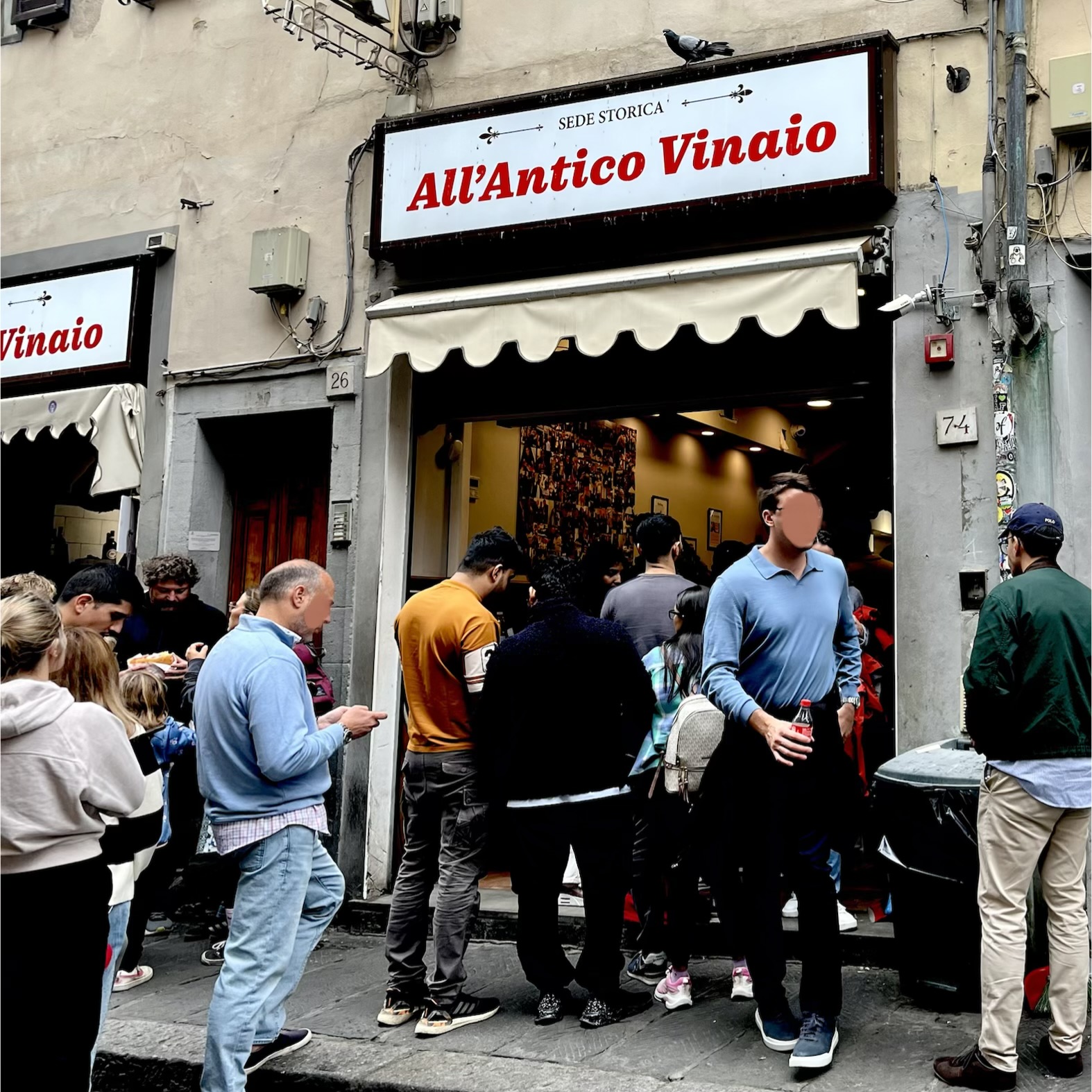
All’Antico Vinaio — the queue institution
The single most-queued food spot in Florence. Via dei Neri 65, 74, 76 and 78 (four Florence locations on the same street). Opened in 1989 by the Mazzanti family; it has since spread to other cities.
The proposition: massive €8 schiacciata sandwiches with absurdly generous fillings. The classic combinations have names: “La Favolosa” (truffle cream, pecorino, artichoke, fresh tomato); “La Boss” (porchetta, sun-dried tomato, pecorino, rocket); “L’Inferno” (spicy salame, pecorino, artichoke, hot pepper). Each sandwich is roughly the size of a small loaf — definitely a meal, possibly a meal for two.
Expect a queue, longest around lunchtime. Cash and card accepted. Eaten standing on Via dei Neri or carried away. Open daily 10:00–22:00.
Critique: All’Antico Vinaio is excellent value but somewhat industrial in feel — multiple branches running at high volume. If you want a more artisanal schiacciata experience, try I’ Brindellone, Pino’s or build-your-own at Pegna.
Porchetta & cured meats
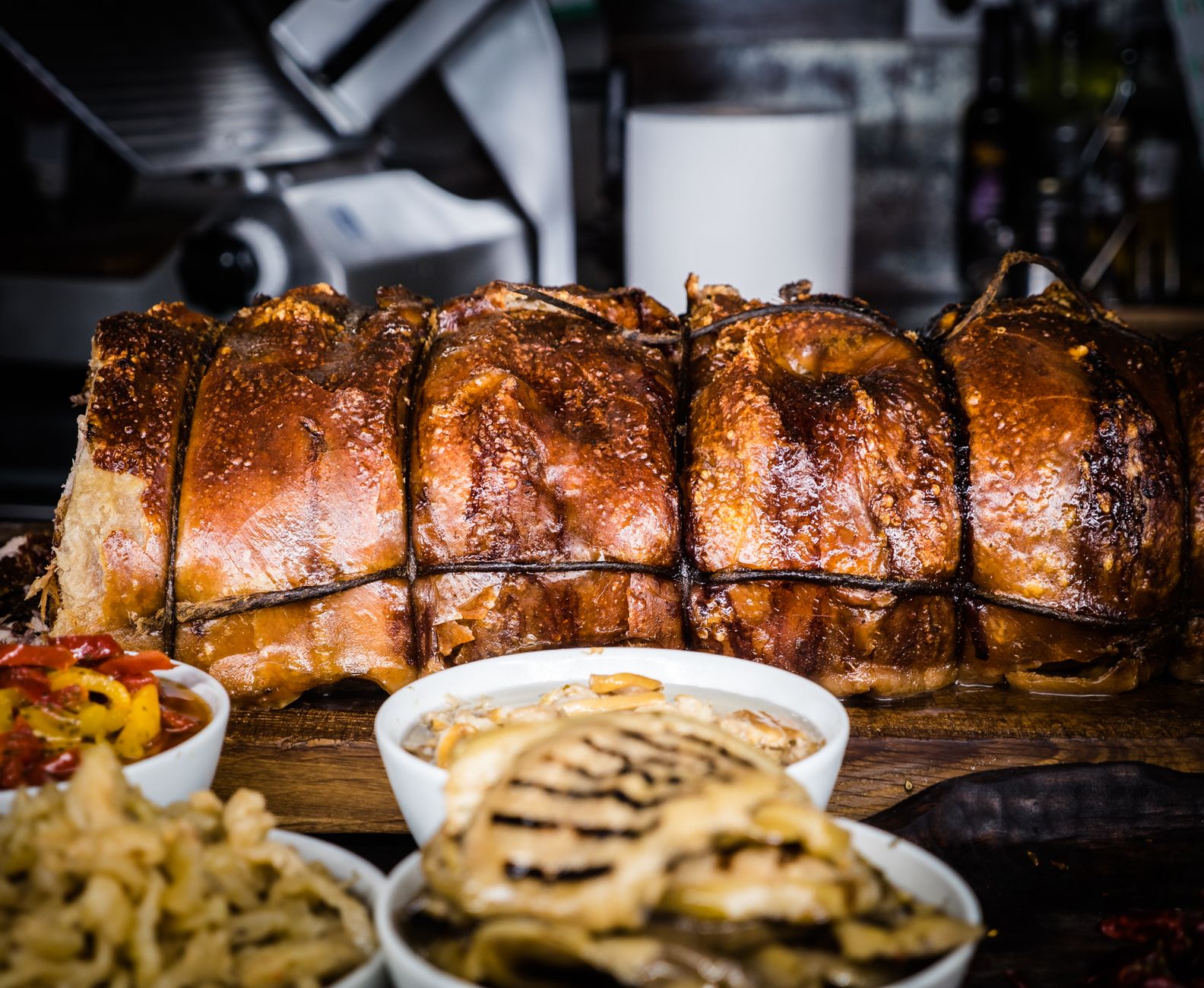
Porchetta is roast pork stuffed with herbs (rosemary, fennel, garlic, sometimes pepper), salted heavily and cooked until the skin crackles and the inside is tender. Originally from central Italy (Umbria, Lazio, Le Marche); adopted into Florentine street-food practice. Sliced thin and served on schiacciata or in a roll.
Best porchetta stops
- Mercato Centrale ground floor — multiple porchetta vendors; €6–€8 a roll.
- Porchetta truck at Mercato Sant’Ambrogio — Saturday mornings only.
- L’Ariosto — porchetta plus other roast specialties.
- Trattoria Sostanza’s porchetta plate — sit-down version at the famous trattoria.
Cured meats & salami
Florence’s cured-meat scene runs deep. Standout vendors at Sant’Ambrogio and Mercato Centrale stock:
- Finocchiona — Tuscan fennel-seed salami; distinctively local.
- Capocollo — cured pork shoulder.
- Prosciutto toscano DOP — Tuscan dry-cured ham (saltier than Parma).
- Salame Toscano — coarse-grain pork salami.
- Lardo di Colonnata — cured pork fat from a Tuscan village near Carrara.
- Mortadella — Bologna’s cured meat, widely available.
Mercato Centrale & Sant’Ambrogio market lunches
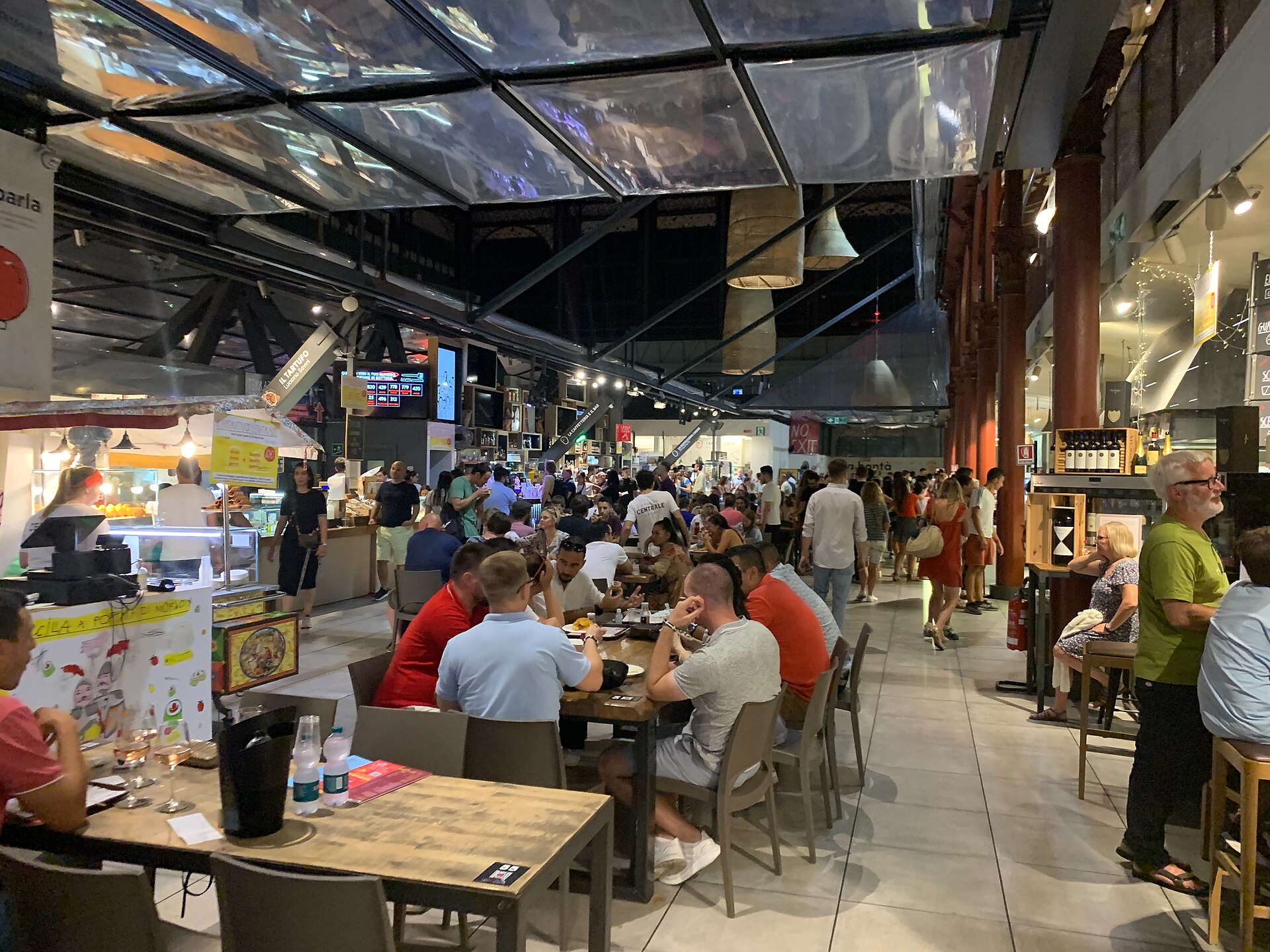
Florence’s two main markets bridge between street food and informal sit-down lunch.
Mercato Centrale (San Lorenzo)
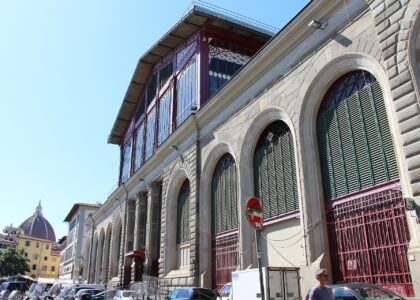
Cast-iron 1874 hall. Ground floor Mon–Fri 07:00–15:00 and Sat 07:00–17:00 with butchers, fishmongers, fresh-pasta makers, cheesemongers. Inside, Da Nerbone serves a classic boiled-beef sandwich (panino di bollito, €6) plus lampredotto. Pasta Fresca serves €8 plates of fresh tagliatelle. Trippaio Centrale is the market’s lampredotto cart.
Upstairs (open daily 09:00–23:00) is the modern food hall: 19 shops plus a bar, brewery, pizzeria, grill and cooking school. Communal long tables; loud, lively. €8–€18 per plate. Best for picky-eater families and travellers wanting a single meal-spot with multiple options.
Sant’Ambrogio market (east of Santa Croce)
Florence’s working-class market. Monday–Saturday mornings (07:00–14:00). Inside the covered hall: Trattoria da Rocco serves daily-changing Florentine working-class lunch (€8–€12). The lampredotto cart in front of the market is among the city’s best.
Sant’Ambrogio is significantly less touristed than Mercato Centrale; quality is comparable or better; pricing slightly lower. Florentine grandmothers shop here daily.
Gelato as street food
Florentine gelato — covered fully in our best gelato in Florence guide — operates as both dessert and street food. Top picks:
- La Carraia (Piazza Nazario Sauro, Oltrarno) — €1.50 small cone.
- Vivoli (Santa Croce) — one of Florence’s oldest gelaterias, opened as a dairy in 1929 and making gelato since 1932.
- Perché No! (centro storico) — best pistachio in central Florence.
- Gelateria della Passera (Oltrarno) — small-batch artisan favourite.
- Edoardo (across from the Duomo).
Crostini, focaccia & market sweets
Crostini neri (chicken-liver pâté toasts)
Tuscan-classic starter. Chicken livers cooked with capers, anchovies, white wine, butter — pulsed into a smooth pâté and spread on small slices of toasted Tuscan bread. Available at most market counters; €1–€2 per piece.
Coccoli (fried dough balls with prosciutto and stracchino cheese)
Florentine appetizer-snack. Bite-sized fried-dough balls served warm with cured meat and soft cheese. Best at Coquinarius and several Sant’Ambrogio stalls. €5 a plate.
Crescentine
Small fried bread squares (similar to coccoli but flatter). Often served with charcuterie. €4–€6.
Schiacciata fiorentina (sweet)
Carnival-season (early February) sweet flatbread dusted with icing sugar. Often filled with whipped cream. €3–€4 a slice at every pasticceria.
Cantucci di Prato
Almond biscotti dipped in vin santo. Universal Tuscan dessert. €5–€8 a small bag at Pegna.
Ricciarelli & panforte
From Siena (an hour south) but widely available. Almond cookies and dense fruit-and-nut cakes. €3–€5 each.
8 more Florence street food stops
- Trippaio Sergio Pollini (Largo Annigoni, near Sant’Ambrogio) — cult lampredotto.
- Da Nerbone (inside Mercato Centrale) — boiled-beef sandwich.
- Trippaio del Porcellino (Mercato Nuovo) — central institution.
- L’Trippaio (Borgo La Croce) — local-favourite second branch.
- I’ Brindellone (Oltrarno) — Oltrarno schiacciata + aperitivo.
- All’Antico Vinaio (Via dei Neri) — queue-institution schiacciata.
- Pegna (Via dello Studio) — premium deli for build-your-own panini.
- Pino’s Sandwich Shop (Borgo Allegri) — English-speaker-friendly schiacciata.
Where to eat your sandwich
In 2018 the city brought in a temporary ordinance against eating on the pavement along Via de’ Neri. It was aimed at the All’Antico Vinaio crowd: the queue spilled across the street, and tourists eating sandwiches on the spot created congestion and rubbish.
The ordinance has lapsed, and there is no fine for it today, but a considerate spot still makes for a better lunch. Most travellers who buy at Antico Vinaio either step into a side street, sit on the steps of Piazza del Grano, or carry their sandwich to a nearby bench (Piazza Santa Croce is a short walk east).
Useful quiet-eating spots within 5 minutes of major street-food stops:
- Piazza Santa Croce — benches and basilica steps (a short walk from Antico Vinaio).
- Piazza del Grano — small steps just south of Piazza della Signoria.
- Lungarno bench — riverside benches between Ponte Vecchio and Ponte alle Grazie.
- Boboli Garden picnic spot — €10 entry but quiet shaded benches.
- Piazza Santo Spirito — basilica steps and piazza benches in the Oltrarno.
- Sant’Ambrogio area streets — quiet, no ordinance, plenty of benches.
A self-guided street-food walking tour
3-hour, 8-stop circuit covering the major Florence street-food categories:
Stop 1: Mercato Centrale ground floor (San Lorenzo)
Espresso + cornetto at the market bar (€2.40). Walk through the working market; observe the produce, butcher and cheesemonger stalls.
Stop 2: Da Nerbone (inside Mercato Centrale)
€6 boiled-beef sandwich (panino di bollito) — Florence’s working-class classic. Eat standing.
Stop 3: Trippaio del Porcellino (Mercato Nuovo)
15-minute walk south. €5 lampredotto sandwich with green and red sauce. Eat it standing at the cart.
Stop 4: Pegna (Via dello Studio)
5-minute walk. Sample-buy a schiacciata (€8–€14) or just window-shop the deli for premium take-home Tuscan ingredients.
Stop 5: Vivoli (Santa Croce)
10-minute walk east. One of Florence’s oldest gelaterias, making gelato since 1932. €4 small cup with crema + riso.
Stop 6: All’Antico Vinaio (Via dei Neri)
5-minute walk. €8 La Favolosa schiacciata. Eat on the steps of Piazza Santa Croce.
Stop 7: Sant’Ambrogio market (east of Santa Croce)
10-minute walk. Lunch at Trattoria da Rocco (€10–€12) inside the covered hall. Saturday morning is the working-market peak.
Stop 8: La Carraia gelato (Oltrarno)
15-minute walk crossing Ponte Vecchio. €1.50 small cone.
Total spend: €25–€40 across the day. Total walking distance: roughly 4 km. Total street food consumed: probably more than your daily allowance.
Dietary considerations
Vegetarian street food
Less obvious than meat-based, but doable: schiacciata stuffed with pecorino, sun-dried tomato, artichoke, rocket and truffle cream (skip the prosciutto). Crostini with truffle or olive paste. Coccoli with stracchino cheese only. Mercato Centrale upstairs has dedicated vegetarian counters. Avoid lampredotto, porchetta, panino di bollito.
Vegan street food
Limited but expanding. Sorbetto from gelaterias is vegan. Some schiacciata shops (Pino’s, Antico Vinaio) will build vegan sandwiches with rocket, sun-dried tomato, marinated artichoke, hummus. Mercato Centrale upstairs has a dedicated vegan counter.
Gluten-free street food
Tougher because the street food is so bread-centric. You can ask a lampredotto cart for the meat alone in a small paper plate (€4), without the bread. Most gelato is naturally gluten-free; ask for “in coppa” (cup) rather than cono.
Cost of Florence street food in 2026
| Item | Price (€) |
|---|---|
| Lampredotto sandwich | €5 |
| Panino di bollito (boiled-beef sandwich) | €6 |
| Schiacciata sandwich (Antico Vinaio) | €8 |
| Schiacciata (Pegna premium) | €10–€14 |
| Porchetta roll | €6–€8 |
| Coccoli plate | €5 |
| Crostini (1 piece) | €1–€2 |
| Mercato Centrale upstairs lunch | €8–€18 |
| Trattoria da Rocco lunch | €10–€12 |
| Espresso standing at bar | €1.20–€1.50 |
| Cornetto pastry | €1.20–€1.50 |
| Gelato small cone | €1.50–€4 |
| Aperitivo (spritz + buffet) | €8–€12 |
A full street-food day in Florence — espresso + cornetto breakfast, lampredotto + bollito sandwich lunch, gelato afternoon, schiacciata + spritz aperitivo — runs €25–€40 per person. The same content as restaurant equivalents would cost €60–€90.
Florence street food with kids
Family-friendly street-food strategy:
- All’Antico Vinaio — kids enjoy the queue-and-spectacle; pick a milder schiacciata (mortadella + pecorino + sun-dried tomato) for younger eaters.
- Mercato Centrale upstairs — 19 shops plus a pizzeria, grill and bar give picky eaters plenty of choice. Communal tables work for families.
- Lampredotto for older adventurous kids — 8+ might enjoy it; younger usually don’t. Order one to share rather than committing.
- Gelato 3x daily — La Carraia €1.50 cones make repeat visits affordable.
- Sant’Ambrogio market on Saturday morning — interactive, lively, lots of sample-friendly cheese and cured-meat vendors.
- Avoid Antico Vinaio at peak (12:30–14:30) with kids — queue is long and the spaces are crowded.
Guided Florence street-food tours
For travellers wanting a structured introduction with a local guide:
- Eating Europe Florence Food & Local Flavors Tour — from €84, 3 hours, tastings including lampredotto and gelato. Groups of up to 12; check departure times when you book.
- Curious Appetite Florence — a team of food and wine experts with strong artisan-vendor relationships; the four-hour Progressive Tuscan Dining Crawl is US$175 per guest in a small group, plus fees at checkout. Includes wine pairings.
- Devour Tours Oltrarno food walk — 3.5 hours of food and wine in the Oltrarno, up to 12 guests; check current prices when you book.
- Walks of Italy Oltrarno at Sunset — 3.5 hours, a food and wine tour of the Oltrarno for up to 12 guests.
- Free Walking Tour Florence Food version — tip-based (€10–€20 typical), 2 hours, lighter on tastings but good orientation.
A short history of Florence street food
Florence’s street-food tradition predates the modern era. Lampredotto emerged in the medieval period as a way for the city’s poor to access protein cheaply — the cow’s fourth stomach was an offcut sold by butchers at low prices, and Florentine cooks developed the slow-stewing technique that made it tender and flavoursome.
The schiacciata bread tradition is roughly contemporaneous. Florentine bakers in the 14th century developed the flat olive-oil-and-salt loaf as a bread that travelled well and stayed fresh longer than standard pane sciocco — a practical advantage for working-class lunches. Stuffing the schiacciata with cured meat and cheese became standard street-food practice by the 15th century.
The late 19th century gave Florence its covered market halls. Mercato Centrale opened in 1874 in a Giuseppe Mengoni cast-iron-and-glass hall; Sant’Ambrogio market dates to 1873. Both housed lampredotto carts and prepared-food vendors that still operate today.
The modern street-food revival took off in the 2010s. All’Antico Vinaio opened in 1989 and grew into a global queue institution. The Mercato Centrale upstairs food hall opened in 2014 and gradually moved street-food culture into a structured indoor format. The 2020s brought a wave of new sandwich-specialty shops (Pino’s, I’ Brindellone, Sandwich) drawing on the schiacciata tradition with modern fillings.
Florence street food through the year
Spring (March–May)
Spring vegetables flood the markets. Schiacciata fillings shift to artichokes, fava beans, fresh peas. Outdoor benches reopen. Lampredotto carts run year-round but feel especially good on mild April lunches.
Summer (June–August)
Peak season for outdoor street-food eating. Mercato Centrale upstairs stays open until 23:00. Gelato breaks every 90 minutes are essential. Cold cuts and tomato-based fillings dominate. Some smaller vendors close for a summer break around mid-August.
Autumn (September–November)
The Florentine food year’s prime period. Wild boar (cinghiale) salami appears at the better stalls. New olive oil arrives mid-November and shows up in every schiacciata. Truffle stalls open at Mercato Centrale; truffle-cream schiacciata is a November signature. Outdoor eating still pleasant through October.
Winter (December–February)
Lampredotto comes into its own — hot stewed meat is a winter craving. Mercato Centrale upstairs is the rainy-day refuge. Schiacciata fiorentina (sweet Carnival flatbread) at every pasticceria from late January through Carnival. A few carts and bakeries close for a short break in the quieter weeks, so check before making a special trip.
When street-food spots are open
- Lampredotto carts: daytime trading, busiest at lunch. Many close Sunday; some are Mon–Sat lunch only.
- All’Antico Vinaio: 10:00–22:00 daily.
- Mercato Centrale upstairs: 09:00–23:00 daily; entry is free and you pay at each counter.
- Mercato Centrale ground floor: Mon–Fri 07:00–15:00, Sat 07:00–17:00; closed Sundays.
- Sant’Ambrogio market: Monday–Saturday 07:00–14:00; closed Sundays.
- Gelaterias: open into the evening, later in summer.
- Bakeries (schiacciata): go in the morning for the freshest trays; hours vary, and some close for an afternoon break.
- Cafés (espresso): open early, busiest at breakfast.
Florence street food — FAQ
What is Florence’s most famous street food?
Lampredotto — slow-stewed cow’s-fourth-stomach sandwich from a street cart, €5. Florence’s working-class signature; eaten standing up at the cart with green and red sauces. The most famous trippaio carts are Trippaio del Porcellino at Mercato Nuovo and L’Trippaio in the Sant’Ambrogio area.
Is All’Antico Vinaio worth the queue?
Yes. €8 buys a massive schiacciata sandwich with quality fillings (truffle cream, pecorino, prosciutto, artichoke). Expect a queue at lunchtime; the four branches all sit on Via dei Neri, at numbers 65, 74, 76 and 78. The cheapest excellent lunch in central Florence.
What is lampredotto and what does it taste like?
Lampredotto is the lining of a cow’s fourth stomach, cooked slowly in broth with vegetables and tomato. Texture is tender and slightly chewy; flavour is deeply savoury with umami depth. Most travellers who try it become converts. €5 a sandwich.
Where to eat schiacciata in Florence?
All’Antico Vinaio (Via dei Neri) is the queue-institution. I’ Brindellone in the Oltrarno is the artisanal alternative. Pegna (Via dello Studio) does premium build-your-own. Pino’s Sandwich Shop is English-speaker-friendly.
Can I eat street food walking around Florence?
Yes. A 2018 ordinance against eating on the pavement along Via de’ Neri was temporary, and there is no fine for it today. Near the All’Antico Vinaio queues, step into a side street or sit on a piazza bench.
What’s the cheapest street food in Florence?
Lampredotto sandwich at €5. Espresso standing at a bar €1.20–€1.50. Cornetto pastry €1.20–€1.50. Small gelato cone at La Carraia €1.50. Schiacciata slice from a bakery €2–€4. A €15 daily allowance covers breakfast, lunch and snack.
Is Florence street food safe?
Yes — Florence’s street-food vendors operate under EU food-hygiene rules, and the most famous carts (Trippaio del Porcellino, L’Trippaio, Da Nerbone) have been operating reliably for decades. The only real risk is the same as any other restaurant — pick a vendor with visible turnover (the meat is freshly cooked) and you’re fine.
What’s the difference between trippa and lampredotto?
Trippa is a generic term for cow’s stomach (any of the first three stomachs); lampredotto specifically refers to the lining of the fourth stomach. The cuts are different cuts; lampredotto has a slightly more delicate texture and is typically served in a bread roll, while trippa is more often served in a bowl or on a plate.