This article contains advertising. Booking links on this site can be turned into paid links automatically by our partner Travelpayouts: if you book through one, we earn a commission from the provider, at no extra cost to you. It never affects what we recommend. Affiliate disclosure
The Bargello Museum Florence is the world’s most important Renaissance sculpture museum and one of Italy’s most-undervisited major galleries. Located in a 13th-century palazzo on Via del Proconsolo — originally the Florentine police headquarters and prison — the museum holds works by Donatello, Verrocchio, Michelangelo, Cellini, Giambologna, della Robbia and the rest of the Florentine sculpture canon. Critically, it includes Donatello’s two Davids (the marble and the revolutionary bronze) and the 1401 Baptistery competition panels by Brunelleschi and Ghiberti. Despite holding works equivalent in importance to the Uffizi or Accademia, the Bargello sees roughly one-fifth the visitors — making it the rare Florence museum where you can stand alone with masterpieces.
For broader museum context see our Florence Museums & Art Guide.

The Bargello holds the sculpture the Uffizi does not, including Donatello’s bronze David and the competition panels that started the Baptistery doors. It reads best alongside our Renaissance art guide and the statues in the loggia on Piazza della Signoria, a minute away.
Six euros on top of an Accademia ticket now covers the Bargello too, on a combined pass valid 48 hours — comfortably the best value in Florentine museum pricing. Our Accademia tickets guide runs through all three combined options.
What is the Bargello?
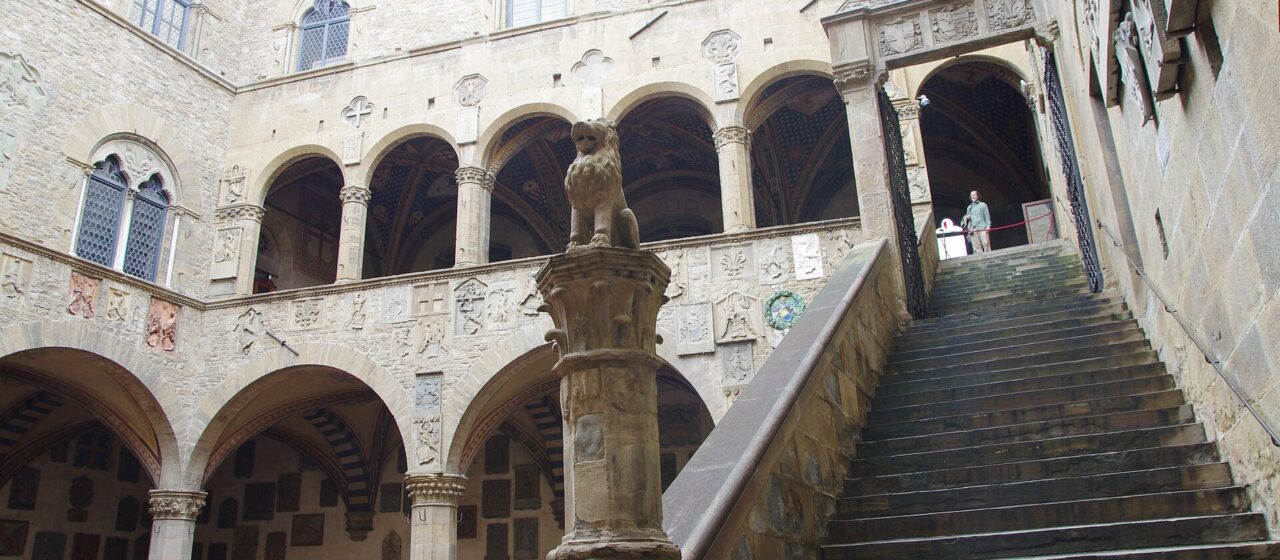
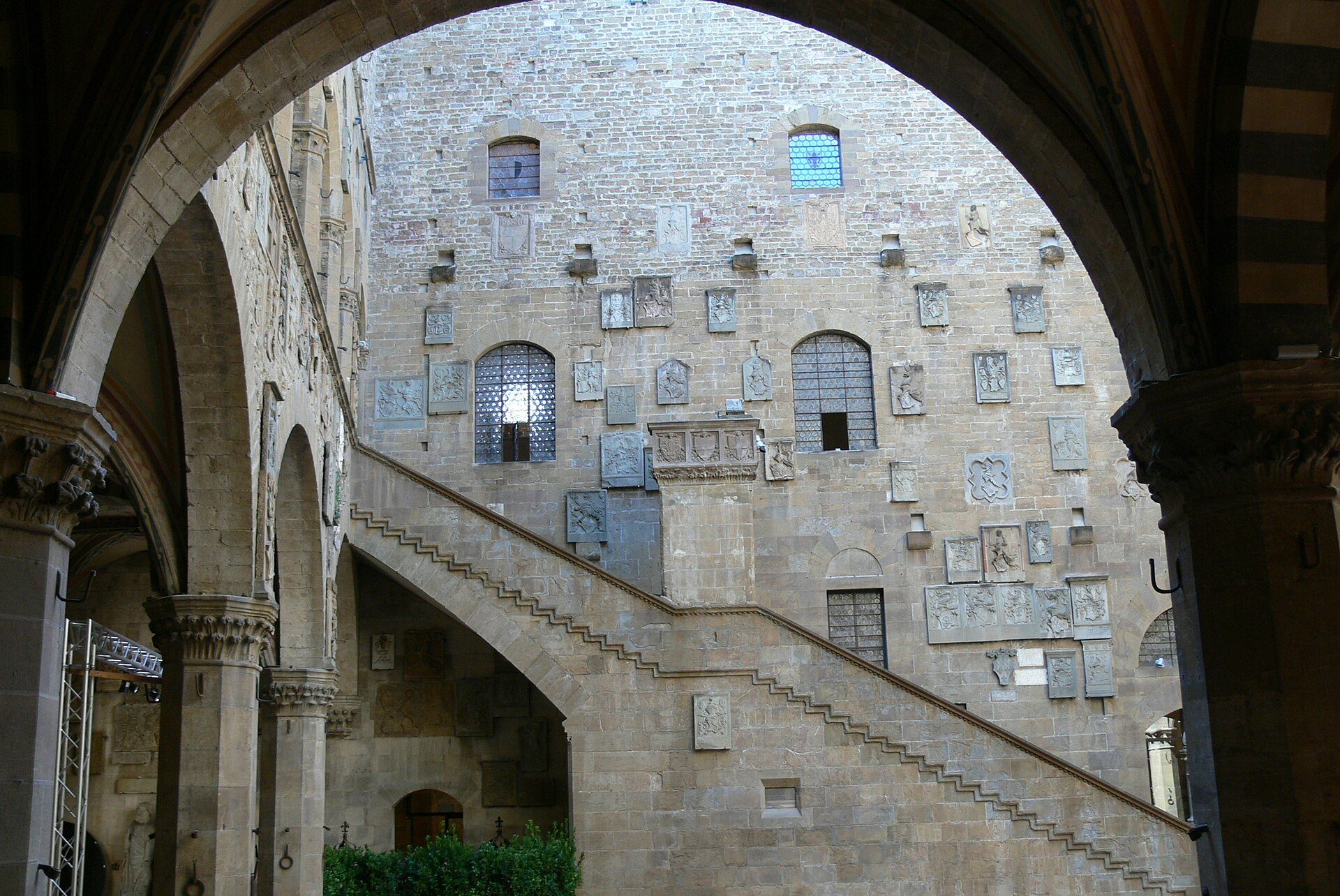
The Museo Nazionale del Bargello is Italy’s first national museum (opened 1865). It occupies a 13th-century palazzo on Via del Proconsolo (just south of the Duomo, between the Bargello-bell-tower and Piazza San Firenze) that originally served as the Capitano del Popolo’s residence (the Florentine governor of the people) and later as the Bargello — the city’s chief of police and prison administrator. The building’s medieval courtyard is one of the most atmospheric Renaissance-era civic spaces in Florence.
The museum’s collection runs from Romanesque sculpture (12th century) through high Renaissance (Michelangelo, Cellini) to Baroque masters. The focus is on sculpture rather than painting — making it a complementary visit to the Uffizi (which is painting-focused). The collection’s depth in Donatello, Verrocchio, Cellini and Giambologna is unmatched anywhere.
A quick history: from police fortress to Italy’s first national museum
The Bargello is the oldest public building in Florence, begun in 1255 — a generation before the Palazzo Vecchio. For its first century it housed the city’s governing magistrate, the Podestà, which is why you’ll still see it called the Palazzo del Podestà on older maps. The name everyone uses now comes from a later tenant: the bargello, the captain of police, who moved in during the 16th century and turned the building into a prison and the seat of city law enforcement.
That is not a charming footnote. For roughly 300 years this was where Florentines were interrogated, jailed, and executed; the gallows stood in the courtyard, and condemned prisoners’ portraits were once painted on the external walls as a warning. The cells were only emptied in 1859. Six years later, in 1865 — the year Florence briefly became the capital of a newly unified Italy — the building reopened as the country’s first national museum, dedicated to sculpture and the decorative arts. So the calm courtyard you photograph today, ringed by a stone staircase and a loggia, spent far longer as a place of punishment than as a gallery. It’s worth a slow lap before you head inside.
Tickets and prices in 2026
- Standard ticket: €12. Optional €4 booking fee online.
- Under-18s: free with €4 reservation.
- EU 18–25: €2 reservation for free entry.
- First Sunday of the month: free for all.
- Combined ticket: occasional Bargello + Medici Chapels combined €15.
- Firenze Card: €85 for 72 hours covers Bargello.
The Bargello is significantly cheaper than the Uffizi or Accademia and rarely requires advance booking outside summer peak.
Hours and best times
Bargello hours: Wednesday–Monday 08:15–13:50 (last entry 13:30). Closed Tuesdays. Note the unusual mid-afternoon closing — the Bargello opens early but closes by 14:00 most days. Some peak-season Tuesdays add evening hours (17:00–19:30); check the official site.
Best time slots:
- 08:15 (opening) — quietest; the courtyard catches morning light.
- 11:30–13:30 — last 90 minutes before closing; tour groups thin out.
- Avoid Wednesday at 10:00 when the museum is busiest.
Museum layout
The museum occupies three floors of the Bargello palazzo:
- Ground floor: the medieval courtyard, the loggia (medieval stone reliefs), and the great hall housing 16th-century Medici sculpture (Cellini’s bronze relief panels for Perseus, Giambologna’s bronzes).
- First floor: Donatello’s hall with the marble David, bronze David, and saint Mark; the Baptistery competition panels; Verrocchio works; della Robbia terracottas; the chapel.
- Second floor: armoury, Verrocchio’s later works, and additional Renaissance sculpture.
Donatello’s two Davids
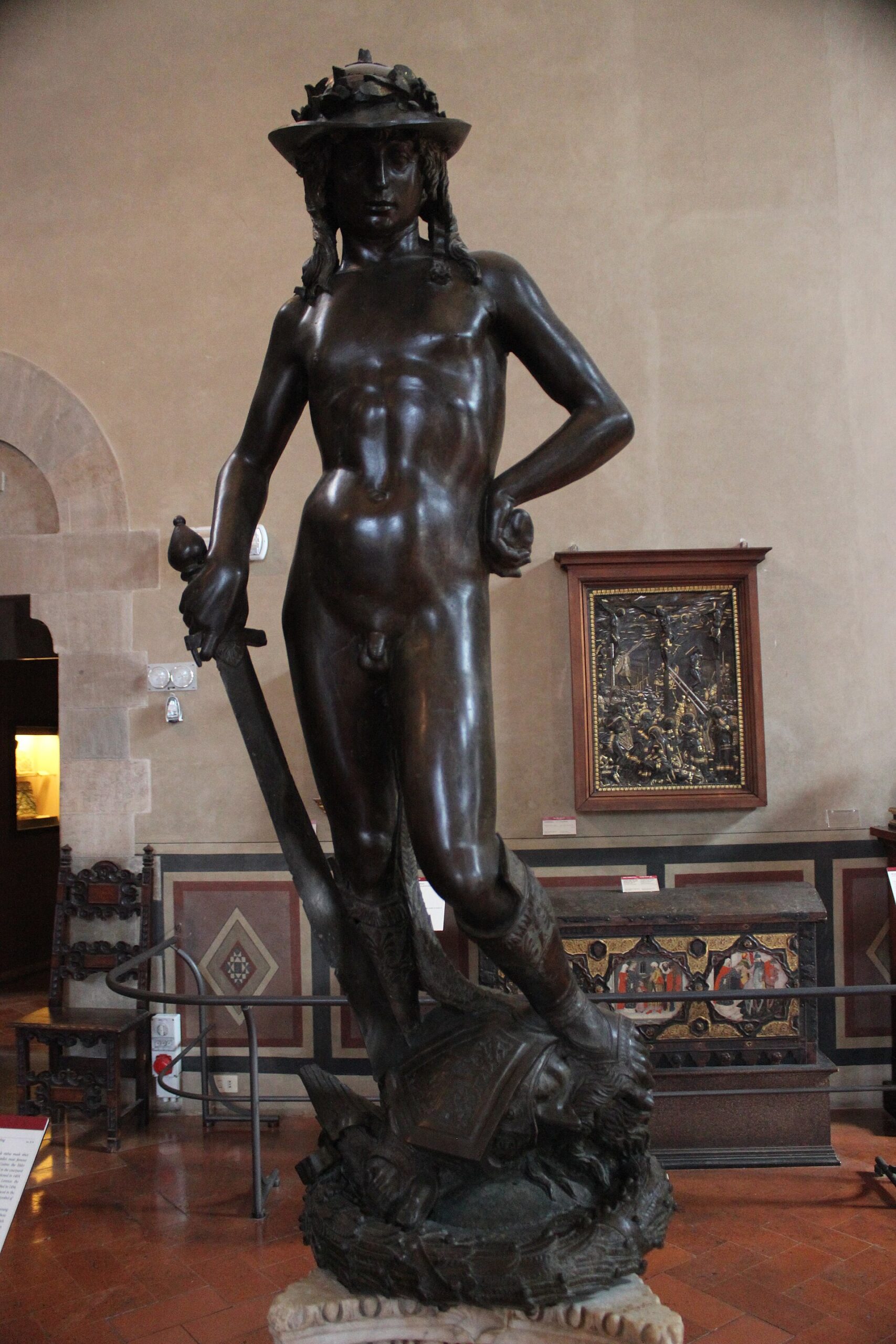
The Bargello’s Donatello hall (first floor) is Florence’s most important sculpture room outside the Accademia. Donatello carved or cast both sculptures known as “David” — the marble David (1408) and the revolutionary bronze David (1440s).
Marble David (1408–09)
An early Donatello work commissioned originally for the Florentine cathedral. The biblical David standing in classical contrapposto pose, holding the head of Goliath. Less famous than the bronze; transitional in style.
Bronze David (c. 1440)
Donatello’s masterwork and one of the most influential sculptures in Western art. The first freestanding male nude sculpture since classical antiquity — a 1,000-year gap. Commissioned by Cosimo de’ Medici (the Elder) for the courtyard of Palazzo Medici Riccardi. The youthful David standing on Goliath’s severed head, dressed only in a hat and boots, holding a sword and stone. Sensual, sculptural, transgressive — the bronze launched a Renaissance fascination with human anatomy that ran through Michelangelo and beyond.
St George (1416)
Originally for an Orsanmichele niche; the figure stands defiant, ready for combat. The base relief showing St George on horseback fighting the dragon is one of the first Renaissance perspective experiments.
Allow 30 minutes in the Donatello hall. The bronze David in particular rewards walking around it from multiple angles.
Brunelleschi vs Ghiberti — the 1401 Baptistery competition panels
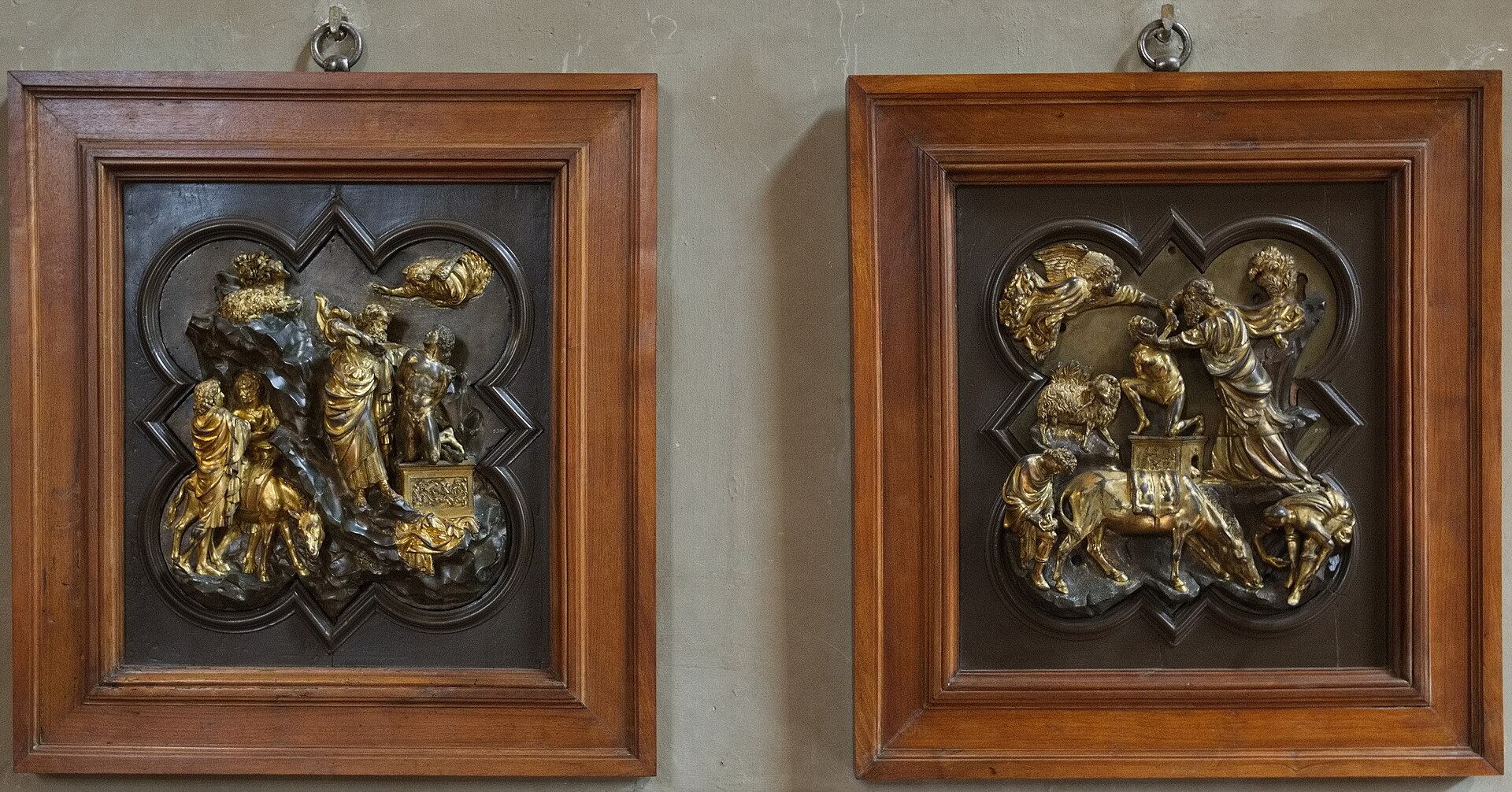
One of the Bargello’s quieter highlights — the two competition panels submitted by Filippo Brunelleschi and Lorenzo Ghiberti in 1401 for the commission of the second set of bronze doors of the Florence Baptistery (the doors that became the “Gates of Paradise”). Both panels depict the Sacrifice of Isaac. Ghiberti won; Brunelleschi shifted his focus to architecture and went on to design the cathedral dome.
Both panels survive in the Bargello and are displayed side by side. The choice between them in 1401 was a turning point in Renaissance art — Ghiberti’s panel (more lyrical, classical, narrative) won over Brunelleschi’s (more dramatic, sculptural). The story is taught in every Renaissance art-history class; the artefacts themselves are here in Florence, in this room, free to view with your Bargello ticket.
Allow 15 minutes here; compare the two panels carefully.
Michelangelo’s Bargello sculptures
The Bargello holds three significant Michelangelo works:
- Bacchus (1496–97) — Michelangelo’s drunk young god of wine; one of his earliest mature works. The figure is unsteady, sensual, slightly erotic. Carved in Rome on a commission from Cardinal Riario; Michelangelo was 22.
- Brutus (1539) — bust of the Roman tyrannicide. Michelangelo’s only completed bust portrait. Symbolic of resistance to tyranny — completed during Florence’s struggle against Medici dominance.
- Apollo (or David-Apollo, 1530) — small, partly-finished marble figure. The work was commissioned mid-political-conflict; Michelangelo’s intentions remain debated.
These three works alone make the Bargello a serious Michelangelo destination — only the Accademia has more in Florence. Allow 20 minutes for the Michelangelo cluster.
Cellini, Giambologna and Verrocchio
The ground-floor great hall holds the bronze relief panels Cellini cast for the base of his Perseus (the original now stands in the Loggia dei Lanzi at Piazza della Signoria). The Bargello panels are the originals; the Loggia versions are 19th-century replicas.
Giambologna’s Mercury (1580) — the famous flying figure balanced on one foot, supported by a puff of wind from a face below. The Bargello has the original; the Mercury image is reproduced internationally as a model of Mannerist sculpture.
Verrocchio’s David (1473–75) — pre-Michelangelo and contemporaneous with Donatello’s bronze, but more compact and proud-stance. Verrocchio also has his Boy with a Dolphin (originally a fountain figure) and his celebrated Christ and St Thomas bronze relief.
The Della Robbia family terracottas — Andrea, Giovanni, and Luca della Robbia’s distinctive blue-and-white-glazed ceramic Madonnas — line the walls of the first floor. The technique they invented in 15th-century Florence is the source of the now-internationally-recognized “Della Robbia” style.
Decorative arts and armoury
Beyond sculpture, the Bargello holds:
- Renaissance ivories and goldsmith work — the Carrand collection, donated 1888.
- Medieval armour — first-floor armoury hall with full-plate Renaissance armour and weapons.
- Renaissance ceramics — maiolica from Faenza, Urbino, Castel Durante.
- Carved seals and intaglios — Medici medallions and ducal seals.
- Medieval and Renaissance bronze door knockers — a small but specialist collection.
More Bargello highlights worth hunting down
Beyond the two Davids and the Michelangelos, three works reward the detour — and they’re the ones most people walk straight past.
Giambologna’s Mercury (c. 1580)
The flying bronze messenger balanced on a puff of wind from a god’s mouth — you’ve seen it on everything from FTD florist logos to textbook covers. The original lives here, and it’s smaller and more delicate in person than the reproductions suggest. Look at how the entire weight of the figure resolves onto a single toe; it’s one of the great show-off feats of Mannerist casting.
Verrocchio’s David (c. 1475)
Andrea del Verrocchio ran the workshop where a teenage Leonardo da Vinci trained, and many art historians think the young Leonardo was the model for this lithe, faintly smirking bronze. Standing it next to Donatello’s earlier bronze David — same subject, same room more or less — is the single best way to watch Florentine sculpture change across two generations.
Donatello’s Atys-Amorino (c. 1440)
A grinning, winged boy-spirit with anklets and a pair of trousers no one has fully explained — part Cupid, part Etruscan curiosity. It’s playful in a way the Renaissance rarely allowed itself, and it tends to be the piece visitors remember once the famous Davids blur together.
90-minute Bargello route
0:00–0:10 — Entry and courtyard
Arrive 10 min before slot. The medieval courtyard is the museum’s atmospheric heart; spend 5–10 minutes here.
0:10–0:30 — Ground-floor great hall
Cellini’s Perseus relief panels, Giambologna’s Mercury and Honour, Bandinelli works.
0:30–1:00 — First-floor Donatello hall
The marble David, bronze David, St George, Baptistery competition panels, Della Robbia terracottas, Michelangelo’s Bacchus and Brutus.
1:00–1:20 — First floor remaining rooms
Verrocchio’s David, Christ and St Thomas, Boy with a Dolphin. Bronze door knockers and decorative bronzes.
1:20–1:30 — Second-floor armoury
Quick pass through the medieval armour hall; less art-focused but interesting.
Total: 90 minutes
Add 10 minutes for arrival and bag check; total visit time roughly 100 minutes.
Combining the Bargello with other sights
Renaissance sculpture day
Bargello (90 min) + Casa Buonarroti (60 min, Michelangelo’s earliest works, €8) + Medici Chapels (60 min, Michelangelo’s tomb sculptures, €11 plus an optional €3 booking fee). Three museums; three Michelangelo phases.
Bargello + Santa Croce
Bargello in the morning; lunch at Antico Vinaio; Santa Croce basilica afternoon (€10, plus a €1 online booking fee) for tomb monuments to Michelangelo, Galileo, Machiavelli.
Bargello + Uffizi
Bargello morning (it closes at 13:50); afternoon Uffizi (4-hour visit). Two opposites — sculpture vs painting. The most concentrated single-day Renaissance art experience in Florence.
Bargello Museum — FAQ
What is the Bargello Museum?
Italy’s first national museum (1865) — a sculpture-focused gallery in a 13th-century Florentine palazzo on Via del Proconsolo. Holds works by Donatello (the marble and bronze Davids), Michelangelo (Bacchus, Brutus), Verrocchio, Cellini, Giambologna and the Della Robbias. Italy’s deepest Renaissance sculpture collection.
How much does the Bargello cost?
2026: €12. €4 online booking fee. Free under-18s with €4 reservation; first Sunday of month free.
What’s the must-see at the Bargello?
Donatello’s bronze David (the first freestanding male nude since antiquity). The 1401 Baptistery competition panels by Brunelleschi and Ghiberti. Michelangelo’s Bacchus and Brutus. Verrocchio’s David and Christ and St Thomas.
How long do I need at the Bargello?
Express: 75 minutes. Standard: 90–120 minutes. Comprehensive: 2.5 hours. Smaller than Uffizi or Pitti; 90 minutes is comfortable.
Is the Bargello worth visiting?
Absolutely yes. The Bargello holds Renaissance sculpture equivalent in importance to the Uffizi’s Renaissance painting. It’s significantly less crowded than the famous museums. For sculpture-interested travellers, it’s a higher-priority visit than the Uffizi.
What time does the Bargello close?
13:50 — significantly earlier than other Florence museums. Last entry 13:30. Closed Tuesdays. Plan a morning visit.
Should I do the Bargello or the Accademia?
If you can do both, do both. Bargello has Donatello’s bronze David and Michelangelo’s Bacchus; Accademia has Michelangelo’s David. Together they give a full Florentine sculpture canon. If forced to choose, the Accademia’s David is more iconic; the Bargello’s depth and quietness reward more.