This article contains advertising. Booking links on this site can be turned into paid links automatically by our partner Travelpayouts: if you book through one, we earn a commission from the provider, at no extra cost to you. It never affects what we recommend. Affiliate disclosure
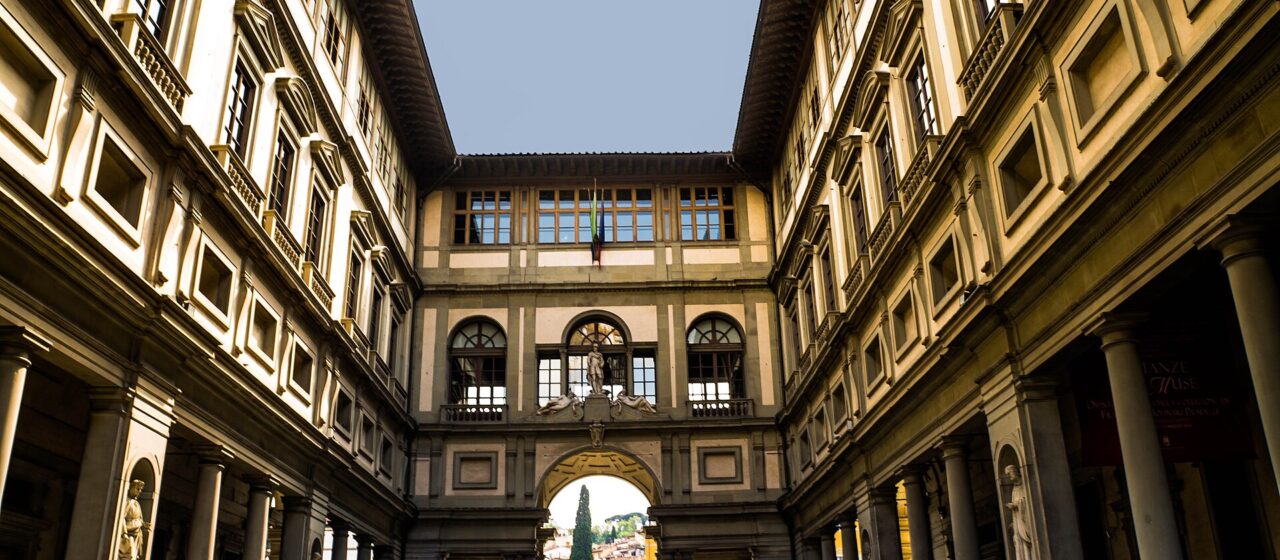
The Uffizi Gallery Florence is one of the world’s leading museums of Italian Renaissance art. It occupies a 16th-century palazzo designed by Giorgio Vasari on the Piazzale degli Uffizi, between Palazzo Vecchio and the Arno. The collection — built from the Medici family’s private holdings, bound to Florence by the last Medici in 1737 — includes Botticelli’s Birth of Venus and Primavera, Leonardo’s Annunciation, Michelangelo’s Doni Tondo, Caravaggio’s Medusa, Titian’s Venus of Urbino, Raphael’s portraits, Giotto’s panels, Artemisia Gentileschi’s Judith, and a great deal more across the gallery’s first and second floors. This 2026 guide covers everything you need to know to visit the Uffizi — tickets, hours, must-see paintings, queue strategies, expert tips and how to get the most from a 2–4 hour visit.
For broader museum context see our Florence Museums & Art Guide; for visitor logistics see Florence Tourist Attractions and Practical Florence Travel Information.
The Vasari Corridor links the gallery to the seat of Florentine government across the river — see our Palazzo Vecchio guide for the other end of that walk.
Before you get to the paintings you have to get through the door, and that is its own small ordeal. Our guide to Uffizi tickets covers the prices (€25 on the day, €29 booked ahead), the cheaper 4pm slot and which of the three courtyard doors you should actually be standing at.
The corridor reopened in December 2024 without the self-portraits it was famous for, and you can only reach it through this building. See our Vasari Corridor guide for what is inside now and how the two time slots fit together.
In the quieter weeks of the year the 08:15 opening slot is worth even more than usual. Our guide to Florence in November explains why that is the month to use this guide in.
Uffizi tickets and prices
Entry is €25 bought on the day or €29 booked ahead with a timed slot, with a cheaper €16 fare for anyone walking in from 16:00. The tiers, the concessions, the three courtyard doors and the season-by-season booking windows are all set out in our Uffizi tickets guide.
Hours and best times to visit
Opening hours
Uffizi Gallery: Tuesday–Sunday, 08:15–18:30 (the ticket office closes at 17:30). Closed Mondays, apart from the occasional special opening announced on uffizi.it. Closed January 1 and December 25.
Special openings, including any evening hours, are announced on uffizi.it, so check there before you plan around them. The first Sunday of every month is free entry, but expect a queue and busy rooms — most travellers should pay rather than fight that crowd.
Best time slots
- 08:15 (opening) Tuesday or Wednesday — the gold-standard time. Crowds light, Botticelli rooms quiet, soft morning light through the windows.
- 16:00–18:00 (late afternoon) — the second sweet spot. Crowds thin, late tour groups have left, and the €16 late-afternoon ticket saves €9. Less time to see everything but sufficient for a 2-hour highlights visit.
- Worst times: the middle of the day in peak season, when tour groups are moving through; allow extra time if that is your only slot. The Botticelli rooms get genuinely uncomfortable around 11:00 in July.
- Sundays: First Sunday of the month is free entry, so expect a queue. Other Sundays are slightly less crowded than Saturdays but expect Tuscan-region day-trippers.
- Worst single day: the first Sunday of August in any year. Free entry combined with peak tourist season means long queues and packed rooms, so allow plenty of extra time or pick another day.
Must-see paintings — the Uffizi top 12
If you have only 2 hours, prioritise these works:
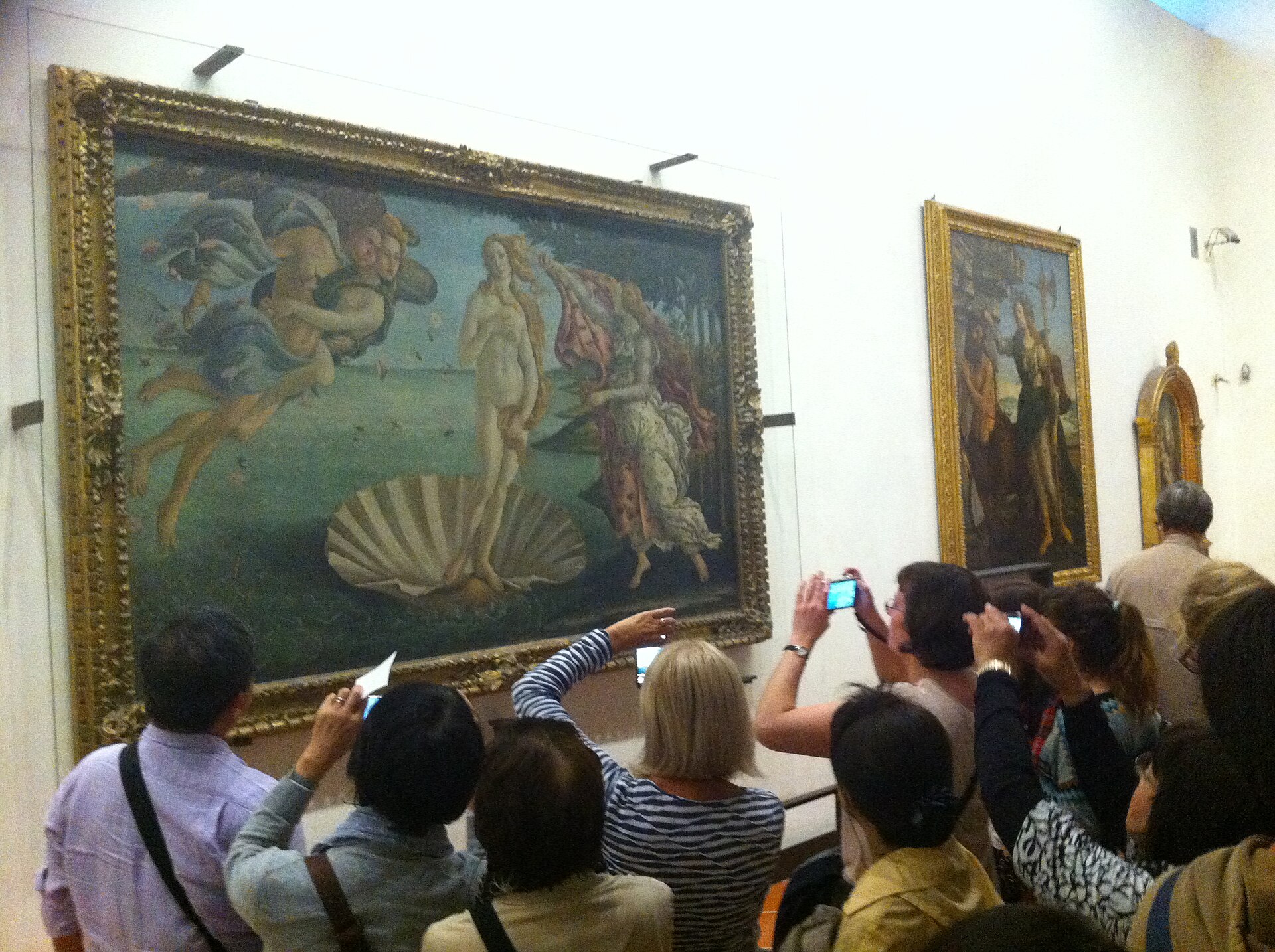
1. Botticelli’s Birth of Venus (1485)
Botticelli rooms. Probably the most-recognised painting in Western art history. The naked Venus rising from a shell, blown ashore by zephyrs. Allow 10 minutes; the room can be crowded.
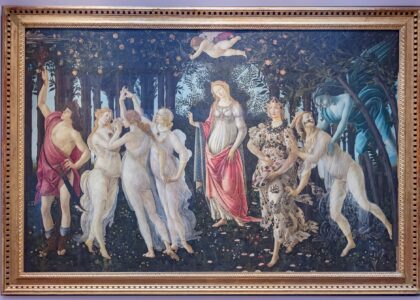
2. Botticelli’s Primavera (c. 1480)
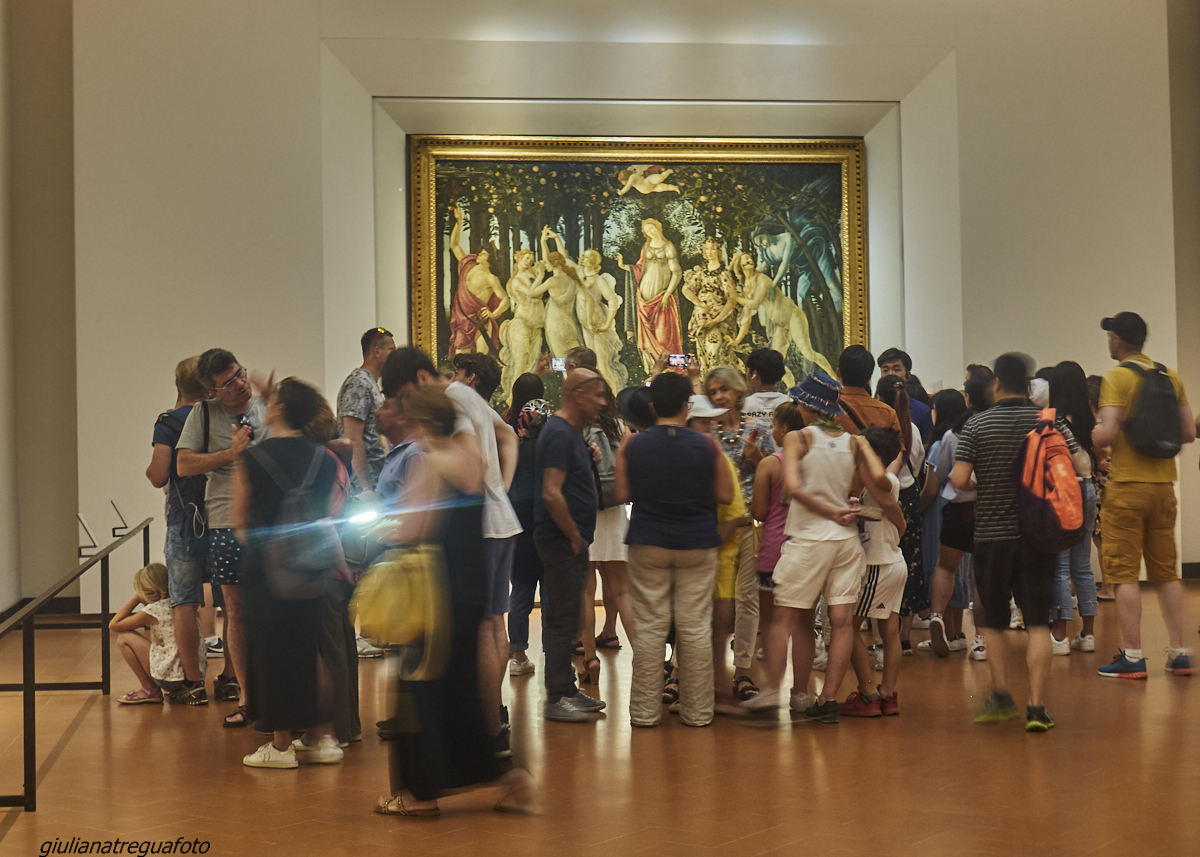
Facing the Birth of Venus. Mercury, the Three Graces, Venus, Cupid, Zephyrus, Chloris and Flora in a flowering grove — a mythological allegory to read figure by figure. Allow 10 minutes.
3. Leonardo’s Annunciation (1472–75)
Room A35. An early work, painted around 1472 while Leonardo was working in Verrocchio’s workshop. Notable for its perspective construction and the Gabriel’s wing technique.
4. Leonardo’s Adoration of the Magi (1481, unfinished)
Same room. Unfinished but reveals Leonardo’s working method — the under-drawing is visible.
5. Michelangelo’s Doni Tondo (1505–06)
Room A38. The Holy Family in a tondo (round) format. Michelangelo’s only finished panel painting to survive; a striking use of bright colour and muscular human bodies.
6. Caravaggio’s Medusa (c. 1597)
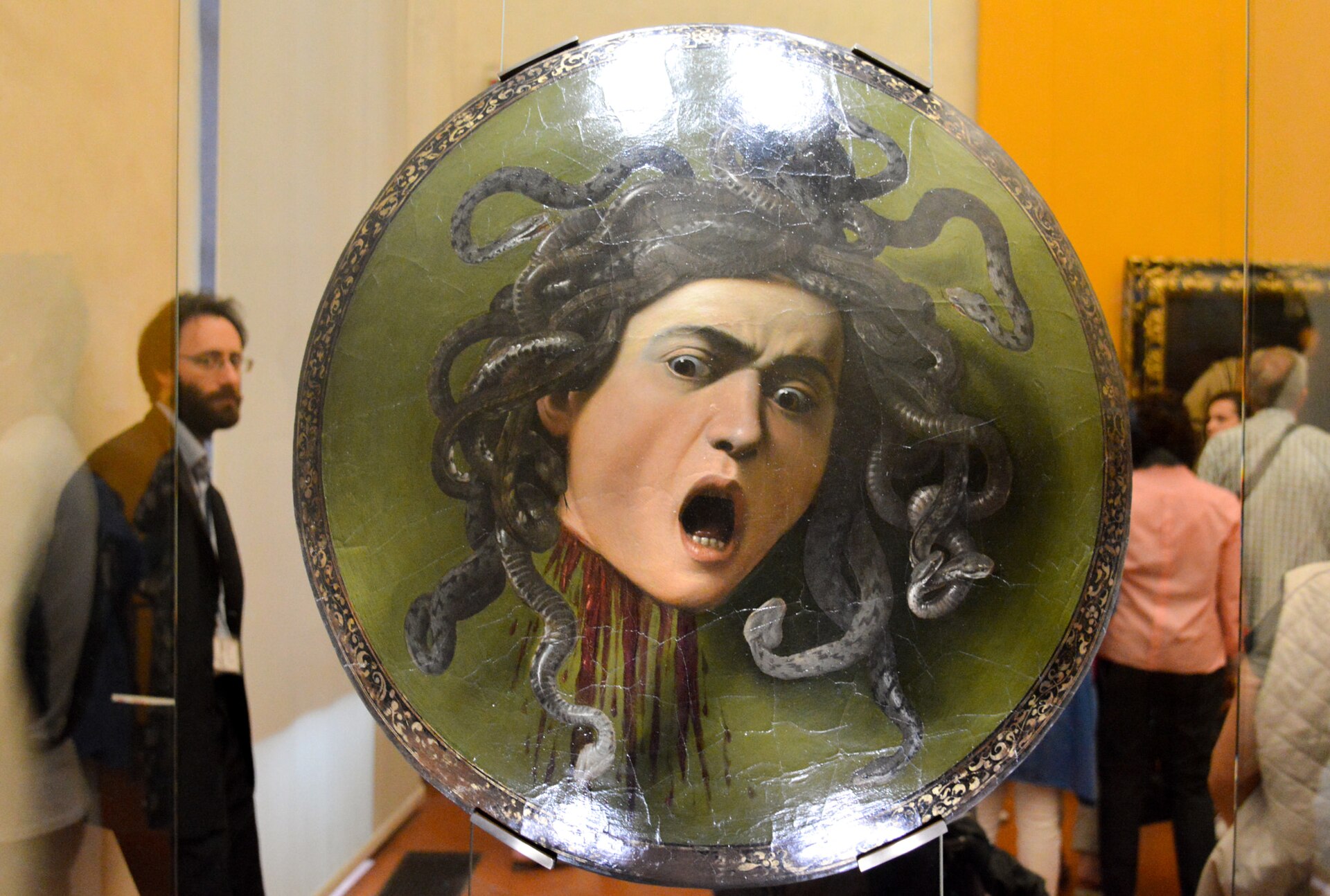
Room E4. Painted on canvas mounted on a convex wooden shield. The severed head of the Greek monster, rendered with violent realism. Allow 10 minutes; the room is small and gets crowded.
7. Caravaggio’s Bacchus (c. 1596)
Room E5. The young god of wine offering a cup. Note the rotting fruit on the table — Caravaggio’s signature realism.
8. Caravaggio’s Sacrifice of Isaac (1603)
In the Caravaggio rooms. Dramatic lighting, divine intervention, brutal realism.
9. Titian’s Venus of Urbino (1538)
First floor, in the Venetian rooms. The reclining female nude that defined Western art’s tradition; later inspired Manet’s Olympia. Allow 10 minutes.
10. Raphael’s Madonna of the Goldfinch (c. 1505–06)
Room A38. Mary, the infant Christ, and St John the Baptist as a child holding a goldfinch.
11. Artemisia Gentileschi’s Judith Beheading Holofernes (1620)
The painting often considered the greatest by a female Old Master. Visceral, dramatic, technically extraordinary. Allow 5–10 minutes.
12. Giotto’s Madonna and Child Enthroned with Angels and Saints (early 1300s)
Room A4, near the beginning of the collection; the museum’s catalogue dates it to about 1300–1305. Giotto’s revolutionary departure from medieval flat painting; the moment Western painting begins to be three-dimensional.
Gallery layout — what’s on each floor
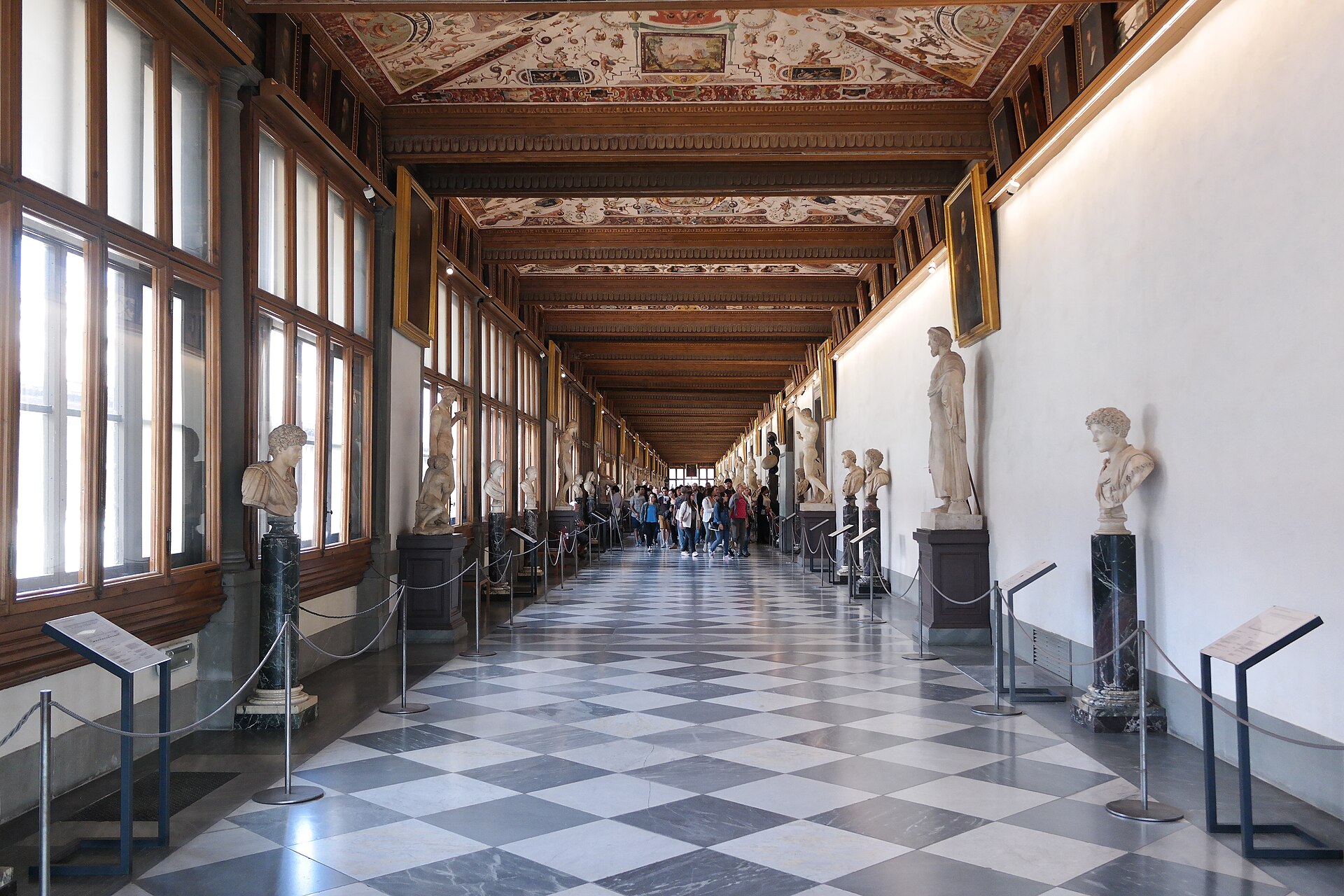
The Uffizi occupies the upper two floors of Vasari’s 16th-century U-shaped palazzo, with the collection displayed across the second floor and the first floor below it, where Caravaggio hangs. The museum map shows the possible routes, including a fast itinerary and an alternative exit by the Lanzi staircase.
Second floor (top) — Renaissance core
- A3–A6: medieval and 14th-century painting — Giotto and Cimabue in A4, Lorenzetti and Simone Martini in A5.
- Botticelli rooms — the Birth of Venus and Primavera, facing one another since the June 2026 reinstallation. Filippo Lippi has separate displays; follow the current museum map.
- The A rooms after the Botticellis: several Italian regional schools, Hugo van der Goes in A13, and separate rooms for Dürer and the Renaissance beyond the Alps.
- A35 and A38: Leonardo, Michelangelo and Raphael — Leonardo’s Annunciation and Adoration in A35; Michelangelo’s Doni Tondo and Raphael’s Madonnas in A38.
First floor — 16th–18th-century
- D rooms: Venetian school — Titian’s Venus of Urbino, followed by rooms of Venetian painting including Tintoretto and Veronese.
- D rooms: 16th-century Tuscan masters such as Pontormo, Rosso Fiorentino and Bronzino.
- E rooms: Caravaggio rooms — the Medusa (E4), Bacchus (E5) and the Sacrifice of Isaac.
- E7: 17th-century European — Rubens, Rembrandt, Van Dyck.
Ground floor — exit and shop
Bookshop, cafeteria, audio guide pickup. Most exits flow back to Piazza Signoria; the river-side exit gives you the Lungarno views.
The Botticelli rooms
Home to two of the gallery’s most celebrated masterpieces. The two flagship paintings — Birth of Venus and Primavera — now face one another. The Birth of Venus is the more famous; the Primavera is arguably the more sophisticated. They are not the same size: the Birth of Venus measures 172.5 × 278.5 cm, the Primavera 207 × 319 cm.
Around them: Botticelli’s other surviving panels including the Adoration of the Magi (which features a self-portrait of the artist on the right side), several Madonnas, and the early Pallas and the Centaur. Look out too for Filippo Lippi’s Madonna and Child with Two Angels (c. 1460–65), whose composition influenced Botticelli; the museum lists it in room C6.
Crowd management: in peak season the Botticelli rooms get busier as the morning goes on, so allow extra time here. The 08:15 opening slot is the best window for less-crowded viewing; alternative is the last hour before closing (17:00–18:00) when most tour groups have left. Booking the very early slot is recommended over later ones — the Botticelli rooms are a peak-traffic bottleneck on the visitor flow.
Leonardo’s Annunciation (Room 35)
One of Leonardo’s youthful works, painted around 1472 while he was working in Verrocchio’s workshop. The angel Gabriel kneels before Mary, who’s reading a book. The setting is a Florentine courtyard with cypress trees in the background.
Notable details: Leonardo’s extraordinarily realistic angel wing — based on close studies of bird wings; this was a Leonardo signature throughout his career. The perspective construction is mathematically precise; the lectern Mary leans on uses one-point perspective with the vanishing point at her hand.
Also in the Leonardo room: his Adoration of the Magi (1481), left unfinished. The under-drawing is visible because Leonardo abandoned the painting to take a Milan commission; you can see his thinking process in the bare-brown areas.
Michelangelo’s Doni Tondo (Room A38)
Painted for Agnolo Doni, a Florentine merchant who married Maddalena Strozzi in 1504. The museum catalogues it as 1505–06 and also weighs the birth of the couple’s child in September 1507 as a possible occasion. Michelangelo’s only finished panel painting to survive (he focused on sculpture and fresco for the rest of his career). Tondo (round) format, roughly 120 cm in diameter.
The composition is unusual — the Holy Family (Mary, Joseph, infant Christ) twists in a complex spiral, a precursor to the Mannerist style. The colours are strikingly bright compared to most Renaissance paintings; the figures’ bodies are muscular and sculptural, reflecting Michelangelo’s sculptor’s eye.
Caravaggio rooms
The first floor’s Caravaggio rooms hold three of the artist’s most famous works:
Medusa (c. 1597)
Painted on a wooden shield for Cardinal Francesco Maria del Monte, who intended it as a gift for Ferdinando I de’ Medici. The severed head of the Greek monster, mid-scream, painted with violent realism. Caravaggio used himself as the model — note the resemblance.
Bacchus (c. 1596)
The young god of wine, holding a cup, with a basket of fruit on the table. The fruit is intentionally rotting in places — Caravaggio’s signature insistence on realistic detail rather than idealised beauty.
Sacrifice of Isaac (1603)
God interrupts Abraham’s sacrifice of his son. Dramatic lighting, brutal realism. The terrified expression on Isaac’s face is unmistakably modern.
The Caravaggio rooms are smaller than the Botticelli rooms and get equally crowded by mid-morning. Visit early or late; spend 30–45 minutes here.
Raphael’s Madonnas
Raphael’s main room is A38, which he shares with Michelangelo. Look for:
- Madonna of the Goldfinch (c. 1505–06), Room A38 — Mary, the infant Christ and child St John the Baptist with a goldfinch (a Renaissance symbol of Christ’s coming Passion).
- Self-portrait (1506) — Raphael at 23, painted in subtle brown tones.
- Pope Leo X with Cardinals (c. 1518–20) — Raphael’s masterpiece group portrait of the Medici pope, a son of Lorenzo the Magnificent, with Cardinals Giulio de’ Medici and Luigi de’ Rossi.
- Portrait of Maddalena Doni (1506) — Raphael’s portrait of Maddalena Strozzi, wife of Agnolo Doni, the patron for whom Michelangelo painted the Doni Tondo.
Titian’s Venus of Urbino
Painted 1538. Considered the foundational work of the Western reclining-female-nude tradition. The model is unknown; the patron was the Duke of Urbino. Titian’s deep red palette and the intimate domestic setting (a small dog at Venus’s feet, a maid in the background) made the painting revolutionary in its time.
The work later inspired Manet’s Olympia (1863), which scandalised Paris by replacing Titian’s idealised goddess with a frank prostitute. Both paintings remain culturally important; Titian’s hangs in the Uffizi, Manet’s in Paris.
The Vasari Corridor (newly reopened 2024)
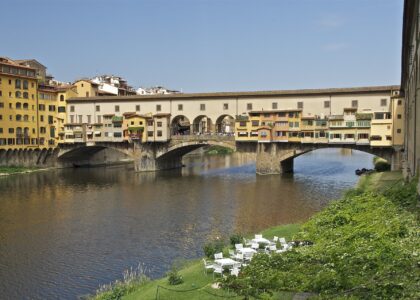
The kilometre-long elevated walkway commissioned by Cosimo I de’ Medici in 1565 — connecting Palazzo Vecchio to Palazzo Pitti via the Uffizi and over Ponte Vecchio. Closed in 2016 for renovation, it reopened on 21 December 2024.
2026 visitor experience: timed entry on the combined Uffizi and Vasari Corridor ticket, €43 on the day or €47 booked ahead, with Uffizi admission included. Groups of up to 25, about 45 minutes, on a one-way route from the Uffizi over Ponte Vecchio towards Palazzo Pitti. Book 4–6 weeks ahead in peak season.
The corridor’s original purpose was to let the Medici grand dukes cross the Arno without descending to street level — a private elevated route from Palazzo Vecchio (the seat of government) to Palazzo Pitti (their residence) over Ponte Vecchio (which had previously been used by butchers; the Medici evicted them in 1593 because the smell offended).
The Corridor ticket includes Uffizi admission, so you book one combined ticket rather than a separate excursion. Check uffizi.it for current slots. Our guide to Florence tours and tickets sets out how the two bookings fit together.
Guided tours and audio guides
Audio guide
€6 from the Uffizi audio guide booth on entry. Available in eight languages: Italian, English, French, Spanish, German, Polish, Russian and Japanese. The commentary covers the highlights. Worth the €6 for first-time visitors; less essential if you’re already familiar with the canon.
Free Uffizi audio
Rick Steves’ free Audio Europe app includes a free Uffizi Gallery audio tour, also offered as an MP3 download. Less comprehensive than the official audio guide but covers the highlights well. Download before your visit.
Guided tour with skip-the-line entry
€60–€90 per person, 2–3 hours. Multiple operators: Walks of Italy, Through Eternity, Context Travel, Take Walks, GetYourGuide, Viator. Includes the entry ticket and a licensed Florentine guide. Best for first-time visitors who want narrative depth without doing self-research.
Premium small-group tours
€100–€150 per person, 3–4 hours, 4–6-person max. Walks of Italy and Context Travel run academic-led tours that go deeper than the standard format. Worth the price for art-history nerds.
Private guides
€280–€600 for a half-day. Bookable via hotel concierge or directly through licensed-guide associations. Most personalised option.
Self-guided
Free; bring an art-history book (J.E. Marx’s The Uffizi: An Illustrated Guide is a respected option) or use the Rick Steves app. Roughly equivalent to a guided tour for travellers who already know the canon.
A 2-hour Uffizi highlights route
For travellers with limited time, this 2-hour route hits the canonical works:
0:00–0:15 — Entry and Room A4 (Giotto)
Arrive 15 minutes before your slot. Enter; bag check (large bags must go in cloakroom, free). Walk straight to Room A4 — Giotto’s Madonna and Child. 10 minutes. The opening salvo of the Western painting tradition.
0:15–0:35 — Rooms A5–A8 (14th century, early Renaissance)
Walk through the 14th-century rooms, with Lorenzetti and Simone Martini in A5, then on to the early Renaissance painters in A8. Brief stops; 5 minutes per room.
0:35–1:10 — The Botticelli rooms
The big stop. Birth of Venus and Primavera, facing one another. Allow 35 minutes for both works plus the surrounding Madonnas. The room can be crowded; position yourself toward the front of each painting and wait briefly for clear sight lines.
1:10–1:25 — The rooms after Botticelli (regional schools)
Several Italian regional schools, and Hugo van der Goes in A13. Move through quickly; the Botticelli stop has eaten time.
1:25–1:50 — Rooms A35 and A38 (Leonardo, Michelangelo, Raphael)
The Annunciation and the unfinished Adoration of the Magi in A35, then the Doni Tondo and Raphael in A38. Allow 25 minutes.
1:50–2:00 — Walk to first floor
Take the descending corridor. Brief glimpses of Raphael portraits along the way.
2:00–2:30 — Caravaggio in the E rooms
Medusa in E4, Bacchus in E5, and the Sacrifice of Isaac. 30 minutes.
2:30–2:45 — Titian and final route to exit
Quick stop at Venus of Urbino in the Venetian rooms; descend to ground floor; exit.
Total: 2 hours 45 minutes. Add 15 minutes for cloakroom + entry queue. The 16:00 entry slot finishes by 18:30 close.
Visiting tips
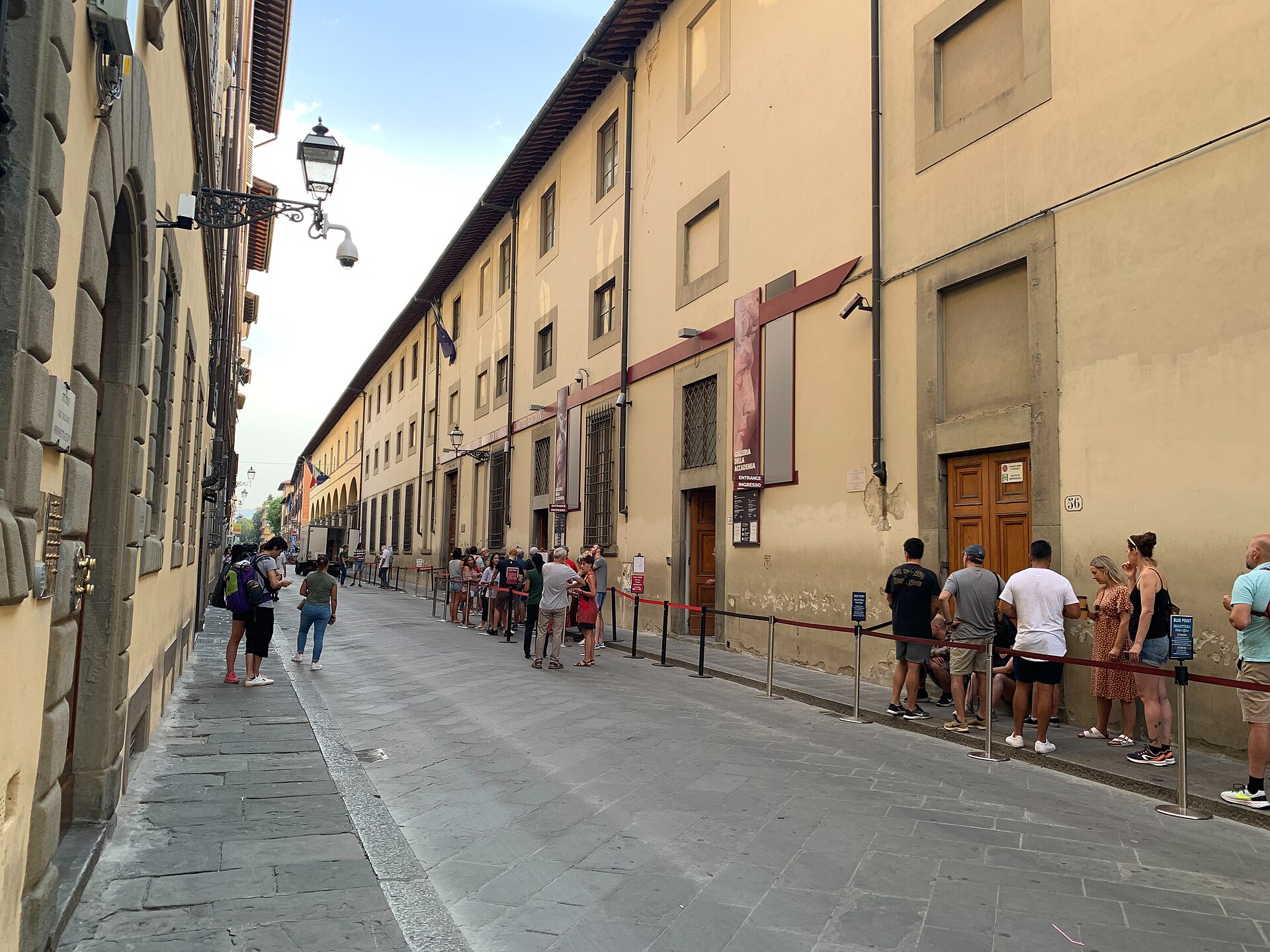
- Book online ahead of time. A booked ticket costs €29 against €25 on the day, and the timed slot spares you the ticket queue at peak.
- Arrive 15 minutes before your slot for security and bag check. Large bags must go in the free cloakroom.
- Photography is allowed without flash or tripod. Selfie sticks not allowed in narrow rooms.
- The cafeteria on the top floor terrace has espresso and snacks. Its panoramic terrace is part of your museum visit — worth a 15-minute pause.
- Wear comfortable shoes. The collection spreads across two long floors, and even a 2-hour highlights visit involves a lot of standing.
- Take a notebook or phone for jotting which painting struck you. The Uffizi shop’s catalog is comprehensive; you can buy postcards or full-size prints of paintings you most enjoyed.
- There are visitor toilets on every floor. For the accessible toilets on the second floor, ask the staff.
- Group tours often skip Caravaggio — many guided tours focus on the Botticelli + Leonardo + Michelangelo trinity and exit before reaching the Caravaggio rooms. If Caravaggio is your priority, mention it to your guide or self-guide.
- Children under 11 get bored. The express 90-minute route (Botticelli + Caravaggio only) is the family-friendly version; under-7s should probably skip the Uffizi entirely. See our Florence with kids guide.
- Don’t try to see everything in one visit. The Uffizi is too big. Pick the canon (above), enjoy slow, and leave the rest for a return trip.
Uffizi accessibility
The Uffizi’s accessibility facilities include:
- Wheelchair access — full elevator access between floors. Free wheelchair loan at the entry; reserve when booking.
- Accessible bathrooms — on the ground floor near the entry, marked with universal symbols.
- Touch-friendly displays for visually-impaired visitors — limited but increasing.
- Reduced-fee tickets — visitors with disabilities and one companion enter free; book through the official portal with the disability flag.
- Sign-language tours — occasional, in Italian sign language; check the museum’s events calendar.
- Audio descriptions — the audio guide includes art-history content; not a dedicated visually-impaired audio description service.
- Sensory-friendly hours — the Uffizi runs occasional “quiet morning” sessions with reduced lighting and crowds; check the calendar.
For wheelchair users specifically: the visit covers long distances across two floors. While elevators connect floors, the rooms themselves feature varying floor surfaces (marble, wood, ceramic) and occasional ramps. Allow extra time; the visit is fully accessible but takes longer than for ambulatory visitors.
The Uffizi Caffè terrace
One of Florence’s least-known museum pleasures: the top-floor café of the Uffizi has an outdoor terrace with a stunning view of the Duomo and the city centre. An espresso runs to about €3; the terrace is part of the museum but can feel like a separate venue.
Coffee, light snacks, sandwiches, gelato. Most travellers don’t realise the terrace exists; even those who use it tend to spend just 10 minutes there. A 30-minute pause mid-Uffizi-visit at the terrace is one of Florence’s better-kept museum secrets.
Note: the terrace is accessible only to ticket-holding visitors during their Uffizi visit. You can’t enter the museum just for the terrace; you need a museum ticket. But once inside, the terrace is included.
The Uffizi bookshop
The ground-floor bookshop is one of Italy’s best museum shops. Strong on art-history books at multiple levels (academic and accessible), high-quality prints and reproductions of Uffizi works, postcards (€1–€2 each), branded merchandise, kids’ art books. The catalog of the Uffizi’s own collection is excellent, and the shop stocks guidebooks in several languages.
Worth budgeting €20–€80 for purchases if you want serious souvenirs. The shop is one of the few places in Florence where the merchandise quality matches the institution’s reputation.
The Uffizi with kids — strategy
The Uffizi can be challenging with children. Strategy varies by age:
Under 6
Skip the Uffizi entirely. The galleries are long, hot, demand silence, and small kids quickly get bored. Spend the time at the Boboli Gardens, the Bardini Garden, the Mercato Centrale upstairs food hall or the Carousel in Piazza della Repubblica.
Ages 6–10
Express 90-minute route only. Hit Botticelli rooms first (the Birth of Venus is recognisable from popular culture and kids react well to the scale). Skip to Caravaggio’s Medusa for shock-value engagement. Avoid the long Northern European and Mannerist corridors.
Ages 11–14
Full 2–3 hour route doable but pace it. Build in a 15-minute café break at the top-floor terrace. Let the child choose 3–4 paintings to spend extra time at; their selections may surprise you. Audio guide for older kids works well.
Teens 14+
Treat as adults. Free under-18 entry (with €4 reservation) is a major saving. Free under-18 entry to all state museums means the teenagers on an Uffizi-Accademia-Pitti loop cost only their booking fees, while parents pay adult admission.
Practical kid tips
- Audio guides (€6) are available at the entrance.
- In peak season crowds build through the morning, so allow extra time. Open at 08:15 or arrive after 16:00.
- Cloakroom is free; large bags must be checked.
- Toilets are on every floor; use them before you start the circuit.
- The cafeteria on the top floor terrace works for a snack break with views.
- Bring water; Uffizi rooms are warm in summer despite air conditioning.
Lesser-known Uffizi rooms worth visiting
Beyond the famous Botticelli and Caravaggio rooms, the Uffizi has several galleries that most visitors miss but reward attention:
Tribuna (Room A16)
The octagonal room Bernardo Buontalenti built for Francesco I de’ Medici between 1581 and 1583. Mother-of-pearl ceiling; lined with classical sculpture (the Medici Venus, Apollino, Wrestlers); paintings cover every wall. You view the restored room from its doorways, since visitors cannot step inside, to protect the floor; it is still one of the Uffizi’s most atmospheric rooms.
Map Terrace (Terrazzo delle Carte Geografiche)
Reopened in 2022 after restoration, with 16th-century maps painted onto the walls. A small, often-empty space that feels like a cabinet of Renaissance curiosities.
Niobe Room (Sala della Niobe)
Neoclassical room created in 1779 (Room A39), housing the ancient sculptural group of Niobe and her children, slaughtered by the gods. Striking marble works in a strikingly modern setting.
Northern European Renaissance (Rooms A17–A20)
Dürer, Cranach, Memling. Often skipped by Italian-Renaissance-focused visitors but contains some of the Uffizi’s most technically extraordinary works. Dürer’s Adoration of the Magi (1504) and Cranach’s Adam and Eve are highlights.
17th-Century European (Room E7)
Rubens, Rembrandt, Van Dyck. The Uffizi’s holdings here are smaller than the Renaissance core but include Rembrandt’s Self-Portrait as a Young Man and Van Dyck’s portrait of Cardinal Ippolito de’ Medici.
Sculpture corridors
The two long corridors connecting the rooms — the Corridoio di Levante and Corridoio di Ponente — are lined with classical Roman sculptures. Most visitors walk past at pace; pause for 5 minutes at each window for free Arno views.
Combining Uffizi with other Florence sights
The Uffizi is on Piazzale degli Uffizi between Piazza della Signoria and the Arno. Logical combinations for a day:
Morning Uffizi + Palazzo Vecchio
Open Uffizi at 08:15; finish by 11:30. Palazzo Vecchio is a short walk away on Piazza della Signoria. Tour the Salone dei Cinquecento and the 75-minute Secret Passages tour (an €8 supplement on top of the €18 museum ticket, so €26 for a full-price adult). Lunch at Antico Vinaio on Via dei Neri. Total: 5 hours combining Florence’s two greatest political-and-artistic sights.
Afternoon Uffizi + Vasari Corridor
16:00 €16 Uffizi entry; finish by 18:30. Walk over Ponte Vecchio (the Vasari Corridor option is a separate ticket combining both). Or skip the corridor and dine at Borgo San Jacopo (1 Michelin star in the 2026 guide, the Uffizi’s natural Oltrarno equivalent).
Uffizi + Bargello + Casa Buonarroti
For art-history travellers wanting Renaissance sculpture alongside Renaissance painting. 08:15 Uffizi; 12:00 Bargello (Donatello, Verrocchio); 14:00 lunch; 15:00 Casa Buonarroti (Michelangelo’s earliest sculptures); 17:00 finish. A complete Renaissance-art day.
Uffizi + Pitti Palace + Boboli
Buy the five-day PassePartout ticket (€40). 08:15 Uffizi; cross to Pitti for the Palatine Gallery; lunch in Oltrarno; afternoon in Boboli Gardens. The Medici-art deep-dive day.
Uffizi through the year
Spring (March–May)
Peak crowds; book 4–6 weeks ahead. The Botticelli rooms are at full crowd levels. Outdoor café terrace is at its best in May.
Summer (June–August)
Hottest months; the Uffizi has air conditioning, though conditions vary from room to room. Crowds peak in July; first Sundays of August are mob-crowded. Any special evening openings are announced on uffizi.it.
Autumn (September–November)
Possibly the best season. Crowds halve from peak, lighting through the Vasari corridors is golden, the reopening of the Vasari Corridor adds a new dimension. Booking 2–4 weeks ahead.
Winter (December–February)
Lowest crowds, at the same prices as the rest of the year: €25 on the day, €29 booked, €16 from 16:00. The Botticelli rooms can feel almost private at 16:00 in January. Last-minute booking possible. Christmas week brings the crowds back.
A short history of the Uffizi building
The Uffizi (literally “offices”) was commissioned by Cosimo I de’ Medici to house the administrative and judicial offices of Florentine government; building began in 1560. Vasari designed the U-shaped building, completed by Buontalenti and Parigi after Vasari’s 1574 death. The building’s open ground-floor corridor and upper-floor offices created a structure ideal for displaying art collections.
Francesco I de’ Medici (Cosimo’s son) set up the first gallery of the family’s art on the upper floor — a private gallery for the family and important guests. The collection grew steadily through the 17th century as successive Medici grand dukes added Italian and European works.
The pivotal moment came in 1737. The last Medici, Anna Maria Luisa de’ Medici, was the final survivor of the Medici dynasty. Her “Family Pact” bound the Medici art collections to the city of Florence and made them inalienable, so they could never leave Florence — a far-sighted condition. It has tied the collection to the city for nearly 300 years, though during the Second World War the artworks were evacuated and German troops carried some of them north.
Twentieth-century events reshape the building. In 1944 the war left the Uffizi itself badly damaged, above all the east corridor towards the Arno, the rooms beside it and the Vasari Corridor. The 1966 Arno flood put the ground-floor deposits and laboratories at risk and damaged the photographic collections. The mafia bombing on Via dei Georgofili (just outside the Uffizi) on 27 May 1993 killed five people, destroyed five artworks and damaged another 30.
The 2010s and 2020s have brought continuous change, from the reinstalled Botticelli rooms to the Vasari Corridor, which reopened to visitors on 21 December 2024.
Common Uffizi myths
- “You can see everything in 4 hours” — false. The collection fills two long floors; even a full day is rushed for completists. Pick the canon and accept incompleteness.
- “Free first Sundays are great” — half-true. Free entry, but expect crowds and long queues. Most travellers should pay rather than wait.
- “Audio guides are essential” — overstated. The €6 audio guide is helpful but the free Rick Steves app is comparable. Self-guided with a basic art-history book also works.
- “The Uffizi closes at 18:00” — actually 18:30, with the ticket office closing at 17:30. The 16:00 €16 ticket gives you 2.5 hours; tight but enough for the canon.
- “You must book months ahead” — overstated for off-peak. Outside the busy months, check the official booking calendar before assuming you need months.
Uffizi Gallery — FAQ
What time is best to visit the Uffizi?
08:15 (opening, Tuesday–Sunday) is the gold standard: you are in before the day fills up. 16:00 (late afternoon) is the second-best time and €9 cheaper. In peak season, allow extra time if you go in the middle of the day.
Is the Uffizi worth the time?
Absolutely yes for first-time Florence visitors. The Uffizi is one of the world’s leading museums of Italian Renaissance art, and skipping it on a first trip to Florence is hard to justify. Allow 2–4 hours minimum.
What are the must-see paintings at the Uffizi?
Top 12: Botticelli’s Birth of Venus and Primavera; Leonardo’s Annunciation and Adoration of the Magi; Michelangelo’s Doni Tondo; Caravaggio’s Medusa, Bacchus, Sacrifice of Isaac; Titian’s Venus of Urbino; Raphael’s Madonna of the Goldfinch; Artemisia Gentileschi’s Judith Beheading Holofernes; Giotto’s Madonna and Child Enthroned.
Should I get a guided tour or audio guide?
Audio guide (€6) is sufficient for first-time visitors with art-history interest. Guided tour (€60–€90) is worth it for travellers who want narrative depth and skip-the-line entry. Self-guided with the Rick Steves free app is comparable to a basic audio guide.
How long do I need at the Uffizi?
Express highlights: 2 hours. Comprehensive visit: 3–4 hours. Art-history nerd visit: 4–6 hours. Trying to see every room in one day is exhausting; many travellers split it across two visits.
Can I take photos in the Uffizi?
Yes, without flash or tripod. Selfie sticks not allowed in narrow rooms. Photography is welcomed in the major rooms; signs indicate where it’s restricted.