This article contains advertising. Booking links on this site can be turned into paid links automatically by our partner Travelpayouts: if you book through one, we earn a commission from the provider, at no extra cost to you. It never affects what we recommend. Affiliate disclosure
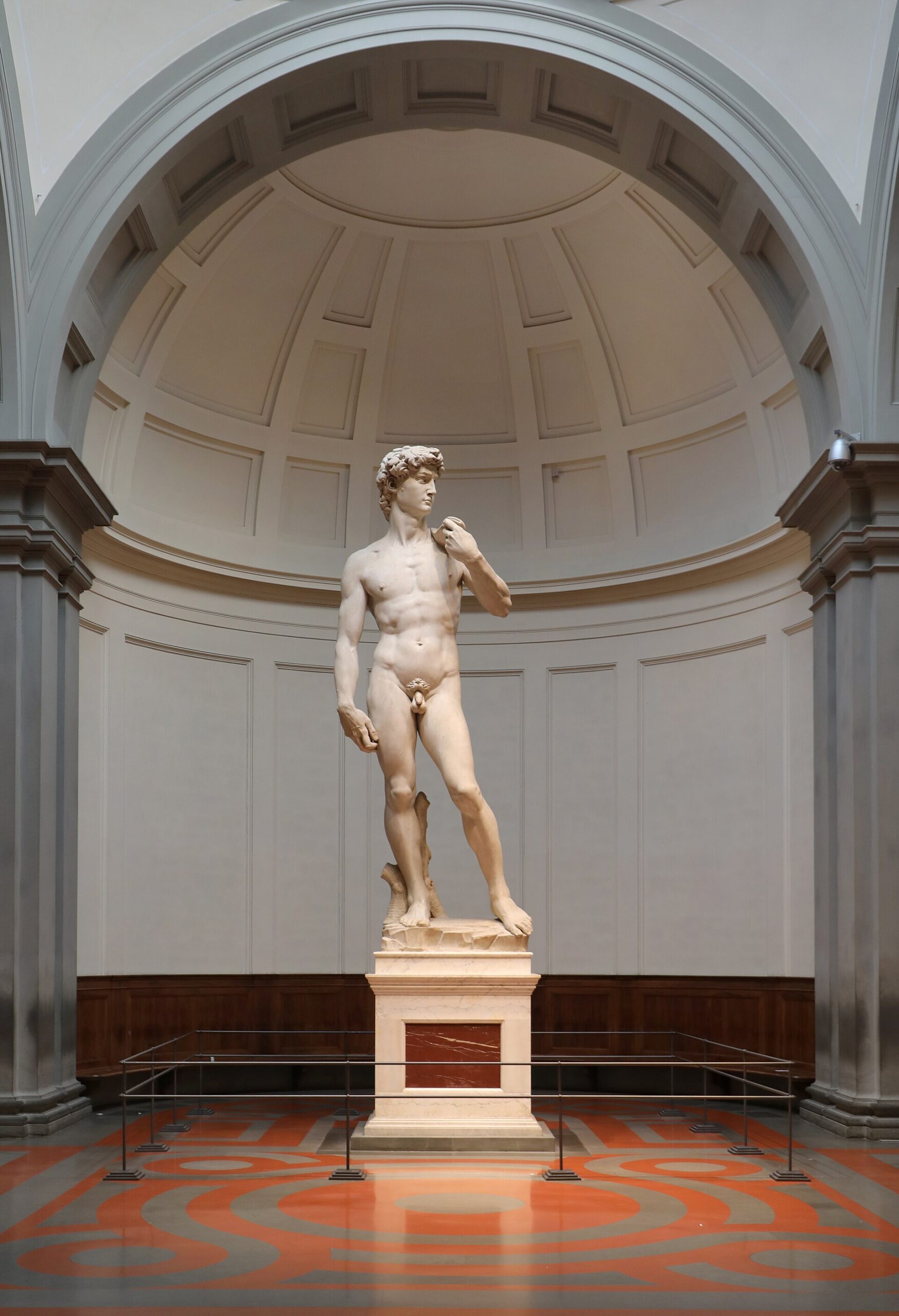
The Galleria dell’Accademia di Firenze exists for one reason: Michelangelo’s David. The 5.17-metre marble colossus, carved between 1501 and 1504 from a single block of Carrara marble, has been the museum’s centrepiece since 1873 when it was moved here from Piazza della Signoria for protection from the elements. The Accademia today holds the original David, the four unfinished Prisoners, the Gipsoteca (a hall of 19th-century plaster casts), the Museum of Musical Instruments, and several other Renaissance works — but for almost every visitor, the pilgrimage is to David. This 2026 guide covers everything you need to know to visit the Accademia Gallery Florence — tickets, hours, what to look for at the David, the Prisoners, booking strategies, queue management, and how to fit it into a Florence trip.
For broader museum context see our Florence Museums & Art Guide; for Uffizi see Uffizi Gallery Guide.
The David takes most visitors under an hour, so pair the Accademia with something nearby: the San Marco Museum is a three-minute walk, the Medici Chapels hold Michelangelo’s other great sculptural project, and our skip-the-line ticket guide explains how to avoid the morning queue entirely.
The price changed in February 2026 and a lot of advice still has the old number. Our Accademia tickets guide has the current fares, the combined ticket that adds the Bargello for six euros, and how far ahead to book in each season.
Accademia tickets and prices in 2026
Standard tickets
- Day-of (walk-up): €20 all year round; EU citizens aged 18–24 pay €2.
- Online pre-booked: €20 + €4 booking fee = €24. Recommended.
- Late afternoon (after 16:00): the full €20 admission still applies, plus €4 if you book.
- Under-18s: free with €4 reservation fee.
- EU citizens 18–24: €2 admission, plus the €4 fee if you reserve ahead. Bring passport ID.
- Visitors with disabilities: free with one companion.
- First Sunday of the month: free for everyone; advance booking still required.
Combined & passport tickets
- Firenze Card: €85 for 72 hours covering 60+ Florence museums including Accademia. Whether it pays depends on your itinerary: booked tickets for the Uffizi (€29), Accademia (€24), Pitti (€19) and Medici Chapels (€14) already add up to €86.
- Combined Accademia + Bargello + San Marco: occasionally available; check at booking. Three Renaissance-sculpture museums.
- Accademia + private guided tour: €40–€60 per person; includes ticket plus 90-minute tour.
Premium experiences
- After-hours private tour: occasionally Tuesday or Thursday evenings; €120 per person, 75 minutes after closing in front of David. Spectacular if you can secure it.
- Private guide: €280–€450 for half-day combining Accademia with one other site.
- Skip-the-line guided tours: €40–€70 per person; multiple operators.
Hours and best times to visit
Opening hours
Galleria dell’Accademia: Tuesday–Sunday, 08:15–18:50; be at the entrance by 18:10 to be sure of getting in. Closed Mondays. Closed January 1 and December 25.
Evening openings run on dated special programmes, posted on the museum’s news page. In summer 2026 the gallery stayed open until 23:00 on 21 July, 28 July and 4 August, and a special opening is listed for 30 November, 17:15–21:00.
Best time slots
- 08:15 (opening) — the gold-standard time. Crowds light.
- 17:00–18:00 late afternoon — the second sweet spot. Tour groups departed; the Tribune emptier than mid-day.
- Worst times: Tuesdays and weekends, which the museum itself names as its busier days. If one of those is your only option, aim for 13:00–14:30, a quieter stretch.
- Sundays: First Sunday of the month is free but mob-crowded; book months ahead.
- Worst single experience: a free first Sunday in August at 11:00 — the Tribune holds dense crowds and the visit experience is much reduced.
How to book Accademia tickets
Official portal — galleriaaccademiafirenze.it
The cheapest reliable option. The museum’s own booking portal. Choose your date and a timed entry slot, then pay with card. €4 booking fee on top of the standard ticket. Follow the entry instructions on your booking confirmation.
Third-party resellers
Avoid GetYourGuide, Viator, Tiqets for standalone tickets — they charge €25–€35 vs €20 official. Use them only when bundling with guided tours (€40–€60 inclusive of ticket and licensed guide can be useful for first-time visitors).
Hotel concierge
A concierge may be able to handle the booking for you, which saves effort on a short stay. Don’t rely on it for last-minute peak-season slots, though: reserve as early as you can.
Booking ahead — how far?
- Peak season (April–October): book as soon as your travel dates are fixed.
- Shoulder season: still reserve once you know your dates; the museum strongly recommends it all year.
- Low season: quieter, but a reservation is still the safer bet.
- First Sunday free entries: no booking at all. Reservations aren’t taken on free first Sundays, so you queue at the entrance.
Michelangelo’s David — the centrepiece
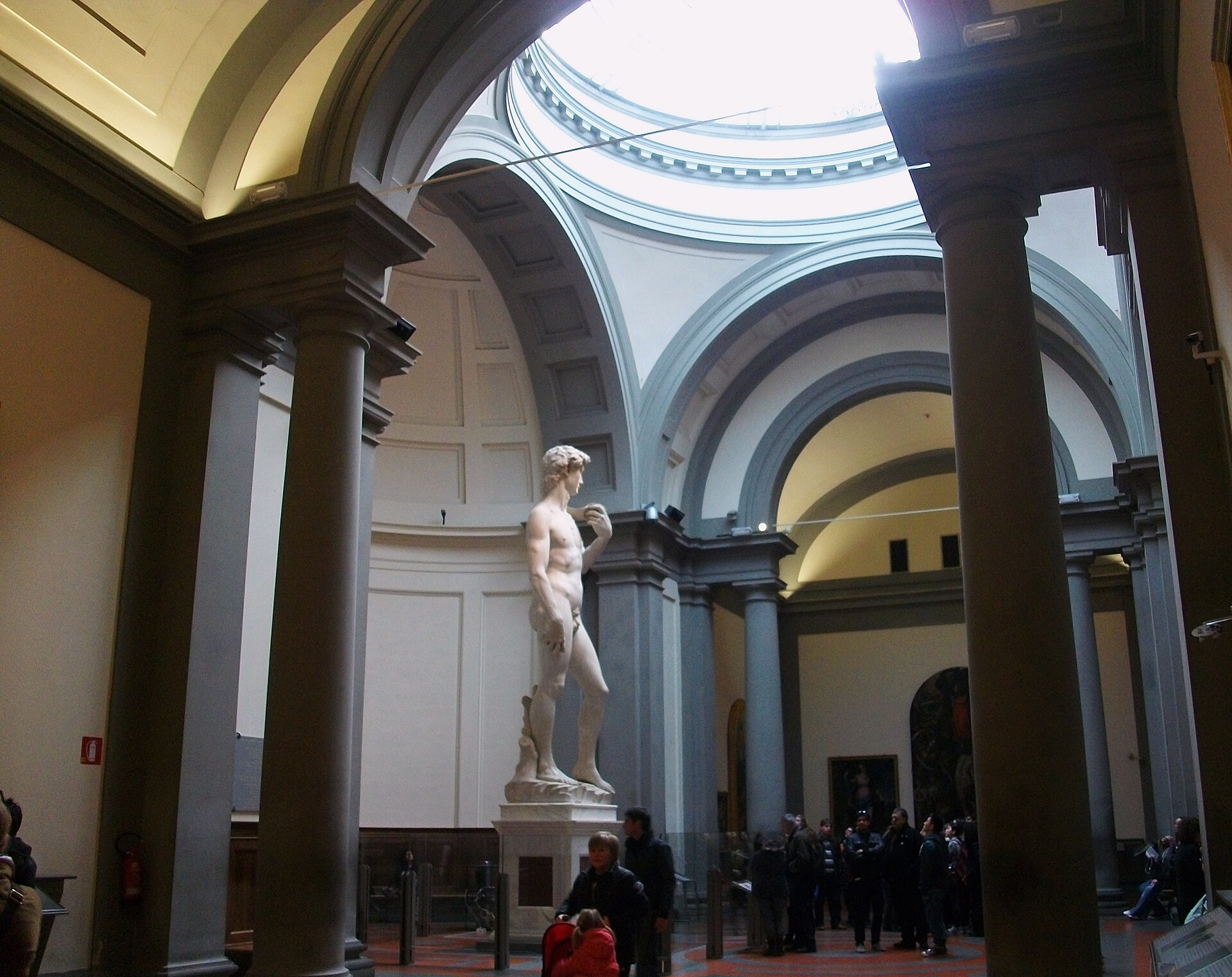
Michelangelo’s David is, by widely-accepted critical consensus, the single most famous sculpture in the world. Carved between 1501 and 1504 from a single block of Carrara marble that had been left abandoned for 25 years, the statue stands 5.17 metres tall and weighs roughly 6 tonnes. Michelangelo was 26 when he started; 29 when he finished.
The figure depicts the biblical David moments before his fight with Goliath — alert, watchful, his right hand holding a sling and stones. Critics historically misread this as “after” the fight; the modern consensus is that David is before the action, deciding what to do.
What to look for
- Disproportion: David’s right hand is famously oversized. Various theories — Michelangelo deliberately exaggerating the warrior’s strength, or compensating for the original viewing angle (the statue was originally meant to stand on a high cathedral buttress).
- The veins: Michelangelo’s astonishing rendering of the veins in the right arm and left hand. Up close they’re so realistic they read as anatomically alive.
- The contrapposto pose: weight on right leg, left leg relaxed, body twisted in subtle counter-rotation. The Renaissance-revival pose that became the Western sculptural standard.
- The eyes: David’s gaze is alert, focused, almost human. Walk around to view from multiple angles — the expression shifts dramatically.
- The bag of stones: David carries a sling over his left shoulder, with stones gathered in the bag at the back. Walk around to the rear; the sling and stones are clearly visible.
- The pubic hair carved into the stone: a Michelangelo signature touch — the realism extends to anatomical detail rare in earlier Renaissance sculpture.
- The toes: a vandal damaged a toe on David’s left foot in 1991; the damage was repaired.
- The marble itself: Carrara marble from northern Tuscany. The block had a long history — acquired at Carrara by Agostino di Duccio in 1465, intended for the Florentine cathedral, then left neglected for about 25 years before Michelangelo took it on.
Where the David has lived
The David’s location history matters. Originally intended for an exterior buttress of the cathedral — but in January 1504 a committee decided to place it at Palazzo Vecchio instead. It went into Piazza della Signoria outside the palace, where it stood for 369 years (1504–1873) as a civic symbol of Florence’s republican defiance.
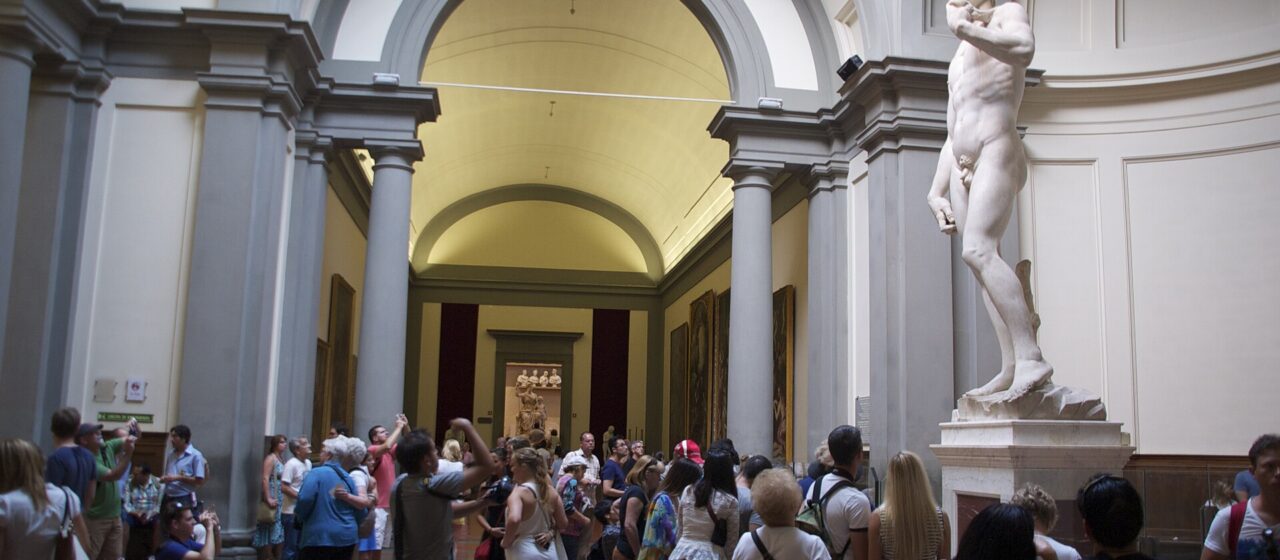
In August 1873, after centuries of weather damage, the David was moved indoors to the Accademia, where it waited nine years in a wooden crate for its Tribune of the Accademia — a purpose-built domed room with a skylight to provide natural lighting, completed in 1882. The original Piazza della Signoria location was filled with a marble copy in 1910. Since 1873, the original has been protected indoors.
Multiple authentic-marble copies of David now exist around the world — most prominently the Piazza della Signoria copy (free to see) and the bronze Piazzale Michelangelo copy (free, panoramic view). Both are excellent if you can’t get an Accademia ticket.
The Prisoners (or Slaves)
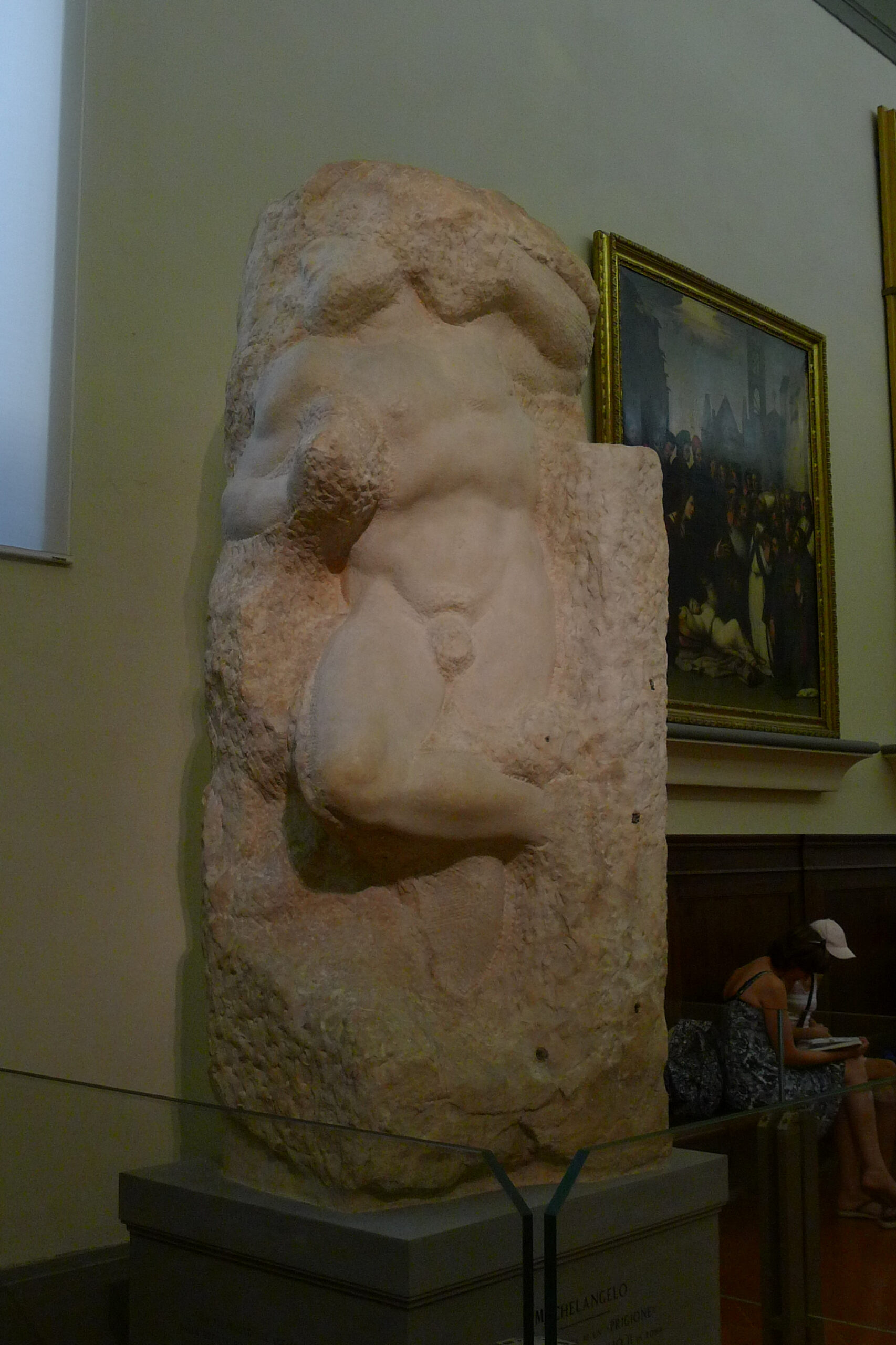
Lining the corridor leading to David are four unfinished marble sculptures by Michelangelo, collectively known as the Prisoners (or Slaves). Carved in the 1520s and 1530s for the unrealised tomb of Pope Julius II, the figures appear to wrench themselves out of raw stone — partial bodies emerging from rough marble blocks.
The four:
- The Bearded Slave — a older figure, slightly more developed than the others.
- The Awakening Slave — appears to be stretching awake from sleep, twisted in mid-motion.
- The Atlas Slave — head buried in a block of marble, body straining as if supporting a weight.
- The Young Slave — younger figure with smoother lines, partially emerged.
The unfinished state is what makes the Prisoners extraordinary. Michelangelo famously described his sculpting method as “removing the marble that imprisons the figure” — and these four works literally show that process mid-step. The chisel marks are visible; the body parts that haven’t yet been “freed” are still raw stone. In some art-history readings, the Prisoners are considered Michelangelo’s most philosophically interesting works — humanity itself emerging from inert material.
Allow 5–10 minutes per Prisoner. Walk all the way around each — the angles reveal different aspects of the figures’ struggle.
Gallery layout
The Accademia is much smaller than the Uffizi — typically a 75–90 minute visit covers it. The visitor route is structured:
Entrance / Hall of Colossus
Where you enter. Plaster casts and a few early Renaissance works.
Tribune corridor / Prisoners
The straight corridor lined with Michelangelo’s four unfinished Prisoners, leading directly to the David Tribune at the end.
Tribuna del David
The purpose-built domed room housing David. Allow 15–25 minutes here.
Side galleries — early Renaissance painting
Several rooms branching off the corridor display Florentine Renaissance painting (Botticelli school, Filippino Lippi, Fra Bartolomeo). 20–30 minutes if you’re interested.
Gipsoteca
The 19th-century plaster cast hall. White-on-white sculpture overload; small and atmospheric.
Museum of Musical Instruments
Smaller, in a side wing. 15–20 minutes for music enthusiasts.
The Gipsoteca
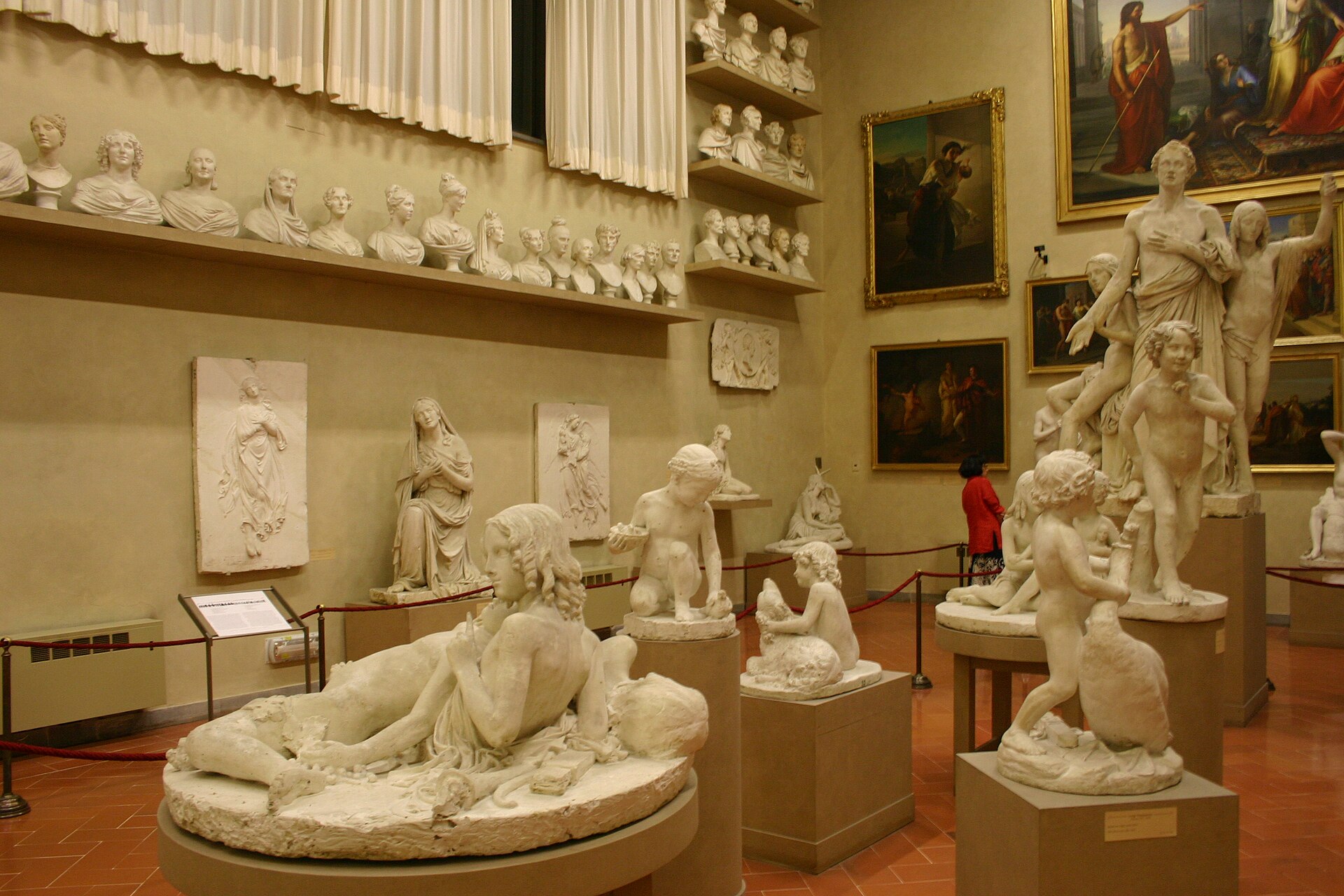
The Gipsoteca (literally “plaster-cast collection”) is a long hall on the side of the Accademia displaying hundreds of 19th-century plaster casts of classical and Renaissance sculptures. Created originally as study aids for academic students; now a striking visual installation in its own right.
The casts are full-size replicas of works including the Apollo Belvedere, the Laocoön, the Medici Venus, and dozens of Greek and Roman classical pieces. Walking through the Gipsoteca is one of the Accademia’s most distinctive experiences — the white-on-white density, the academic-historical purpose, and the way the casts function as “ghosts” of lost or distant originals.
Most travellers spend 10–15 minutes here. Worth pausing in to recover from the David Tribune crowds.
Museum of Musical Instruments
The Accademia includes a Museum of Musical Instruments containing instruments collected by the Medici and Lorraine grand dukes from the 17th century onwards. Standout pieces:
- Stradivari violin (1716) — shown alongside Stradivari’s tenor viola and cello, both from 1690.
- Amati cello (1650) — Niccolò Amati’s violoncello, a pre-Stradivari Cremonese masterwork.
- Bartolomeo Cristofori’s spinet and harpsichord — Cristofori invented the piano in Florence. His three surviving pianos are in New York (1720), Rome (1722) and Leipzig (1726); here you see two of his other keyboard instruments.
- Antique woodwinds — a set of historic wind instruments.
- Ducal harpsichords — multiple harpsichords from the Medici grand-ducal collection.
Allow 15–20 minutes. The museum is included in the Accademia ticket; many travellers skip it because they’re focused on David. For musicians and music historians, it’s a small revelation.
Other Renaissance works at the Accademia
Beyond David, the Prisoners, the Gipsoteca and the Musical Instruments, the Accademia displays:
Florentine Renaissance painting
- Sandro Botticelli’s Madonna del Mare — small but exquisite Botticelli devotional panel.
- Filippino Lippi’s Madonna in Glory — late-15th-century altarpiece.
- Fra Bartolomeo’s Holy Family — Florentine Mannerism precursor.
- Pontormo and Bronzino works — selected Mannerist examples.
Early Renaissance sculpture
- Andrea della Robbia terracottas — the colourful glazed-ceramic style invented in Florence.
- Pisano-school sculpture — early-14th-century works.
Russian icons
An unusual sub-collection — 17th-century Russian Orthodox icons donated to the Florence collection in the 19th century.
For first-time visitors, the David and Prisoners are the priority. The other works are excellent supplementary content for return visits or for travellers with deep Renaissance interests.
A 90-minute Accademia route
For travellers wanting to focus on the canon:
0:00–0:10 — Entry and security
Arrive 15 minutes before slot. Bag check; large bags must go in the free cloakroom.
0:10–0:30 — Walk through the Prisoners corridor
20 minutes for the four unfinished Prisoners. Walk slowly; pause at each. Note the chisel marks, the partially-emerged body parts, the raw stone.
0:30–1:00 — Tribuna del David
30 minutes at David. Walk a full circle around the statue. View from multiple angles — the front, the side, the back, looking up. Then step back and let the experience settle before you move on.
1:00–1:15 — Side galleries (Florentine painting)
Brief pass through the early Renaissance painting rooms. Highlights only.
1:15–1:25 — Gipsoteca
10 minutes through the plaster-cast hall.
1:25–1:30 — Exit via gift shop
The bookshop has excellent Michelangelo books and prints.
Total: 90 minutes. Add 15 minutes for queue and check-in. Total visit time including arrival: roughly 105 minutes.
Queue strategy

The Accademia’s main visitor pain point is the queue. Strategies:
- Book online — the €4 fee is the best money you’ll spend here, and the museum strongly recommends it.
- Choose 08:15 first slot — you are among the first through the door.
- Combined ticket queue is shorter — Firenze Card holders enter through a separate entrance.
- Pre-booked ticket queue is shortest — visitors without a reservation can face a long wait.
- Skip the Accademia in peak season if you can’t book — see the bronze David at Piazzale Michelangelo (free) and the marble copy on Piazza della Signoria (also free) as legitimate alternatives.
Visiting tips
- Book online ahead of time. The booking fee is invariably worth it.
- Photography is allowed without flash or tripod. Selfie sticks not allowed inside.
- Wear comfortable shoes. You’ll spend most of the visit on your feet, and longest of all at the David.
- Walk around David multiple times. Each side reveals something different. The back is rarely-photographed but architecturally fascinating.
- The Accademia is small enough that 75 minutes is comfortable; 2 hours is luxurious; 30 minutes is rushed but possible.
- Cloakroom on the ground floor; free; large bags required.
- Restroom on the ground floor near the entry.
- Children 5+ generally enjoy David — even small kids react to the scale. Under-7s sometimes get bored; under-18s free.
- Audio guide €6; the adult version comes in seven languages (Italian, English, French, German, Spanish, Russian and Japanese), the children’s in five. Useful for first-time visitors with art-history interest.
- Don’t try to combine Accademia and Uffizi the same morning. Both are emotionally heavy; pace them across separate days.
Accademia vs Uffizi — which to prioritise
If you can only visit one, choose based on what matters most to you:
| Factor | Accademia | Uffizi |
|---|---|---|
| Top draw | Michelangelo’s David | Botticelli, Leonardo, Caravaggio, Titian, Raphael |
| Time required | 75–120 minutes | 2–4 hours |
| Crowd density | Lower (single-room peak) | Higher (Botticelli rooms can be uncomfortable) |
| Ticket price | €20 (€24 booked) | €25 (€29 booked) |
| Booking pressure | Moderate | High |
| Suitable for kids | Yes from 5+ | From 8+ for highlights only |
| Sculpture focus | Yes | Some, mostly painting |
| Mondays | Closed | Closed |
Most first-time travellers do both on a Florence trip — Accademia on one day, Uffizi on another. They’re complementary; the David at the Accademia and the painting masterpieces at the Uffizi together give a complete Renaissance experience.
If you must choose only one, the Uffizi has more breadth and depth (it’s the bigger collection). But the David is irreplaceable — there is genuinely no substitute for seeing it in person. Many travellers who skip the Accademia regret it; few who skip the Uffizi do.
Combining the Accademia with other Florence sights
Morning Accademia + San Marco
08:15 Accademia (90 minutes); 10:00 walk 5 minutes north to the Museum of San Marco; 10:30 Fra Angelico’s frescoed cells (90 minutes); 12:00 lunch at Trattoria Mario or Mercato Centrale upstairs.
Accademia + Medici Chapels
08:15 Accademia; 10:00 walk 5 minutes south to San Lorenzo; 10:30 Medici Chapels (Michelangelo’s tomb sculptures, the Sagrestia Nuova). Total Renaissance-sculpture day.
Accademia + lunch + Bargello
A suggested morning: 08:15 Accademia; around 10:00 an early lunch at Caffè Cibreo or Pasticceria Robiglio; around 11:30 walk south to the Bargello (roughly 12 minutes); Renaissance sculpture (Donatello’s Davids); finish around 13:30.
Accademia + walking tour
Combine with a 2-hour walking tour of San Marco / San Lorenzo neighbourhood. €60–€90 for a guided tour that includes Accademia entry. Multiple operators; see Florence Walking Tours guide.
Accademia through the year
Spring (March–May)
Peak crowds; book as soon as your dates are set. Tuesdays and weekends are the busiest days, while 13:00–14:30 is one of the quieter windows. The Tribune’s natural light is at its best in April and May.
Summer (June–August)
Hot crowds; the air-conditioned Tribune is a welcome refuge. Summer evening openings are announced as dated events: in 2026 the gallery ran three late Tuesdays in July and August, until 23:00. First Sundays of August are mob-crowded.
Autumn (September–November)
Possibly the best season. Crowds halve; lighting through the Tribune skylight is golden in October. The David Tribune feels most contemplative in autumn.
Winter (December–February)
Lowest crowds; the ticket costs the same €20 as the rest of the year. The David Tribune can feel almost private at 16:00 in January. Last-minute booking possible. Christmas week bumps prices.
Other places to see the David in Florence
You can see Michelangelo’s David in three places in Florence: the original indoors and two prominent outdoor replicas.
The original (Galleria dell’Accademia)
The 5.17-metre marble carved by Michelangelo, 1501–04. The pilgrimage destination. Ticket required: €20, or €24 booked.
Marble copy (Piazza della Signoria)
Installed 1910 in the original Piazza Signoria location. Free to see, out in the open square. Less detailed than the original (it’s a 19th-century copy) but full-size and excellent for travellers who can’t get an Accademia ticket.
Bronze copy (Piazzale Michelangelo)
Installed 1873 atop the Piazzale terrace. Free; panoramic Florence view. The greenish-bronze patina makes it visually distinctive from the marble versions.
Many travellers see all three on a Florence trip. The original is the deep-experience destination; the copies are the alternative-or-supplement options.
A short history of David
The block of marble for David was acquired at Carrara in 1465 by Agostino di Duccio for the Florentine cathedral. After his work was rejected and abandoned, the block sat in the Cathedral workyard for about 25 years. On 16 August 1501 the cathedral commissioned Michelangelo to carve a David figure from it; he started work in September 1501 and finished in 1504.
The original commission was for the David to stand on a high cathedral buttress. On completion, in January 1504, a committee that included Leonardo da Vinci and Botticelli debated where it should go and chose the entrance to Palazzo Vecchio. The Operai del Duomo (cathedral workers) followed that choice, installing it in Piazza della Signoria as a civic symbol of Florentine republican defiance. The 5.17-metre statue was transported by more than 40 men over four days through narrow Florentine streets to its new location.
For 369 years (1504–1873), the David stood in Piazza della Signoria exposed to the elements. Multiple cleanings and restorations; weather damage accumulated. In August 1873 the original was moved indoors to the Galleria dell’Accademia, where it has stood ever since; the Tribune built for it was finished only in 1882. The Piazza della Signoria position was filled with a marble copy in 1910.
The 20th and 21st centuries saw multiple cleanings and restorations of the original — most recently a careful cleaning in 2003–2004, and today the statue gets regular maintenance dusting. The 1991 toe-vandalism incident damaged the second toe of the left foot, which was repaired.
The David has appeared on Italian currency, in countless reproductions, and is widely considered the single most-influential sculpture in the Western tradition. Visiting the original is, for most travellers, a once-in-a-lifetime experience.
The Accademia bookshop
The Accademia has two bookshops on the ground floor, a natural stop for Michelangelo monographs (multiple price points from €20 paperbacks to €120 hardcover), David-themed souvenirs and books on Renaissance art.
Worth budgeting €15–€60 for purchases. The David replica statuettes are tasteful (avoid the kitschy ones in tourist-trap shops outside) and the Michelangelo monographs are excellent travel souvenirs.
Accademia accessibility
- Wheelchair access — full elevator access to all floors; free wheelchair loan at entry, reserve when booking.
- Accessible bathrooms — on the ground floor near the entry.
- Reduced-fee tickets — visitors with disabilities and one companion enter free.
- Audio descriptions — the audio guide includes art-history content; not a dedicated visually-impaired audio description service.
- Sign-language tours — occasional, in Italian sign language; check the museum’s events calendar.
- Sensory-friendly hours — occasional “quiet morning” sessions; check the calendar.
The Accademia’s relatively small footprint (the visit is roughly 75–90 minutes) makes it more accessible than the Uffizi (which involves longer walking distances). Most accessibility-focused travellers find the Accademia experience smoother than the Uffizi.
The Accademia with kids
The Accademia is more child-friendly than the Uffizi — David is recognisable from popular culture, the visit is shorter, and the focus on a single iconic work works for younger attention spans. Strategy varies by age:
Under 5
The David scale (5.17 metres) makes a strong impression on even very young children — they react to the sheer size. A 30-minute visit focused on the Tribune works.
Ages 5–10
Full 75–90 minute visit doable. The Prisoners corridor is engaging — children often understand the “figure trying to get out of the rock” concept intuitively. The Gipsoteca’s white-on-white density also captures kids’ attention.
Ages 11–14
Treat as adults; let them set the pace. The Music Instruments museum (keyboards by Cristofori, the piano’s inventor) often surprises older kids.
Teens 14+
Full visit; free under-18 entry; audio guides for older kids work well.
Practical kid tips
- Audio guides (€6) are available at the museum entrance, with a children’s version in five languages.
- Bag check is free; take a small backpack only.
- Bathroom on ground floor; use it before the upper-floor circuit.
Common Accademia myths
- “Accademia is just one statue” — false. The Prisoners corridor, the Gipsoteca and the Musical Instruments museum together justify a full 90-minute visit even if you’re David-focused.
- “You can see David at Piazza Signoria” — partially true. The marble copy is excellent, but it’s a 1910 copy with less detail than the original.
- “The Accademia is small enough to skip booking” — overstated. In peak season, turning up without a reservation can mean a long wait.
- “Photography ruins the experience” — overstated. Photos of David from the Accademia are widely shared; the experience is enhanced if you let visitors take pictures and move on.
- “David is taller in the Accademia” — false. The original stands 5.17 metres, and the Piazza della Signoria version is a full-size copy. The Tribune ceiling height makes him feel slightly more intimate than at Piazza della Signoria.
Accademia Gallery — FAQ
How much does the Accademia cost?
2026: €20 on the day, all year round. €24 with the €4 online booking fee. Free for under-18s with €4 reservation. EU citizens aged 18–24 pay €2 (plus €4 if booked). First Sunday of month free for everyone.
Do I need to book Accademia tickets in advance?
Strongly recommended, above all in peak season — book as soon as your travel dates are known. Without a reservation the wait to get in can be long. Online booking from galleriaaccademiafirenze.it adds €4 fee but saves significant queueing.
What’s the best time to visit?
08:15 opening — first through the door. 17:00–18:00 late afternoon — second-best time, lighter crowds. Avoid free first Sundays in summer (mob crowds).
Is the Accademia worth the time?
Absolutely yes for first-time Florence visitors. Michelangelo’s David is irreplaceable; many travellers who skip the Accademia regret it. The 90-minute visit is short relative to the experience.
What else is there besides David?
Michelangelo’s four unfinished Prisoners (the corridor leading to David), the Gipsoteca (19th-century plaster casts), the Museum of Musical Instruments (Stradivari, Amati, Cristofori’s spinet and harpsichord), Florentine Renaissance painting (Botticelli, Filippino Lippi), and a small collection of Russian icons.
How long do I need at the Accademia?
Express visit: 60 minutes. Standard: 75–90 minutes. Comprehensive: 2 hours. The Accademia is much smaller than the Uffizi; 90 minutes is comfortable.
Can I take photos at the Accademia?
Yes without flash or tripod. Selfie sticks not allowed in narrow areas. Photography is welcomed at David and the Prisoners.
Should I skip the Accademia and just see the David copy at Piazza Signoria?
The marble copy is genuinely excellent and free. But it’s a 1910 copy lacking the original’s detail and texture. Most travellers who see both agree the original is significantly more powerful — you can see chisel marks, the veins, the texture of the marble. If you can get an Accademia ticket, do.