This article contains advertising. Booking links on this site can be turned into paid links automatically by our partner Travelpayouts: if you book through one, we earn a commission from the provider, at no extra cost to you. It never affects what we recommend. Affiliate disclosure
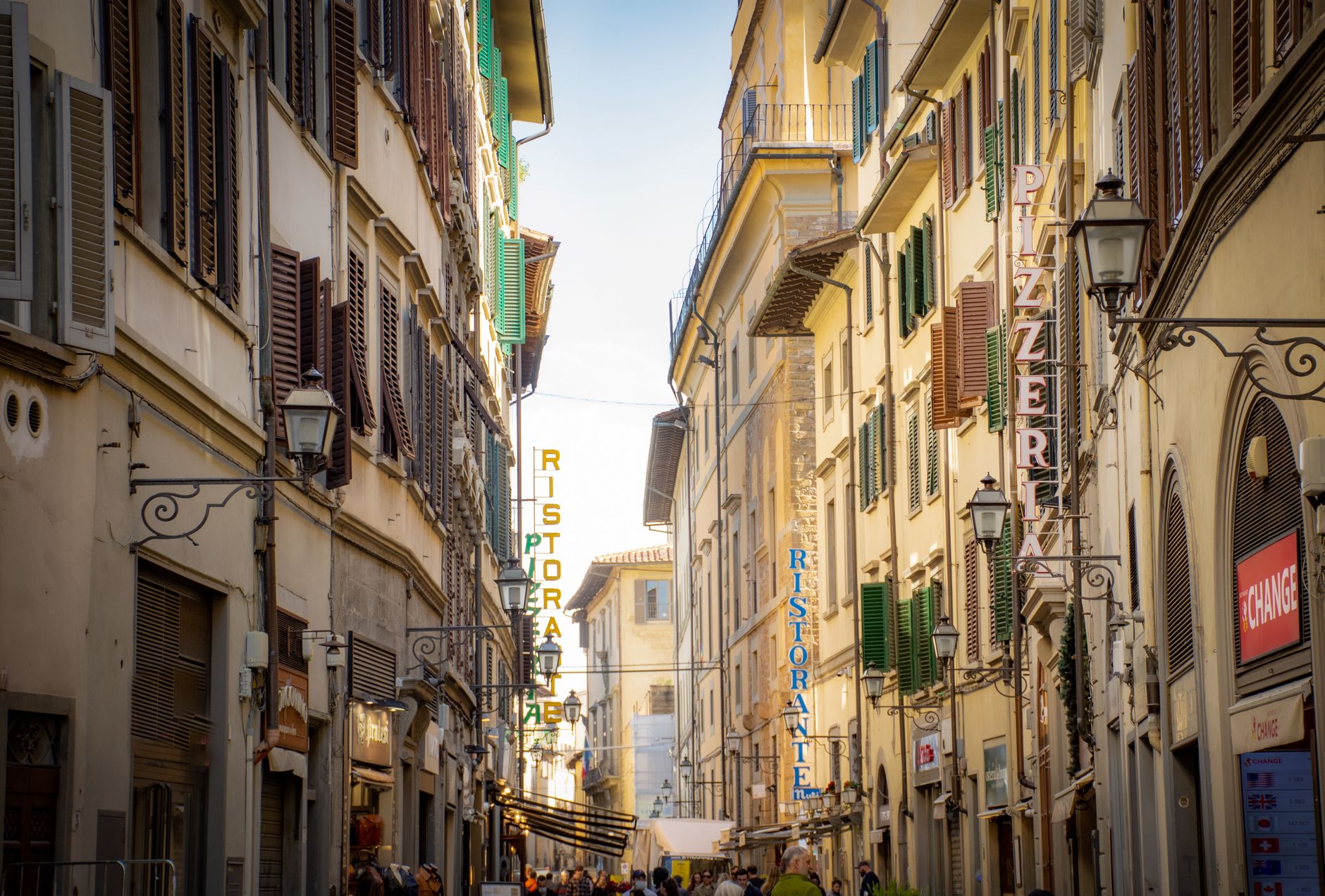
Florence is, in the best possible sense, a walking city. Its UNESCO-protected historic centre is barely 1.5 km square, the streets are largely flat (south-of-Arno climbs aside), the Arno divides the city into two perfectly walkable halves, and almost everything that matters — Duomo, Uffizi, David, Ponte Vecchio, Pitti, Boboli — is reachable on foot. This 2026 guide gives you five complete self-guided walking tours of Florence, each between 90 minutes and 4 hours, with downloadable Google Maps links, exact stops, photo tips, food and bathroom breaks, and a comparison of when to splash out on a paid guide instead. Walk all five and you’ll know Florence better than 95% of visitors who pay for tour buses.
Start with the 2-hour Renaissance Highlights walk if it’s your first time. Move on to the Oltrarno or the Dante walk on day two. Save the food walking tour for an afternoon you don’t want to plan. The walking tours Florence Italy business is a healthy one — paid tours cost €25–€110 — but for the standard “show me the famous sights” version, a printed map and 90 minutes is plenty.
If you only have time for one self-guided route, make it the 13-stop Renaissance walking tour, which threads the buildings the Medici paid for into a single loop. Wear something that passes the church dress code so you can step inside as you go.
Walking tours are one line on a much longer bill. Our pillar guide to Florence tours and tickets weighs them against the museum bookings, food tours and day trips competing for the same budget.
If a group of thirty is not what you had in mind, hiring someone outright starts at about €150 for a half day — for the whole party, not per person. Our private guide guide covers the rates, the national-register QR code that proves a licence, and when a group tour is genuinely enough.
Tour 1 — Renaissance Highlights (90 minutes, free)
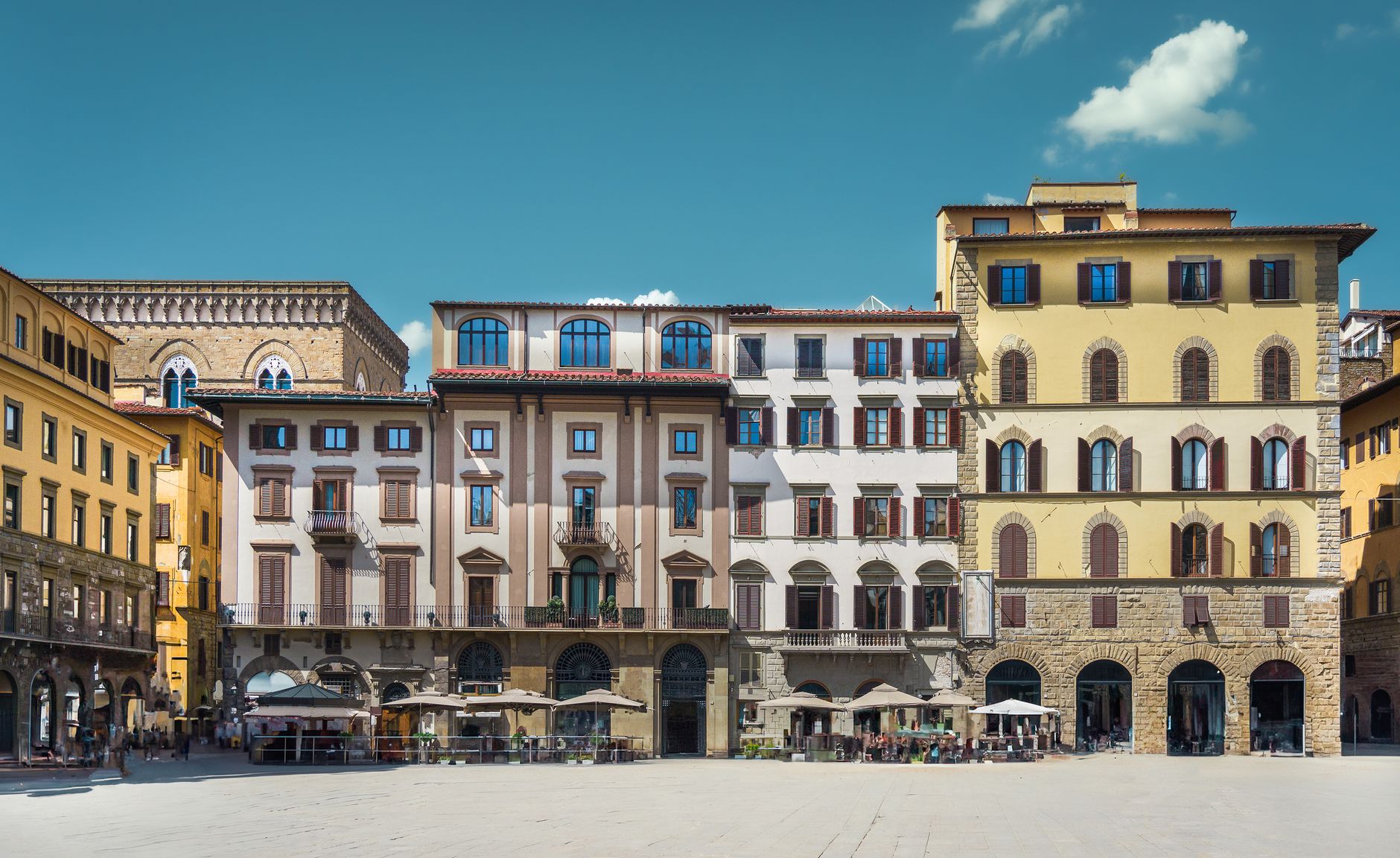
The classic first-day route. 2.5 km, mostly flat, hits every iconic Florence sight without any tickets. Best done at 08:30 (light, no crowds) or 18:00 (golden hour).
Stops (in order)
- Santa Maria Novella — start at the train station; the basilica’s pink, white and green geometric façade is your warm-up.
- Officina Profumo Santa Maria Novella — five minutes east; pop into the world’s oldest pharmacy (free, open 09:30).
- Mercato Centrale — the cast-iron market hall (1874); the upstairs food hall is open daily 09:00–23:00.
- Cappelle Medicee + San Lorenzo — Brunelleschi’s deliberately unfinished family church.
- Piazza del Duomo — the cathedral, Baptistery and Giotto’s bell tower together.
- Via dei Calzaiuoli — Florence’s main pedestrian shopping street; halfway down, peek into Orsanmichele.
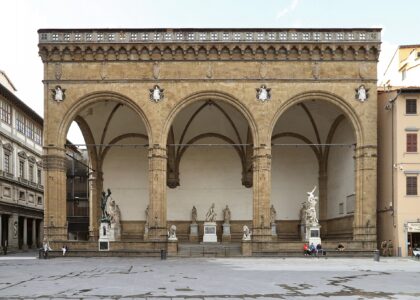
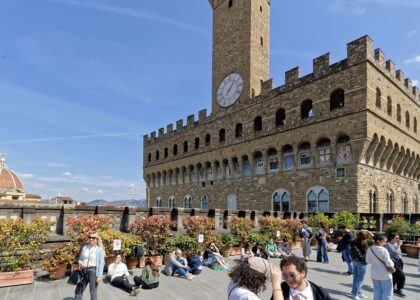
- Piazza della Signoria — Loggia dei Lanzi sculptures, Palazzo Vecchio, copy of David.
- Piazzale degli Uffizi — the Uffizi corridor between the Palazzo Vecchio and the Arno; statues of every Florentine genius from Dante to Galileo.
- Ponte Vecchio — cross the Arno via Florence’s oldest bridge.
- Palazzo Pitti — your endpoint; cross back via Ponte Santa Trinita for the photographer’s Ponte Vecchio shot.
Coffee stops: Caffè Gilli or Caffè Paszkowski in Piazza della Repubblica (mid-route); Procacci on Via Tornabuoni for an elegant truffle-butter sandwich.
Tour 2 — Oltrarno Artisans (2.5 hours, free)
The other side of Florence. 3 km, undulating, walks you past gilders, frame-makers, leather-workers, paper-marblers and bookbinders. Best 10:00–13:00 when workshops are open.
Stops (in order)
- Ponte Santa Trinita — start with the Ponte Vecchio money shot east of you.
- Via Maggio — Florence’s antiques street; window-shop the Renaissance furniture.
- Piazza Santo Spirito — sit on the basilica steps; if it’s a Sunday, the farmers’ market runs.
- Via dei Serragli — turn right; gilders, restoration shops and small leather ateliers.
- Borgo San Frediano — Florence’s bookbinder street.
- Brancacci Chapel (Santa Maria del Carmine) — €15 (€10 reduced; booking online is recommended), the frescoes that birthed the Renaissance.
- Piazza Tasso — pause for an espresso at Caffè degli Artigiani.
- Via di Camaldoli — quiet artisan street ending back near the river.
- Lungarno Soderini — Arno towpath back to Ponte Vecchio for sunset.
Workshops to slow down at: Alberto Cozzi (paper marbling, Via del Parione 35r — slightly off the route, a 5-minute detour); Giannini (Piazza Pitti 36r-37r); Stefano Bemer (bespoke shoes, Via San Niccolò 2r).
Tour 3 — Dante’s Florence (1.5 hours, free)
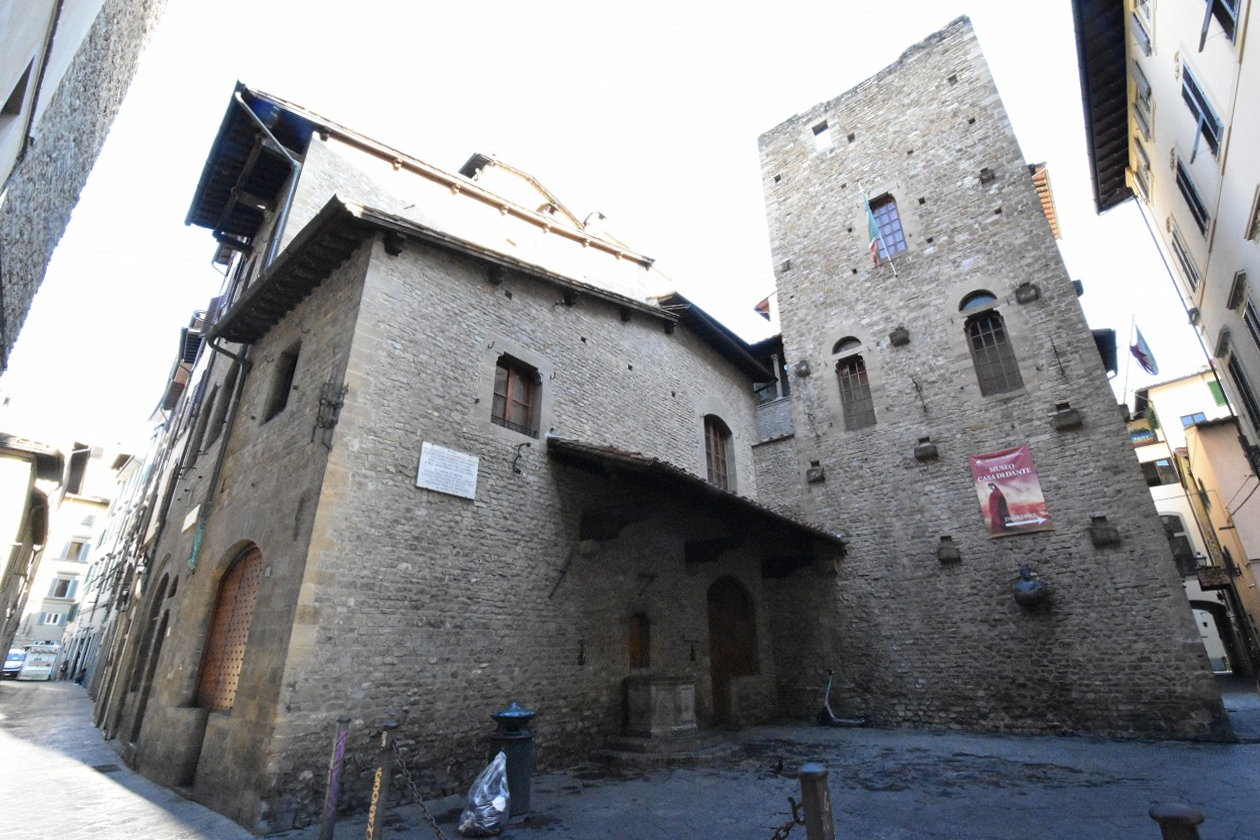
The medieval heart of Florence — Dante Alighieri’s neighbourhood. 1.5 km, a literary scavenger hunt rather than a sights tour. Free except for the optional Casa di Dante museum (€8).
Stops (in order)
- Baptistery of San Giovanni — Dante was baptised here in 1266.
- Casa di Dante (Via Santa Margherita 1) — a 19th-century reconstruction of his birth house, now a small museum (€8).
- Chiesa di Santa Margherita de’ Cerchi — the tiny church where Beatrice Portinari (Dante’s idealised love) is buried.
- Torre della Castagna — one of the few surviving medieval towers from Dante’s Florence.
- Badia Fiorentina — the church where Dante first saw Beatrice; Filippino Lippi’s Apparition of the Virgin to St. Bernard hangs inside.
- Via dell’Inferno — yes, that’s its real name; the medieval street layout Dante would recognise.
- Piazza San Firenze + Bargello — Dante was tried and exiled here in 1302.
- Santa Croce — Florence’s “temple of glories”; Dante’s cenotaph (he is buried in Ravenna, where he died).
Tour 4 — Florence Food Walk (3 hours, ~€30 of tastings)
A self-guided tasting route through the city’s classic food stops. 2 km, all on the centre side of the Arno. Pace yourself — eight tastings in three hours.
Stops (in order)
- Caffè Gilli (Piazza della Repubblica) — espresso and a Florentine schiacciatina pastry (€3.50).
- Antico Vinaio (Via dei Neri) — the city’s biggest schiacciata sandwich (€8); skip the queue and walk to Branch 2 around the corner.
- Vivoli (Via Isola delle Stinche) — one of the city’s oldest gelaterie (a dairy from 1929, serving gelato since 1932); a small cup with rice and ricotta-and-fig (€3.50).
- Procacci (Via de’ Tornabuoni 64r) — truffle-butter sandwich and a glass of Chianti Classico (€10).
- La Sosta del Rossellino or Cantinetta dei Verrazzano — wine bar lunch, a glass and one cured plate (€12).
- Mercato Centrale — Nerbone’s lampredotto sandwich on the ground floor (€6); upstairs a glass of Chianti (€5).
- La Carraia (Piazza Nazario Sauro, Oltrarno) — €1.50 small gelato cone, the city’s best price-quality ratio.
- Piazza Santo Spirito — finish with a €5 spritz at Volume.
Total: roughly €45 per person across eight stops, or €30 if you skip a couple. For paid food tours by experienced guides see Curious Appetite, Eating Europe and Devour Tours below.
Tour 5 — Sunset & San Miniato (3 hours, free)
The slow late-afternoon walk. Start at 16:30 in summer (15:00 in winter). 4 km, with a 130-metre climb halfway through.
Stops (in order)
- Piazza della Signoria — Loggia dei Lanzi at golden hour.
- Piazzale degli Uffizi → Ponte Vecchio → cross south.
- Lungarno Serristori — riverside walk east.
- Rampe del Poggi — walk up the 19th-century switchbacks (15 minutes).
- Piazzale Michelangelo — sunset (45 min before sunset to 15 min after).
- Climb +5 min to San Miniato al Monte — Gregorian vespers daily at 18:30.
- Walk down via Costa San Giorgio — past the Galileo observatory and the old city walls.
- Forte di Belvedere (ticketed during its summer open season; check the programme on the Musei Firenze site) — second sunset terrace.
- Down to Ponte Vecchio — finish with a glass of wine on the bridge or at La Terrazza Continentale rooftop.
Themed self-guided walks for special interests
The Medici power walk
Trace the rise and rule of the Medici dynasty. 2.5 km, 2 hours. Starts at Palazzo Medici Riccardi (the family’s first residence, with Benozzo Gozzoli’s Procession of the Magi fresco), continues to San Lorenzo and the Medici Chapels (Michelangelo’s Sagrestia Nuova tombs), passes the Mercato Centrale (where Cosimo I held public audience), through Piazza della Signoria (Palazzo Vecchio’s Sala dei Cinquecento), over Ponte Vecchio (under the Vasari Corridor) and ends at Palazzo Pitti and Boboli Gardens — the family’s later residence and tomb estate.
The Galileo science trail
Galileo lived in Florence and is buried in Santa Croce. 2 km, 90 min. Starts at the Museo Galileo on the Arno (his actual telescopes), to Santa Croce (his tomb), via Costa San Giorgio to the Galileo observatory ruins on the hill, ending at Pian dei Giullari where his villa still stands.
The Brunelleschi engineering walk
The architect of the dome left fingerprints across central Florence. 1.8 km, 2 hours. Starts at Santa Maria del Fiore (the dome itself), to the Ospedale degli Innocenti (the first true Renaissance building, 1419), Piazza Santissima Annunziata, San Lorenzo (Brunelleschi’s perfect basilica), the Pazzi Chapel at Santa Croce, and Santo Spirito (Brunelleschi’s last and purest church).
The female-Florentines walk
A walk featuring Florence’s overlooked women — Beatrice Portinari, Lucrezia Tornabuoni, Anna Maria Luisa de’ Medici, Artemisia Gentileschi. 2 km, 2.5 hours. Stops include Santa Margherita de’ Cerchi, the Tornabuoni Chapel at Santa Maria Novella, the Anna Maria Luisa monument outside the Palazzo Medici Riccardi, and Artemisia’s Judith at the Uffizi (skip-line ticket required).
Tour 6 — Florentine Renaissance Sculpture Trail (2 hours, free)
For sculpture-obsessed travellers. Hits every important Donatello, Verrocchio, Cellini and Michelangelo statue accessible without a museum ticket. 2 km, mostly central.
- Orsanmichele — the niche statues outside (Donatello’s St George, Ghiberti’s St Matthew, Verrocchio’s Christ and St Thomas).
- Piazza della Signoria — Loggia dei Lanzi (Cellini’s Perseus, Giambologna’s Sabines), Ammannati’s Neptune fountain, copy of David, mounted Cosimo I.
- Piazza del Duomo — Ghiberti’s Gates of Paradise (the Baptistery East doors, originals in the Museo dell’Opera).
- Piazza Santa Croce — Dante statue, Garibaldi.
- Piazza Santo Spirito — Brunelleschi statue.
- Piazzale Michelangelo — replica David in bronze.
Tour 7 — Florence Wall Walk (3 hours, free)
An off-piste route along Florence’s surviving medieval city walls. 5 km, with a 70-metre climb.
- Porta San Niccolò — start at the eastern gate, climb the tower if it’s a summer evening (€4).
- Lungarno Serristori — east along the river to the Costa San Giorgio gate.
- Costa San Giorgio — walk uphill via the Galileo observatory ruins.
- Forte di Belvedere — pause on the bastion (ticketed during its summer open season).
- Boboli’s outer wall — walk west along the Boboli garden wall (the path is on the outside).
- Porta Romana — the southern city gate.
- Down Via dei Serragli back to Ponte alla Carraia.
How long does each tour really take?
Estimating walking-tour timing is harder than it looks because Florence is dense — every block has something worth a 5-minute stop. Realistic timings:
- Tour 1 (Renaissance Highlights): 2.5 km of walking, but with photo and coffee stops you’ll spend 2.5–3 hours total.
- Tour 2 (Oltrarno Artisans): 3 km but 4 hours if you stop into 5+ workshops.
- Tour 3 (Dante’s Florence): 1.5 km, but 2.5 hours if you read every plaque and visit Casa di Dante.
- Tour 4 (Food Walk): 2 km, but 3.5 hours including 8 tastings.
- Tour 5 (Sunset): 4 km with 130 m climb, 3 hours including the summit time at Piazzale Michelangelo and San Miniato.
- Tour 6 (Sculpture Trail): 2 km, 2–3 hours.
- Tour 7 (Wall Walk): 5 km, 3 hours.
Paid guided walking tours — when to book one
Self-guided is fine for the headline routes. Paid tours genuinely add value when:
- You want skip-the-line entry to the Uffizi or Accademia. Guided 3-hour Uffizi+walking-tour combos run €60–€90 per person.
- You’re an art-history nerd. A licensed Florentine guide knows things no audio guide will tell you. Walks of Italy, Through Eternity and Context Travel run small-group walking tours (max 6) at €80–€110 per person.
- You want a food tour. Curious Appetite (€110, 4 hours) and Eating Europe (3 hours, from €84) include 6–8 tastings and 1–2 wine pairings — better value than self-guiding once you tally up the bill. Our Florence food tours guide compares the operators properly.
- You’re with a tight time budget. A 2-hour highlights tour at €25 per person packs the basics and leaves you with the afternoon free.
Recommended paid tour operators
- Walks of Italy — premium small-group tours (Uffizi, Accademia, Renaissance walking).
- Context Travel — academic-led, expensive, deeply researched.
- Through Eternity — long-running specialist; excellent night Uffizi tours.
- Take Walks — solid mid-priced 2-hour highlights walks.
- Curious Appetite — owner-led Florence food walks.
- Eating Europe — the bigger food-tour brand; reliable.
- GetYourGuide and Viator — good for last-minute booking; check guide reviews carefully.
“Free” walking tours (tip-based)
Several operators run “free” walking tours that work on a tip-at-the-end basis (€10–€20 per person is the typical, expected tip). Not actually free, but cheaper than paid tours and a fine introduction to Florence.
- Florence Free Tour — 2.5 hours, departs 10:30 and 15:30 daily from Piazza Santa Maria Novella.
- Guruwalk Florence — booking platform with a dozen tip-based tours; book ahead online.
- SANDEMANs — global brand; runs Florence highlights tours.
- Free Tours by Foot — has a Renaissance walking tour and a sunset route.
Important: tour guides licensed by the Tuscany region must have a permit. “Free” tour guides often aren’t licensed — that’s why they can’t enter ticketed sites with you. They’re fine for outdoor walks; not a substitute for a licensed Uffizi guide.
Walking out of Florence — half-day & full-day routes into Tuscany
For active travellers wanting to walk beyond the city walls:
Florence to Fiesole (5 km, 2 hours, 350 m climb)
The classic. From Ponte alle Grazie, climb Via San Leonardo (the Robert Browning path), continue past Forte di Belvedere, drop into Pian dei Giullari and the Galileo observatory, then onto the trail to Settignano and Fiesole. Bus 7 brings you back in 20 minutes (€2.00). Spectacular panoramas; pack 1.5 L of water in summer.
The Sentiero CAI 00 ridge walk (any 3–4 hour stretch)
The Italian Alpine Club’s “Trail Zero” runs along the Florentine hills’ southern ridge. Pick it up at the bottom of Viale Galileo and follow the red-and-white blazes east through Pian dei Giullari, Settignano and into the Mugello. Free, well marked, often deserted.
Settignano village walk (6 km, 1.5 hours)
Bus 10 to Settignano, walk west along Via Desiderio da Settignano along the ridge, descend to San Domenico, return on bus 7. Easy gradient.
Monte Ceceri loop (4 km, 1 hour)
From Fiesole, a free 1-hour loop through ancient pietra-serena quarries to a viewpoint where Leonardo tested his flying machines in 1505.
Chianti vineyards day (8–25 km, 4–8 hours)
Drive or train+bus to Greve in Chianti, walk through the vineyards via the Strada del Gallo Nero (Black Rooster route). Multiple agriturismi offer lunch. Best in September–October during harvest.
For deeper coverage of outdoor activities and hill walks see our Outdoor Activities in Florence guide and Day Trips from Florence.
Walking Florence by season
Spring (March–May)
The best walking weather of the year. 13–22°C days, low humidity, gardens in bloom. Mid-March to mid-April is the connoisseur’s window. The Bardini wisteria pergola peaks in late April. Sunset walking is gorgeous and gradually moves later through the season (18:30 in March, 21:00 by mid-May).
Summer (June–August)
Hot. Walk before 11:00 and after 17:00; pause for an indoor lunch and a riposo in the heat of the day. Carry 1.5 L of water. The covered Borgo Santi Apostoli and the Vasari Corridor span on Ponte Vecchio offer rare central-Florence shade. Summer-only Torre San Niccolò climb (June 21–October 1, 17:00–19:30) adds an evening viewpoint.
Autumn (September–November)
October is arguably the city’s best walking month — clear cold-morning air, long warm afternoons, dramatic Tuscan colour. November’s dampness adds atmospheric morning fog over the Arno that turns Ponte Vecchio into a charcoal sketch.
Winter (December–February)
Cold but bracing. 4–12°C days, fewer tourists, hotel pricing 30–40% off. Florence’s Christmas markets on Piazza Santa Croce and Piazza Santissima Annunziata add seasonal walking colour from December 1 through January 6. Snow on the dome — rare, 2–3 days a year — is the unicorn winter shot.
Florence after-dark walking
Florence at night is genuinely safe and arguably more atmospheric than during the day. The historic centre is busy with locals and visitors until well after midnight; lighting is good; police patrols are visible. A short suggested night route:
- Piazza della Repubblica at 21:30 — under the Belle Époque arches, light-up neon “L’antica fonte di vita”.
- South down Via Calzaiuoli — half the shops are still open, gelato counters still going.
- Piazza della Signoria — Loggia dei Lanzi sculptures lit dramatically; almost empty after 22:00.
- Cross Piazzale degli Uffizi to the Arno — the corridor between the river and the Uffizi looks medieval at night.
- Ponte Vecchio — the goldsmith shops are closed but the bridge is illuminated; cross to the Oltrarno.
- Lungarno Soderini — west along the south bank for blue-hour reflections of Ponte Vecchio in the Arno.
- Back via Ponte Santa Trinita — the walk-back gives the photograph everyone wants.
Time required: 60 minutes. Best between 22:00 and 23:30. Keep zip-pockets closed; don’t flash phones for too long around Santa Maria Novella’s late-night crowd.
Where to break for food, coffee and bathrooms on every route
A useful reference for any of the seven routes above:
Coffee & pastry
- Caffè Gilli, Piazza della Repubblica (the city’s oldest, since 1733).
- Procacci, Via Tornabuoni (truffle-butter sandwiches and a glass of Antinori).
- Caffè Rivoire, Piazza della Signoria (under the arcade).
- Pegna, Via dello Studio (delicatessen since 1860; perfect picnic-pickup).
- Ditta Artigianale, Via dello Sprone (Oltrarno specialty coffee).
Quick lunch
- Antico Vinaio, Via dei Neri (Florence’s biggest schiacciata sandwich, €8).
- Mercato Centrale upstairs, San Lorenzo (24 counters, food-hall format).
- Trattoria Mario, Via della Rosina (lunch Monday to Saturday, plus dinner on Fridays except in July; reservations accepted).
- Gusta Pizza, Piazza Santo Spirito (€7 Margherita, eat on the basilica steps).
- 5e Cinque, Piazza della Passera (Oltrarno).
Public bathrooms
- Mercato Centrale upstairs (free for buyers).
- La Rinascente department store (free, clean, 4th floor).
- Eataly Via dei Martelli (free for customers).
- Public WC on Piazza della Stazione (€0.50–€1).
- Most café bathrooms — buy a €1.50 espresso, you’re in.
Where to buy a sandwich for a Boboli or Piazzale picnic
- Pegna deli on Via dello Studio (€8–€12 per assembled box).
- Sant’Ambrogio market vendors (€5–€8 per generous panino).
- Conad City on Via de’ Benci 22r (chain supermarket; €5 for a 350g sandwich plus drink).
Florence walking apps and offline maps
Several apps and downloadable maps make self-guided tours easier:
- Rick Steves Audio Europe (free, iOS & Android) — Rick’s free audio tours of the Uffizi, Accademia, Renaissance walking tour and Florence highlights. The narration is fantastic; the audio plays GPS-triggered as you walk.
- GPSmyCity — paid (around €4 per tour) self-guided walking-tour app with Florence-specific routes; downloadable maps work offline.
- VoxCity — multilingual (English, French, Spanish, Mandarin) GPS audio walks; €5–€10 per route.
- Visit Florence Official App (free) — covers main attractions, opening hours, ticket links.
- Google Maps offline — download a 10 × 10 km area centred on Florence; works without data, will show your blue-dot location even with no signal.
- Komoot — for hill walks (Florence to Fiesole, Sentiero CAI 00); turn-by-turn directions with elevation profile.
- What3Words — useful for meeting people at unsignposted locations (e.g. a Bardini garden corner).
Walking tour comparison: free vs paid vs licensed-guide private
Quick framework:
“Free” tip-based tours (€10–€20 tip)
Best for: first-timers wanting an overview, social travellers wanting to meet people, anyone on a tight budget. Typical group size: 15–30. Tour length: 2–2.5 hours, outside only. Drawbacks: guides aren’t always licensed (can’t enter ticketed sites), depth varies, occasionally rushed.
Standard 2-hour group walking tours (€25–€40)
Best for: travellers who want a focused historical narrative. Typical group size: 8–20. Drawbacks: not much time for questions; you’re at group pace.
3-hour walking tours with skip-the-line museum entry (€60–€90)
Best for: short trips where Uffizi/Accademia entry is essential. Typical group size: 6–15. Includes: ticket booking and queue-jumping. Probably the best value tier for first-time visitors.
Premium 4-hour expert tours (€100–€150)
Best for: art-history nerds, second-time visitors. Group size: 4–8. Operators: Walks of Italy, Context Travel, Through Eternity. Drawbacks: price.
Private licensed guide (€180–€280 half-day, any group size)
Best for: families, multi-generational trips, dietary or accessibility considerations, special-occasion trips. Drawbacks: price; you’re committed to one guide’s pace.
Self-guided walking (free)
Best for: independent travellers, photographers, repeat visitors. Drawbacks: you do all the planning yourself; no historical narration.
How to plan a multi-day walking-only Florence trip
Florence is small enough that you can structure a 3–5-day trip almost entirely on foot. Suggested daily structure:
Day 1 — Renaissance Highlights walk (2.5 hrs)
Tour 1 above as your warm-up to the city. Follow with the Uffizi or Accademia (one museum), early dinner.
Day 2 — Sculpture Trail + Bargello + Loggia dei Lanzi
Tour 6 above merged with a Bargello visit (€12). Lunch at Mercato Centrale; afternoon free for shopping or a coffee circuit.
Day 3 — Oltrarno Artisans + Brancacci
Tour 2 in the morning. Brancacci Chapel (€15, €10 reduced; book online) at lunchtime. Afternoon free in San Frediano.
Day 4 — Dante’s Florence + Wall Walk
Tour 3 in the morning, lunch at Trattoria Cibreo. Afternoon Tour 7 along the medieval walls.
Day 5 — Sunset Ridge walk
Late-afternoon Tour 5 ending at San Miniato. Dinner panoramic at La Loggia.
Total walking distance: 18–22 km across 5 days. Plus rotating stops at museums and rests, plenty of pauses for food and coffee. You’ll cover everything you came for and you’ll know Florence at street level.
Practical walking-tour planning tips
- Comfortable shoes with rubber or leather soles. Cobblestones eat trainer foam fast and slip when wet.
- Water — 1 litre per person in summer. The city has 40+ free public fountains; refill.
- Sun protection: 35°C summer afternoons turn an hour walk brutal. Wide-brim hat, SPF 50.
- Cash in small denominations — €1 for the church donation box, €5 for the Vivoli gelato, €0.50 for a public toilet.
- Phone offline maps: download a Florence Google Maps offline area or save the route in My Maps.
- Avoid 12:00–15:00 in July and August — walking is genuinely uncomfortable. Switch to indoor/museum routes during those hours.
- Sundays: many small shops close. Plan accordingly.
- Bus 12 / 13 back from Piazzale Michelangelo to the centre is the easiest non-walking return after sunset (€2.00).
Walking tours in Florence — FAQ
Are there free walking tours in Florence?
Yes — operators like Florence Free Tour, Guruwalk, SANDEMANs and Free Tours by Foot run “free” walking tours that work on a tip-at-the-end basis (typical tip €10–€20 per person). Departures from Piazza Santa Maria Novella at 10:30 and 15:30 daily. Tours run rain or shine.
How long does it take to walk through Florence?
The historic centre’s main north-south axis (SMN station to Pitti Palace) is about 2 km, walkable in 25 minutes without stops. The 90-minute Renaissance Highlights walk above hits every famous sight. A thorough first-day walk including museums takes 4–6 hours; a full-week visit can rack up 50+ km on foot.
Is Florence walkable?
Yes — Florence is one of Europe’s most walkable cities. The historic centre is largely pedestrian (ZTL traffic restrictions exclude cars), almost flat, and 1.5 km square. Even Oltrarno is a 5-minute walk over Ponte Vecchio. Expect cobblestones — wear shoes with grip and arch support.
What is the best self-guided walking tour of Florence?
The 90-minute Renaissance Highlights route (SMN → Mercato Centrale → Duomo → Piazza Signoria → Ponte Vecchio → Pitti) hits every famous sight without tickets. For day two, the Oltrarno Artisans walk (2.5 hrs) is the local favourite. For sunset, our San Miniato route ends at the city’s best free panorama.
Should I book a paid walking tour in Florence?
Pay for a guide if you want skip-the-line Uffizi or Accademia entry, you’re an art-history enthusiast who’d benefit from a licensed expert, or you want a food tour with multiple tastings included. For “show me the famous sights”, self-guiding plus a printed map works fine.
How much do Florence walking tours cost?
Tip-based “free” tours: €10–€20 per person. Standard 2-hour highlights walks: €25–€40. Small-group 3-hour walking tours with skip-the-line museum entry: €60–€90. Premium 4-hour expert tours (Walks of Italy, Context Travel): €100–€150. Food walking tours: €95–€110 with all tastings.
What time do walking tours start in Florence?
Morning tours typically depart at 09:30 or 10:30; afternoon tours at 15:00 or 15:30; sunset tours 90 minutes before sunset; food tours at 11:00 or 17:30. Most run rain or shine. The 08:30 slot for the Uffizi and 17:30 for sunset routes are usually the least crowded.