This article contains advertising. Booking links on this site can be turned into paid links automatically by our partner Travelpayouts: if you book through one, we earn a commission from the provider, at no extra cost to you. It never affects what we recommend. Affiliate disclosure
Day Trips from Florence: The Complete Guide to Tuscany and Beyond (2026 Edition)
The best day trips from Florence — Siena, Cinque Terre, Pisa, Chianti, San Gimignano, Lucca, Val d’Orcia, Cortona, Bologna, and Arezzo — fully covered with train times, driving routes, insider tips, and honest advice on what is actually worth the journey. Fully updated for 2026.

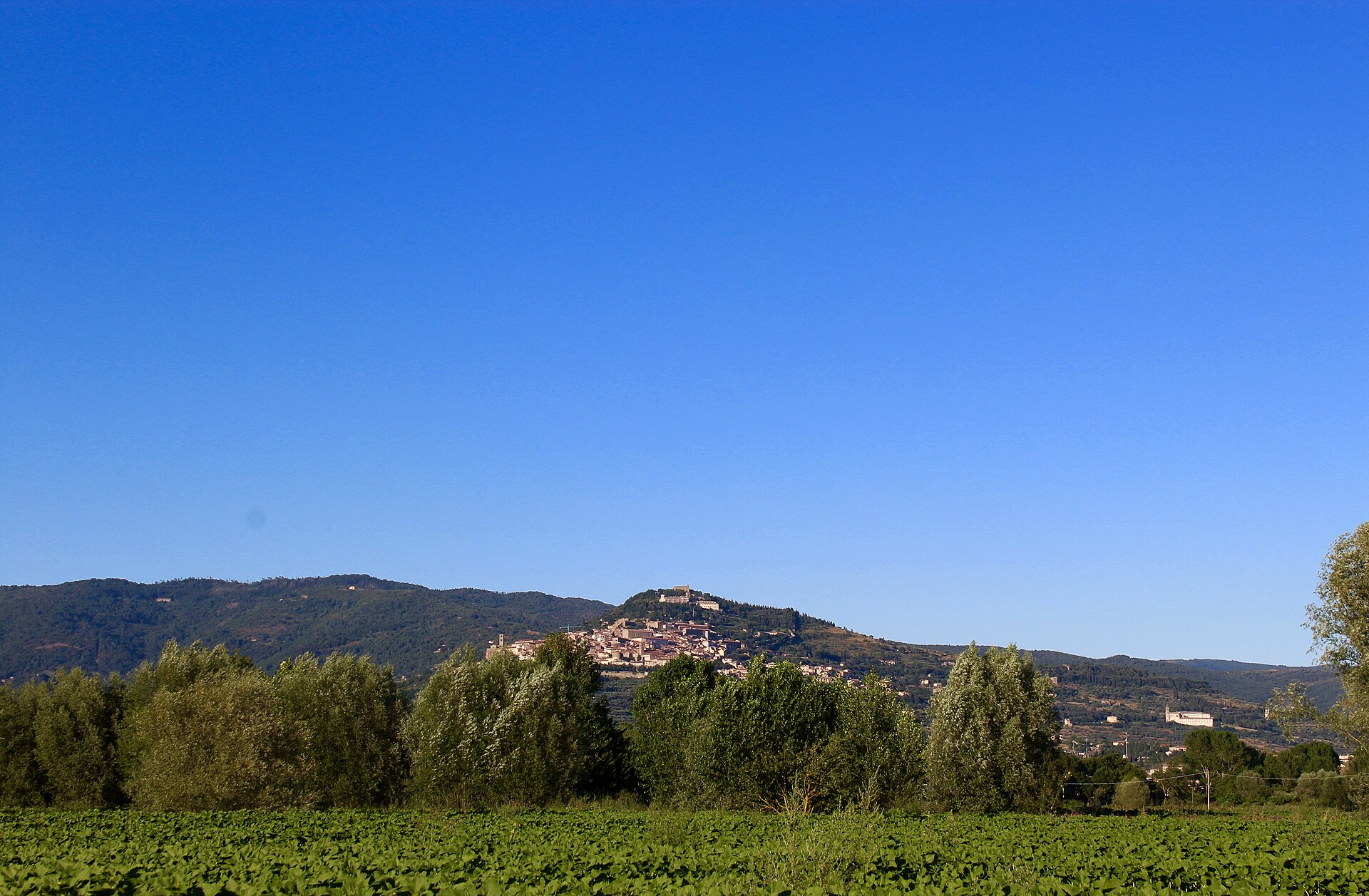
Two under-rated options worth adding to your shortlist are Bologna, 37 minutes away by high-speed rail, and Cortona, the quietest hill town on this list.
The last weekend of May is Cantine Aperte, when Movimento Turismo del Vino estates across Chianti open their cellars — most of them within an hour of the city. Our guide to Florence in May covers how to do it without driving.
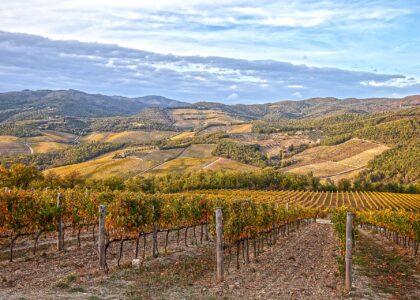
Chianti is never better than in September — heavy vines, gold light and tastings run by the people actually bringing the fruit in. Our guide to Florence in September has the booking windows and why two cellars beat five.
Hiring a car for Tuscany is often the right call — the mistake is bringing it into Florence. Our guide to the Florence ZTL and parking explains how to keep the car and the city apart, and which other Tuscan towns have their own cameras.
For Siena, the journey decides the day more than people expect: the rapid coach drops you at the walls, the train in the valley below. Our guide to getting from Florence to Siena compares the two, with the Sunday timetable that changes the answer.
Florence as a Base: Why It Works So Well
Florence sits at the geographic and cultural heart of central Italy, and no other city on the peninsula gives you such effortless access to such variety within a single day’s reach. Within two hours of Firenze Santa Maria Novella station — the city’s main rail hub, a ten-minute walk from the Duomo — you can be standing in a medieval walled city, hiking between clifftop fishing villages above the Ligurian Sea, tasting Brunello wine in a Montalcino cantina, or eating tortellini in Bologna’s ancient porticoed streets. The day trips from Florence available to you are, without exaggeration, some of the finest single-day excursions in all of Europe.
This is not an accident of geography. The Romans built roads from here. The Medicis built political connections that mapped onto the same routes. The modern Italian rail network — Trenitalia and Italo both using Firenze SMN as a major interchange — has made those same distances conquerable before breakfast. Pisa is 48 minutes by regional train. Bologna is 35 minutes by high-speed Frecciargento. Siena is 75 minutes by direct bus. Even the dramatic coastline of Cinque Terre, which feels like it belongs to a different Italy entirely, is reachable in under three hours.
This guide covers eleven of the best destinations reachable as Florence side trips, with honest assessments of what each one demands in time and energy, how to get there without a car, and what you will regret missing. There is also a full practical section and ten-question FAQ at the end for quick reference when you are mid-planning. For everything you need to know about getting around the city itself before you set out, see our Getting Around Florence guide. For deciding how many days to base yourself here in the first place, the Florence Travel Planning Guide covers that in detail.
Quick Comparison: Day Trips from Florence at a Glance
| Destination | Travel Time | Best Transport | Minimum Time Needed | Difficulty |
|---|---|---|---|---|
| Siena | 75 min (bus) / 80 min (train) | Rapida bus or train | 4–6 hours | Easy |
| Chianti Wine Region | 30–60 min depending on village | Car or guided tour | Half day to full day | Easy (if guided) |
| Cinque Terre | ~2.5 hrs (train to La Spezia) | Train | Full day (8–10 hrs there) | Demanding |
| Pisa | 48–60 min (train) | Train | 3–4 hours | Very easy |
| San Gimignano | ~1.5 hrs (bus via Poggibonsi) | Bus | 3–4 hours | Easy |
| Lucca | ~80 min (train) | Train | 4–5 hours | Very easy |
| Val d’Orcia | ~1.5 hrs (car) | Car or guided tour | Full day | Moderate (by car) |
| Cortona | ~1 hr (train) | Train | 4–5 hours | Easy |
| Bologna | 35–40 min (high-speed train) | Freccia train | 4–6 hours | Very easy |
| Arezzo | ~1 hr (train) | Train | 3–5 hours | Easy |
Siena: The Rival Republic
If you make only one day trip from Florence, make it Siena. The two cities spent centuries as bitter enemies — Siena was a Ghibelline stronghold while Florence backed the Guelphs, and they fought actual pitched battles over the rolling hills that separate them. That rivalry produced something remarkable: two of the finest medieval city centres in Italy, just 70 kilometres apart, each completely distinct in character. Florence dazzles with Renaissance grandeur. Siena enchants with something darker, more intimate, and more medieval — a city that feels almost untouched since the Black Death of 1348 halted its expansion mid-stride.
What to See in Siena
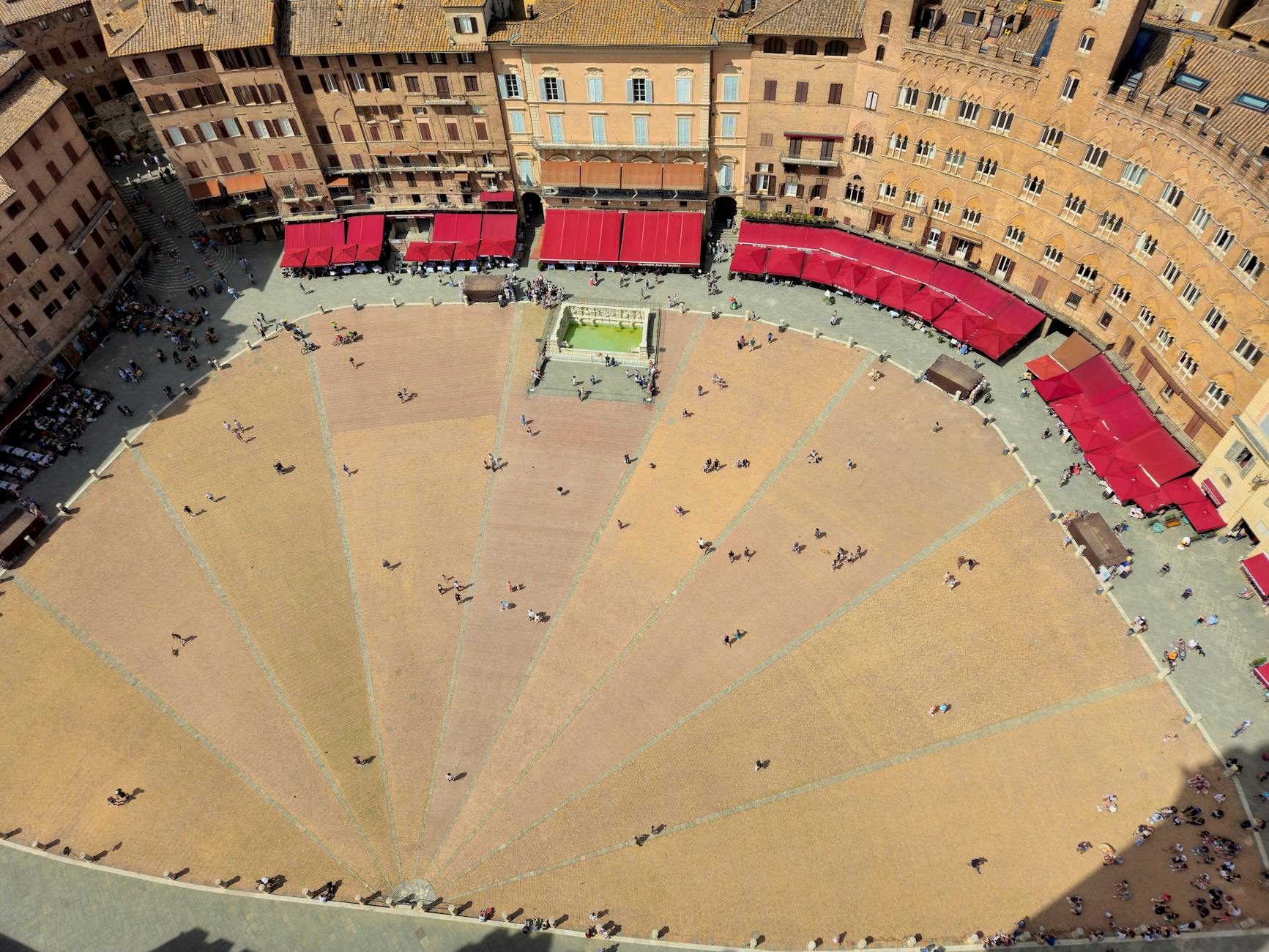
The city organises itself around Piazza del Campo, one of the great public spaces of the world. It is fan-shaped, slightly concave — sloping gently down toward the Palazzo Pubblico like a shallow bowl — and paved in a herringbone pattern of brick that radiates outward in nine segments, representing the nine consuls who governed medieval Siena. Twice a year, in July and August, this square becomes the track for the Palio, a bareback horse race that has been run since the 13th century and reduces the entire city to a fever pitch of neighbourhood rivalry. On any ordinary day, it is simply a sublime place to sit and drink coffee. Find a cafe table on the curved outer edge and stay longer than you planned.
From the Campo, walk uphill five minutes to the Siena Cathedral (Duomo di Siena), and prepare to revise your expectations of what a cathedral can look like. The facade is wrapped in alternating bands of green and white marble — a Tuscan Gothic confection that makes the building look almost impossibly theatrical. Inside, the floor is a masterpiece of inlaid marble narrative panels, partially covered for protection (the sections on display rotate seasonally). The adjoining Piccolomini Library contains a complete cycle of brilliantly coloured frescoes by Pinturicchio depicting the life of Pope Pius II. Budget at least an hour here alone.
Climb the Torre del Mangia (€15, book online) for the definitive view over the Campo and the city’s terracotta roofscape stretching to the Tuscan hills — 503 steps, no lift, completely worth it. Then walk downhill to Basilica San Domenico, a large brick Gothic church containing the preserved head and thumb of St Catherine of Siena, Siena’s patron saint and one of the two patron saints of Italy. It is a genuinely strange experience, displayed in a golden reliquary, but one that tells you something important about medieval devotion that no museum exhibit quite replicates.
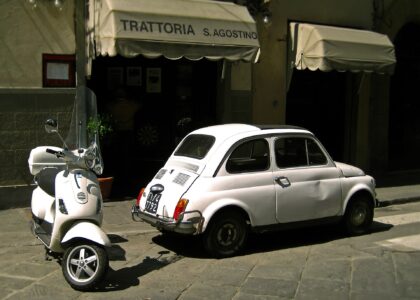
For food, the area around the Campo is well-supplied with trattorias serving Sienese specialities: pici (thick hand-rolled pasta) with wild boar ragù, ribollita, and the city’s extraordinary panforte — a dense, spiced fruit-and-nut cake that has been made here since the 13th century and travels home well as a gift.
Getting from Florence to Siena
The fastest and most convenient option is the Rapida bus run by Tiemme (also marketed as Sena), which departs from the bus terminal outside Florence SMN and arrives directly in Siena’s Piazza Gramsci (close to the city centre) in approximately 75 minutes. Buses run regularly throughout the day; a return ticket costs around €14–18. No advance booking needed, but buy your ticket at the station or online rather than on board.
Alternatively, regional trains from Firenze SMN run via Empoli to Siena station in around 80–90 minutes. Note that Siena’s train station is at the bottom of the hill, requiring a bus or uphill walk (about 20–25 minutes) to reach the centre. For this reason, most experienced visitors prefer the bus. Validate your regional train ticket in the yellow machine on the platform before boarding — fines for unvalidated tickets are €50+. See our Getting Around Florence guide for more on validating train tickets.
Allow: 4–6 hours minimum. A full day is better. Best for medieval history lovers, architecture enthusiasts, and anyone who wants to understand how Italy was before the Renaissance reordered its priorities.
Chianti Wine Region: Tuscany Excursions Through the Vine Country
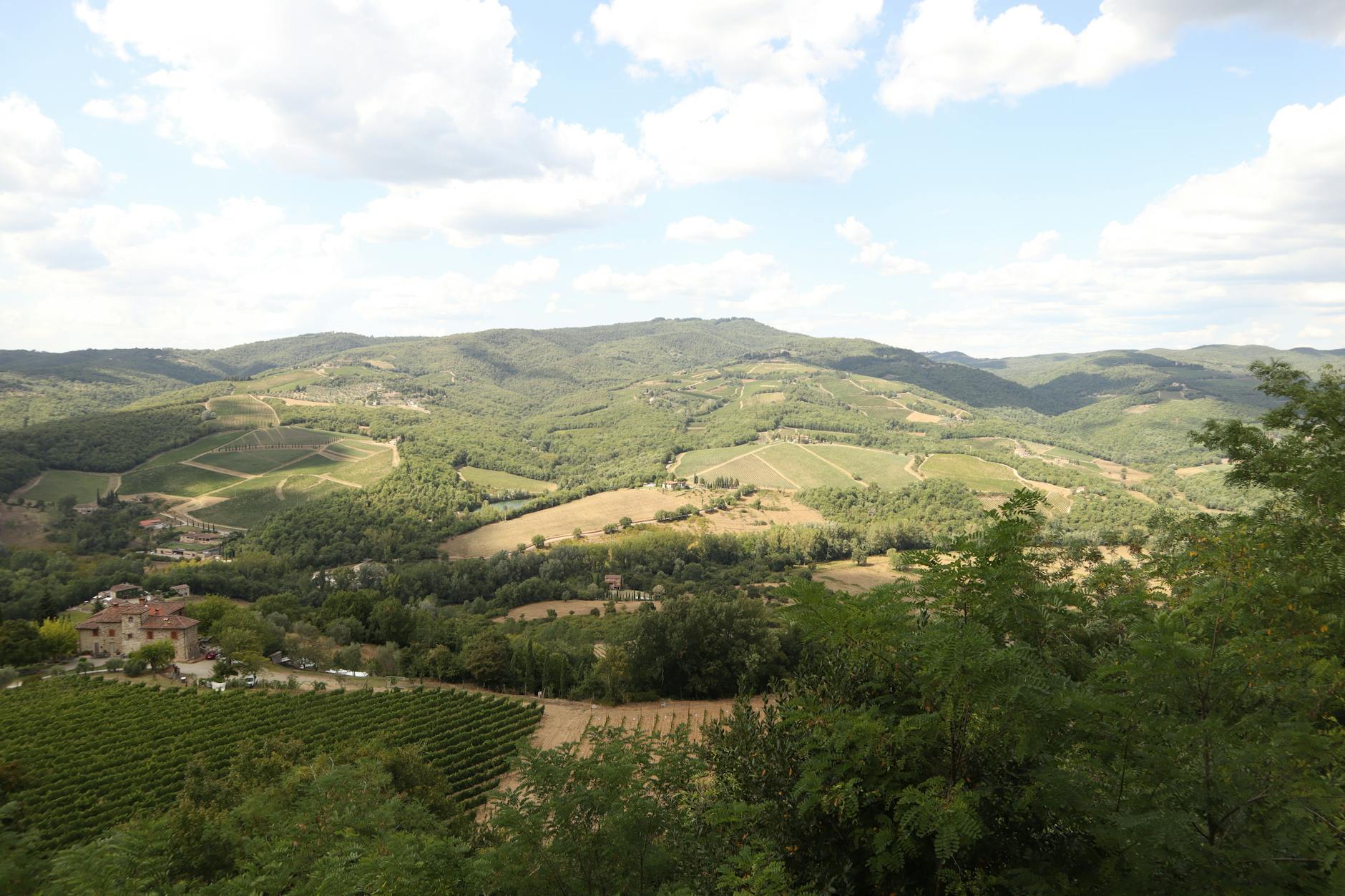
The hills between Florence and Siena constitute one of the most beautiful wine landscapes on earth. This is Chianti Classico territory — the heartland of the black rooster-labelled DOCG that has been producing Sangiovese-dominant reds since the Medici formally designated wine production zones in 1282, making this one of the world’s oldest legally defined wine regions. As Tuscany excursions go, a half-day or full day in Chianti is the one that most viscerally delivers the image of Tuscany that brought you to Italy in the first place: rolling green hills, cypress-lined gravel roads, stone farmhouses, and tables laid in the shade of pergolas laden with grapes.
The Route and the Villages
The spine of Chianti is the Via Chiantigiana (SR222), a winding two-lane road that runs from the Florence city limits through the heart of the region before arriving in Siena. Driving it end-to-end is a genuine pleasure — there is enough variety in the landscape, enough pull-off points for photographs, and enough villages to stop at that you could easily fill six to eight hours without rushing.
The main towns worth stopping in are:
- Greve in Chianti (30 km south of Florence) — the region’s unofficial capital and most accessible village. Its triangular piazza, named after Giovanni da Verrazzano who was born nearby, is surrounded by arcaded buildings housing wine shops, butchers selling Chianti’s famous finocchiona salami, and cafes. The enoteca in the central piazza is an excellent place to begin a wine education with a tasting paddle of four or five local reds. Roughly 45 minutes by car from Florence.
- Castellina in Chianti — a classic medieval hill town built around a 15th-century rocca (fortress), now housing an excellent wine cellar. The covered walkway along the town walls, the Via delle Volte, is one of Chianti’s architectural curiosities: a street that runs through the inside of the medieval fortifications, with arrow slits looking out over the valley. Approximately 45 km south of Florence.
- Radda in Chianti — smaller and quieter than Castellina, with a handsome main street lined with wine producers and a views terrace that looks straight out over a valley of vines. This is where Chianti’s most photogenic countryside concentrates.
Wine Tastings and What to Expect
Chianti Classico estates range from enormous industrial operations to tiny family-run properties of fifteen hectares where the owner pours the wines herself. For a day trip, the sweet spot is a mid-sized estate with a proper tasting room and the option to pair wines with local cheese and cured meats — which most offer. Expect to pay €15–30 per person for a structured tasting of three to five wines; cellars tours with tastings typically run €25–45. Book ahead, especially April through October. Estate websites usually offer direct booking; alternatively, the consortium website (chianticlassico.com) lists member producers by area.
Tastings typically follow a progression: a Chianti Classico base (minimum 12 months in oak, bright and tangy), a Chianti Classico Riserva (24 months oak, rounder and more structured), and often a Gran Selezione (the DOCG’s top tier, single-vineyard wines). Alongside the wine, expect platters of local pecorino at various stages of ageing, crostini with black truffle paste, and sliced finocchiona — fennel-seed salami that is one of the region’s most distinctive food products.
Getting to Chianti from Florence
Chianti is genuinely best explored by car. Public bus connections to Greve in Chianti exist (Autolinee Toscane bus from Florence, approximately 1 hour), but Castellina and Radda are barely served by bus and the landscape between villages — which is much of the point — is inaccessible without wheels. Car rental in Florence is practical (pick up at the airport or a city agency), but note that the ZTL camera network covers the historic centre and will issue automatic fines if you drive into restricted zones. Pick up your car from outside the ZTL. See the Florence Transportation Guide for complete ZTL advice.
The most stress-free option for a Chianti day trip without a car is a guided tour from Florence, of which there are many excellent options. Half-day tours (4–6 hours) typically visit one estate and one village; full-day tours (up to 11 hours) cover the entire Chianti Classico zone with multiple stops, lunch included. Prices for guided tours range from €65–130 per person. They solve the drink-driving problem, provide context, and handle all the logistics — strongly recommended if wine is the primary motivation for the trip. Our pillar guide to Florence tours and tickets weighs the day tours against everything else competing for the same budget.
Allow: Half day for a focused wine-and-village visit; full day (8–11 hours) for a comprehensive drive through the region. Best for wine lovers, foodies, and anyone who wants the quintessential rolling Tuscan hills experience. Pairs well with a night in an agriturismo if you have an extra day to spare.
Cinque Terre: The Five Villages on the Ligurian Coast
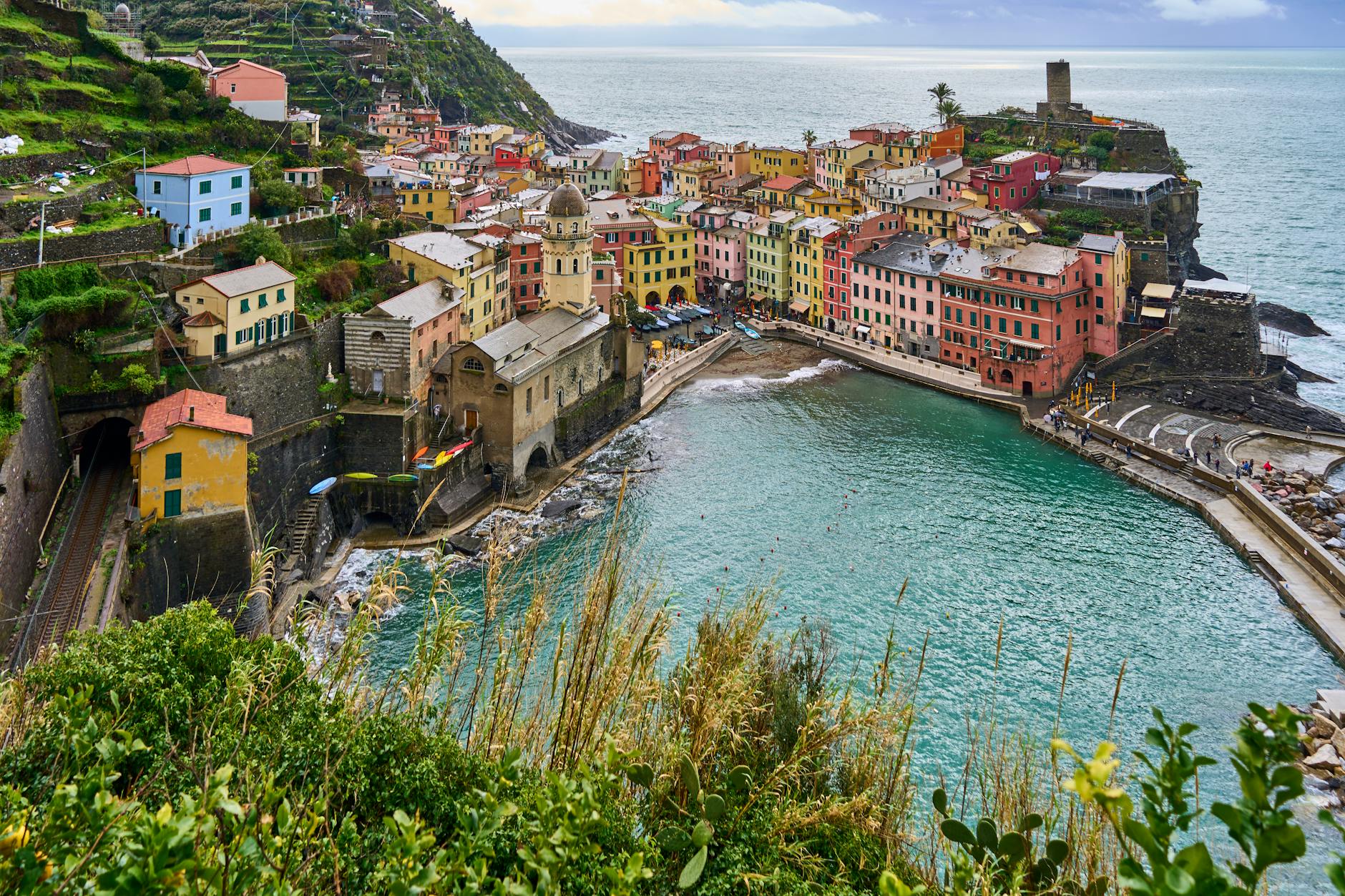
Let me be honest with you about Cinque Terre: it is one of the most beautiful places in Italy, and it is also one of the most demanding day trips from Florence on this list. The five clifftop fishing villages — Riomaggiore, Manarola, Corniglia, Vernazza, and Monterosso al Mare — cling to vertical Ligurian limestone above water so blue it looks artificially enhanced. Coloured houses stack up the cliff faces like tiles in a mosaic. The coastal hiking trail linking the villages passes through vineyards and olive groves with vertiginous drops to the sea below. It is, by any measure, extraordinary.
But the logistics are significant, and you deserve a clear picture before committing.
Getting There: The Honest Route
From Florence SMN, take a direct or one-change train to La Spezia Centrale — journey time approximately 2 hours 15 minutes to 2 hours 45 minutes depending on connections, with trains running regularly throughout the day. From La Spezia, the Cinque Terre Express (a local train that stops at all five villages) runs every 30 minutes or so and covers the full route in about 30 minutes. A Cinque Terre Card (€7.50–18.20 depending on inclusions) covers unlimited train travel between villages plus hiking trail access — buy it at La Spezia station.
If you leave Florence at 7:00 AM, you can arrive in Riomaggiore by 9:30 AM. If you leave at 8:00 AM, you are arriving at 10:30 AM, and summer crowds peak from mid-morning onwards. An early start is not optional — it is what determines whether your day feels like a dream or a disappointment.
The return journey works in reverse; the last trains from La Spezia to Florence run until around 9:00 PM, but the more comfortable option is to leave the villages by 5:30–6:00 PM, giving you around six to eight hours in the Cinque Terre. With travel added, you are looking at 13–15 hours door to door.
What to Do Once You Are There
Most day-trippers visit two or three villages. Riomaggiore and Manarola are the southernmost and visually the most dramatic — narrow main streets plunging straight to the sea, with fishing boats pulled up on the rocks. Vernazza, roughly in the middle, has the only true harbour and a small beach, and its piazza looking out over the water is one of Cinque Terre’s finest spots for a coffee. Monterosso al Mare, at the northern end, has the only proper sandy beach and the most resort-like atmosphere — it is the best option if children are involved.
The most famous hiking path is the Via dell’Amore (Lovers’ Lane) between Riomaggiore and Manarola — a paved clifftop walkway that was partially closed for rockfall repairs for years and has reopened in sections. Check current status before arriving, as conditions change seasonally. The more demanding trail network through the upper Cinque Terre, above the villages, is spectacular and substantially less crowded; allow 3–5 hours for the full traverse and wear proper trail shoes.
Summer Crowds: A Realistic Warning
July and August in Cinque Terre are genuinely overwhelming. The villages are not large — Corniglia has around 150 permanent residents — and daily summer visitor numbers routinely exceed local capacity. The Italian government has at various times restricted access and introduced timed entry systems for the most popular sections. The shoulder season (April to mid-June, September to October) is when Cinque Terre is at its best: warm enough for swimming, uncrowded enough that you can actually sit at a table in Vernazza’s piazza without queueing.
Allow: Full day minimum — 6+ hours in the villages requires leaving Florence by 7:00–7:30 AM. Best for coastal scenery lovers, hikers, and photographers. Not recommended in peak summer without booking ahead and arriving before 9:30 AM.
Pisa: More Than a Leaning Tower

Pisa is the easiest of all the day trips from Florence — just 48 to 60 minutes by regional train from Firenze SMN, with services running approximately every 30 minutes throughout the day. Return tickets cost around €8–12 (regional, no advance booking needed). The combination of proximity and the sheer fame of what awaits makes Pisa a near-universal fixture on Florence itineraries, though it often gets dismissed as a half-day obligation rather than a genuine pleasure. That undersells it.
Piazza dei Miracoli
The Piazza dei Miracoli (Field of Miracles) is one of those rare tourist sites that genuinely exceeds expectations. Four monumental buildings — the Leaning Tower, the Cathedral (Duomo), the Baptistery, and the Camposanto (monumental cemetery) — are arranged across a vast lawn of improbably green grass, creating a composition that looks designed for drama. It was, in fact, the result of 200 years of medieval construction, beginning in 1064, and the ensemble has a coherence that individual photographs never quite convey.
The Leaning Tower (Torre Pendente) leans at approximately 3.97 degrees following engineering corrections made between 1990 and 2001 — it used to lean more and was heading toward collapse before straightening work reduced the angle by 47 centimetres. Climbing it (€18–20, advance booking strongly recommended) requires negotiating 251 steps on a spiral staircase that clings to the inner wall; the floor beneath you tilts noticeably as you walk, which is slightly disorienting and entirely memorable. The view from the top over the Arno plain is excellent.
The Duomo is a masterpiece of Pisan Romanesque architecture — façade encrusted with blind arcades, bronze doors cast by Bonanno Pisano, and an interior containing a Giovanni Pisano pulpit of extraordinary sculptural complexity. The Baptistery across the lawn is the largest baptistery in Italy, with astonishing acoustics: guides regularly demonstrate the echo, which sustains for up to seven seconds. The Camposanto is a Gothic cloister surrounding what legend says is earth brought from Calvary by the Crusaders; its walls once held famous 14th-century frescoes (the Triumph of Death) now preserved in the adjacent museum after wartime bomb damage.
A combined ticket for the Baptistery, Camposanto, and associated museums costs €8; add tower access separately. The Duomo itself is free with a (free) timed pass distributed at the entrance.
Combining Pisa with Lucca
Half a day is sufficient for Pisa’s Piazza dei Miracoli, leaving plenty of afternoon light for Lucca — only 20 minutes away by regional train. This Pisa-Lucca combination is arguably the best value two-city day trip from Florence, covering two very different but equally rewarding cities in a single outing. See the Lucca section below for what to do there.
Allow: 3–4 hours for Pisa alone; pair with Lucca for a complete day. Best for first-time visitors, families, and anyone who wants a manageable Tuscany excursion without logistical complexity.
San Gimignano: The Medieval Manhattan
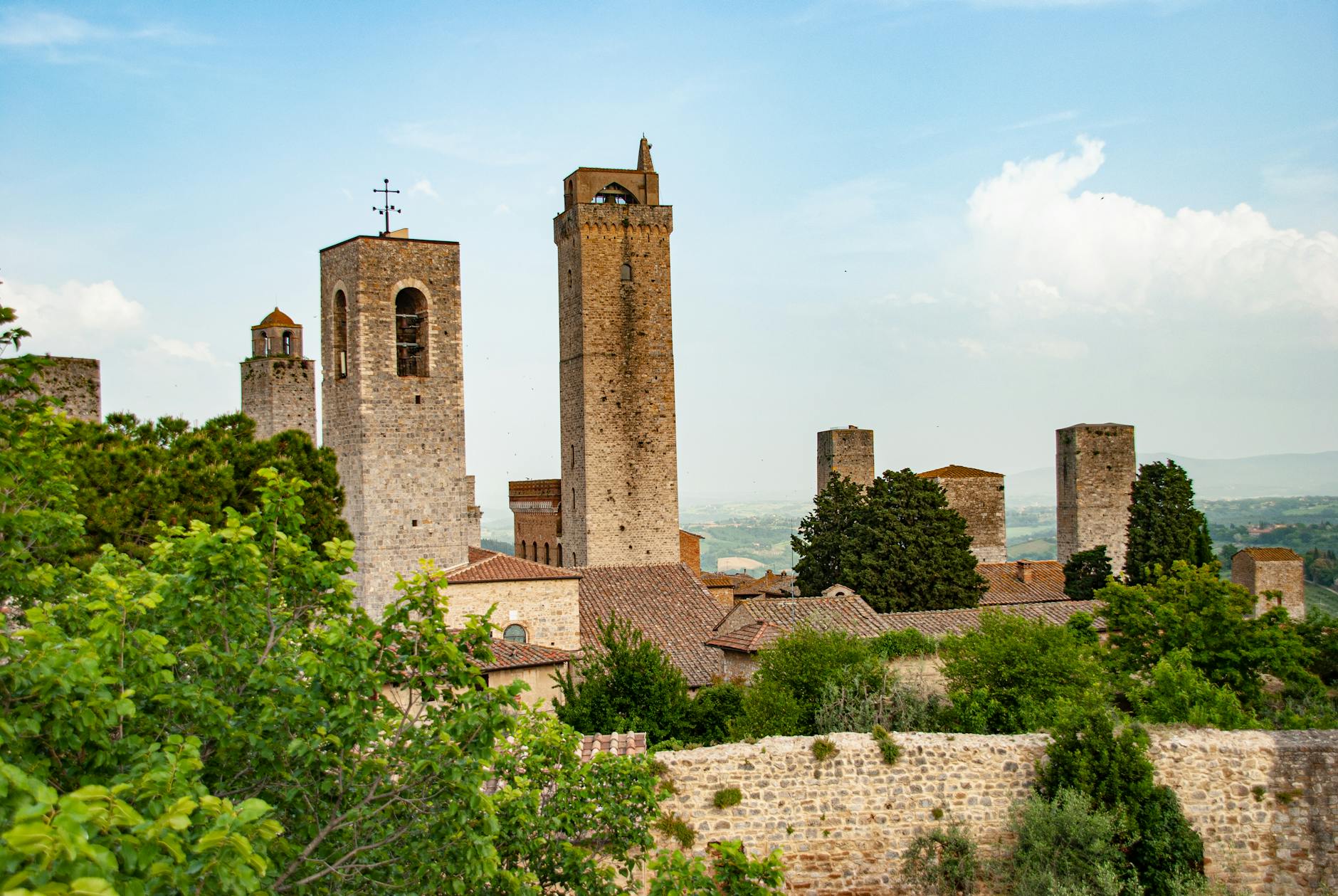
San Gimignano’s skyline is one of the most recognisable in Italy: 14 stone towers, the survivors of an original 72 built by competing noble families in the 12th and 13th centuries as expressions of wealth and power. From a distance, across the Val d’Elsa, the town looks like a miniature Manhattan dropped into a Tuscan hillside — an image so particular that it genuinely stops you mid-road the first time you see it. Inside the walls, the reality is more intimate: a single main street (Via San Giovanni) running uphill to Piazza della Cisterna, a perfectly formed medieval square built around a 13th-century well, with the towers looming above on all sides.
What to Do in San Gimignano
The town is compact enough to cover on foot in two hours, which should not discourage you from spending longer. Climb the Torre Grossa (the tallest surviving tower, €6), attached to the Palazzo del Popolo, for views across the Val d’Elsa and the valley of olive groves and vines below. The Collegiata, San Gimignano’s main church, contains some of the finest Gothic frescoes in Tuscany — a narrative cycle of Old and New Testament scenes by Bartolo di Fredi and Barna da Siena that covers almost every wall surface.
The singular non-medieval attraction is the Gelateria Dondoli in Piazza della Cisterna, which has won the World Gelato Championship twice and is, by any reckoning, one of the best gelaterias in Italy. The queue here can be long in summer, but it moves quickly, and the product justifies the wait. The saffron-with-pine-nut gelato, made with local Vernaccia wine and San Gimignano saffron (a local speciality since medieval times), is outstanding.
San Gimignano also produces a white wine worth seeking out: Vernaccia di San Gimignano, which was the first Italian wine to receive DOC status in 1966. Dry, mineral, and slightly nutty, it pairs beautifully with the local pecorino and cured meats available in the town’s food shops.
Getting There
There is no direct train to San Gimignano. The standard route from Florence is bus: take a bus or train to Poggibonsi, then transfer to a local bus to San Gimignano (a further 20–25 minutes). Total journey time from Florence is approximately 1 hour 15 minutes to 1 hour 45 minutes. Autolinee Toscane buses from Siena also serve the route. A car makes the trip faster and more flexible, especially if combining with nearby Volterra.
Allow: 3–4 hours for San Gimignano alone. Afternoon visits tend to be quieter after the tour groups depart (many leave by 4:00 PM). Best for medieval architecture enthusiasts and gelato lovers.
Lucca: The Walled City Worth a Full Day
Lucca is, by some margin, the most underrated city in Tuscany. It lacks the blockbuster appeal of Florence, the medieval drama of Siena, or the novelty of the Leaning Tower, and this is precisely its charm. Lucca is simply a very beautiful, very liveable small Italian city that happens to be entirely encircled by one of the finest sets of Renaissance walls in Europe — wide enough at the top to carry two lanes of tree-lined path, where Lucchesi families have walked, cycled, and picnicked since the walls were planted with oaks and ilexes in the 18th century.
Walking and Cycling the Walls
The Mura di Lucca are 4.2 kilometres in circumference, 30 metres wide at the ramparts, and intact from the 16th and 17th centuries when they were built as a fortification against Florentine aggression (Lucca remained an independent republic until 1847 — one of the last Italian city-states). Walking the full circuit takes about an hour at a comfortable pace; cycling it takes 30 minutes. Bike rental shops cluster near Piazzale Verdi (the western entrance) and Porta Santa Maria, with rates around €3–5 per hour. This is not a tourist gimmick — it is genuinely how Lucca residents spend a Sunday morning, and it is one of the most pleasant ways to arrive in any Italian city.
Inside the Walls
The most distinctive space inside the walls is Piazza dell’Anfiteatro, an oval piazza whose shape was determined by the Roman amphitheatre that once occupied the site — the medieval buildings that replaced it simply followed the ellipse of the original structure, creating a piazza that curves in on itself like no other in Italy. It is now ringed by cafes and restaurants; the aperitivo hour here is particularly fine, with chairs spilling into the oval under strings of lights.
Lucca is also a city of extraordinary churches. The Cattedrale di San Martino contains the Volto Santo, a crucifix believed since medieval times to be a true likeness of Christ carved by Nicodemus, which made Lucca one of the great pilgrimage destinations of medieval Europe. The asymmetrical facade — the right-hand arcade was squeezed by the pre-existing campanile — is a delightfully imperfect piece of Romanesque design. San Michele in Foro, built on the site of the Roman forum, has a tiered facade of loggias stacked four layers high, each decorated with carved columns of different patterns — no two columns are alike.
Lucca was the birthplace of Giacomo Puccini, and the city takes its operatic heritage seriously: the Puccini Museum in the composer’s birthplace on Corte San Lorenzo is small but well-curated, and the city hosts a dedicated Puccini festival in summer.
Getting There
Regional trains from Firenze SMN to Lucca take approximately 80–90 minutes, with a change at Pisa Centrale in most cases (some direct services exist). Tickets cost €8–12. Lucca’s station is just outside the city walls — from the station, the main gates are a five-minute walk. As noted above, the ideal strategy is to combine Lucca with Pisa for a complete day out: morning in Pisa (Piazza dei Miracoli), afternoon in Lucca (walls, Anfiteatro, churches), return train from Lucca station in the early evening.
Allow: 4–5 hours for Lucca alone; half day each for Pisa+Lucca combined. Best for history lovers, cyclists, food enthusiasts, and anyone who wants to experience an Italian city that has not been entirely consumed by tourism.
Val d’Orcia: UNESCO Landscape and the Great Tuscan Hill Towns
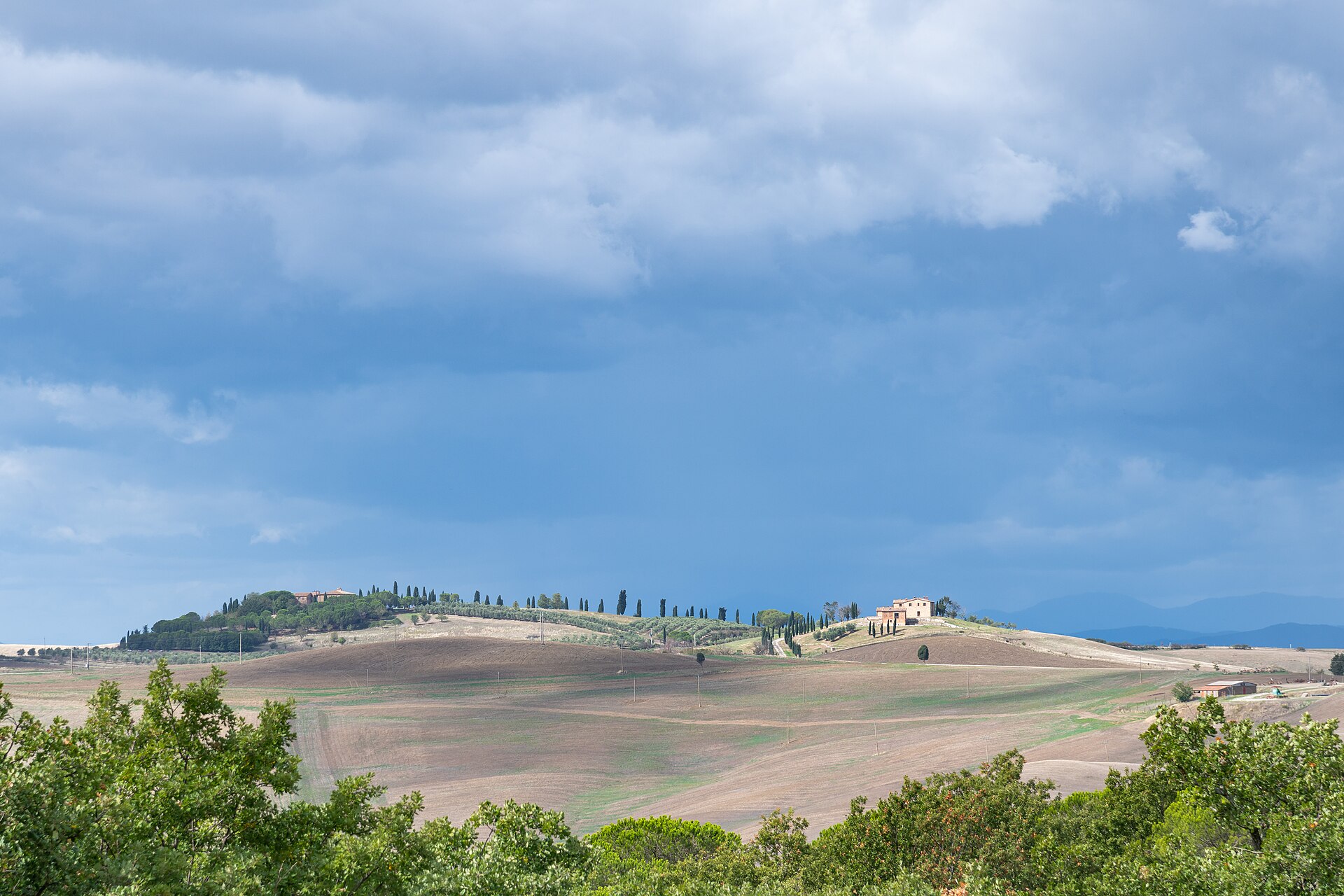
The Val d’Orcia — the valley of the Orcia River south of Siena — is the landscape that defines Tuscany in the collective imagination. Rolling clay hills the colour of café au lait, planted with wheat in spring (bright green turning to gold) and bare in autumn (the famous grey-brown crete senesi). Cypress trees marching in single file along ridge roads to isolated farmhouses. The occasional abbey or hill town emerging from the haze at the end of a straight white road. UNESCO awarded the Val d’Orcia World Heritage status in 2004, recognising it as a “Renaissance painting brought to life” — which sounds like hyperbole until you arrive and understand that it is simply accurate.
A day in Val d’Orcia requires a car (or an organised tour) and a full day. There are no meaningful public transport connections between the valley’s towns. But the rewards are substantial enough that it is the day trip most likely to stay with you permanently.
The Towns of Val d’Orcia
Pienza is the smallest and most perfect of the Val d’Orcia towns — a Renaissance planned city commissioned in the 1450s by Pope Pius II as a model of humanist urban design, built on the site of his birthplace village. The main street takes less than five minutes to walk end to end, but it is lined with the best pecorino di Pienza shops in Tuscany. This semi-aged sheep’s-milk cheese is one of Italy’s great dairy products; buy it fresh (fresco), medium (semi-stagionato), or aged (stagionato), or in the intriguing local variations aged in walnut leaves or red wine. The view from Pienza’s ramparts over the Val d’Orcia is the one on every Tuscan postcard.
Montepulciano (not to be confused with Montefalco in Umbria) is a larger, steeper hill town famous for Vino Nobile di Montepulciano, a Sangiovese-based DOCG red that is one of Tuscany’s trinity of great wines alongside Chianti Classico and Brunello di Montalcino. The town’s cantinas are built directly into the tufo rock beneath the streets; many are open for tastings and cellar tours. The main piazza — Piazza Grande — holds one of the region’s finest architectural ensembles. The climb to the top of the town is genuinely steep; wear comfortable shoes.
Montalcino, in the western Val d’Orcia, produces Brunello di Montalcino, widely considered one of Italy’s greatest red wines and one of the most age-worthy. The town itself is small and dominated by a 14th-century fortress (La Fortezza) whose inner hall has been converted into an enoteca serving Brunello and Rosso di Montalcino by the glass — a civilised way to taste without the formality of a full estate visit. Book estate visits in advance; the best producers (Biondi-Santi, Poggio di Sotto, Salvioni) are booked out weeks ahead.
Bagno Vignoni is one of the most unusual villages in Italy: its central piazza is not a square but a large thermal pool, the Vasca, built by the Medici and fed by volcanic springs at 51°C. You cannot swim in the piazza pool (it is a protected monument), but a thermal park below the village operates hot pools and spa facilities. The village is tiny, but the atmosphere — steam rising from the pool, medieval buildings on three sides — is genuinely remarkable and unlike anywhere else.
San Quirico d’Orcia, between Pienza and Bagno Vignoni, has a lovely Romanesque collegiate church and the Horti Leonini — a 16th-century Italian formal garden that remains largely unchanged, with box hedges, ilex trees, and a very quiet atmosphere that is the antithesis of tourist Tuscany.
Getting There
Val d’Orcia is approximately 1.5 hours from Florence by car, heading south on the A1 autostrada before diverting east toward Montalcino or Pienza depending on your itinerary. A full day gives you time to visit two to three towns comfortably; a rushed half-day to see only Pienza is possible but leaves you wanting more. Guided tours from Florence covering Val d’Orcia run at €75–130 per person and typically include two to three towns plus a wine tasting. For the foodie aspects of Val d’Orcia — the wines, the cheeses, the pici pasta — our Florence Food Guide provides broader context on Tuscan food culture.
Allow: Full day essential. A car is required unless booking a guided tour. Best for wine lovers, food enthusiasts, landscape photographers, and anyone who has specifically come to Italy for the Tuscan countryside.
Cortona: The Etruscan Hilltop Under the Tuscan Sun
Frances Mayes’s memoir Under the Tuscan Sun, published in 1996 and adapted into a film in 2003, brought Cortona to the attention of the English-speaking world, and the town has never quite recovered — or needed to. But Cortona’s appeal predates Mayes by several millennia: the city is one of the oldest in Italy, with Etruscan origins stretching back to at least the 7th century BC, and its defensive walls (partially still standing) are Etruscan construction. When you walk the steep lanes of Cortona and feel the particular quality of silence that settles here at dusk, you are experiencing a continuity of habitation that goes back well before Rome.
What to See
The town is arranged on a steep hillside above Lake Trasimeno and the broad Chiana Valley — the view from the upper town on a clear day extends across into Umbria. The hub of Cortona’s daily life is Piazza della Repubblica, a slightly irregular medieval square overlooked by the clock-towered Palazzo del Comune. From here, most attractions radiate outward within easy walking distance.
The MAEC (Museo dell’Accademia Etrusca e della Città di Cortona) is one of the best Etruscan museums outside Rome and Florence, housing a collection that includes the famous Etruscan lamp — a bronze chandelier of extraordinary craftsmanship dating to the 5th century BC — along with Egyptian artefacts (Cortona had an Egyptian craze in the 18th century), medieval paintings, and a comprehensive account of the city’s 2,700-year history. Entry is €10; allow 90 minutes.
The Diocesan Museum contains Fra Angelico’s Annunciation — a painting so luminously beautiful that people make detours of hundreds of kilometres to see it. If you have ever seen a reproduction and wondered whether the original justifies the journey, the answer is yes, unequivocally.
Walk uphill above the town to the Fortezza Medicea (partially open) and the church of Santa Margherita for the single best view in the area — Lake Trasimeno glittering to the south, the Chiana Valley spreading east, and, on the clearest days, the mountains of Umbria beyond.
Getting There
Regional trains from Firenze SMN to Camucia-Cortona station take approximately 55–70 minutes. From the station (which is in the valley town of Camucia, not Cortona itself), a local bus (Line 1, running every 30 minutes or so) connects to the hilltop town in about 10 minutes. Alternatively, taxis wait outside the station. The combination is straightforward and does not require any advance planning; just validate your train ticket before boarding.
Cortona pairs naturally with Arezzo (30 km north, on the same train line) for a two-town day. See the Arezzo section below. Together, they make one of the most satisfying two-city day trips from Florence.
Allow: 4–5 hours for Cortona alone. Best for history enthusiasts, art lovers, and anyone specifically drawn by the Etruscan heritage or the Fra Angelico Annunciation.
Bologna: Italy’s Food Capital by High-Speed Train

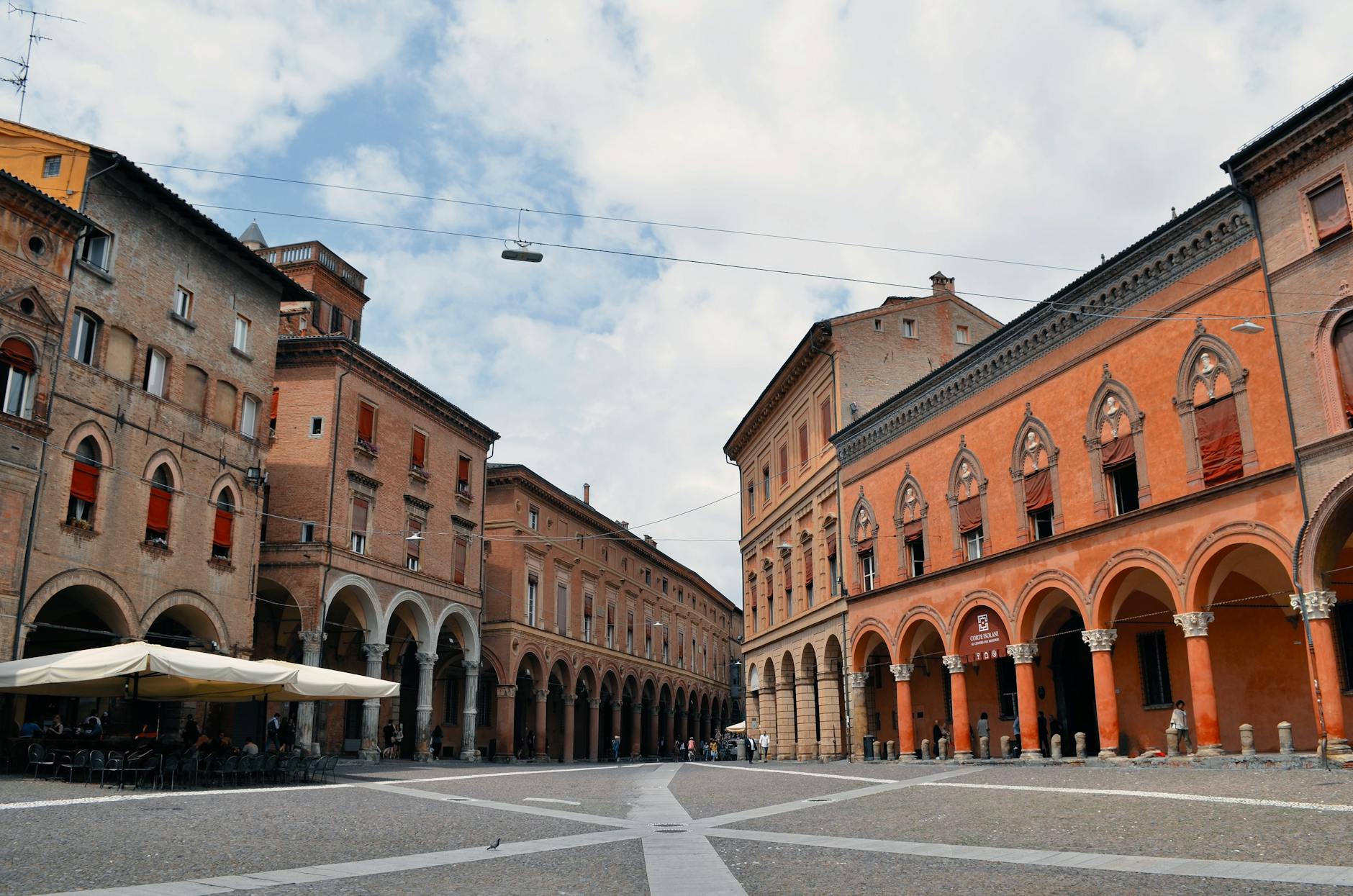
Bologna is the day trip that most Florence visitors have not considered and the one that, once you have done it, you immediately wish you had allocated two days. The city is only 35–40 minutes from Florence by Frecciargento or Frecciarossa high-speed train — a journey that costs €15–30 depending on advance booking and makes Bologna as accessible as Pisa, if not more so. Yet it is a radically different experience from any of the Tuscan hill towns: Bologna is a living, working, modern Italian city with a two-thousand-year history, a university founded in 1088 (the oldest in the Western world), 38 kilometres of medieval covered arcades (the longest portico network in the world, now a UNESCO World Heritage Site), and a culinary tradition that has earned it the title La Grassa — the Fat One.
What to See and Do
Start at Piazza Maggiore, Bologna’s vast central square, dominated by the unfinished facade of the Basilica di San Petronio — the fifth largest church in the world, built from red brick because the city ran out of money before it could apply the marble facing. The Neptune Fountain on the square’s western edge is a triumph of Mannerist bronze-casting by Giambologna (a Flemish sculptor who spent his career in Florence — his Italian name is a tribute to his adopted city).
The Due Torri (Two Towers) are Bologna’s most photographed landmarks — two medieval towers that once numbered among 180 such structures built by the city’s competing noble families, the same civic rivalry that produced San Gimignano’s skyline. The taller, the Asinelli Tower, can be climbed (€5, ~500 steps) for a remarkable view over the terracotta roofscape that justifies Bologna’s other nickname, La Rossa — the Red One.
The Quadrilatero, the market quarter south of Piazza Maggiore, is one of the best food markets in Italy — a dense grid of medieval lanes where butchers, fishmongers, cheesemongers, pasta makers, and wine shops have traded continuously since the Middle Ages. This is where you find the real Bolognese kitchen: mortadella hanging in whole loaves the size of footballs, fresh tagliatelle nests piled in pasta shop windows, towers of aged Parmigiano Reggiano, and jars of traditional balsamic vinegar priced accordingly (proper Aceto Balsamico Tradizionale di Modena, aged 12–25 years, costs €40–100 for 100ml and is worth every cent).
The hidden gem of Bologna that every local knows: Via Piella and its finestra sul Canale — a small window in a wall that frames a view of one of Bologna’s hidden canals. The city had an extensive canal system built by the medieval university; most were covered in the 20th century, but this tiny window reveals the water still flowing beneath the streets, with coloured buildings reflecting on its surface. It sounds modest. The queue of people wanting a photograph of it suggests otherwise.
Eating in Bologna: The Main Event
No trip to Bologna is complete without eating, and the choices are specific: tortellini in brodo (tiny hand-folded pasta in capon broth — the definitive version of a dish Florentines think they do well), tagliatelle al ragù bolognese (wider than you expect, dressed with a meat sauce that contains no tomato in its original version and very little liquid — nothing like what the world calls Bolognese), and a plate of mortadella cut to order, thick enough to eat in slices rather than shavings. For a proper lunch, any of the trattorias on and around Via Pratello or in the university quarter will serve all three. Budget €25–40 per person for a full three-course lunch with wine. For context on how Tuscan and Emilian food traditions differ, our Florence Food Guide covers the Florentine side of the comparison.
Allow: 4–6 hours minimum. The high-speed train means you could feasibly leave Florence at 9:00 AM, arrive by 9:40 AM, have a full day’s exploration and lunch, and be back in Florence for dinner. Best for food lovers, history enthusiasts, and architecture admirers.
Arezzo: Florence’s Most Overlooked Neighbour
Arezzo is the city that Florentines go to when they want to escape Florence tourists, which tells you something. It is a substantial town — population around 100,000 — with a well-preserved medieval and Renaissance centre, one of the most important fresco cycles in Italy, a setting that millions of cinema-goers recognise without knowing its name, and a monthly antique market that draws dealers from across Europe. Despite all of this, it barely appears on most Florence itineraries. The journey is approximately one hour by regional train from Firenze SMN, tickets cost €7–10 return, and the experience is entirely different from the Tuscan hill towns — more urban, more lived-in, and considerably less crowded.
The Frescoes of Piero della Francesca
The primary reason serious art pilgrims make the journey to Arezzo is the Basilica di San Francesco, which contains the Legend of the True Cross fresco cycle by Piero della Francesca, painted between 1452 and 1466. These are among the most important paintings of the Italian Renaissance — a sequence of twelve scenes narrating the legendary history of the cross of Christ, from the death of Adam through the Emperor Constantine’s vision before battle to the discovery of the cross by St Helena. Piero’s use of light — flat, even, almost sourceless, creating a quality of stillness that feels neither day nor night — is unlike anything else in 15th-century painting and has influenced artists from Seurat to Luca Signorelli to David Hockney.
Access to the frescoes is timed and ticketed (€8, advance booking at the basilica website recommended), with groups limited to 25 people for 30-minute viewing windows. This is not a crowd-management inconvenience — it is the reason the frescoes survive.
Piazza Grande and the Antique Market
Piazza Grande is one of the most dramatic squares in Tuscany — steeply sloping, surrounded by loggie, medieval towers, and Renaissance palazzi at wildly different levels, framed at the top by Giorgio Vasari’s elegant 16th-century loggia. Roberto Benigni filmed key scenes of Life is Beautiful here, and the square has the same quality on screen as in person: a layered, improbable, very Italian architectural confection.
On the first weekend of every month, Arezzo’s Antique Market (Fiera Antiquaria) fills Piazza Grande and the surrounding streets with 600 dealers selling antique furniture, ceramics, prints, jewellery, textiles, and objects of every period from the Renaissance to the 1970s. It is one of the largest antique markets in Italy and one of the oldest, having run continuously since 1968. If your Florence visit happens to coincide with the first Saturday or Sunday of the month, Arezzo deserves a full day.
Allow: 3–5 hours for Arezzo alone; pair with Cortona for a complete day. Best for art history enthusiasts, antique hunters, and anyone who wants an authentic Italian city experience away from the tourist trail.
Practical Tips for Day Trips from Florence
Train Travel: Everything You Need to Know
The majority of day trips from Florence are best done by train, and the Italian rail system is genuinely good once you understand a few rules that catch visitors out regularly.
Validate regional tickets. If you buy a regionale or regionale veloce ticket (as opposed to a Freccia high-speed ticket), you must stamp it in the yellow validation machines on the platform before boarding. Freccia and Intercity tickets with reserved seats do not require validation (the seat reservation serves as validation). Fines for unvalidated regional tickets are €50 minimum. This is the single most consistent mistake made by visitors to Italy.
Trenitalia vs Italo. Both operators run services from Florence. Trenitalia is the national operator and serves the full network including regional trains; Italo only operates high-speed routes (Bologna, Rome, Venice, Naples). For Bologna, compare prices on both — Italo is often cheaper for early-booked advance fares. For Pisa, Lucca, Siena, Cortona, and Arezzo, Trenitalia is your only option.
Book Freccia trains in advance. High-speed Frecciarossa and Frecciargento services to Bologna (and beyond) have advance-purchase fares that are significantly cheaper than walk-up prices. A Florence-Bologna-Florence return booked two weeks ahead can cost €25–35 total; the same journey bought on the day costs €50–80. Regional trains to destinations like Pisa, Lucca, Arezzo, and Cortona are always the same price regardless of when you buy and require no advance booking.
Buy tickets at the station or online. The Trenitalia app and website (trenitalia.com) and the Italo app (italotreno.it) both work well. At Florence SMN, the ticket hall has a combination of staffed windows (queues can be long) and self-service machines (faster, accept credit cards). Platform information is posted on large departure boards and updated to the minute.
Car Rental: When and How
For destinations like Chianti and Val d’Orcia, a car is either necessary or strongly preferable. Renting in Florence has one critical complication: the city’s ZTL (Zona a Traffico Limitato) camera network. The ZTL covers the entire historic centre and issues automatic fines to any vehicle without a registered permit. Pick up your rental car from a location outside the ZTL — the airport, or agencies on the Viale outside the centre — and do not drive into the historic area under any circumstances. See our full Florence Transportation Guide for ZTL maps and advice.
Parking in Tuscan hill towns is generally in designated car parks just outside the medieval walls (ZTL regulations protect most hill towns too). Follow the blue P signs. Rates are typically €1.50–3.00 per hour. Many car parks are attended by unofficial “parcheggiatori” who may wave you into spots — you are not obliged to pay them, though small coins are customary.
Organised Tours vs. Independent Travel
For destinations well-served by train (Pisa, Lucca, Bologna, Arezzo, Cortona, Siena), independent travel is easy, flexible, and cheaper than organised tours. For Chianti, Val d’Orcia, and San Gimignano, organised tours eliminate transport logistics and often include guide commentary and meals that significantly enrich the experience. For Cinque Terre, an organised tour adds no particular value — the destination is self-explanatory and transport is straightforward.
When booking organised tours, look for small-group options (maximum 8–12 people) rather than coach tours — the difference in quality of experience is considerable. Reputable operators include Context Travel (scholarly guides, small groups) and Walks of Italy, among many others.
What to Pack for Day Trips
For walking-heavy day trips (Siena, San Gimignano, Cortona, Cinque Terre trails): comfortable, broken-in walking shoes or trainers. Not flip-flops; not new shoes. The cobblestones of Siena’s Piazza del Campo are smooth enough to be slippery, and the hiking trails of Cinque Terre are genuinely rocky. A small daypack with water (€0.50 at any supermercato, €3 at tourist sites), sunscreen, and a light rain layer covers all contingencies.
For churches: carry a scarf or light jacket to cover bare shoulders and knees. Italian churches still enforce dress codes, and being turned away at the door of the Siena Cathedral after a 75-minute bus journey is an entirely preventable disappointment.
Seasonal Considerations
Spring (April–May) and early autumn (September–October) are the ideal seasons for most Tuscan day trips. Temperatures are comfortable, the landscape is at its most photogenic (spring wildflowers in Val d’Orcia; autumn harvest colours in Chianti), and crowds are manageable. The exception is Cinque Terre, which should be approached with caution at any time from June to September.
Summer (June–August): heat and crowds peak simultaneously. Arrive at all destinations early (before 10:00 AM), carry substantial water, and plan to be inside or shaded during the 1:00–4:00 PM hottest hours. Many sites close for midday break in summer anyway, reinforcing this pattern.
Winter (November–February): most sites are open with shorter queues, prices are lower, and the Tuscan light in winter has a particular quality that photographers seek out. Val d’Orcia can be magical under frost. Downsides: some agriturismo and smaller estates close entirely, Cinque Terre hiking trails may be closed after rainfall, and some San Gimignano shops and restaurants close for a winter break. Bologna and Arezzo are excellent year-round city destinations that do not vary significantly by season.
For a complete overview of the best time to visit Florence and the surrounding region, see the Florence Travel Planning Guide, which covers seasonal weather patterns and crowd levels in detail. If you are still deciding what to do during your days in the city itself — before or after your day trips — our Things to Do in Florence guide covers the full range of city experiences, and the Florence Museums & Art Guide covers pre-booking for the Uffizi, Accademia, and other major sites.
Frequently Asked Questions: Day Trips from Florence
What is the best day trip from Florence?
Siena is widely considered the single best day trip from Florence, combining extraordinary medieval architecture (Piazza del Campo, the Cathedral, Torre del Mangia), excellent food and wine, and manageable logistics — direct bus in 75 minutes from Florence. For wine lovers, a Chianti wine tour is the top choice. For something completely different within the same rail pass, Bologna by high-speed train (35 minutes) offers Italy’s finest food city in a compact, highly walkable package. The “best” trip ultimately depends on your interests: medieval cities (Siena, San Gimignano, Cortona), coastal scenery (Cinque Terre), food and wine (Chianti, Val d’Orcia, Bologna), or art history (Arezzo, Cortona).
Can you do Cinque Terre as a day trip from Florence?
Yes, but it is the most demanding day trip from Florence on the list. The train journey to La Spezia takes approximately 2 hours 15 minutes to 2 hours 45 minutes each way, meaning you spend around 5–6 hours travelling for a day out. To make it worthwhile, leave Florence by 7:00–7:30 AM to arrive at the coast by 9:30 AM, giving you 6–7 hours in the villages before the return journey. In summer (June–August), the crowds are severe and arrival before 10:00 AM is not optional. Many experienced travellers recommend spending one night in Cinque Terre instead, which transforms the experience entirely — the coast at dawn and after the day-trippers leave is incomparably beautiful.
How do you get from Florence to Siena?
The best way is the Rapida express bus (operated by Tiemme/Sena) from the bus terminal adjacent to Florence SMN station, which reaches Siena’s Piazza Gramsci (near the city centre) in approximately 75 minutes. Return tickets cost €14–18. Buses run regularly throughout the day; no advance booking is needed. The alternative is the regional train from Firenze SMN (via Empoli), taking 80–90 minutes, but Siena’s station is at the bottom of the hill and requires a connecting bus or uphill walk to reach the centre — making the direct bus preferable for most visitors.
Is Pisa worth visiting as a day trip from Florence?
Yes, absolutely. Despite Pisa’s reputation as a one-monument destination, the Piazza dei Miracoli is a genuinely spectacular ensemble of medieval architecture — the Leaning Tower, Duomo, Baptistery, and Camposanto together are more impressive than any individual attraction. The journey is only 48–60 minutes by regional train, making Pisa the easiest and most accessible day trip from Florence. Half a day is sufficient for the Piazza dei Miracoli, making Pisa ideal to combine with Lucca (20 minutes by train): morning in Pisa, afternoon in Lucca, return to Florence for dinner.
What are the best wine tours from Florence?
The Chianti Classico wine region, directly south of Florence along the Via Chiantigiana scenic road, is the most accessible and varied wine touring destination from the city. Half-day guided tours visit one or two estates and a village; full-day tours cover the entire Chianti Classico zone with multiple tastings and lunch. For the greatest Tuscan wines (Brunello di Montalcino, Vino Nobile di Montepulciano), Val d’Orcia is the destination — a full day by car or guided tour, approximately 1.5 hours south. Book estate tastings in advance, particularly in spring and autumn. Small-group specialist wine tours from Florence start at around €65–80 per person for a half day.
Are there free day trips from Florence?
The train fare is unavoidable, but several day trip destinations have free entry to key sights. In Lucca, walking and cycling the city walls is free, Piazza dell’Anfiteatro is a public square, and many of the smaller churches are free to enter. In Siena, wandering the Piazza del Campo costs nothing. In Arezzo, Piazza Grande is a public space and walking the historic centre is completely free — only the Basilica di San Francesco frescoes require a ticket (€8). In Bologna, the porticoes, Piazza Maggiore, and the city streets are all free; the Two Towers charge for climbing but can be admired from the outside. The most budget-friendly day trips from Florence are therefore Lucca, Bologna, and Arezzo.
Which day trips from Florence can be done by train?
Most of Florence’s best day trips are accessible by train. Directly reachable by train from Firenze SMN: Pisa (48–60 min), Bologna (35–40 min by high-speed), Lucca (~80 min, usually change at Pisa), Arezzo (~1 hr), Cortona/Camucia station (~1 hr), and Cinque Terre (via La Spezia, ~2.5 hrs). Siena is best reached by bus rather than train (75 min direct bus vs 80–90 min train with station at the bottom of the hill). San Gimignano requires a bus connection from Poggibonsi. Chianti and Val d’Orcia require a car or guided tour — public transport does not adequately serve the countryside between villages.
What are the best day trips from Florence for families with children?
Pisa tops the list for families — the Leaning Tower and the wide green lawns of Piazza dei Miracoli are instantly engaging for children, the journey is short (under an hour), and the whole visit can be done at a relaxed pace in half a day. Lucca is excellent for families, particularly for cycling the city walls — bike hire is cheap and the tree-lined ramparts circuit is completely flat and safe. San Gimignano appeals to children (towers, medieval atmosphere, world-class gelato at Gelateria Dondoli). Bologna’s food market and the Due Torri are well-suited to curious older children. Avoid Cinque Terre with young children in summer — the crowds, heat, and steep stairs make it genuinely challenging.
What are the best day trips from Florence in winter?
Winter (November–February) actually improves several day trips significantly. Bologna is superb in winter — it is Italy’s greatest food city, and the warmth of its porticoes and trattorias makes cold days entirely comfortable. Arezzo in winter, particularly on the first weekend of the month (antique market), is excellent — fewer tourists and no heat. Siena in winter has a quieter, more authentic atmosphere, with the Piazza del Campo and Cathedral completely uncrowded. Pisa and Lucca are good year-round. Avoid Chianti wine estate tours in January–February as many smaller estates close; Val d’Orcia landscape photography can be spectacular in winter frost and mist.
How many day trips should I plan from Florence?
For a 5-day Florence visit, plan one to two day trips — enough to taste the surrounding region without sacrificing Florence itself, which genuinely deserves three full days of its own. For a 7-day stay, two to three day trips is a comfortable balance. For 10 days or more, three to four day trips is feasible. The mistake most visitors make is over-scheduling day trips and under-experiencing Florence: the Uffizi, Accademia, Palazzo Pitti, Boboli Gardens, Oltrarno neighbourhood, and a day in the Florentine hills above the city all reward full days of their own. See our Things to Do in Florence guide for help prioritising city activities alongside day trips.