This article contains advertising. Booking links on this site can be turned into paid links automatically by our partner Travelpayouts: if you book through one, we earn a commission from the provider, at no extra cost to you. It never affects what we recommend. Affiliate disclosure
The Basilica di Santa Croce is the world’s largest Franciscan church and Florence’s most important sacred building after the Duomo. Begun in 1294 by Arnolfo di Cambio on a site St. Francis himself reportedly visited, completed by 1442, and given its current marble facade in 1863, Santa Croce holds the tombs of Michelangelo, Galileo, Machiavelli, Rossini, and a cenotaph for Dante—earning it the nickname “Pantheon of the Italian Glories.” The basilica also contains some of the most important Giotto frescoes still in situ and the Pazzi Chapel by Brunelleschi—a small Renaissance jewel in the cloister. This complete guide covers what to see, who is buried where, tickets, hours, and how to plan a visit.
Michelangelo, Galileo and Machiavelli are buried here, and Giotto frescoed two of the chapels. The basilica gives its name to the surrounding Santa Croce neighbourhood, and belongs alongside the other interiors in our Florence churches guide and our Renaissance art guide.
Santa Croce Quick Facts (2026)
| Detail | Information |
|---|---|
| Type | Minor basilica, Franciscan friary |
| Founded | 1294 by Arnolfo di Cambio |
| Length | 115 meters (377 feet)—the largest Franciscan church in the world |
| Facade | 1857-1863, neo-Gothic, by Niccolò Matas |
| Famous tombs | Michelangelo, Galileo, Machiavelli, Rossini, Foscolo |
| Cenotaph | Dante (buried in Ravenna) |
| Number of tombs | Approximately 300, dating 14th-19th centuries |
| Adult ticket | €10, plus €1 online booking fee (includes basilica, both cloisters, Pazzi Chapel, museum) |
| Hours | Mon-Sat 9:30-17:30; Sun & holidays 12:30-17:30 (last entry 17:00) |
| Address | Piazza Santa Croce 16, Florence |
A Brief History
According to Franciscan tradition, St. Francis of Assisi visited Florence in 1224 and established a small Franciscan friary on the marshy land east of the city center where Santa Croce now stands. The friars built a modest first church around 1228. As the Franciscan order grew rapidly in 13th-century Italy, Florence’s wealthy patrons (notably the wool merchants of the Calimala guild) commissioned a larger replacement.
Construction of the present basilica began in 1294 to designs attributed to Arnolfo di Cambio—the same architect commissioned to design the Duomo two years later. The vast Gothic nave was completed by the mid-14th century. The basilica was consecrated in 1442. The building has 16 chapels along the choir’s eastern walls and the transepts, decorated by the leading 14th-century painters of Florence (chiefly Giotto and his pupils).
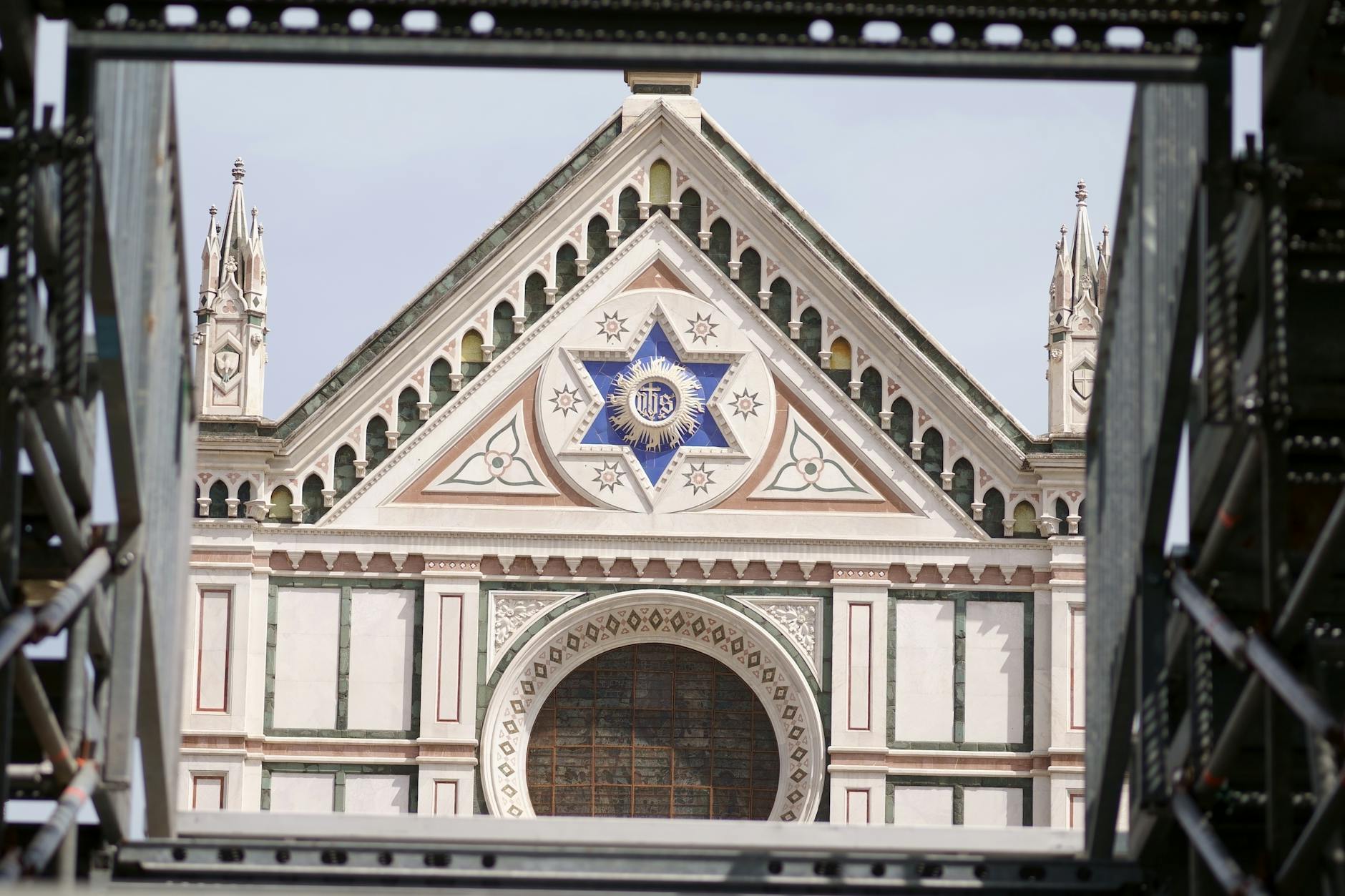
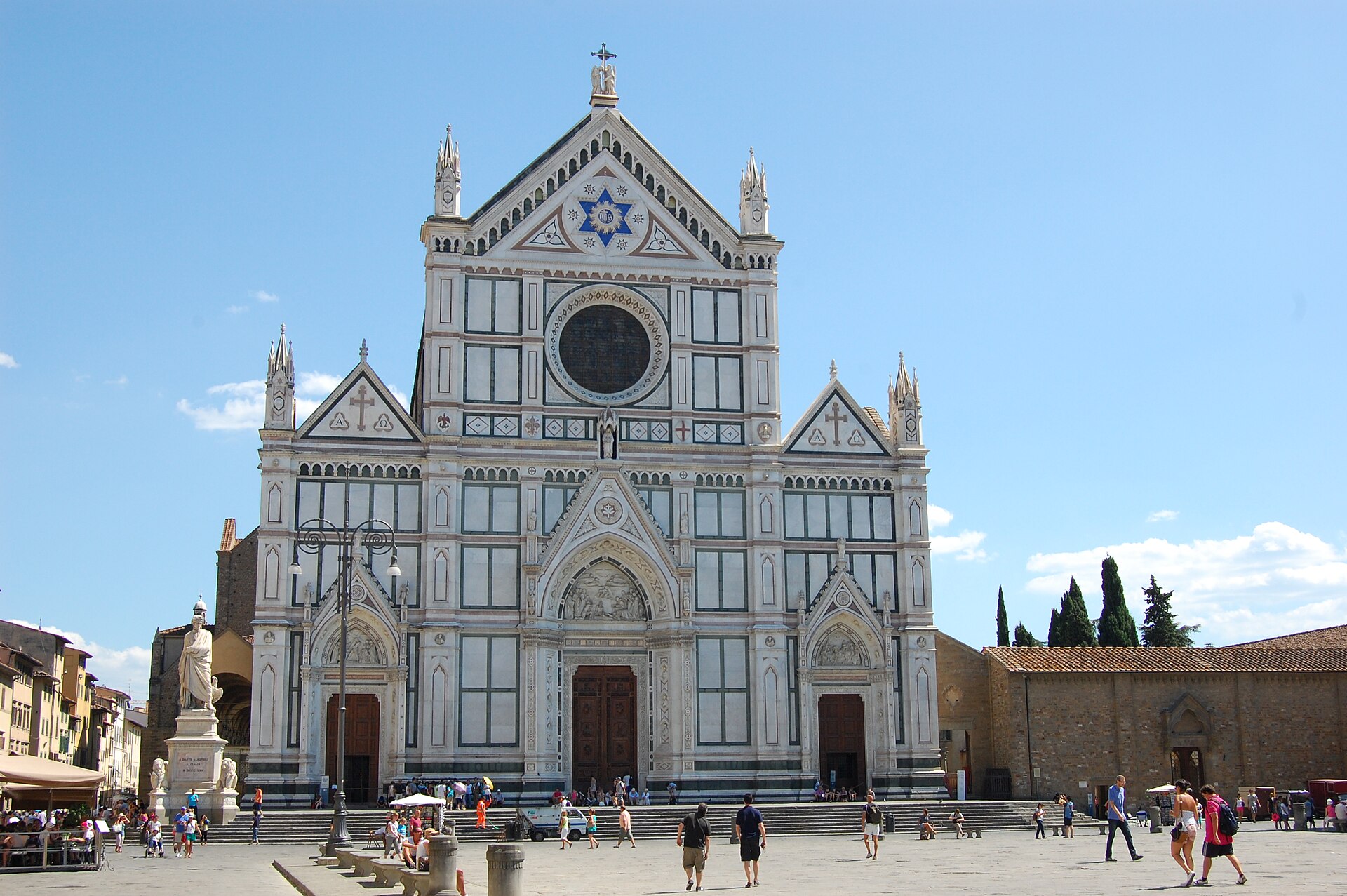
For nearly 600 years Santa Croce stood without a finished facade—just plain stone. In 1857-1863, Niccolò Matas designed the present facade in green and white Tuscan marble, neo-Gothic in style with a Star of David in the gable (Matas was Jewish and reportedly negotiated his religion to remain visible in the design). This is why the facade is so much later than the building behind it. The exterior we see today represents Florence’s 19th-century romantic taste rather than medieval intentions.
The 1966 Florence flood devastated Santa Croce. Water reached six meters in some chapels; a celebrated Cimabue crucifix was severely damaged (carefully restored over decades and now displayed in the museum). The basilica was a focal point of the international restoration effort that gave rise to many modern conservation techniques.
The Famous Tombs
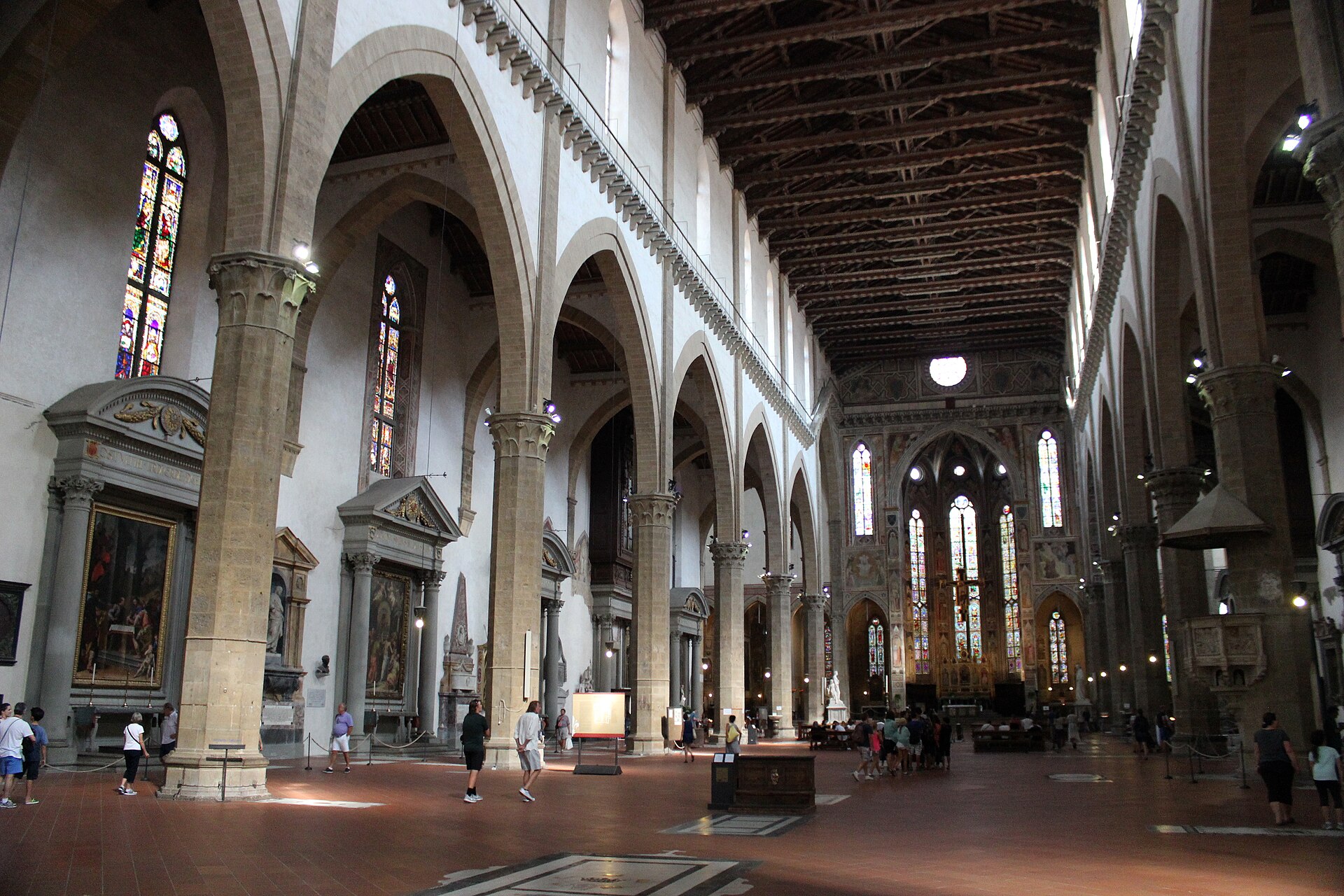
Santa Croce’s most-photographed feature is the wall-tombs along the south aisle (right side as you face the altar from the entrance). The tombs are placed in chronological order of the deceased and form an extraordinary historical sequence:
Michelangelo Buonarroti (1475-1564)
Designed by his protégé and biographer Giorgio Vasari (1564-1576). Michelangelo died in Rome in 1564; his nephew arranged for his body to be returned to Florence in secret, sneaking it into the city in a packing crate to avoid Papal interception. The Florentine government honored him with a state funeral and burial in Santa Croce. The tomb features a sarcophagus topped by three allegorical female figures representing Painting, Sculpture, and Architecture, the three arts Michelangelo mastered. A bust of Michelangelo gazes down from above.
The famous (probably apocryphal) story: Michelangelo specifically chose this site for his tomb so that on Judgment Day, when he rose from the dead, the first thing he would see was Brunelleschi’s dome on Florence Cathedral. Whether or not he actually said this, the line through the basilica’s main door does indeed sight directly to the Duomo’s dome.
Dante Alighieri (1265-1321) — Cenotaph Only
Dante was exiled from Florence in 1302 and died in Ravenna in 1321. Florentine attempts to retrieve his body across the centuries have failed; Ravenna refused to give him up. Santa Croce’s monument (1830, by Stefano Ricci) is therefore a cenotaph—an empty memorial. Dante is depicted seated, in classical pose, contemplative; allegorical figures of Italy and Poetry mourn at his sides. The poet remains in Ravenna.
Niccolò Machiavelli (1469-1527)
The political philosopher and author of The Prince died in Florence in 1527. The 18th-century monument by Innocenzo Spinazzi was erected long after his death—Machiavelli’s reputation was rehabilitated only gradually as Florentines forgot the Republican-era controversy around his work. The Latin inscription declares he was “without equal in either era of his fortune”—diplomatic speech for the man whose reputation oscillated between celebrated philosopher and amoral schemer.
Galileo Galilei (1564-1642)
Across the basilica from Michelangelo’s tomb, Galileo’s monument (by Giulio Foggini, 1737) marks where he was finally interred in the main church—95 years after his death. Galileo was condemned by the Roman Inquisition in 1633 for advocating Copernican astronomy; he died under house arrest in Arcetri (a Florence suburb). The Catholic Church initially denied him a Christian burial in consecrated ground, and his body was placed in a side chamber of Santa Croce. In 1737, after the Medici dynasty ended and attitudes shifted, Galileo was finally moved to a tomb in the nave, with a small marble sculpture showing him pointing to the heavens. The Catholic Church formally rehabilitated Galileo in 1992. His tomb is now opposite Michelangelo’s.
Gioachino Rossini (1792-1868)
The composer of The Barber of Seville, William Tell, and many others died in Paris in 1868 and was initially buried at Père Lachaise. In 1887, after extensive Italian negotiations, his remains were repatriated to Florence and interred in Santa Croce. The 19th-century monument is more sentimental than the older tombs around it but reflects Italy’s late-19th-century surge of national pride and the recognition of Rossini as a national figure.
Other Notable Burials
- Lorenzo Ghiberti (1378-1455) — sculptor of the Gates of Paradise. Modest tomb slab in the floor.
- Leonardo Bruni (1370-1444) — humanist scholar and Chancellor of Florence. Tomb by Bernardo Rossellino, a key early Renaissance funerary monument with the deceased lying as if asleep on a bier.
- Carlo Marsuppini (1399-1453) — humanist Chancellor; tomb by Desiderio da Settignano (1453).
- Vittorio Alfieri (1749-1803) — playwright; monument by Antonio Canova.
- Ugo Foscolo (1778-1827) — Romantic poet whose 1807 ode “Dei Sepolcri” famously celebrated Santa Croce’s tombs as Italy’s national pantheon.
- Galileo Galilei’s young assistant Vincenzo Viviani — opposite his master.
- Florence Nightingale — has a memorial plaque (she was born in Florence and named after the city, though buried in England).
The Giotto Frescoes
Beyond the tombs, Santa Croce holds two of the most important Giotto fresco cycles surviving in any church. Both were commissioned by wealthy banking families for their burial chapels around 1320:
The Bardi Chapel (right of the main altar) is decorated with scenes from the life of St. Francis. The compositions show Giotto’s revolutionary capacity to depict three-dimensional space, weighted figures, and emotional intensity—qualities that fundamentally changed the direction of Western painting. The Funeral of St. Francis is particularly powerful, showing the saint’s death and the verification of his stigmata. These frescoes were whitewashed during a Counter-Reformation cleanup and rediscovered in the 19th century.
The Peruzzi Chapel (just to the right of the Bardi Chapel) holds Giotto’s frescoes of the lives of John the Baptist and John the Evangelist. The composition is more architecturally ambitious than the Bardi cycle—Giotto experimented with structured perspective, painted architectural elements that look like real buildings, and figure groupings that interact across pictorial space.
Other 14th-century chapels along the choir’s east wall (the Baroncelli Chapel by Taddeo Gaddi, the Castellani Chapel by Agnolo Gaddi) are also worth seeing—these are works of Giotto’s pupils and represent the spread of his style across the next generation.
The Pazzi Chapel: Brunelleschi in Miniature
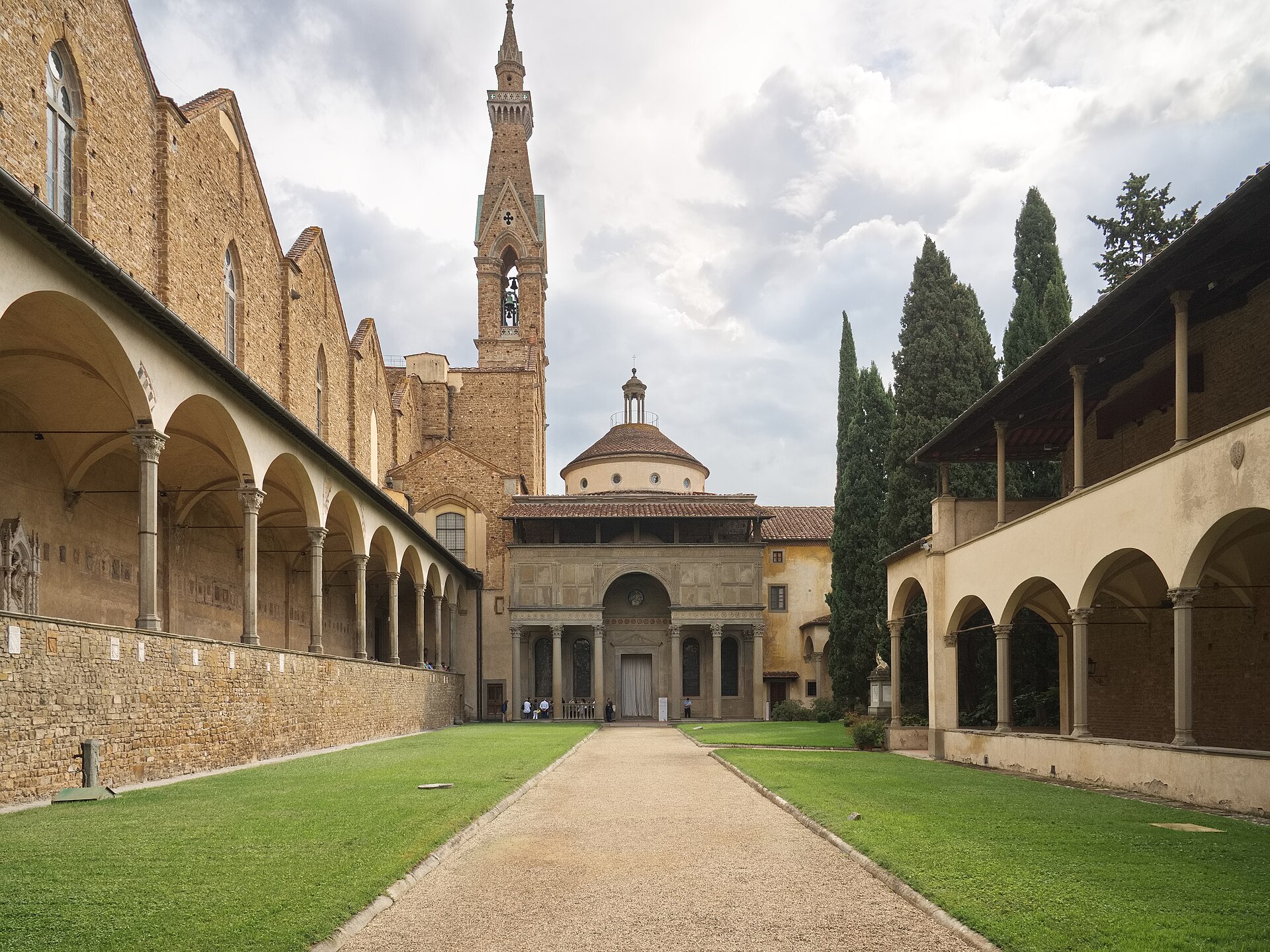
Cross from the basilica into the first cloister, and on the right is the entrance to the Cappella dei Pazzi (Pazzi Chapel)—one of the great works of early Renaissance architecture. Filippo Brunelleschi designed the chapel in the 1440s for the Pazzi banking family (rivals of the Medici). It was completed after his death by his pupils, with the portico finished around 1460.
The chapel is small—a square room about 18 meters across with a central dome and barrel-vaulted side bays. Its importance is architectural: Brunelleschi achieved here what he wanted in San Lorenzo and Santo Spirito but in concentrated form. White-plastered walls articulated by gray pietra serena pilasters and arches, perfect proportions, classical detailing, no medieval clutter. The 12 terracotta tondi of the Apostles by Luca della Robbia (added c. 1442) decorate the walls. The pendentive medallions show the Four Evangelists, also by della Robbia.
The Pazzi Chapel is one of those small spaces where you should sit, look up, and feel the proportional perfection of Renaissance space. It was here, perhaps more than anywhere else, that the rules of classical architecture were translated into Christian sacred space. Spend at least 15 minutes inside.
The Cloisters and Cathedral Museum
Beyond the Pazzi Chapel and the first cloister, a second cloister extends further east. Both are quiet, beautifully proportioned spaces with stone wells and orange trees. The cloisters house archaeological finds and the entrance to the Museo dell’Opera di Santa Croce.
The museum’s central feature is Cimabue’s Crucifix (c. 1280)—badly damaged in the 1966 flood, restored over decades, now displayed under museum conditions. It’s a powerful image of Christ on the cross and one of the most important Italian paintings of the late 13th century. Other museum highlights include Donatello’s painted wood sculpture of St. Louis of Toulouse, fragments from the original (pre-1863) facade, and the basilica’s medieval frescoes.
The Scuola del Cuoio (Leather School)
A discreet doorway on the north side of the cloister leads to the Scuola del Cuoio—the basilica’s working leather school, founded in 1950 by Franciscan friars and the Gori and Casini families. The original mission was to train war orphans in the craft of Florentine leatherwork; today the school continues both training and high-end leather production. You can watch the artisans at work, browse beautifully made bags, wallets, and journals, and (if budget allows) commission custom pieces.
The Scuola has a separate entrance and you don’t strictly need a Santa Croce ticket to visit it—you can enter from Via San Giuseppe 5R. But discovering the school via the basilica is the more atmospheric route. It’s open daily 9:30-19:00 (closed Sunday from November to March). Free to browse.
Tickets, Hours, and Practical Info
Tickets: Adult €9.50; children 11-17 €6.50; under 11 free. Combined ticket includes basilica, both cloisters, Pazzi Chapel, and Cathedral Museum—all in one entry. Audio guides available for €3.
Hours: Monday-Saturday 9:30-17:30. Sunday and Catholic religious holidays 12:30-17:30. Last entry is 17:00. Closed January 1, Easter Sunday, June 13 (Feast of St. Anthony), August 15, December 25.
Dress code: Shoulders covered, knees covered, hats off indoors. The dress code is enforced.
Photography: Allowed without flash. Tripods and selfie sticks not permitted.
Accessibility: The basilica is wheelchair-accessible at the main entrance via a ramp. The cloisters are mostly accessible. The museum has an elevator. The Pazzi Chapel has one step at the entrance.
Time needed: Allow 90 minutes for a thorough visit. Quick visits can be done in 60 minutes; deeper exploration with the museum can take 2 hours.
How to Get There
Santa Croce is in central Florence, a 10-minute walk east of the Duomo through Via del Proconsolo. From Piazza della Signoria it’s a 5-minute walk via Borgo dei Greci. From Santa Maria Novella station it’s a 15-minute walk. Autolinee Toscane (AT) buses C1, C2, and C3 stop near the basilica.
The piazza in front of Santa Croce (Piazza Santa Croce) is one of Florence’s most beautiful squares. The flat surface was historically used for football matches—and still hosts the annual June Calcio Storico tournament, the brutal medieval Florentine football matches that define the Festa di San Giovanni (June 24). The square also has cafés and trattorias around its edges; Boccadama on the south side is a reliable lunch option.
Frequently Asked Questions
Who is buried in Santa Croce?
Approximately 300 Italians, including Michelangelo, Galileo, Machiavelli, Rossini, Lorenzo Ghiberti, Leonardo Bruni, Vittorio Alfieri, and Ugo Foscolo. Dante has a cenotaph (empty monument) since he died in exile in Ravenna and his actual remains have never been returned to Florence.
Why is Santa Croce called the Pantheon of Italian Glories?
Because it’s the burial site of so many notable Italians from across history—artists, scientists, philosophers, writers, composers. The phrase comes from Ugo Foscolo’s 1807 poem “Dei Sepolcri” (Of the Sepulchres), which celebrated Santa Croce’s tombs as Italy’s national patrimony.
How much does it cost to enter Santa Croce?
€9.50 for adults; €6.50 for children 11-17; under 11 free. The ticket includes the basilica, both cloisters, the Pazzi Chapel, and the Cathedral Museum. Audio guides are €3 extra.
What are the opening hours of Santa Croce?
Monday-Saturday 9:30-17:30; Sunday and religious holidays 12:30-17:30. Last entry is 17:00. Closed on January 1, Easter Sunday, June 13 (St. Anthony), August 15, and December 25.
Is Dante buried in Santa Croce?
No. Dante was exiled from Florence in 1302 and died in Ravenna in 1321; Ravenna has consistently refused to return his remains. The monument in Santa Croce is a cenotaph (empty memorial). The actual burial is in Ravenna, where his tomb is also a tourist site.
Are there really Giotto frescoes at Santa Croce?
Yes. The Bardi Chapel (Life of St. Francis) and Peruzzi Chapel (Lives of the two Saints John) hold authentic 14th-century frescoes by Giotto and his immediate workshop. They are among the most important survivals of Giotto’s church work and were rediscovered in the 19th century after being whitewashed during a Counter-Reformation cleanup.
Can you visit the Pazzi Chapel?
Yes. The Pazzi Chapel is included in the standard Santa Croce ticket and accessed through the first cloister. It’s one of the most important works of early Renaissance architecture—a small jewel by Brunelleschi worth at least 15 minutes of attention.
Is Santa Croce wheelchair accessible?
Yes. The basilica’s main entrance has a wheelchair ramp. The cloisters are mostly accessible at ground level. The Cathedral Museum has an elevator. The Pazzi Chapel has one step at its entrance. Some chapels in the basilica are accessed by a step.
How long do I need to visit Santa Croce?
Allow 90 minutes for a thorough visit covering the basilica, tombs, frescoes, cloisters, Pazzi Chapel, and museum. Quick walk-through possible in 60 minutes. Deeper study (focusing on Giotto frescoes, Brunelleschi architecture, or specific tombs) can extend to 2 hours or more.