This article contains advertising. Booking links on this site can be turned into paid links automatically by our partner Travelpayouts: if you book through one, we earn a commission from the provider, at no extra cost to you. It never affects what we recommend. Affiliate disclosure
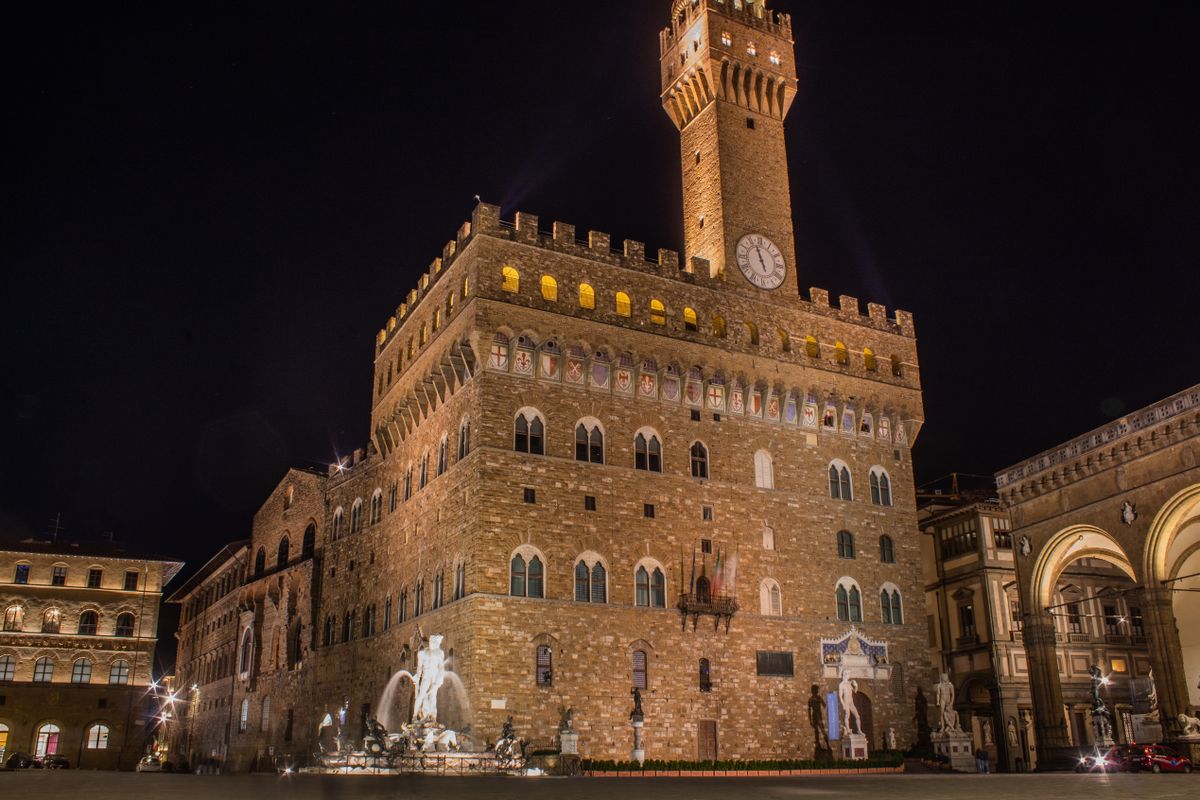
Piazza della Signoria has been the political and ceremonial heart of Florence for over 700 years. The L-shaped square has hosted everything from medieval grain markets to public executions, from Republican town meetings to Medici processions, and today functions as the city’s open-air sculpture museum and most famous gathering place. Standing in the piazza you can see Donatello, Michelangelo (a copy), Cellini, Giambologna, Ammannati, and Bandinelli without paying admission to a single museum. The Loggia dei Lanzi, the Fountain of Neptune, the equestrian Cosimo I, the David replica, and the towering Palazzo Vecchio all face each other across cobblestones marked by 600 years of history. This guide covers what to see, the stories behind each sculpture, where to eat, and how to visit Piazza della Signoria.
The square is an open-air sculpture gallery with Palazzo Vecchio on one side and the Uffizi on the other. The originals of several statues here now live in the Bargello, and the whole piazza is stop one on our Renaissance walking tour.
Piazza della Signoria Quick Facts
| Detail | Information |
|---|---|
| Function | Florence’s political and ceremonial main square |
| Shape | L-shaped, partially enclosed |
| Created | Late 13th century |
| Major buildings | Palazzo Vecchio, Loggia dei Lanzi, Uffizi (south side) |
| Famous sculptures | David replica, Perseus by Cellini, Neptune fountain, Hercules & Cacus |
| Admission | Free (square); Palazzo Vecchio paid |
| Best time | Early morning or after 19:00 for fewer crowds |
| Photography | Best light: morning or golden hour |
Brief History
The square was created at the end of the 13th century after the rival Ghibelline faction (Florence’s pro-Imperial party) was defeated and their houses on the site demolished. The Palazzo Vecchio (then the Palazzo della Signoria, “palace of the lordship,” referring to the elected priors who governed Florence) was begun in 1299 by Arnolfo di Cambio, with its 94-meter Tower of Arnolfo as the symbol of Florentine governmental authority.
For centuries the square hosted the meetings of the General Council—Florentine men summoned to the piazza by the great bell of the tower (the Vacca, “the cow”) to discuss public business. Markets, coronations, jousts, executions, and processions all occurred here. The square has seen extraordinary moments: in 1497 the Dominican friar Girolamo Savonarola organized the famous “Bonfire of the Vanities” here, burning books, paintings, mirrors, and luxury goods that he considered morally corrupting; less than a year later, in May 1498, Savonarola himself was hanged and burned in the same square—a small bronze plaque on the pavement marks the exact spot.
Under the Medici Grand Dukes, the piazza was transformed into a royal stage. Cosimo I commissioned multiple sculptures to demonstrate Medici power. The square gradually became the open-air gallery we know today.
The Sculptures: A Walking Tour
The Marzocco (Lion of Florence)
To the right of the Palazzo Vecchio entrance stands a stone lion holding the lily shield of Florence. This is a copy; the original by Donatello (1416-1418) is in the Bargello Museum. The Marzocco was the first statue placed in the piazza and the symbol of Florentine independence—a republican lion guarding the seat of government. The original Marzocco predated even the Medici and was the heraldic symbol of the medieval Florentine commune.
Judith and Holofernes
To the left of the Marzocco, a bronze statue depicts Judith holding the severed head of Holofernes, sword raised. The original by Donatello (c. 1455-1460) is now inside Palazzo Vecchio; the version outside is a replica. The Judith was originally commissioned by Cosimo the Elder for the Medici Palace garden, but after the Medici were expelled in 1494, the Florentine republic seized the statue and placed it here as a political emblem—a virtuous Florentine republic beheading tyranny. The dedicatory inscription reads (in Latin): “Citizens placed me as an example of public salvation, 1495.”
Michelangelo’s David (Replica)
Beside the Palazzo Vecchio’s main entrance stands a marble David, 5.17 meters tall. This is a faithful copy installed in 1910. The original Michelangelo David (1501-1504) was placed in this exact spot in 1504 as the first secular monumental sculpture in Florence—a political statement of Republican defiance, with David representing virtuous Florence against the tyranny of larger Italian states. The original was moved indoors to the Galleria dell’Accademia in 1873 to protect it from weathering and damage; the replica is excellent and gives a strong sense of how the piazza looked when the original stood here.
Hercules and Cacus
To the right of David stands Bandinelli’s Hercules and Cacus (1534), nearly the same size as Michelangelo’s David and intentionally placed to balance it. The Medici (back in power after their 1530 reconquest of Florence) commissioned this group from the sculptor Baccio Bandinelli to show their physical and political dominance over the city. Bandinelli was a rival of Michelangelo, who reportedly said the figure looked like “a sack of melons.” The work has had a poor reputation among critics for centuries but is, fairly seen, an interesting Mannerist composition reflecting Medici authoritarian propaganda.
Fountain of Neptune (Biancone)
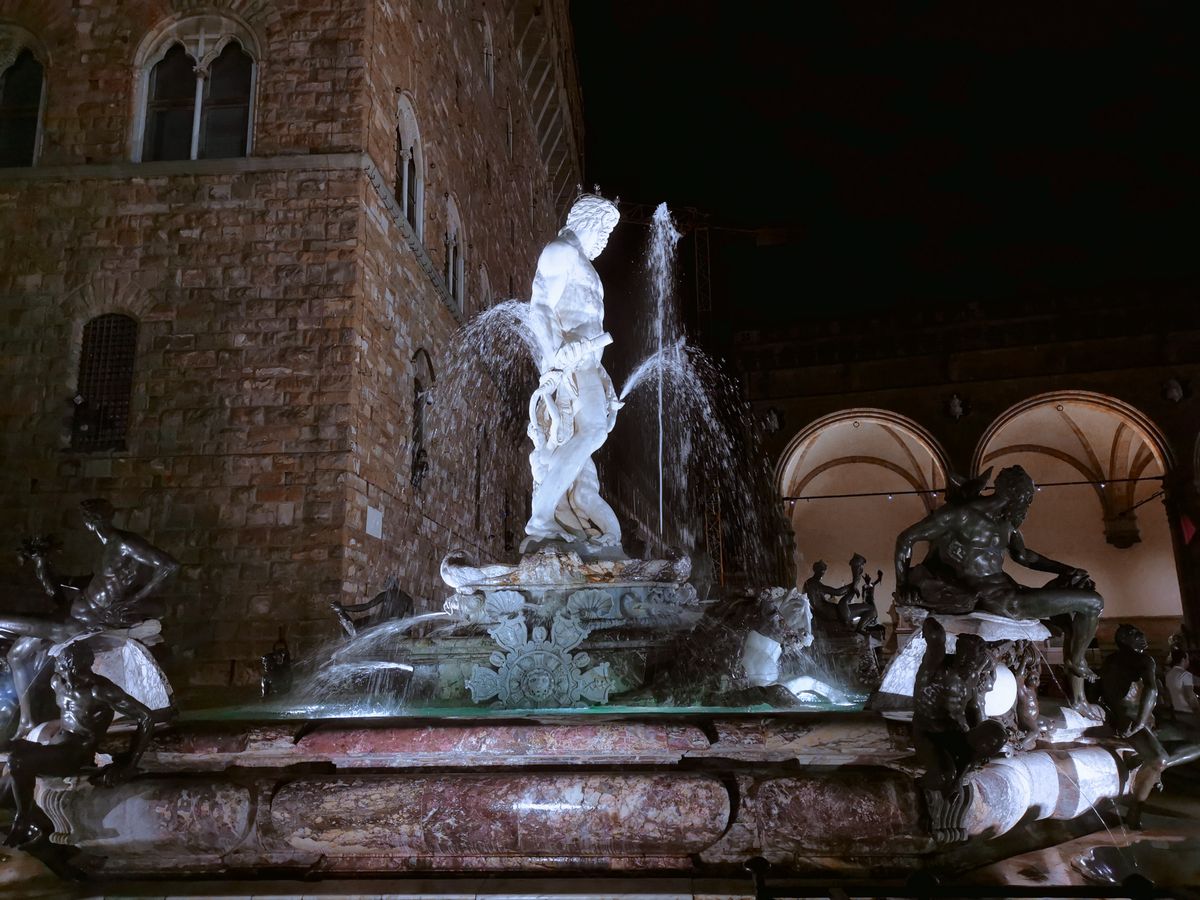
The huge marble Neptune fountain (1559-1575) by Bartolomeo Ammannati dominates the northern half of the piazza. Cosimo I commissioned it to celebrate his expansion of Tuscan naval power (a fleet was operating from the new port of Livorno). The white-marble Neptune is so pale that Florentines nicknamed him Il Biancone—”the Big White One.” Around the basin, bronze figures of Tritons and sea-horses by Giambologna and others spit water; reliefs of mythological scenes line the lower edge. Vasari’s famous remark on Ammannati’s sculpture: “Ammannato, Ammannato, what beautiful marble you have ruined!” Recent restorations have, however, recovered considerable freshness in the bronze figures around the base.
Equestrian Statue of Cosimo I
In the center of the piazza stands a bronze equestrian statue of Grand Duke Cosimo I de’ Medici (1519-1574), executed by Giambologna between 1587 and 1594, after Cosimo’s death, on commission from his son Ferdinando I. The relief panels on the pedestal show key moments of Cosimo’s reign: his coronation as Grand Duke by Pius V; the Senate of Siena pledging loyalty; and the entry into Siena after its conquest in 1555. The statue is an important early example of monumental equestrian bronze and influenced equestrian portraits across Europe.
The Loggia dei Lanzi: Open-Air Sculpture Gallery
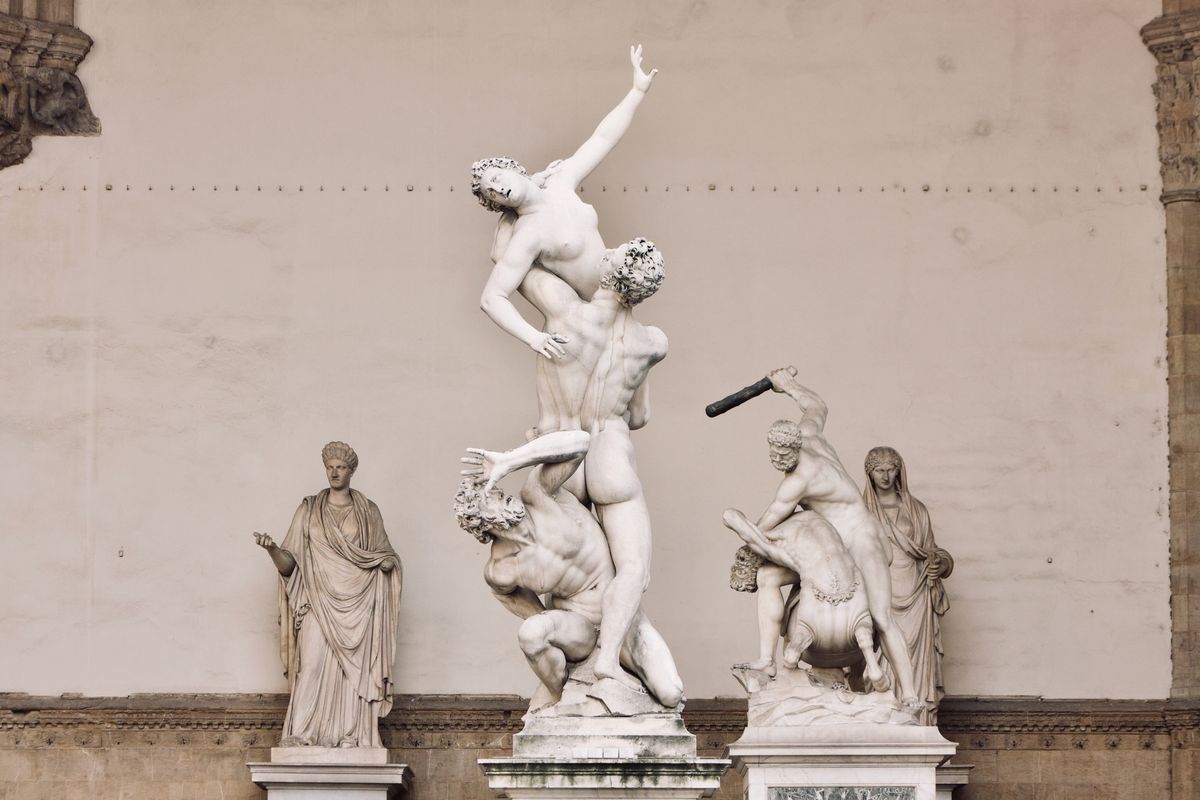
The Loggia dei Lanzi—the elegant arched gallery on the south side of the piazza—was built between 1376 and 1382 to host public ceremonies and shelter dignitaries during outdoor functions. Its three large Gothic arches give it a distinctive silhouette. The name comes from the German pikemen (“Lanzi”) who guarded Cosimo I in the 16th century and were stationed here.
Today the Loggia houses several extraordinary sculptures, all originals (a rarity in the Florence outdoor sculpture scene):
- Perseus with the Head of Medusa by Benvenuto Cellini (1545-1554). Bronze. Cellini’s masterpiece, commissioned by Cosimo I to balance Donatello’s Judith and Michelangelo’s David in the piazza. The complex casting nearly killed Cellini—he describes in his autobiography the dramatic struggle to save the bronze pour from imminent failure. The pedestal contains four bronze figurines and a relief panel of Perseus and Andromeda. Look for the artist’s hidden self-portrait on the back of Perseus’s head, formed by his curls.
- The Rape of the Sabine Women by Giambologna (1581-1582). One of the most ambitious marble sculptures ever made—three figures (a Roman, a Sabine woman, a Sabine elder) carved from a single 5-meter block in a serpentine spiral that demands viewing from every angle. There is no single “correct” front view; the work invites circumnavigation. Giambologna executed it at age 53 to demonstrate his technical supremacy.
- Hercules Slaying the Centaur Nessus by Giambologna (1599). Marble.
- Menelaus Holding the Body of Patroclus (Roman copy of a Hellenistic original).
- Six Roman matrons along the back wall (Roman antiquities, 2nd century AD).
- Two Medici lions guarding the steps—one ancient (Roman), one Renaissance (Giovanni Fancelli, 1598).
The Loggia is open and free—you can walk inside and view the sculptures from all angles. Photography is permitted. Note: the sculptures are protected by glass barriers at floor level to prevent climbing.
Palazzo Vecchio: The Building Behind the Piazza
The piazza is dominated by Palazzo Vecchio (the “Old Palace”), the Florentine town hall since 1299. The medieval fortress-palace with its asymmetric tower (94 m) is one of the iconic Florentine buildings. After Cosimo I made it briefly his ducal residence in the 1540s, the interior was lavishly remodeled by Vasari with frescoes celebrating Medici military victories. The Salone dei Cinquecento (Hall of the Five Hundred) is the largest room with the most extensive Medici frescoes; the Studiolo of Francesco I, a small alchemical study, is one of the strangest and most fascinating rooms in Florence.
Palazzo Vecchio is open as a museum (€18, reduced €12). The Arnolfo Tower and walkway can be climbed for €20 (reduced €13). Hours: 9:00-19:00 daily; closed Wednesdays. See our Palazzo Vecchio guide for details.
Other Notable Features in the Piazza
Plaque marking Savonarola’s execution: Set into the pavement near the Fountain of Neptune is a small bronze disk inscribed with Savonarola’s name and the date May 23, 1498—the spot where he and two fellow friars were hanged and then burned. Florentines and visitors regularly leave flowers there.
The Tribunale della Mercanzia (Court of Merchants): The Gothic building in the corner of the piazza near the Loggia. Built in 1359 to house Florence’s commercial tribunal, it now houses cafes and shops at street level.
The Uffizi entry corridor: The piazza opens at its south end into the long covered corridor of the Uffizi Gallery, lined with niches containing 19th-century statues of famous Tuscans (Dante, Petrarch, Boccaccio, Galileo, Machiavelli, Leonardo, Michelangelo). These are 19th-century sculptures and artistically minor, but the corridor itself is a useful pedestrian passage between the piazza and the Arno.
Cafés and Restaurants on the Piazza
The piazza is ringed by cafés and restaurants at every economic level. Most have outdoor tables in summer—the experience of an espresso or aperitivo with a view of the Loggia and Palazzo Vecchio is one of the great Florentine pleasures, but expensive (you’re paying for the location, not the food).
Caffè Rivoire (Piazza della Signoria 5R) is the historic cafe on the piazza, founded in 1872. Specializes in chocolate; their hot chocolate and chocolate confections are excellent. Pricey but high quality.
Caffè Gilli at Piazza della Repubblica (3 minutes’ walk) is older (1733) and arguably finer for cocktails and traditional Florentine cafe culture.
For lunch on the piazza itself, expect to pay €25-€40 per person at the outdoor tables for relatively standard tourist Italian. For better and cheaper food, walk 3-5 minutes off the piazza into Via dei Neri (with All’Antico Vinaio’s famous schiacciate sandwiches) or Via dei Pucci toward Mercato Centrale.
Best Time to Visit
The piazza is open 24 hours and the sculptures are visible at all times. The most pleasant times to visit:
- Early morning (7:00-9:00): Cool, low light on the marble, almost no other tourists. The David replica looks especially striking in early light.
- Late afternoon golden hour (17:30-19:00 in summer, 16:00-17:00 in winter): Warm light brings out the marble texture; photography is at its best. Crowds are present but tolerable.
- Evening after dark (21:00-23:00): Sculptures are lit by spotlights; the Palazzo Vecchio tower glows. Most touristas have gone for dinner. A different and dramatic atmosphere.
Avoid 11:00-15:00 in summer when the piazza is shoulder-to-shoulder with tour groups, the marble radiates heat, and there’s no shade. Winter visits are pleasant any time of day with the lowest crowds of the year.
Photography Tips
For full-square photographs: stand at the south end (near the Uffizi corridor) and shoot north toward Palazzo Vecchio—you’ll capture the David replica, the Fountain of Neptune, and the tower in one frame. For the Loggia: stand at the western edge of the piazza facing east; the symmetry of the three Gothic arches with the sculptures within frames beautifully. For close-ups of Cellini’s Perseus: walk under the Loggia and approach from a low angle to capture the bronze against the sky—best in early morning or late afternoon when the light is angled. The David replica needs morning light to highlight the marble and tower behind it. The Neptune fountain photographs best in golden hour with the white marble glowing against blue sky.
How to Get to Piazza della Signoria
The piazza is in the exact center of Florence’s pedestrian zone. From the Duomo it’s a 5-minute walk south on Via Calzaiuoli (a major shopping street, fully pedestrian). From Ponte Vecchio it’s a 3-minute walk north. From Santa Maria Novella station it’s a 12-minute walk through the historic center.
The piazza is fully wheelchair-accessible. The cobblestones are smooth enough for most wheelchairs; gentle slopes connect the piazza to surrounding streets. Public toilets are available inside Palazzo Vecchio (free with admission) and at several cafés on the square.
Frequently Asked Questions
Is Piazza della Signoria free to visit?
Yes. The piazza, all the outdoor sculptures, the Loggia dei Lanzi, and walking around the Palazzo Vecchio exterior are completely free, 24 hours a day. Only the interior of Palazzo Vecchio (museum and tower climb) requires a ticket.
Is the David in Piazza della Signoria the original?
No. The David in the piazza is a 1910 replica installed after the original was moved to the Galleria dell’Accademia in 1873 for protection from weather and damage. The replica is faithful and gives a strong sense of the original’s scale and presence in the piazza. To see the original, visit the Accademia (€20 plus a €4 booking fee, see our Accademia guide).
Are the sculptures in the Loggia dei Lanzi originals?
Yes—uniquely. Most outdoor sculptures in the piazza are replicas (David, Marzocco lion, Judith and Holofernes), but the major works in the Loggia dei Lanzi are originals: Cellini’s Perseus, Giambologna’s Rape of the Sabine Women, Giambologna’s Hercules and Centaur, and the Roman antiquities. They are protected by the Loggia’s roof.
Why is there a plaque on the pavement?
It marks the exact spot where the Dominican preacher Girolamo Savonarola and two companions were hanged and burned on May 23, 1498. Savonarola had ruled Florence as a kind of theocratic moral dictator for four years before being condemned by the Pope and the Florentine establishment. The plaque is a quiet historical marker; visitors often leave flowers.
What does “Marzocco” mean?
The Marzocco is the heraldic lion of Florence, holding a shield with the lily emblem of the city. The name probably derives from “Marte” (Mars, the Roman god of war), reflecting the lion as a war symbol of Florentine independence. The Marzocco was the symbol of the medieval Florentine Republic and pre-dates the Medici by centuries.
Can I climb the tower of Palazzo Vecchio?
Yes, but it requires a paid ticket (€20, or €13 reduced, for the Arnolfo Tower and walkway; the museum is a separate €18 ticket). It’s 416 steps with no elevator. The view from the top includes the entire Piazza della Signoria, the Duomo, the Arno, and the surrounding hills. Children under 6 are not permitted.
How long do I need at Piazza della Signoria?
30 minutes for a quick walk-through and photographs. 60-90 minutes for a thorough viewing of all the sculptures. Add 90 minutes if you also enter Palazzo Vecchio. The piazza is also a natural starting point for visits to the Uffizi (10 min walk south) or Ponte Vecchio (5 min south).
Is the piazza safe at night?
Yes. Piazza della Signoria is one of Florence’s safest squares with consistent municipal and police presence and a steady stream of pedestrians until very late. The cafés and Palazzo Vecchio illumination keep it well-lit. Standard urban precautions apply (watch for pickpockets in crowds), but violent crime is virtually unknown.
Can I sit in the piazza?
There are some stone benches at the edges and steps you can sit on without ordering anything. To sit at a café table you need to consume something. Eating personal food (sandwiches, takeaway) on the steps is technically prohibited under Florence’s “decoro urbano” rules but rarely enforced if you’re respectful.