This article contains advertising. Booking links on this site can be turned into paid links automatically by our partner Travelpayouts: if you book through one, we earn a commission from the provider, at no extra cost to you. It never affects what we recommend. Affiliate disclosure
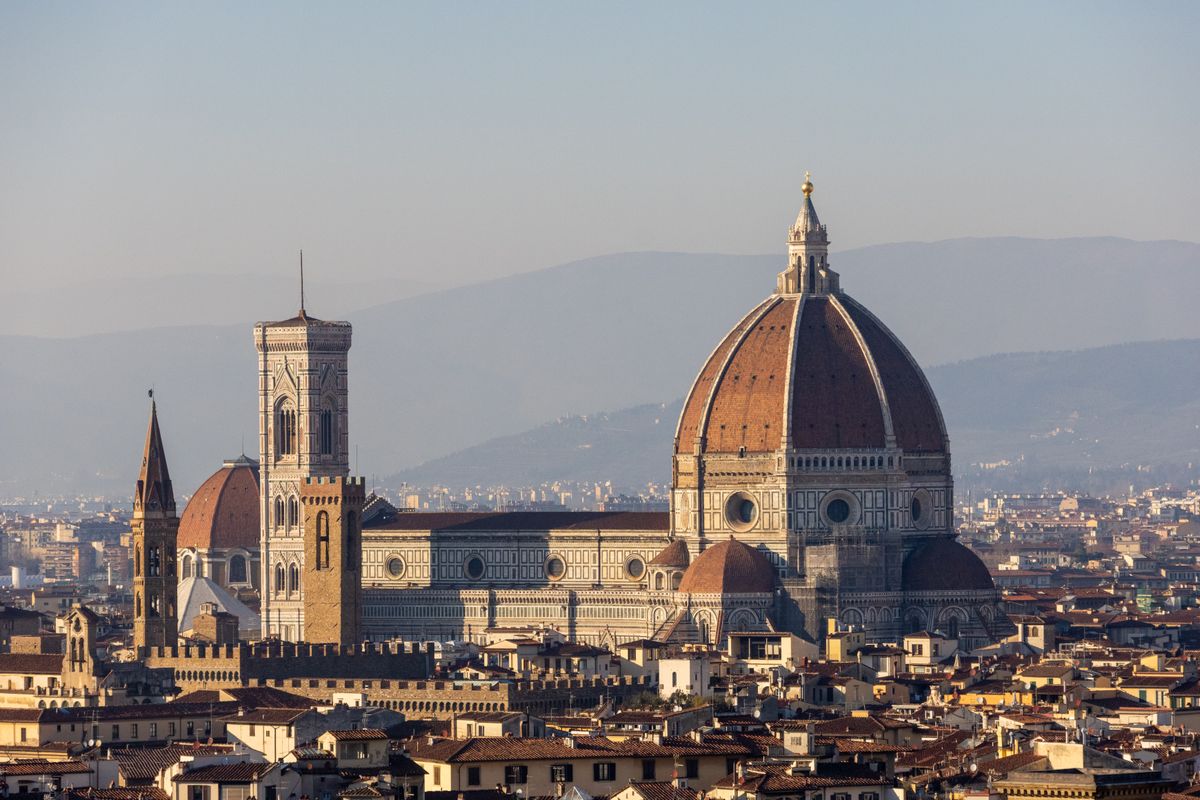
Climbing Brunelleschi’s dome in Florence is one of those rare travel experiences that earns its hype. The 463-step ascent takes you through the space between the cathedral’s two domed shells—a hidden interior that the architect designed in the 15th century. At the top, the marble lantern platform delivers what most travelers consider the single best panoramic view of Florence. This guide covers exactly what to expect on the climb: how to book tickets, how long it takes, accessibility, what’s worth photographing, what to wear, and how to plan around the steepest, narrowest, and most rewarding stairs in Italy.
The climb is one of five tickets in the cathedral complex, and the order you do them in matters — our Duomo complete guide sequences them. If 463 steps in a narrow shell sounds like too much, Giotto’s bell tower is easier and actually shows you the dome, and our viewpoints guide lists the no-stairs options.
The climb is only on the €30 Brunelleschi Pass, and the time slot you pick when you buy it is fixed. Our Duomo tickets guide covers the three passes, how far ahead the dome slots go in each season, and which door you need on the day.
The Dome Climb at a Glance
| Detail | Information |
|---|---|
| Total steps | 463 (no elevator) |
| Visit time | About 45 minutes (Opera del Duomo’s recommendation) |
| Ticket required | Brunelleschi Pass (€30) only |
| Reservation | Mandatory timed slot, book online |
| Entrance | Porta della Mandorla, north side of cathedral |
| Daily hours | First ascent 8:15 Mon-Sat, 12:45 Sundays and holidays; check the official calendar for your date |
| Children | Free up to age 6; under-18s must be accompanied by an adult |
| Closures | Jan 1, Easter Sunday, Christmas Day; maintenance days are shown on the calendar |
Why the Dome Is Worth Climbing
Brunelleschi’s dome is an engineering marvel that solved a problem nobody else could solve. By the early 15th century, the cathedral still stood without a dome over its eastern end. Roman concrete techniques had been lost, and the span was too wide for traditional Gothic centering. In 1418, the wool guild held a public competition. Filippo Brunelleschi—a goldsmith by training—proposed an unprecedented solution: a self-supporting double-shell dome built without internal scaffolding, using a herringbone brick pattern that locked each course in place as it rose.
The dome you walk through today is the result. The inner shell carries the structural load; the outer shell, lighter and slimmer, protects it from the weather and gives the silhouette its iconic profile. Between them runs the staircase route that visitors still use—a passage through a working monument, not a tourist add-on. When you ascend, you’re walking through Renaissance architecture from inside, not just looking at it from outside. The frescoes you see at the gallery level are the underside of the inner dome; the curving walls you brush against are the bones of one of history’s most influential buildings.
The view at the top is the practical payoff. From the lantern platform, the entire historic center fans out below you: Santa Croce to the east, Santa Maria Novella to the west, the Arno snaking south toward Pisa, the green hills of Fiesole rising behind the city. The Duomo’s bell tower is at eye level (its top platform is just slightly lower), and the Palazzo Vecchio’s tower stands in the foreground. There is no other vantage point in Florence that combines historical experience with panoramic view.
How to Book Dome Climb Tickets
The dome climb is included only with the Brunelleschi Pass, priced at €30 for adults and €12 for ages 7-14; children up to 6 go free, and anyone under 18 must climb with an adult. The pass also includes Giotto’s Bell Tower, the Baptistery, Crypt of Santa Reparata, and Cathedral Museum, valid for three calendar days starting from the date you book for the dome, whenever you first use it. The dome climb requires a reserved timed entry; when you book, check which of the other monuments also ask you to pick a time.
Book online at the official site duomo.firenze.it or the Opera del Duomo app. Dome slots can sell out, so for a visit between May and September book as soon as your dates are fixed, especially if you want an early-morning climb. The Florence Tourism information office at Via Cavour 1r occasionally has same-day availability for cancellations, but don’t rely on it—book online before you arrive.
Third-party ticket vendors (Tiqets, GetYourGuide, Viator) sell the same passes for €5-€15 more than the official site. Some bundle a guided tour or audio guide. The official site is cheaper and equally easy to use; only book third-party if you specifically want a guided tour. Beware of “skip-the-line” tickets being sold by touts in Piazza del Duomo: every dome visit runs on a named, timed reservation, so buy from the official site or app.
Choosing Your Time Slot
The 8:15 first slot is universally recommended. The dome opens at this time Monday to Saturday (12:45 on Sundays and holidays), and you’ll be among the first climbers of the day. The interior is cooler (especially important June-August), the climb less crowded, and the gallery-level view of the Vasari frescoes is unimpeded by photographers. Sunrise from the lantern in summer (around 6:00 AM) is not accessible, but the early light still hits Florence beautifully at 8:30-9:00.
Late afternoon slots can bring warm light over the city on clear days, good for photography; the final dome slot is normally 18:45 on weekdays and 16:30 on Saturdays, Sundays and religious holidays. The trade-off is heat: by 17:00 in July or August, the dome’s brick masonry has been baking all day and the climb feels like a sauna. Carry water. The very last slot of the day is generally a third of the climbers it would be at midday, and you may have the lantern platform almost to yourself for a few minutes before closing.
Avoid 11:00-15:00 in summer. Midday is when the climb is at its hottest and often its busiest, and the lantern platform can be uncomfortably packed. If 8:15 is sold out, choose any slot before 10:00 or after 16:00 over a midday slot, regardless of season.
What the Climb Is Like, Step by Step
Stage 1: Entry and Lower Section
The climb begins at the Porta della Mandorla on the cathedral’s north flank (Via dei Servi side). Show your ticket, pass through a security check (small bags only), and you’re directed to the first flight of stairs. It is narrow, and this section gets your blood moving. There’s no view yet.
Stage 2: The Cathedral Roof (Brief Outdoor Section)
You emerge briefly onto a narrow terrace at the base of the dome where the cathedral’s nave roof meets the dome’s drum. Take a few breaths and look around—you’re already higher than most of Florence’s medieval towers and you can see the bell tower right across the way. Then you re-enter the dome itself through a small door.
Stage 3: The Frescoed Gallery
This is the magical moment of the climb. You arrive on a circular interior balcony that runs around the inside of the dome at a height where Vasari and Zuccari painted the lower bands of The Last Judgment. From the cathedral floor, these frescoes look impossibly distant; here, you’re standing among them, separated only by a railing. You can see the brushstrokes, the layered glazes, the slightly differing styles between Vasari (who died with the work unfinished in 1574) and Zuccari (who completed it in 1579). Below, the cathedral floor lies a very long way down—vertigo warning. The damned souls being dragged into hell are the panel directly above eye level here, and they’re terrifying in person.
Stage 4: Between the Shells
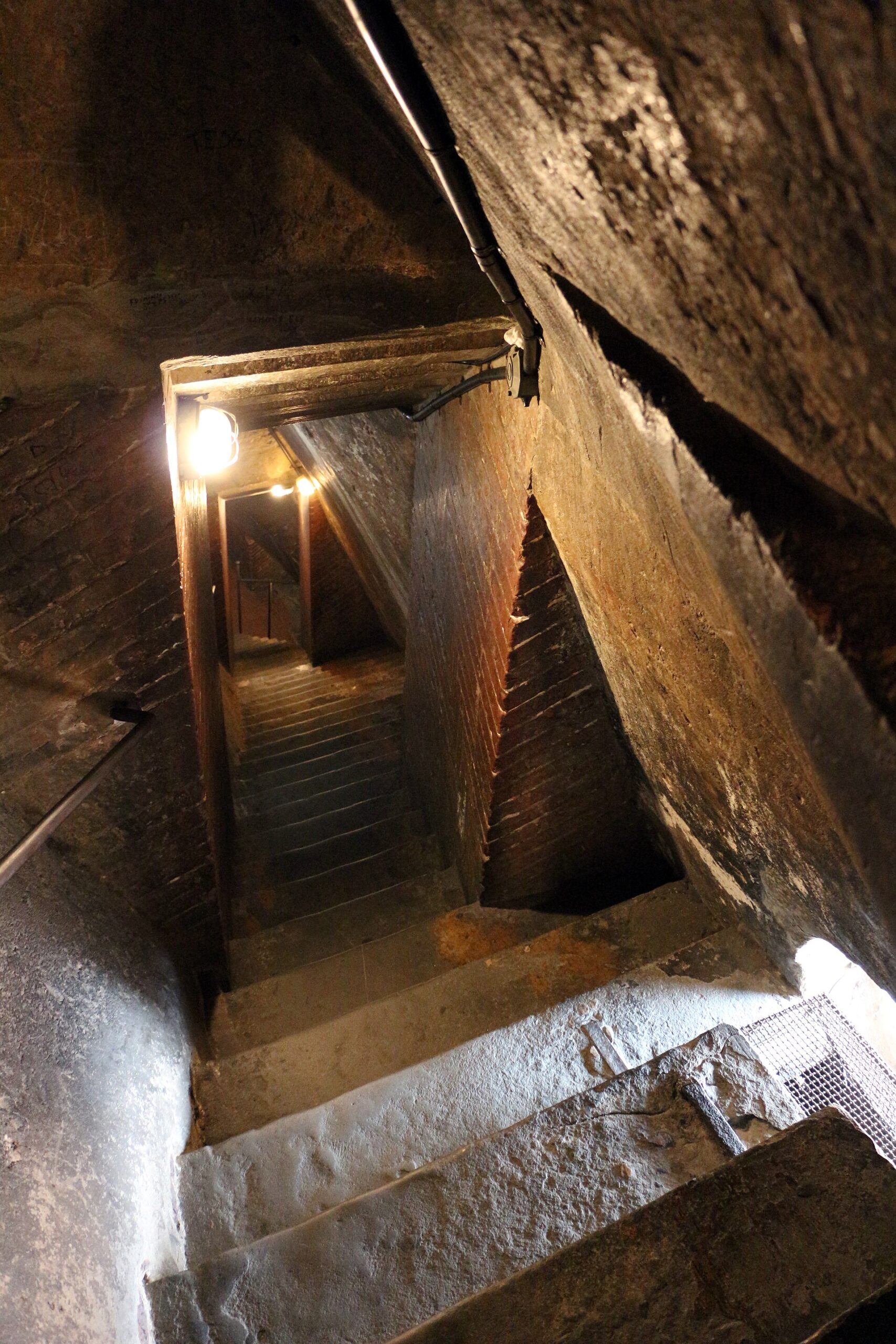
From the gallery, the route enters the curving corridor between the inner and outer domes. The architecture changes character here. The walls are no longer straight—they tilt inward as the dome curves, and the staircases follow the geometry. Some sections are nearly horizontal stone passages with sloping floors; others are stairs cut into the inner curve. The lighting is dim. This is the section that some find disorienting or claustrophobic. Keep moving with the flow of climbers; there are occasional landings where you can pause.
Stage 5: The Final Spiral
The final stretch is the steepest and tightest—a spiral staircase climbing toward the dome’s apex. The walls are close enough to touch on both sides; the steps are higher than standard. People with broader builds may find this section uncomfortable. There’s a single up-route and the spiral is too narrow for two-way traffic, so you go in waves. At the top, you push through a heavy bronze door and emerge onto the lantern platform.
Stage 6: The Lantern Platform
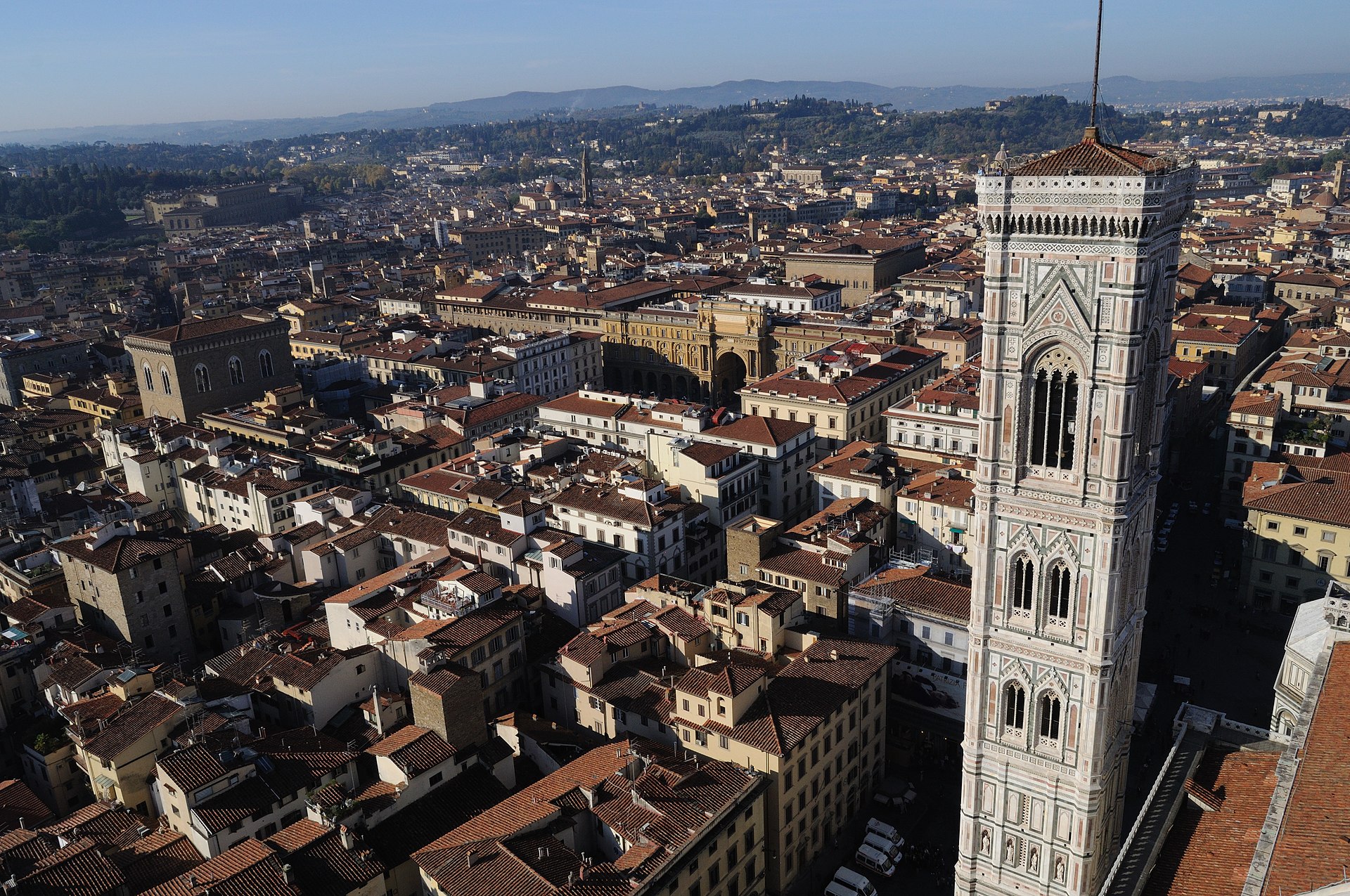
This is the reward: the top of the climb, at the marble lantern that crowns the dome. Florence opens up beneath you. To the north you see San Marco, San Lorenzo, and the hills of Fiesole. To the east, Santa Croce and the Synagogue’s distinctive copper dome. To the south, the Arno, Ponte Vecchio, the Boboli Gardens, and Piazzale Michelangelo. To the west, Santa Maria Novella and the Cascine park.
The Descent
You return the same way you came up, with the gallery and frescoes hit twice—a bonus. Descending the spiral staircase is harder on knees than ascending. Hold the railing. You exit through the same Porta della Mandorla you entered.
What to Wear and Bring
Footwear: Closed-toe shoes with grip. The stone steps are smooth and worn from six centuries of feet—they’re slippery, especially descending. Sneakers or hiking shoes are ideal. Avoid heels, sandals, or new dress shoes. Some sections have low overhangs; tall climbers should be aware.
Clothing: Layers. The dome climb is unconditioned and gets warm even in winter from physical exertion. The lantern platform at the top is exposed to the wind and can feel noticeably cooler than ground level—particularly in spring and autumn. A light jacket you can tie around your waist works well. There’s no dress code for the climb (unlike the cathedral interior), so shorts and tank tops are fine.
Bag size: Small backpacks only. Larger bags must be left at the security check. The corridors are narrow and a large bag will catch on the walls. Bring water in a small bottle, your phone or camera, and a small towel for face-wiping in summer. Selfie sticks and tripods are not permitted.
Photography: Smartphones work great. The gallery section requires a wider-angle lens to capture the frescoes; phone cameras typically handle this fine. The lantern platform is bright with strong contrast against the city below; portrait mode or HDR helps. There is no flash photography permitted in the gallery (it damages the frescoes).
Accessibility and Health Considerations
The dome climb is not wheelchair accessible. There is no elevator, no alternative route, and no exemption from the 463-step ascent. The cathedral itself, the Baptistery, and the Cathedral Museum are accessible; the dome and bell tower are not.
Mobility: The climb requires reasonable physical fitness. Healthy adults of average fitness handle it without problem. Anyone with knee, hip, or back issues should consider carefully—the descent is hard on joints. Anyone using a cane or walking stick should know that some narrow sections make stick use awkward.
Cardiac: The climb is a moderate cardiovascular workout: 463 steps, with no lift. People with significant heart conditions should consult their doctor first or simply skip the climb. There is no medical staff on the route; if you experience chest pain, dizziness, or significant shortness of breath, sit down on a step and let staff (who patrol the route) know.
Claustrophobia: Some sections—particularly the final spiral and the corridors between the shells—are tight and unventilated. People with significant claustrophobia frequently regret starting the climb. The route is one-way upward to the lantern; once you commit, you have to either reach the top or descend against the flow of climbers. If you have any doubt, climb the bell tower instead—it’s open-air, with the same step count, and offers similar (some say better) views.
Pregnancy: The climb is generally not recommended during pregnancy due to the physical exertion and balance demands. Pregnant climbers should consult their doctor; many find the bell tower a safer alternative.
Children: Children up to 6 go free and under-18s must be accompanied by an adult, but 463 steps with no lift is a lot to ask of small legs. Even able children may find the height intimidating at the gallery. Younger climbers sometimes panic at the gallery looking down at the cathedral floor. Talk to your child beforehand and be ready to descend if needed. Children in carriers or strollers cannot do the climb.
Dome Climb vs. Bell Tower: Which to Choose?
| Factor | Brunelleschi Dome | Giotto Bell Tower |
|---|---|---|
| Steps | 463 | 414 |
| Climb experience | Inside the dome’s structure | Standard square tower stairs |
| View of Florence | Excellent (360°) | Excellent (360°) |
| View of the dome itself | You can’t see the dome you’re on | Iconic photo of the dome |
| Frescoes | Yes (Vasari Last Judgement) | No |
| Open-air sections | Brief terrace + lantern | Multiple terraces |
| Claustrophobia risk | Higher | Lower |
| Best for photos of the Duomo | No | Yes |
| Historical significance | Greater (Renaissance landmark) | Lower (still important) |
If you can do both, do both—they’re different experiences. If you must pick one, climb the dome for the historical significance and unique architectural experience, then take photos of the dome from Piazzale Michelangelo or the rooftop bar of Hotel Cavour. If photography of the dome is your priority and you don’t mind less drama in the climb itself, do the bell tower instead. For families with mixed mobility levels, the bell tower is a safer choice—open-air and less claustrophobic.
Alternative Viewpoints if You Can’t or Don’t Want to Climb
If the dome climb isn’t possible for you, several other Florence viewpoints offer comparable panoramas:
- Piazzale Michelangelo — An uphill walk from Ponte Vecchio (or take Autolinee Toscane bus 12 or 13). Free, accessible by car, and offers the postcard view of Florence with the Duomo as centerpiece. Best at sunset.
- San Miniato al Monte — Just above Piazzale Michelangelo, this Romanesque church stands on one of the highest points in Florence. The terrace below offers the same view as Piazzale plus access to a beautiful 11th-century church.
- Forte Belvedere — A Medici-era fortress with terraces overlooking Florence. Open seasonally May-October. The view includes the Boboli Gardens directly below.
- Hotel Cavour rooftop bar — Just two blocks from the Duomo, this rooftop bar offers eye-level views of Brunelleschi’s dome with cocktails. Open to non-guests.
- La Rinascente rooftop café — Department store on Piazza della Repubblica with a free rooftop café and direct view of the Duomo. The most accessible elevated view in the historic center.
- Bardini Gardens — Above Pitti Palace in Oltrarno, with terraces, an excellent rose garden, and a sweeping view across the Arno toward the Duomo. Less crowded than Boboli.
Combining the Dome Climb with Other Sights
Half-Day Duomo Complex Itinerary
8:15 — Climb the dome (Monday to Saturday; allow about 45 minutes). 9:45 — Coffee at one of the cafés on Piazza del Duomo. 10:15 — Cathedral interior opens; visit (45 minutes). 11:00 — Crypt of Santa Reparata (20 minutes). 11:30 — Baptistery (30 minutes). 12:00 — Lunch nearby. 13:30 — Cathedral Museum (90 minutes). 15:00 — Optional Bell Tower climb (60 minutes). The 3-day pass means you can easily split this across multiple days if preferred.
One-Day Florence Itinerary with Dome Climb
8:15 — Dome climb. 10:00 — Cathedral and Baptistery. 11:30 — Walk to the Uffizi (15 min), prebooked entry at 12:00. 14:00 — Lunch in San Lorenzo. 15:30 — Walk through Mercato Centrale. 17:00 — Ponte Vecchio and Oltrarno. Early evening — Aperitivo with view at Hotel Cavour rooftop (book ahead, as its hours can vary). The dome climb fits naturally as the morning anchor.
The Engineering Behind the Climb
While you’re climbing, you’re literally walking through Brunelleschi’s solutions to the problems that had kept the cathedral without its dome. Each is visible during the climb if you know what to look for:
The double shell: The dome is two domes—an inner, structural one that bears most of the weight, and an outer, weather-resistant shell. The space between (where you climb) reduced overall weight while preserving the iconic external silhouette. As you walk through the shells, you’re inside Brunelleschi’s central engineering trick.
The herringbone brick pattern: Look at the brickwork in the corridors between the shells. The bricks are laid in a herringbone pattern (alternating courses of vertical and horizontal bricks) that locks each layer in place as it’s built, eliminating the need for centering scaffolding. This was Brunelleschi’s most secretive innovation; he refused to share details with rivals.
The four stone chains: At four heights within the dome, Brunelleschi installed circumferential rings of stone tied together with iron cramps to absorb the outward thrust. You can see hints of these in the wall structure as you climb. The dome essentially hugs itself, transferring forces around its base rather than out into the supporting walls.
The pointed arch profile: Brunelleschi’s dome is not a hemisphere but a pointed (Gothic) arch in cross-section, which directs forces more vertically downward than a Roman hemisphere would. This profile was both a structural choice and a deliberate aesthetic continuity with the cathedral’s existing Gothic body.
Practical Tips From Frequent Climbers
- Use the bathroom before entering. There are no toilets on the climb route.
- Eat a light breakfast 60-90 minutes before. Climbing on an empty stomach can cause dizziness; climbing on a full stomach is uncomfortable.
- Wear breathable clothing in summer. The dome interior gets very hot in July-August.
- Bring a small water bottle but don’t carry coffee or sticky drinks—you’ll be using both hands at points.
- If you’re tall, be aware of low overhangs in the curved sections. You’ll need to duck.
- Opera del Duomo suggests about 45 minutes for the visit, but crowd flow on the stairs can slow you down, so don’t book anything tight straight afterwards.
- Visit the Cathedral Museum before climbing if possible—seeing the original Gates of Paradise and the Pietà gives historical context for what you’ll experience on the climb.
- Take photos at the gallery quickly; staff move people along to prevent congestion.
- The wind on the lantern platform makes hats fly off. Hold onto yours or leave it tucked in a pocket.
What to Do After You Climb
The endorphins from a successful dome climb pair well with food. Close by: Trattoria Mario for Tuscan lunch (12:00-15:00; book by phone or email), All’Antico Vinaio on Via dei Neri for the legendary stuffed schiacciate (expect a queue), or the rooftop café at La Rinascente for coffee with a Duomo view. For a celebratory drink, the Hotel Cavour rooftop bar two blocks away is unbeatable.
If you have energy left, the natural complement to the dome climb is the Cathedral Museum, just behind the cathedral. The museum is air-conditioned, less crowded than the cathedral, and ties together everything you saw during the climb.
Frequently Asked Questions
How hard is it to climb Brunelleschi’s dome?
Moderately hard for adults of average fitness: 463 steps, with no lift, up old, narrow staircases. Most healthy people complete the climb without issue but are tired afterward. The descent is hard on knees. People with cardiac issues, severe claustrophobia, or significant mobility limitations should not attempt the climb.
Is there an elevator to the top of the dome?
No. There is no elevator and no alternative route. Visitors must climb all 463 steps. The dome is a 15th-century structure with no possibility of retrofitting an elevator without damaging the building. If you can’t climb, the Cathedral Museum and Baptistery (which are wheelchair-accessible) and the panoramic view from Piazzale Michelangelo are the alternatives.
How long does the dome climb take?
Opera del Duomo recommends allowing about 45 minutes for the dome visit, from the way up to the way out. If you climb slowly and stop often, give yourself longer.
Can I climb the dome without booking a time slot?
No. The dome requires a timed entry slot reserved in advance, even with the Brunelleschi Pass. Walking up at the door without a reservation will result in being turned away, so book your slot before you travel. The Brunelleschi Pass also covers the Bell Tower, Baptistery, Crypt and Museum within its three-day validity; check when you book which of these also need a time slot.
What’s the best time of day to climb the dome?
The first slot at 8:15 (Monday to Saturday) has the smallest crowds, coolest temperatures, and best light. The last slot is normally 18:45 Monday to Friday and 16:30 on Saturdays, Sundays and religious holidays; late-afternoon light can be lovely, but the climb is hotter. Avoid 11:00-15:00 in summer, which is hot and crowded.
Is the dome climb safe?
Yes. The dome has stood for almost 600 years, and the route has standard safety features (railings, lighting, staff patrols). The structural integrity of the dome is monitored continuously. Health emergencies on the climb are handled by staff who can summon medical assistance. The climb itself is no more dangerous than climbing any old staircase, but it does require physical exertion and stable footing.
Can I bring a backpack on the dome climb?
Small backpacks (daypack size) are allowed. Larger bags must be left at the security checkpoint. Tripods, selfie sticks, large cameras, and bulky luggage are not permitted. There are no bag storage facilities at the Duomo; if you’re traveling with luggage, store it at your hotel or use a left-luggage service like Bagbnb.
Are children allowed to climb the dome?
Yes. Children up to 6 go free, and anyone under 18 must be accompanied by an adult at all times. With 463 steps and no lift, think about whether a young child can manage the whole climb. Children in carriers or strollers cannot climb. Older kids generally enjoy the climb but can find the gallery section vertiginous; talk to them beforehand.
What if I get scared or tired during the climb?
You can pause on landings and many sections have benches or wider areas to rest. If you decide you cannot finish, descend slowly with the staff’s guidance. The route is technically one-way but staff can help you turn around in safer sections. Don’t push through panic—the climb will still be there another day.
How does the Brunelleschi dome compare to other famous domes?
Brunelleschi’s dome (45.5m internal diameter) is wider than St. Peter’s Basilica in Rome (41.5m, designed by Michelangelo and completed by Giacomo della Porta and Domenico Fontana in 1590) and the U.S. Capitol (29m). It remains the largest masonry dome in the world. It’s also wider than the Pantheon’s dome (about 43.3m, c. 126 AD), but the Pantheon’s was made with unreinforced Roman concrete, while Brunelleschi’s is brick and stone—a different engineering challenge.