This article contains advertising. Booking links on this site can be turned into paid links automatically by our partner Travelpayouts: if you book through one, we earn a commission from the provider, at no extra cost to you. It never affects what we recommend. Affiliate disclosure
Florence’s historic center is a roughly 5-square-kilometer space where the Italian Renaissance was invented—where Brunelleschi proved a dome could be built, Donatello carved bronze nudes, Botticelli painted Venus from sea foam, and Masaccio rediscovered three-dimensional space. A self-guided walking tour through the medieval and Renaissance core takes 4-5 hours at a leisurely pace and covers approximately 3.5 kilometers, hitting the major sites in chronological order from the 13th-century commune to the 16th-century Medici principality. This guide provides a complete Renaissance Florence walking tour with detailed stops, historical context, where to eat along the way, and timing for one or two-day routes.
The route below links the buildings that defined the period — the Baptistery doors that arguably started it, the civic power of Piazza della Signoria, and the Medici Chapels where Michelangelo finished it. Allow half a day and comfortable shoes.
You can walk this route perfectly well on your own — but if you would rather ask questions as you go, our private guide guide covers what a licensed guide costs and how to verify one on the national register.
Tour Overview
| Detail | Information |
|---|---|
| Distance | 3.5 kilometers (2.2 miles) |
| Duration | 4-5 hours at a leisurely pace |
| Stops | 13 major sites + minor stops |
| Difficulty | Easy; mostly flat with cobblestone streets |
| Cost | Free walking; some sites have entry fees (€20-80 if all visited) |
| Best for | First-time visitors, history lovers, photo enthusiasts |
| When to start | 9:00-9:30 morning ideal; 13:00 if planning afternoon end |
| Starting point | Battistero (Baptistery), Piazza San Giovanni |
| End point | Pitti Palace and Boboli Gardens |
Stop 1: The Baptistery (8th-11th Century)
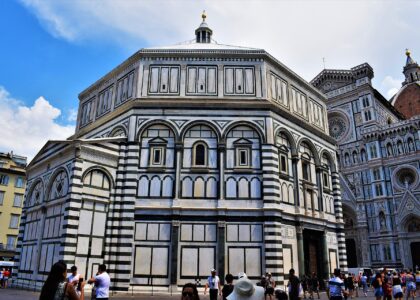
Begin in Piazza San Giovanni at the octagonal Baptistery of San Giovanni—Florence’s oldest building. The original structure dates to roughly the 4th-5th century AD; the current octagonal form with its green and white marble cladding was built between the 11th and 13th centuries. Notice the three sets of bronze doors: the south doors by Andrea Pisano (1330-1336), the north doors by Lorenzo Ghiberti (1403-1424), and the east doors—the celebrated Gates of Paradise by Ghiberti (1425-1452, replicas; the originals are in the Cathedral Museum).
Inside, the byzantine-style mosaics of the dome cover over 1,000 square meters and date from the 13th century. Notice the enormous Christ in Majesty and the eight-meter Hell scene below. For most visitors, the Baptistery is a 30-minute stop. See our complete Baptistery guide.
Stop 2: Florence Cathedral and Brunelleschi’s Dome (1296-1436)
Cross the small piazza to the Duomo—Cattedrale di Santa Maria del Fiore. Begun in 1296 by Arnolfo di Cambio and completed in 1436 with Filippo Brunelleschi’s revolutionary dome. The 19th-century polychrome marble facade was added 1871-1887. The Florentine Republic deliberately built this enormous cathedral to surpass rival cities Pisa and Siena—a statement of Florence’s wealth and ambition that took 140 years to complete.
Stand in the piazza and look at the dome from below. The 45.5-meter span was the largest masonry dome ever built when finished, and remains the largest in the world. Brunelleschi designed a self-supporting double-shell construction with a herringbone brick pattern that locked itself in place during construction—engineering that wouldn’t be matched in scale until the 19th century. For our complete guide to the Duomo and dome climb, see Florence Duomo guide.
Cathedral entry is free but only specific door times. The dome climb requires a paid Brunelleschi Pass (€30) reserved in advance. A quick exterior viewing takes 20 minutes; the full dome experience can take 3-4 hours.
Stop 3: Giotto’s Bell Tower (1334)
Beside the cathedral stands Giotto’s Campanile—the 84.7-meter bell tower designed by Giotto in 1334 (he died in 1337 with only the lower section built) and completed by Andrea Pisano and Francesco Talenti by 1359. The tower is decorated with two registers of relief sculptures depicting the Creation, biblical scenes, the planets, the virtues, and the seven sacraments—an encyclopedia in stone of medieval thought. The originals are in the Cathedral Museum; replicas are on the building.
The bell tower can be climbed (414 steps) for €20 with a Giotto Pass, but for our walking tour we’ll continue on foot. From here you can also see the modern Cathedral Museum entrance behind the apse on Piazza del Duomo 9 (not part of this walking tour but a worthwhile add-on).
Stop 4: Walk South to Orsanmichele
Leave the cathedral piazza walking south on Via Calzaiuoli—Florence’s main pedestrian artery and a major shopping street. Halfway down (about 2 minutes) you’ll reach Orsanmichele, an unusual square building that was once a 14th-century grain market converted into a church. The exterior is decorated with 14 niche sculptures by the leading Renaissance sculptors, each commissioned by a different Florentine guild.
Walk slowly around the building looking up. The 14 niches contain replicas (originals in the small museum upstairs); each was placed by a specific guild for their patron saint. Donatello’s St. George (linen guild, c. 1416) and St. Mark (linen merchants, 1411) are particularly important—the latter being one of the first true Renaissance freestanding figures, with weight and contrapposto pose recovering classical sculpture’s grammar after a thousand years.
The interior of Orsanmichele houses Andrea Orcagna’s stupendous tabernacle (1359). Free admission. The upstairs museum (€3) opens limited hours, typically Monday and Saturday, but houses the original niche sculptures.
Stop 5: Piazza della Signoria (13th-16th Century)
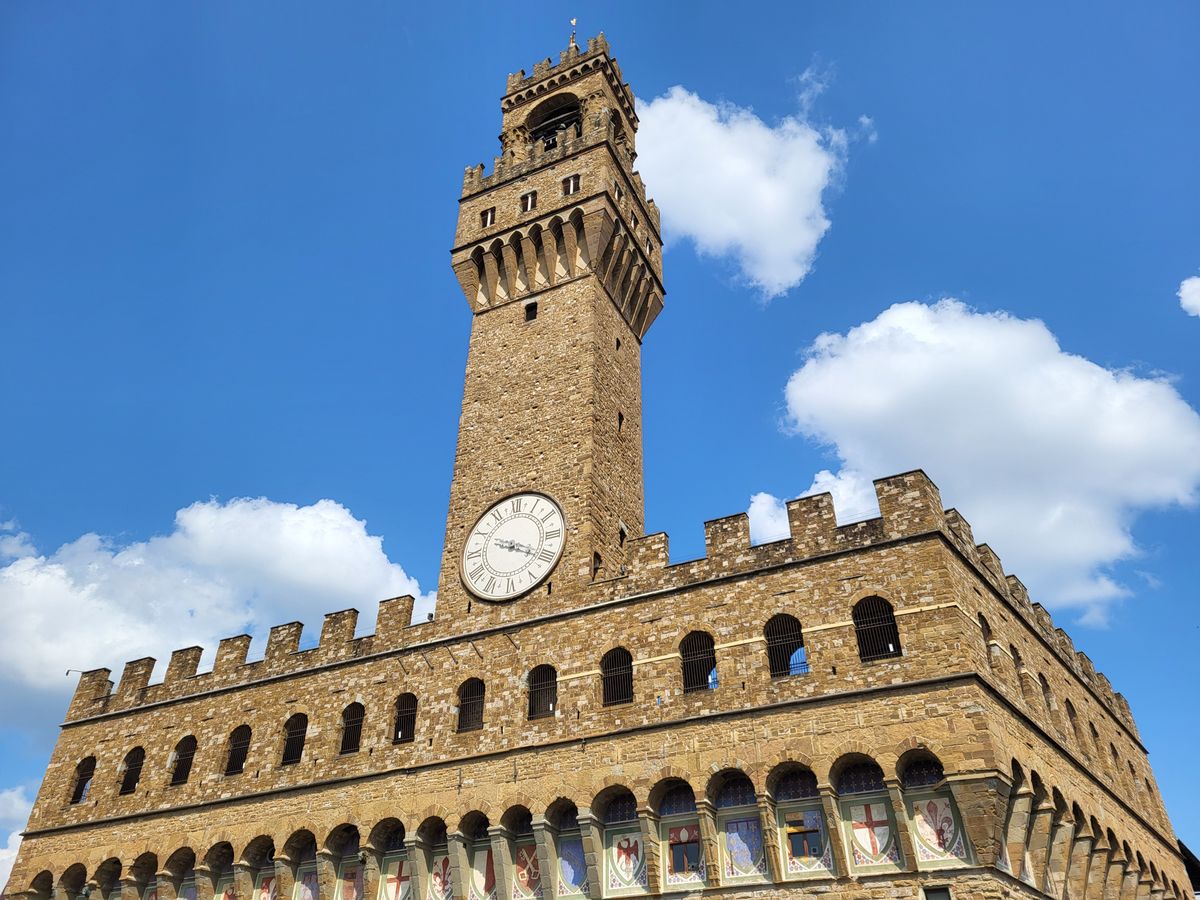
Continue south another minute to Piazza della Signoria—Florence’s political and ceremonial heart since 1299. The piazza is essentially an outdoor sculpture museum: Michelangelo’s David replica (the original is in the Accademia), the Marzocco lion, Bandinelli’s Hercules and Cacus, Ammannati’s Fountain of Neptune (1575), and Giambologna’s equestrian Cosimo I (1594). The Loggia dei Lanzi on the south side holds Cellini’s masterpiece Perseus with the Head of Medusa (1554) in bronze and Giambologna’s Rape of the Sabine Women (1582) in marble.
The bronze plaque set into the pavement near the Fountain of Neptune marks where the Dominican preacher Girolamo Savonarola was executed on May 23, 1498. He had ruled Florence as a quasi-theocratic moral dictator for four years before being condemned by both the Pope and the Florentine establishment.
Spend at least 30 minutes here, walking around the sculptures. Free. Optional: Palazzo Vecchio interior (€18, reduced €12, allow 90 minutes additional). See our Piazza della Signoria guide.
Stop 6: The Uffizi (Built 1560)
Walk through the south end of Piazza della Signoria into the corridor of the Uffizi. The U-shaped building was constructed by Giorgio Vasari for Cosimo I de’ Medici between 1560 and 1581 as government offices (hence “Uffizi”—offices). It became a public art museum in 1769 when Anna Maria Luisa de’ Medici’s collections were opened to public view.
The Uffizi today holds the world’s most important collection of Italian Renaissance painting: Botticelli’s Birth of Venus and Primavera, Leonardo’s Annunciation, Michelangelo’s Doni Tondo, Raphael’s portraits, Caravaggio’s Medusa, and works by virtually every Florentine and Italian master from the 13th to the 17th century. A full Uffizi visit takes 3-4 hours and is best as a separate activity, but the building exterior is part of this tour.
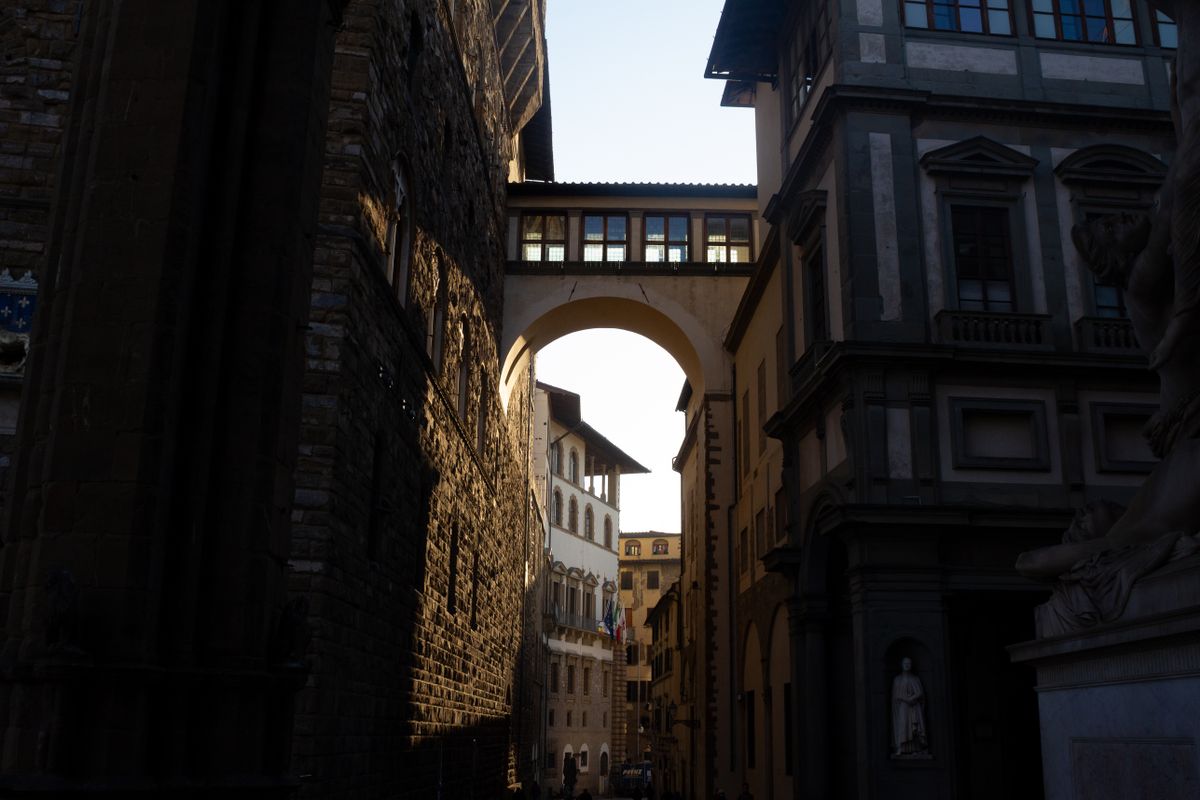
Walking through the corridor, look at the niches with 19th-century statues of famous Tuscans—Dante, Petrarch, Boccaccio, Galileo, Machiavelli, Leonardo, Michelangelo. Continue to the south end of the corridor, which opens onto the Lungarno (riverside embankment).
Stop 7: Ponte Vecchio (1345)
Turn right at the end of the Uffizi corridor and you’ll see the Ponte Vecchio 200 meters downstream. This is the bridge of bridges—built in 1345 on the site of a Roman crossing, lined with goldsmith shops since 1593, the only Florentine bridge spared by retreating German forces in August 1944.
Walk across slowly. Look up to spot the elevated Vasari Corridor running along the eastern (upstream) side—the kilometer-long passageway built in 1565 for the Medici to walk privately between Palazzo Vecchio and Pitti Palace. Look for the bronze bust of Benvenuto Cellini in the central piazzetta of the bridge. The bridge crossing takes about 5-7 minutes; full appreciation 20 minutes. See our Ponte Vecchio guide.
Stop 8: Palazzo Pitti and Boboli Gardens
Continue south from the Ponte Vecchio along Via Guicciardini for about 5 minutes. You’ll arrive at Piazza Pitti, dominated by the massive rusticated facade of the Pitti Palace. Originally built around 1458 for the wealthy Florentine banker Luca Pitti, it was expanded and acquired by the Medici in 1549 as their new ducal residence (Cosimo I felt Palazzo Vecchio was too cramped). Pitti remained the residence of the Medici and later the Lorraine and Savoy royal families until the 20th century.
The palace today houses the Palatine Gallery (paintings), the Royal Apartments, the Costume Gallery and the Gallery of Modern Art; the Treasury of the Grand Dukes is closed until further notice and the Porcelain Museum is closed for refurbishment. Combined ticket €15-€22 depending on season. Behind the palace lie the Boboli Gardens—Cosimo I’s pleasure garden designed for his wife Eleanor of Toledo starting in 1550, one of the earliest Italian Renaissance formal gardens. Boboli alone is worth 90 minutes; the full Pitti complex requires half a day.
This is the natural endpoint of a Renaissance walking tour. From here you can return to the city center via Ponte Santa Trinita (more elegant than Ponte Vecchio), explore Oltrarno’s artisan quarters, or simply pause at one of the cafés in Piazza Santo Spirito (5 min walk) for a well-earned aperitivo.
Optional Extensions
Extension A: Santa Croce
From Piazza della Signoria, walk east 5 minutes to Santa Croce (the world’s largest Franciscan church, with tombs of Michelangelo, Galileo, Machiavelli, and Rossini, plus the Pazzi Chapel by Brunelleschi). Allow 90 minutes. €9.50. See our Santa Croce guide.
Extension B: San Lorenzo and Medici Chapels
From the Duomo, walk west 5 minutes to San Lorenzo—the Medici parish church designed by Brunelleschi—and the adjoining Medici Chapels with Michelangelo’s New Sacristy. Combined €9, allow 90 minutes.
Extension C: Santa Maria Novella
From the Duomo, walk west 8 minutes to Santa Maria Novella—the principal Dominican church with Masaccio’s Trinity (the first true Renaissance painting using single-point perspective). €7.50, allow 60 minutes.
Extension D: Walk up to Piazzale Michelangelo
From Pitti, you can climb 25 minutes to Piazzale Michelangelo and San Miniato al Monte for the best panoramic views of Florence. Best at sunset.
One-Day Itinerary (5 hours, focused)
9:00: Baptistery (30 min). 9:30: Cathedral exterior + dome view (20 min). 9:50: Walk via Calzaiuoli, stop at Orsanmichele (20 min). 10:30: Piazza della Signoria + Loggia dei Lanzi (45 min). 11:15: Walk through Uffizi corridor (10 min). 11:25: Cross Ponte Vecchio slowly (20 min). 11:45: Walk to Pitti Palace (5 min). 11:50: Pitti exterior + Boboli Gardens entrance (60 min). 13:00: Lunch break in Oltrarno. 14:30 onwards: Pitti Palace interior, Santa Maria Novella, or San Lorenzo (90 min each).
Two-Day Renaissance Walking Plan
Day 1 (Renaissance North bank): Baptistery → Cathedral → Bell Tower exterior → Cathedral Museum (90 min) → Lunch → Santa Maria Novella → San Lorenzo + Medici Chapels → Aperitivo near the Duomo.
Day 2 (Renaissance South bank + Santa Croce): Santa Croce (90 min) → Walk west via Borgo dei Greci → Piazza della Signoria + Loggia (45 min) → Uffizi (3-4 hours, full visit) → Lunch → Cross Ponte Vecchio → Pitti Palace + Boboli Gardens (3 hours) → Aperitivo in Oltrarno.
Practical Tips for the Walking Tour
- Footwear: Comfortable walking shoes essential. Florence’s cobblestones are smooth from centuries of wear but slippery when wet. Avoid heels.
- Time of day: Start at 9:00 for cool morning, fewer crowds at the Baptistery, and best light at the Duomo. Avoid summer midday—the historic center has little shade.
- Crowds: Piazza della Signoria, Ponte Vecchio, and the Duomo area get extremely crowded 11:00-15:00 in summer. Visit these stops early or in late afternoon if possible.
- Hydration: Florence has 65 public drinking fountains in the historic center, marked with cast-iron tops. The water is safe and free.
- Toilets: Public toilets are limited. Cafés on the route (Caffè Rivoire, Caffè Gilli, Caffè Procacci) offer toilets to paying customers.
- Lunch: Best options on or near the route: All’Antico Vinaio (Via dei Neri, schiacciata sandwiches), Trattoria Mario (Via Rosina, Tuscan classics), Mercato Centrale (food court).
- Photography: Best light at Duomo: morning. Best at Ponte Vecchio: golden hour. Best at Piazza della Signoria: morning or late afternoon. Avoid midday harsh shadows.
- Tickets: Pre-book any sites you plan to enter (Duomo, Uffizi, Pitti, Accademia, Santa Croce). Walking the route exterior-only is free.
- Pickpockets: Crowded areas (Piazza della Signoria, Ponte Vecchio, around the Duomo) are pickpocket hotspots. Keep wallets in front pockets, bags zipped, no valuables on display.
Self-Guided vs. Guided Tour
This walking tour can be done entirely self-guided. The streets are well-signposted, Florence’s historic center is small enough that getting lost is briefly possible at most. Pair this guide with a map app (Google Maps or download an offline Florence map) and you’ll have everything you need.
That said, a licensed guide adds value if you’re an art lover wanting deeper context. Group walking tours run €25-50 per person for 3 hours; private guides €120-200 for half-day. Free walking tours operated by guruwalk.com offer tip-based 2-hour tours of similar routes.
Frequently Asked Questions
How long does a Florence Renaissance walking tour take?
The basic 3.5-kilometer route covering the major Renaissance sites takes 4-5 hours at a leisurely pace, including time for photographs and observation. With museum entries (Uffizi, Pitti), allow a full day. Compressed walking-only versions can be done in 2.5 hours.
Is Florence safe for walking tours?
Yes. Florence is one of Europe’s safest cities. Pickpocketing in crowded tourist areas is the main concern. Violent crime against tourists is virtually unknown. Solo female travelers can walk the historic center safely at any hour. Standard urban precautions (watch your bag, no valuables on display) apply.
What’s the best starting point for a Florence walking tour?
Most tours start at either the Duomo (most famous landmark, central) or Santa Maria Novella (close to the train station). The route in this guide begins at the Baptistery in Piazza San Giovanni for chronological clarity—it’s Florence’s oldest building. From the train station the Baptistery is a 10-minute walk.
Can children do this walking tour?
Yes, but adapt the pace. 4-5 hours of walking through the historic center is a lot for young children. Plan plenty of gelato breaks. Consider doing only the highlights (Baptistery → Duomo → Piazza della Signoria → Ponte Vecchio) and saving museums for adults-only days. Strollers handle Florence’s smooth cobblestones reasonably well.
Is the route wheelchair accessible?
Mostly yes. The historic center is largely flat and pedestrianized. Cobblestones are smooth but bumpy. Most major sites (Duomo, Piazza della Signoria, Ponte Vecchio, Pitti exterior) are wheelchair-accessible at street level. Specific museums and church interiors may have steps; check accessibility for each entry. Avoid Boboli Gardens uphill paths.
What if I only have 2 hours?
A compressed walking-only highlight tour: Baptistery exterior → Duomo + dome view (15 min) → walk Via Calzaiuoli to Orsanmichele (10 min) → Piazza della Signoria with Loggia dei Lanzi (30 min) → walk south to Ponte Vecchio + cross slowly (20 min) → return via Lungarno. Roughly 2 hours of walking + observation, 1.8 km total.
Should I do a guided or self-guided tour?
Self-guided is fine for most visitors—the route is straightforward, sites are well-signposted, and you control your pace. A licensed guide adds historical depth and context that a guidebook can’t replicate. For first-time visitors with strong interest in art history, splurge on at least one private 3-hour guided tour to build framework, then do the rest self-guided.
What should I bring on the walk?
Comfortable walking shoes, a refillable water bottle (Florence has free public fountains), small backpack, sunscreen and hat in summer, light layer for evening, charged phone with offline maps, cash for small purchases, and your prepaid museum tickets. Skip umbrellas in summer (it rarely rains); carry a foldable umbrella in October-March.
When is the best season for a walking tour?
April-May (mild, blooming, manageable crowds), late September-October (crisp, golden light, harvest season). Avoid July-August midday heat; if visiting then, walk early morning (7:00-11:00) and late afternoon (17:00-20:00). Winter (November-February) has the lowest crowds and is perfect for cool-weather walking, though some sites have shorter hours.