This article contains advertising. Booking links on this site can be turned into paid links automatically by our partner Travelpayouts: if you book through one, we earn a commission from the provider, at no extra cost to you. It never affects what we recommend. Affiliate disclosure
The Medici family of Florence is one of history’s most consequential dynasties—a family of Tuscan wool merchants who became Europe’s wealthiest bankers, then the political masters of Florence, then Grand Dukes of Tuscany, then the source of two queens of France and four popes. Their three centuries at the center of Florentine life (roughly 1397-1737) coincided with—and substantially funded—the Italian Renaissance. Without the Medici, there is no Brunelleschi dome, no Michelangelo David, no Botticelli Birth of Venus, no Galileo astronomy, and probably no Florence as we know it. This complete guide traces the dynasty from the wool guild offices of Giovanni di Bicci to the lonely death of Anna Maria Luisa, the last Medici, who in 1737 secured Florence’s artistic patrimony for the city forever.
The family’s fingerprints are on almost every building in this guide: they commissioned the Medici Chapels, governed from Palazzo Vecchio and later moved across the river to Palazzo Pitti, connecting the two by a private corridor over the Arno.
Nothing says more about how safe Cosimo I felt in his own city than the private road he had built across it in five months. Our Vasari Corridor guide follows the route from Palazzo Vecchio to Palazzo Pitti.

The Medici at a Glance
| Detail | Information |
|---|---|
| Family origin | Mugello region, north of Florence |
| First documented | 1230 (as small landowners and traders) |
| Bank founded | 1397 by Giovanni di Bicci de’ Medici |
| First political ruler | Cosimo “the Elder” (de facto from 1434) |
| Most famous patron | Lorenzo “the Magnificent” (1449-1492) |
| Hereditary title | Duke of Florence (1532); Grand Duke of Tuscany (1569) |
| Popes | Leo X, Clement VII, Pius IV, Leo XI |
| Queens of France | Catherine de’ Medici (1547), Marie de’ Medici (1600) |
| Last Medici | Anna Maria Luisa (d. 1743) |
| Family motto | Festina lente—”Hasten slowly” |
Origins: From Mugello Farmers to Florentine Bankers
The Medici came from the Mugello, the rolling agricultural region 30 kilometers north of Florence. The family name probably derives from “medico” (doctor)—possibly an ancestor was a physician—and the six red palle (balls) on the family crest may represent either pills or pawnbroker’s coins. Both interpretations are guesses; the symbolism was already obscure by the Renaissance.
In the 13th and 14th centuries, the Medici were minor nobility—respectable but unremarkable. They produced a few priors of Florence’s republican government, fought in factional disputes, and dabbled in trade. The family suffered a setback in 1378 when one branch backed the Ciompi Revolt, a wool workers’ uprising that ended badly for its supporters. By the 1390s, the Medici were a middle-tier Florentine clan among many. Then Giovanni di Bicci de’ Medici (1360-1429) decided to start a bank.
Giovanni had trained in Rome at his cousin’s bank. Returning to Florence in 1397, he opened the Medici Bank—a wool-trading firm with banking sidelines that quickly became a banking firm with wool sidelines. Giovanni’s genius was a network of branches in foreign cities (Rome, Venice, Geneva, eventually London and Bruges) connected by sophisticated bookkeeping and credit instruments. The bank’s biggest customer was the papacy. By 1410, the Medici were the bankers to Pope John XXIII (whose election they helped finance). When that pope was deposed at the Council of Constance, Giovanni cleverly transferred Medici loyalty to his successor Martin V—a political maneuver that secured the bank’s future.
Giovanni di Bicci was politically cautious. He deliberately stayed out of the front rank of Florentine politics, preferring to influence events from behind the scenes. He died in 1429 leaving a fortune of 180,000 florins (roughly $300 million in today’s purchasing power) and a son who would not be cautious at all.
Cosimo the Elder: Founder of the Dynasty (1389-1464)
Cosimo de’ Medici, called il Vecchio (“the Elder”) to distinguish him from his great-grandson Cosimo I, was the first Medici to wield real political power. Inheriting the bank in 1429, he was already among the wealthiest men in Europe. He used the wealth shrewdly—lending to the Florentine government, financing churches, and building a clientele of powerful supporters.
This made enemies. In 1433, the rival Albizzi faction had Cosimo arrested and exiled. They underestimated him. Within a year, Cosimo’s faction had organized enough support that Florence recalled him in triumph. From October 1434 until his death in 1464, Cosimo was the de facto ruler of Florence—officially still a republic, but in practice run through Medici-controlled committees, friendly priors, and the bank’s patronage networks. He never took an official title beyond “first citizen.” After his death, the Florentine senate granted him the posthumous honor of Pater Patriae (“Father of the Fatherland”), still inscribed on his tomb at San Lorenzo.

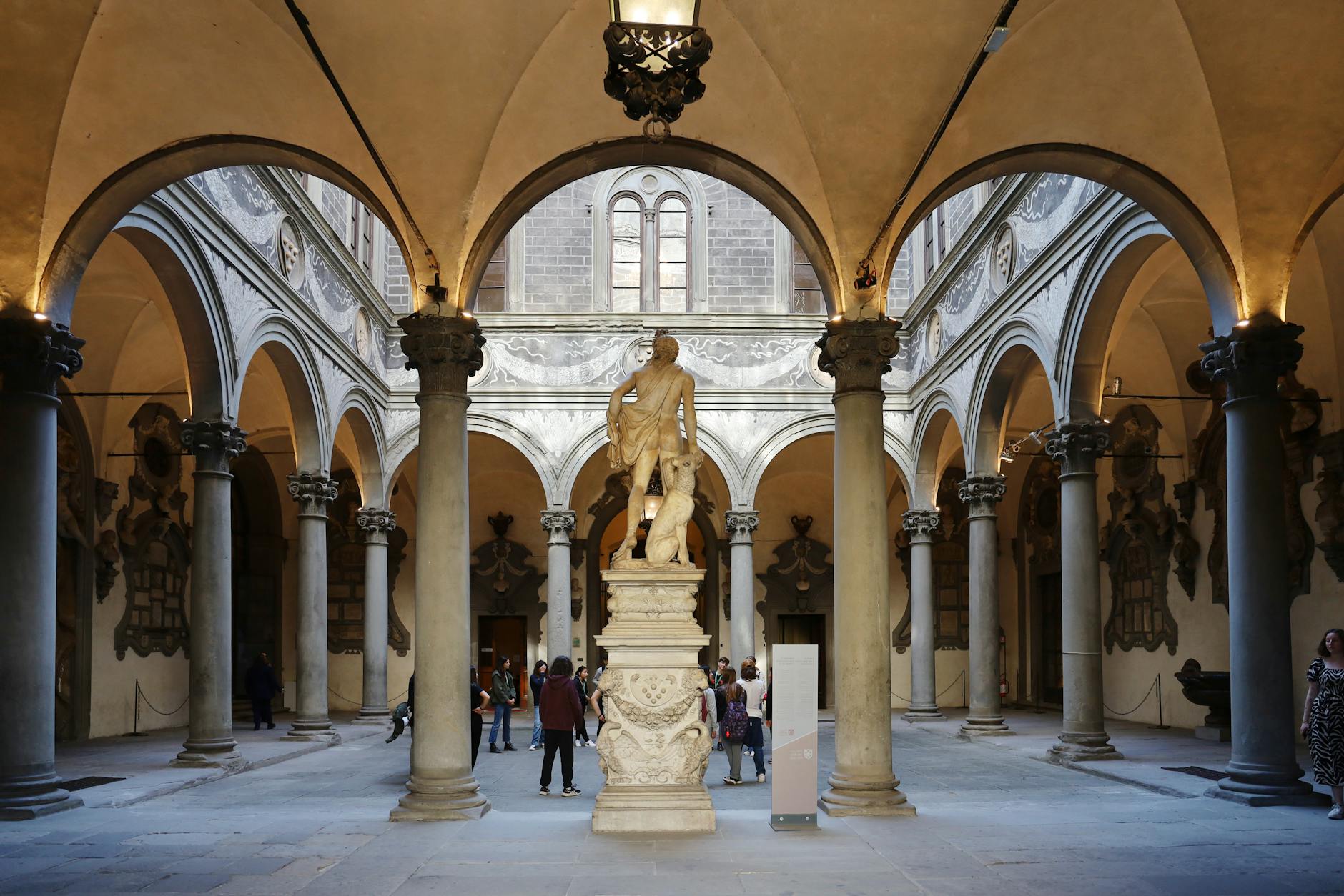
Cosimo was a remarkable patron. He commissioned Brunelleschi to redesign the church of San Lorenzo (which became the Medici parish church and burial chapel), founded the Platonic Academy that revived ancient Greek philosophy in Florence, and funded Donatello’s most important sculptures including the bronze David—the first freestanding nude bronze made in Europe since antiquity. Cosimo’s library, gathered through agents who scoured monasteries across Europe for forgotten manuscripts, became the foundation of the Laurentian Library and saved many ancient texts from oblivion. His Palazzo Medici on Via Cavour, designed by Michelozzo, set the model for Renaissance palace architecture and is still visitable today (now the Palazzo Medici Riccardi).
Lorenzo the Magnificent: Renaissance at Its Peak (1449-1492)
Cosimo’s son Piero “the Gouty” (so named for his arthritis) ruled briefly, dying in 1469 and leaving the family in the hands of his 20-year-old son Lorenzo. Despite his youth, Lorenzo de’ Medici became one of the most consequential rulers in Italian history—not for territorial expansion but for cultural patronage so consistent and refined that he is remembered as il Magnifico, the Magnificent.
Lorenzo was a poet himself (his Carnival songs are still sung in Tuscany), a scholar of Plato, a connoisseur of art, and a gifted diplomat who held the fragile peace of Italy together for two decades through balance-of-power politics among Milan, Venice, the papacy, and Naples. Under his patronage, Botticelli painted the Birth of Venus and Primavera for the family’s Villa di Castello. Michelangelo, recognized as a teenage prodigy, lived in the Medici household and ate at Lorenzo’s table for several years, learning sculpture in the Medici garden full of antiquities. Leonardo da Vinci, Pico della Mirandola, Angelo Poliziano, Marsilio Ficino—an astonishing concentration of genius worked under Lorenzo’s protection.
Lorenzo’s reign had its dark moments. The Pazzi Conspiracy of April 26, 1478—a plot to murder Lorenzo and his brother Giuliano during High Mass at the Duomo—killed Giuliano in the cathedral while Lorenzo escaped, wounded, into the sacristy. The conspiracy involved the rival Pazzi banking family, the Archbishop of Pisa, and Pope Sixtus IV, and triggered a brutal Medici reprisal: dozens of conspirators were hanged from the windows of the Palazzo Vecchio, including the Archbishop in his robes. Botticelli was commissioned to paint defamatory portraits of the conspirators on the palazzo wall (since destroyed). The crisis brought Florence into a costly war with the papacy that Lorenzo personally ended through a daring diplomatic mission to Naples to detach an enemy ally—one of the most famous acts of his rule.
Lorenzo also presided over a deteriorating Medici Bank. Distracted by politics and patronage, he neglected the financial machine that paid for everything else. By the time of his death in 1492 at age 43, the bank was failing, his sons were unprepared, and a Dominican friar named Girolamo Savonarola was preaching apocalyptic sermons against Medici corruption. Two years later, in 1494, Lorenzo’s incompetent son Piero “the Unfortunate” mishandled the French invasion of Italy, surrendered Florence’s fortresses, and was expelled from the city by an angry citizenry. The Medici went into exile.
Exile, Return, and the Pope-Princes (1494-1537)
For 18 years (1494-1512), Florence was again a republic—at first under Savonarola’s theocratic puritanism (which ended in his execution by burning in Piazza della Signoria in 1498), then under more conventional republican government featuring Niccolò Machiavelli as a senior diplomat and military organizer. The exiled Medici plotted their return.
Their re-entry came through the papacy. Lorenzo’s second son Giovanni was a cardinal at age 13—a position Lorenzo had purchased and cultivated. In 1513, Cardinal Giovanni was elected Pope Leo X, the first Medici pope. With papal armies and money, the Medici regime was restored to Florence the year before. Pope Leo presided over a magnificently corrupt papacy, accelerated indulgence sales (which directly triggered Martin Luther’s rebellion in 1517), and patronized Raphael, the late Michelangelo, and the construction of new Saint Peter’s. He famously remarked, “God has given us the papacy; let us enjoy it.”
A second Medici pope, Clement VII (born Giulio, the illegitimate son of Lorenzo’s murdered brother Giuliano), reigned 1523-1534. His pontificate was a disaster—he chose the wrong side in the wars between France and Emperor Charles V, and in 1527 imperial troops sacked Rome in one of the worst urban catastrophes of the era. Clement also alienated England by refusing to grant Henry VIII his divorce, helping spark the English Reformation.
During Clement’s pontificate, Florence briefly expelled the Medici again (1527-1530, the “last republic”). Imperial troops loyal to Clement besieged the city for ten months in 1530, and Michelangelo—patriotic Florentine Republican—designed the city’s defenses. After Florence’s surrender, Clement installed his teenage relative Alessandro de’ Medici as the first hereditary Duke of Florence in 1532. The Florentine Republic, founded around 1115 and lasting four centuries, was finished.
The Grand Dukes of Tuscany (1537-1737)
Duke Alessandro was assassinated in 1537 by a distant cousin, prompting the elevation of an obscure Medici cadet branch in the person of Cosimo I (1519-1574). Only 17 at his accession, Cosimo I proved one of the most capable Medici. He defeated a Republican coup, conquered Siena (1555), professionalized the Tuscan state, and in 1569 received the title Grand Duke of Tuscany from Pope Pius V—the first sovereign monarchy in Tuscany.
Cosimo I rebuilt Florence as a princely capital. He commissioned Vasari to construct the Uffizi (originally government offices, hence the name) and the Vasari Corridor connecting Palazzo Vecchio to the new ducal residence Pitti Palace, by way of Ponte Vecchio. He sponsored the painters Bronzino, Vasari, and Pontormo. He commissioned Cellini’s bronze Perseus and Giambologna’s marble Rape of the Sabine Women for Piazza della Signoria. He invited Galileo’s father Vincenzo to court as a musician, indirectly nurturing the boy who would revolutionize science.
Cosimo’s son Francesco I (r. 1574-1587) was an introverted alchemist who married his Venetian mistress Bianca Cappello and likely died alongside her by malarial fever (rumors of poisoning persisted for centuries). Francesco’s brother Ferdinando I (r. 1587-1609) was an effective ruler who dredged the port of Livorno into Tuscany’s commercial gateway, sponsored Galileo, and married Christine of Lorraine—bringing French sophistication to Florence. Their grandson Cosimo II (r. 1609-1621) gave Galileo a court position and protected him during his early conflicts with the Inquisition.
Decline set in. Ferdinando II (r. 1621-1670) was kindly but ineffective; under him plague (1630-1633) killed 12% of Florentines. Cosimo III (r. 1670-1723) was a religious bigot who imposed punishing morality laws, expelled Jews, restricted women, and bankrupted the state with extravagant ceremonies. By the early 18th century the dynasty had run out of viable heirs. Cosimo III’s sons Ferdinando (a brilliant patron of music who predeceased his father) and Gian Gastone were the last male Medici.
Gian Gastone and the Family Pact (1723-1743)
Gian Gastone de’ Medici, the last Grand Duke (r. 1723-1737), was a tragic figure—an intelligent, melancholy man trapped in an arranged marriage to a Bohemian princess he detested. He spent most of his adult life in bed, surrounded by his “Ruspanti” (a male entourage paid in ruspi, a small coin). To his credit, he reversed his father’s worst religious legislation: he readmitted Jews, repealed laws criminalizing intellectual life, and ended ceremonial pageantry. He was popular with the Florentine poor for these acts. But he produced no heir.
The European powers had already decided Tuscany’s fate. By the 1735 Treaty of Vienna, the duchy would pass to Francis Stephen, Duke of Lorraine and future husband of Maria Theresa of Austria. Gian Gastone died on July 9, 1737. His Lorraine successors took control. The Medici grand-ducal line was extinct.
One Medici remained: Anna Maria Luisa, Gian Gastone’s older sister, the widow of the Elector Palatine of Düsseldorf. She returned to Florence in 1717 and lived in the Pitti Palace until her death in 1743. In her old age she signed the document for which she should be most remembered: the Patto di Famiglia (Family Pact) of 1737, an agreement with the new Lorraine dynasty stipulating that all the Medici art collections—the Uffizi paintings, the sculptures, the Pitti collections, the libraries—must remain in Florence forever, “for the benefit of the public of all the nations.” She had no obligation to do this. The collections were her personal property and could have been dispersed across Europe. Instead, she gifted Florence its identity as a museum city. Without that act, the Uffizi might be empty today.
Famous Medici Outside Florence
Catherine de’ Medici, Queen of France (1519-1589)
Born in Florence to Lorenzo II de’ Medici, Catherine married the future King Henry II of France in 1533 and became one of the most powerful women in 16th-century Europe. As regent for her young sons, she dominated French politics during the Wars of Religion and bears responsibility (still debated by historians) for the St. Bartholomew’s Day Massacre of 1572, which killed thousands of French Protestants. She introduced Italian cuisine, ballet, and table manners to the French court—the fork, allegedly, came north with her.
Marie de’ Medici, Queen of France (1575-1642)
The second Medici Queen of France, Marie was Catherine’s great-niece. She married King Henry IV of France in 1600 and became regent after his assassination in 1610. Her tumultuous court patronized Rubens, who painted the famous Marie de’ Medici cycle (now in the Louvre) celebrating her life. She was eventually exiled by her son Louis XIII at the urging of Cardinal Richelieu.
The Medici Popes
Four Medici popes shaped Catholic history: Leo X (Giovanni, r. 1513-1521) presided over the early Reformation; Clement VII (Giulio, r. 1523-1534) failed to prevent the Sack of Rome and the English Reformation; Pius IV (Giovanni Angelo, r. 1559-1565)—from a different Lombard branch but adopted into the Florentine clan—oversaw the final sessions of the Council of Trent; Leo XI (Alessandro, r. 1605) reigned only 27 days before dying.
Medici Florence: Sites You Can Visit Today
Three centuries of Medici presence have left Florence saturated with their footprints. The following sites are all open to visitors and together form an essential Medici itinerary:
- Palazzo Medici Riccardi (Via Cavour 3) — The original family palace built for Cosimo the Elder by Michelozzo, 1444-1484. The chapel inside contains Benozzo Gozzoli’s Procession of the Magi, a fresco depicting the Medici as the three kings, which is one of the loveliest small spaces in Florence. Tickets €10.
- San Lorenzo Basilica and Medici Chapels — The family parish church, designed by Brunelleschi. The Old Sacristy contains the tombs of Giovanni di Bicci and Cosimo the Elder. The adjoining New Sacristy was designed by Michelangelo for Lorenzo’s heirs. The grandiose Cappella dei Principi behind the apse holds the tombs of the Grand Dukes. Combined ticket €9.
- Uffizi Gallery — Built by Cosimo I as government offices in 1560, converted to a public art museum in 1769. Houses the Medici collection of Renaissance painting—Botticelli, Leonardo, Michelangelo, Raphael, Caravaggio. €25 standard, plan 3-4 hours. See our Uffizi guide.
- Pitti Palace — Acquired by the Medici in 1549 and used as ducal residence by Cosimo I and successors. Now houses the Palatine Gallery, royal apartments, and several specialized museums. The Boboli Gardens behind the palace are equally important Medici art. See our Palazzo Pitti guide.
- Palazzo Vecchio — The medieval town hall co-opted by Cosimo I as his initial ducal residence. The Salone dei Cinquecento contains Vasari’s enormous frescoes celebrating Medici military victories. Camera Verde and the Studiolo of Francesco I are highlights. See our Palazzo Vecchio guide.
- Vasari Corridor — A kilometer-long elevated passageway built by Vasari in 1565 connecting Palazzo Vecchio to Pitti Palace via the Uffizi and over Ponte Vecchio. Cosimo I commissioned it so the Grand Dukes could move through Florence without mingling with their subjects. Reopened to public visits in late 2024 after long restoration; tickets must be reserved separately.
- Boboli Gardens — The Medici pleasure garden behind Pitti, designed for Eleanor of Toledo (Cosimo I’s wife) starting 1550. One of the earliest Italian Renaissance gardens, full of grottoes, fountains, and antiquities.
- Villa Medicea di Castello, Villa La Petraia, Villa di Poggio a Caiano — Three of the Medici country villas around Florence, all UNESCO-listed. Castello held Botticelli’s Birth of Venus until the Uffizi acquired it. Open to visitors; some open by appointment only.
Medici Patronage: What They Funded
The Medici directly commissioned, supported, or sheltered an extraordinary roster of artists and thinkers. Among the most important:
- Filippo Brunelleschi — Designed the dome of Florence Cathedral with Medici financial backing. Also designed San Lorenzo for Cosimo the Elder.
- Donatello — Cosimo’s favorite sculptor; produced bronze David and the powerful sculptures of San Lorenzo.
- Sandro Botticelli — Painted Birth of Venus, Primavera, and several Madonnas under Lorenzo the Magnificent’s patronage.
- Leonardo da Vinci — Lived and worked in Florence under Lorenzo before moving to Milan; later returned briefly to do the Battle of Anghiari for Palazzo Vecchio (never finished).
- Michelangelo Buonarroti — Adopted into Lorenzo’s household as a teenager; later worked extensively for the Medici Popes (Sistine Chapel, Medici Chapels).
- Raphael — Painted multiple Medici portraits and decorations for Pope Leo X.
- Giorgio Vasari — Court artist to Cosimo I; designed the Uffizi, Vasari Corridor, and the Palazzo Vecchio frescoes; wrote the Lives of the Artists with Medici support.
- Galileo Galilei — Court mathematician to Cosimo II; named the moons of Jupiter “Medicean Stars” in 1610. Protected by the Medici until the 1633 Inquisition trial.
- Niccolò Machiavelli — Although primarily a Republican, dedicated The Prince (1513) to Lorenzo II de’ Medici as an unsuccessful job application.
The Medici Bank
The financial machine that paid for the Renaissance was an innovation of considerable sophistication. The Medici Bank pioneered the use of the bill of exchange (a kind of medieval traveler’s check that allowed money to move across Europe without physically transporting coin), holding company structures (where a parent firm controlled semi-autonomous regional branches), and double-entry bookkeeping. At its peak under Cosimo the Elder around 1450, branches operated in Florence, Rome, Geneva, Lyon, Bruges, London, Avignon, Milan, Venice, and Pisa.
The bank was always politically vulnerable. As papal bankers, the Medici could not safely refuse loans to the popes; as Florentine politicians, they often had to lend to the city government regardless of repayment prospects. Loans to King Edward IV of England during the Wars of the Roses—loans Edward never repaid—badly damaged the London branch. By Lorenzo the Magnificent’s time, the bank was overextended and poorly managed by relatives Lorenzo trusted with cousinly affection but no commercial ability. The bank failed in 1494, the same year the Medici were exiled. The dynasty survived. The bank did not.
Medici-Themed Walking Itinerary in Florence
For visitors who want to follow Medici history on foot, this half-day itinerary covers the family’s main Florence sites in chronological order:
9:00 — Begin at Palazzo Medici Riccardi on Via Cavour. Visit the Magi Chapel (book ahead). About 60 minutes. 10:30 — Walk 5 minutes to San Lorenzo Basilica and the Medici Chapels. See Michelangelo’s New Sacristy and the Cappella dei Principi. About 90 minutes. 12:30 — Lunch break (Mercato Centrale is two blocks away). 14:00 — Walk to Piazza della Signoria. See the Marzocco lion (Donatello, originally), Cosimo I’s equestrian statue (Giambologna), and Cellini’s Perseus in the Loggia. 14:45 — Enter Palazzo Vecchio. See the Salone dei Cinquecento and Studiolo. About 90 minutes. 16:30 — Walk through the Uffizi exterior (the gallery itself takes a separate full day) and along Lungarno to Ponte Vecchio. 17:00 — Cross to Pitti Palace; see exterior and Boboli Gardens. End the day with aperitivo at a rooftop bar with Medici views.
The Medici Legacy
Three centuries after the dynasty ended, the Medici remain inseparable from Florence’s identity. The Anna Maria Luisa pact ensured that the artistic legacy stayed in the city; the urban fabric they shaped—the palaces, the churches, the squares, the bridges—is still the historic center we walk today. The dynasty produced figures like Lorenzo the Magnificent who genuinely loved art and learning, and figures like Cosimo III who damaged the state through bigotry. Their lives included Renaissance brilliance and Renaissance brutality, intellectual generosity and authoritarian severity. Modern Florence venerates them critically, neither sainting them nor erasing them.
Florence honored Anna Maria Luisa de’ Medici on the 250th anniversary of her death in 1993 by declaring February 18 (the day she died) the “Day of the Medici.” Every year now, on that date, the city’s museums offer free admission and ceremonies are held at her tomb in the Cappella dei Principi—a quiet acknowledgment that without the family’s last act of generosity, much of what makes Florence Florence would be elsewhere.
Frequently Asked Questions
How did the Medici become so wealthy?
Through banking. Giovanni di Bicci de’ Medici founded the Medici Bank in 1397, which became the largest bank in 15th-century Europe. The papacy was its biggest customer, and Medici banking innovations—including bills of exchange, holding company structures, and branch networks—allowed unprecedented profits. By the mid-1400s, the family was among the wealthiest in Europe.
Who was the most famous Medici?
Lorenzo de’ Medici, called Lorenzo the Magnificent (1449-1492), is the most famous. He ruled Florence from 1469 to 1492 during the high point of the Italian Renaissance, patronized Botticelli, Michelangelo, and Leonardo, and was a poet and diplomat himself. Cosimo the Elder (his grandfather) and Cosimo I (the first Grand Duke of Tuscany) are also major figures.
How long did the Medici rule Florence?
About 300 years. The Medici controlled Florence informally from 1434 (Cosimo the Elder) to 1494 (exile of Piero), then again from 1512 to 1527, and again continuously from 1530 to 1737—first as Dukes of Florence, then as Grand Dukes of Tuscany. The dynasty ended with Gian Gastone’s death in 1737.
Where can I visit Medici sites in Florence?
The major Medici sites are Palazzo Medici Riccardi, San Lorenzo Basilica with the Medici Chapels, the Uffizi Gallery, Pitti Palace, Palazzo Vecchio, the Vasari Corridor, and Boboli Gardens. All are open to visitors with separate tickets. Outside the city, several Medici villas (Castello, La Petraia, Poggio a Caiano) are also visitable.
How many Medici popes were there?
Four: Leo X (1513-1521, born Giovanni), Clement VII (1523-1534, born Giulio), Pius IV (1559-1565, born Giovanni Angelo), and Leo XI (1605, born Alessandro—reigned just 27 days). Leo X and Clement VII were direct descendants of Lorenzo the Magnificent’s family.
What did the Medici contribute to the Renaissance?
Patronage and protection. The Medici funded works by Brunelleschi, Donatello, Botticelli, Michelangelo, Raphael, Leonardo da Vinci, Vasari, Cellini, and Galileo, among many others. They sheltered scholars, founded the Platonic Academy, built the Laurentian Library, and created the artistic environment in which the Renaissance flourished. Without their wealth and patronage, the Italian Renaissance would have looked very different.
Why are there six balls on the Medici coat of arms?
The exact meaning is lost to history. Theories include: pills (medico means doctor), pawnbroker’s coins, dents in a shield made by a giant’s mace (an heraldic legend), or simply abstract devices. By the Renaissance, the Medici themselves had forgotten the original meaning. The number of balls varied between five and eight before settling at six in the early 14th century.
Who was the last Medici?
Anna Maria Luisa de’ Medici (1667-1743), Electress Palatine, was the last member of the senior line. She was the elder sister of the last Grand Duke Gian Gastone. In 1737, she signed the Family Pact ensuring the Medici art collections remained permanently in Florence—an act that preserved the city’s status as a cultural capital.
What is the Medici Family Pact?
The Patto di Famiglia (Family Pact) was signed in 1737 by Anna Maria Luisa de’ Medici with the new Lorraine grand-ducal dynasty. It stipulated that all Medici art collections—paintings, sculptures, furniture, books—must remain in Florence forever and could never be sold or moved abroad. This pact preserved the Uffizi, Pitti collections, and other cultural treasures in their original city.
Is the Medici line still alive?
Not in the senior, princely line. That ended with Anna Maria Luisa in 1743. Distant collateral branches of Medici relatives still exist as ordinary citizens in Italy and elsewhere, but no descendant of the ruling line of Florence and Tuscany survives. Various people occasionally claim descent, with mixed validity.