This article contains advertising. Booking links on this site can be turned into paid links automatically by our partner Travelpayouts: if you book through one, we earn a commission from the provider, at no extra cost to you. It never affects what we recommend. Affiliate disclosure
Florence is one of Italy’s great leather cities — a place where a craft tradition going back to the medieval guilds still shapes what is made and sold, and where careful visitors can buy authentic Italian leather for less than they would pay at retail elsewhere. The challenge is that the same markets and streets sell low-quality factory imports alongside genuine handcrafted leather, often labelled identically. This 2026 guide explains how to spot real leather, where to buy authentic goods (Scuola del Cuoio leather school vs San Lorenzo market vs boutique shops), price ranges by item, what to bargain and what not to, and the specific products Florence does best.
Leather is the single biggest category in our Florence shopping guide. Most visitors start at the stalls of the San Lorenzo market, but the genuinely handmade pieces come from the artisan workshops across the river.
Why Florence for Leather?
Florence’s leather tradition dates to the medieval guild system. Tanners and curriers belonged to the Arte dei Cuoiai e Galigai, one of Florence’s 21 guilds (the furriers and skinners had their own, the Arte dei Vaiai e Pellicciai). The Santa Croce area was a historic centre of leather working, and across the river the Oltrarno — San Niccolò and San Frediano — still has traditional artisan workshops. Today the city’s leather industry includes:
- The Scuola del Cuoio (Leather School) at Santa Croce — Florence’s premium leather school, founded 1950, training artisans and selling high-end goods
- San Lorenzo Market — the famous outdoor leather market beside the Basilica of San Lorenzo
- Mercato del Porcellino (the smaller “Pig Market”) — outdoor leather market on Via Porta Rossa
- Mercato di Santa Croce — the leather stalls around the basilica
- Oltrarno artisan workshops — small one-person studios making custom and limited-edition pieces
- Premium leather boutiques on Via dei Tornabuoni and Via Roma — Gucci, Salvatore Ferragamo (founded in Florence), Bottega Veneta, and smaller artisanal Italian houses
The price range across these is enormous: a “leather” wallet can cost €10 at the cheapest market stall or €1,500 at Gucci, with vast quality differences. Knowing what you’re buying is essential.
How to Spot Real vs Fake Leather
The key distinction: real leather (made from animal hide) vs faux leather / pleather / PU (polyurethane) leather (made from plastic). Quality variations within real leather also matter — full-grain, top-grain, and bonded leather are dramatically different.
Real Leather Tests
- Smell test — real leather has a distinctive natural smell. Plastic-leather smells synthetic or chemical. Real leather smells warm and slightly animal.
- Pressure test — press a finger firmly into the leather. Real leather wrinkles around the finger then returns to shape; faux leather has plastic-foam compression with no wrinkling.
- Edge inspection — real leather has rough, fibrous edges (especially on cut bag straps). Faux leather has perfect, foam-like edges with smooth plastic finish.
- Texture variation — real leather has natural variation in surface texture, small imperfections, slight color shifts. Faux leather is uniformly perfect across the surface.
- Weight — real leather is heavier than faux of equivalent thickness, with a denser feel.
- Touch — real leather warms to body temperature; faux leather stays cool plastic-feeling.
- Burn test — real leather burns slowly with a hair-burning smell; faux leather melts with a chemical-plastic smell. (Don’t actually do this in a shop, but useful to know.)
- Water test — a small drop of water absorbs into real leather, leaving a darker spot that fades. On faux leather, water beads up and wipes off cleanly.
Leather Quality Grades
Even within “real leather,” quality varies dramatically:
- Full-grain leather — top quality, the outermost layer of the hide, with all natural grain intact. Strongest, most durable, ages beautifully (develops a patina). Most expensive.
- Top-grain leather — second-tier; the outermost layer with surface sanded for uniformity. Less durable than full-grain but still high quality.
- Genuine leather (legal label) — third-tier; lower-quality split leather, can be quite poor. The label “genuine leather” sounds reassuring but is actually a downgrade from full-grain or top-grain.
- Bonded leather — lowest tier; ground-up leather scraps glued together with synthetic binders. Looks like leather but performs like plastic.
- Faux leather / PU / pleather — not leather at all; polyurethane plastic.
Reputable Florence vendors will tell you the leather grade if asked. “Vera pelle” (real leather) on the label is required by Italian law for genuine leather products, but doesn’t distinguish between full-grain and lower grades.
“Made in Italy” Verification
Look for the “Made in Italy” or “Vera Pelle Italiana” label. Vegetable tanning, which uses plant tannins, has a long history in several countries, and Tuscany has a distinctive tradition of the craft. Vegetable-tanned leather has distinctive characteristics:
- Natural earth-tone colors (browns, tans, dark reds)
- Develops a rich patina over time
- The “Pelle Conciata al Vegetale in Toscana” consortium label on premium pieces
- Slight earthy smell rather than chemical
Watch for “Made in Italy” labels stamped on plastic-leather goods at low prices — this is sometimes counterfeit-labelled. If a leather jacket costs €120 and the label says “Made in Italy,” skepticism is warranted.
Where to Buy: The Three Tiers
Tier 1: Scuola del Cuoio (Leather School)
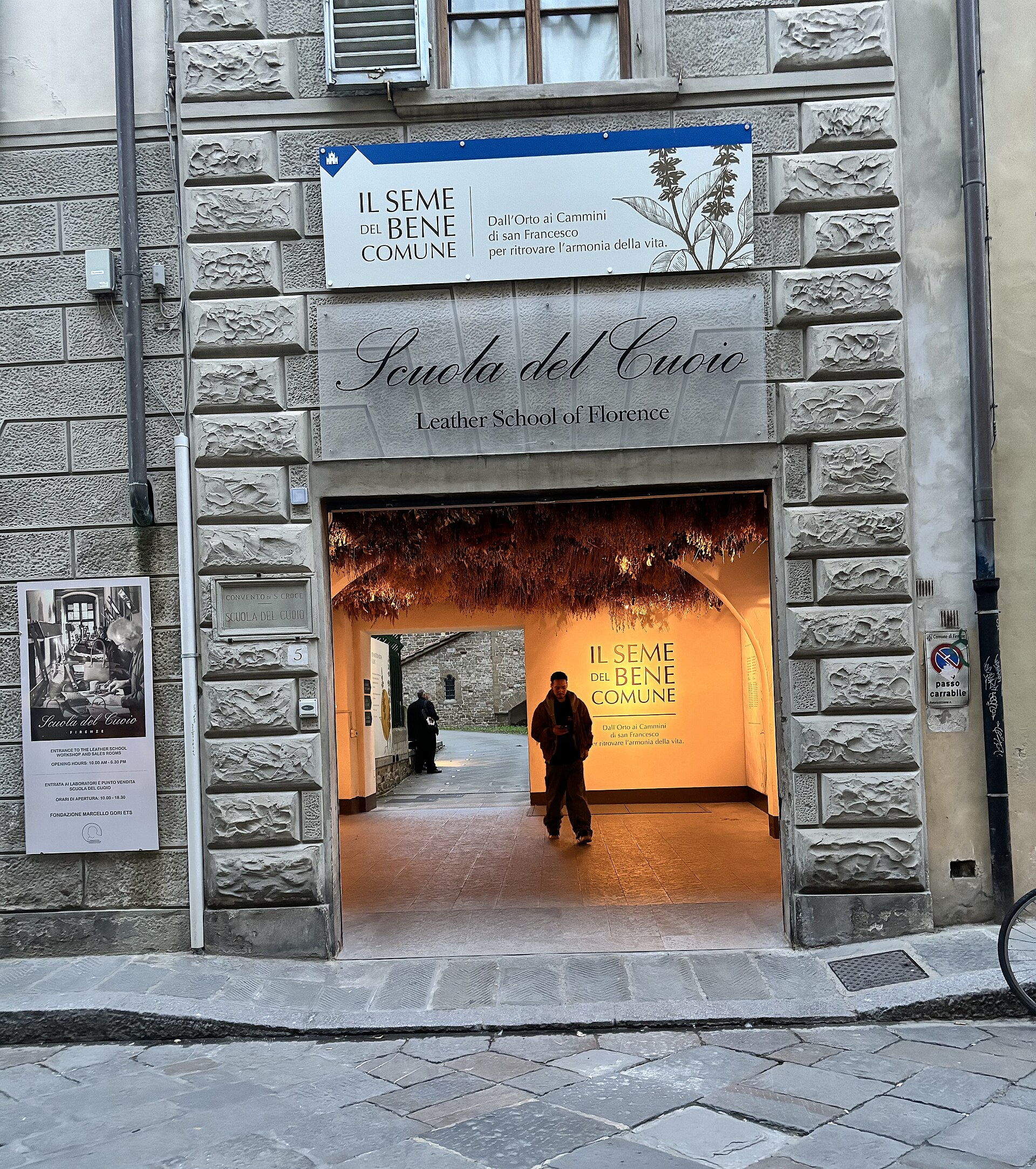
The premium-quality option. Located behind the Santa Croce basilica, with its entrance through the garden around the apse at Via San Giuseppe 5R. Founded 1950 by the Franciscan friars of Santa Croce as a vocational school for orphans — now a working leather school producing world-class goods.
- Quality: Top-tier handcrafted leather, mostly full-grain Italian vegetable-tanned
- Prices: Wallets €60–150, small bags €200–500; jackets and larger bags are priced model by model in the school’s online catalogue
- Visit: You can watch artisans at work in the workshop. Opening hours change with the season, so check the school’s opening information before you go.
- Range: Bags, wallets, belts, jackets, accessories. Custom orders possible.
- Reputation: Royalty and celebrities have shopped here for decades. The Franciscan setting (you reach it through the garden behind the basilica’s apse) adds atmosphere.
The Scuola del Cuoio is the safest place to buy authentic Florence leather — quality is consistently high, prices are fair (premium but not boutique-elite), and haggling isn’t part of a visit there.
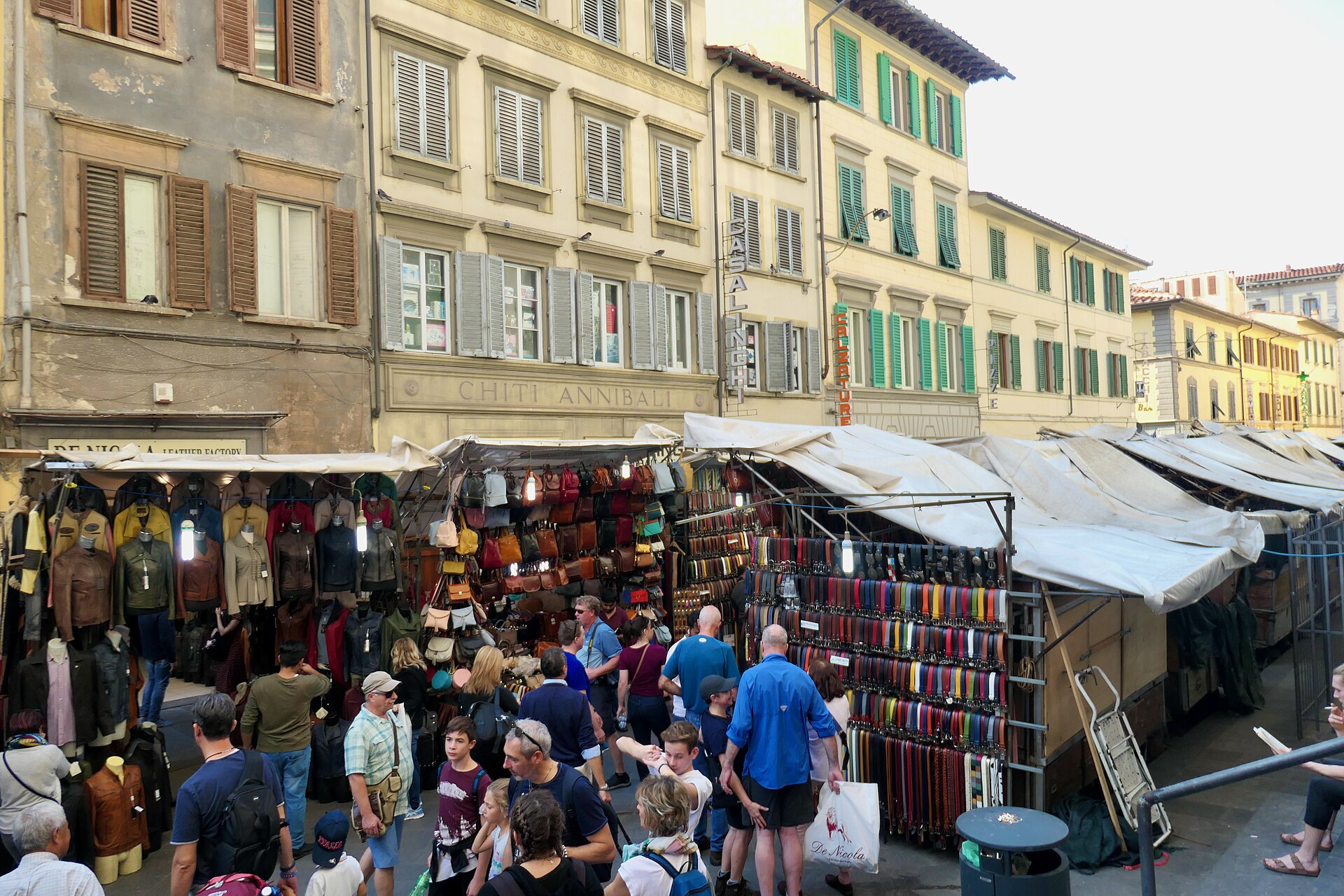
Tier 2: San Lorenzo Market
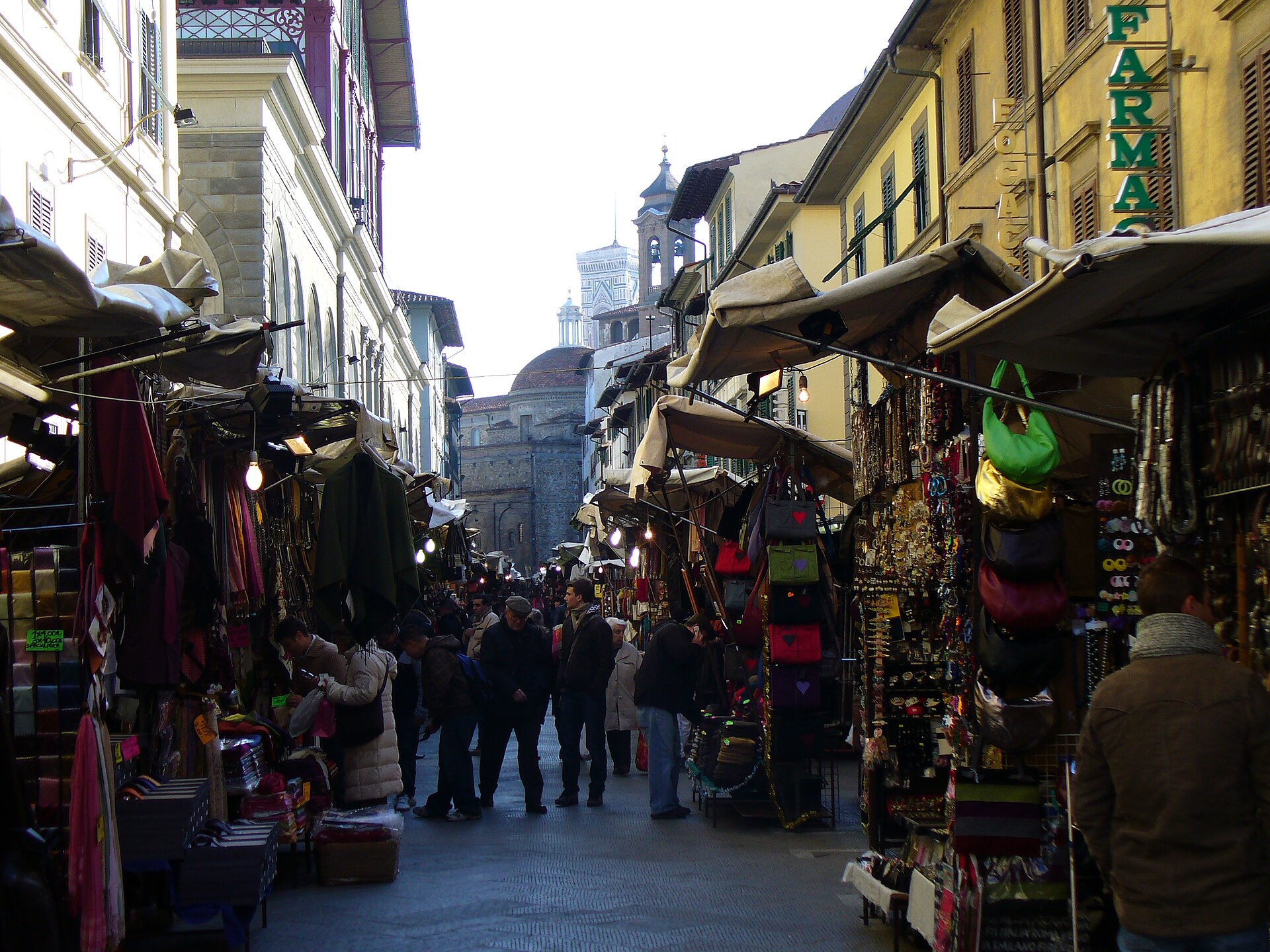
The famous outdoor leather market beside the Basilica of San Lorenzo. Its stalls fill the streets around the church. Operating since the late 19th century.
- Quality range: Wide — from cheap factory imports to genuine Italian-made artisan goods
- Prices: Wallets €10–60, small bags €30–150, jackets €120–400 (real leather), €60–150 (faux/lower quality)
- Opening: The stalls are cleared on set Mondays through the year under a city calendar, so check before planning a Monday visit
- Bargaining: Expected. Start at 60–70% of the asking price; settle at 75–85%.
San Lorenzo is the place where you can find genuinely good Italian leather at great prices — but also where you can buy total garbage at high prices. Apply the leather-quality tests rigorously. Watch for:
- Vendors who can’t answer questions about the leather
- Suspiciously low prices on items labelled as full-grain or top-grain
- “Made in Italy” stamps that look freshly applied
- Foam-edged or perfectly uniform-textured pieces
- Vendors using the bracelet-tying scam approach (sometimes the leather-shop equivalent)
Best stalls: the longer-established vendors with permanent-looking displays. Avoid the lightweight pop-up stalls with all-imported merchandise.
Tier 3: Boutique & Premium Shops
For premium and luxury Italian leather:
- Salvatore Ferragamo (Via dei Tornabuoni) — Florence-founded luxury house, the historic flagship store and museum. Premium leather, €600+ for bags, €300+ for wallets.
- Gucci Garden (Piazza della Signoria) — Gucci’s Florentine flagship with archive collection and on-site restaurant. Vintage and current Gucci.
- Bottega Veneta (Via dei Tornabuoni) — Venice-based but Florence’s outlet for the woven-leather signature pieces.
- Madova (Via Guicciardini) — historic glove maker: the Donnini family has made gloves since 1919 and opened the Florence shop in 1954. Premium leather gloves and accessories. €60–200 for gloves.
- Il Bisonte (Via del Parione) — leather goods house since 1970, distinctive aged-leather aesthetic. €200–800 for bags.
- Casadei — premium shoes
- Cellerini (Via del Sole) — small artisanal bag-maker since the late 1950s.
Smaller artisan workshops in Oltrarno (San Niccolò, San Frediano) often produce limited-edition or custom pieces at €200–800 — many open their doors to visitors during work hours. The Scuola del Cuoio has a list of recommended workshops; alternatively walk Borgo San Frediano and Via dei Serragli looking for “pelletteria” signs.
What Florence Does Best
Leather Jackets
Florence’s signature leather product. Price ranges:
- San Lorenzo market: €120–400 for genuine leather, often heavily bargained
- Mid-range artisan workshops: €400–800
- Scuola del Cuoio: varies by model and leather; see the school’s catalogue
- Premium boutiques: €1,500–4,000+
Quality leather jacket considerations: weight (heavier is generally better quality), lining (silk or cotton, not synthetic), zippers (YKK or branded Italian), stitching (uniform, tight), interior pockets (functional, properly finished).
Leather Bags & Handbags
- San Lorenzo market: €30–150 (small to medium handbags), €100–250 (larger totes)
- Mid-range workshops: €150–400
- Scuola del Cuoio: priced bag by bag in its online catalogue
- Premium (Ferragamo, Gucci, Bottega): €1,000–4,000+
Wallets
- San Lorenzo market: €10–60 (small leather wallets, varying quality)
- Scuola del Cuoio: €60–150
- Premium: €200–400
Belts
- San Lorenzo market: €20–60
- Scuola del Cuoio: €70–150
- Premium: €200–400
Shoes & Boots
Florence has fewer shoe-making workshops than bag-making (most Italian shoes are made in Le Marche or Veneto), but several quality shoe shops:
- Stefano Bemer — bespoke men’s shoes, €1,500–6,000
- Mannina — handmade men’s shoes since 1953, €500–1,500
- Salvatore Ferragamo flagship — €400–1,500
Gloves
Madova (Via Guicciardini 1r), run by a family that has made gloves since 1919, is a historic Florentine glove specialist — leather gloves €60–200 per pair. Also at smaller artisan shops in Oltrarno.
Bargaining at San Lorenzo Market
Bargaining is expected and normal at the open-air leather markets (San Lorenzo, Porcellino, Santa Croce). Haggling isn’t part of a visit to the Scuola del Cuoio or the boutiques.
Bargaining Strategy
- Initial offer: 60–70% of the asking price
- Final price target: 75–85% of asking price
- Don’t show too much enthusiasm for a specific item — vendors price up if they sense desire
- Don’t pay a card surcharge: EU rules generally ban extra charges for paying with a consumer debit or credit card
- Walking away is the most powerful bargaining tactic — vendors often call you back with a better offer
- Bargain politely but firmly — Italian market culture is conversational, not hostile
- Compare across multiple stalls for similar items before bargaining seriously
Bargaining Example
You see a leather bag at San Lorenzo. Vendor’s asking price: €150.
- “Quanto è?” (How much is it?) — €150
- “È molto bello, ma €100?” (It’s beautiful but €100?) — vendor counters at €130
- “Posso pagare in contanti €110?” (Can I pay €110 in cash?) — vendor counters at €120
- You pause, look at it again, “OK, €115?” — vendor accepts
Final price €115 vs €150 starting (23% discount). Anything 15–25% off the asking price is a successful negotiation.
Shipping vs Carrying Home
- Leather wallets, belts, gloves, small bags — fit in carry-on; carry home
- Medium bags (totes, satchels): still carry-on size; consider buying a foldable spare bag in Florence (€10–20 at any market) for the return trip
- Leather jackets: wear it on the return flight (saves bag weight and is more compact)
- Multiple pieces or heavy items: the Scuola del Cuoio and most artisan workshops ship internationally for €30–80 (Europe) or €60–120 (US/Asia). Ask about VAT refund.
VAT Refund (Tax-Free Shopping)
Non-EU residents can shop tax-free at participating shops when each invoice comes to more than €70 including VAT, provided the goods leave the EU within three months of the invoice date:
- Look for “Tax Free Shopping” or “Global Blue / Premier Tax Free” stickers in shop windows
- Ask for the tax-free form at purchase (pay full price including VAT, get the form)
- Get the form stamped at customs at the airport when leaving the EU
- Submit the form to the tax-free service for a refund (cash at airport kiosk, or refund to card later)
- What you get back depends on the shop, the refund company and its fees
The Scuola del Cuoio, all major boutiques, and many San Lorenzo market vendors participate. Bring your passport when shopping — required for the form.
Leather Shopping Tips
Tip 1: Visit the Scuola del Cuoio first to calibrate your eye for premium-quality leather. Then visit San Lorenzo for budget-friendly options with a clearer sense of what good leather looks and feels like.
Tip 2: If you’re buying a leather jacket, try multiple options on. The cut, weight and lining vary dramatically. Don’t impulse-buy at San Lorenzo without trying on.
Tip 3: Don’t try to bargain at the Scuola del Cuoio; it isn’t a market.
Tip 4: The “Pelle Conciata al Vegetale in Toscana” (Vegetable-Tanned Leather of Tuscany) consortium label on premium Italian leather guarantees authentic vegetable-tanned local production. Look for it on bag tags.
Tip 5: If you’re spending €500+ on a single piece, ask if the vendor knows the tannery the leather came from. Reputable artisans can name specific Tuscan tanneries (Vacchetta in Pisa, Conceria Volpi, etc.).
Tip 6: Avoid leather sales tactics like “We close in 2 hours!” or “Only one left!” — in a city this full of leather shops, if one piece is sold, another similar will be available.
Tip 7: For bag straps, check the inside of the strap — real leather has rough fibrous texture; faux leather has plastic-foam smooth feel. Bag straps are where vendors most often substitute lower-quality material.
Tip 8: Don’t fly home with a brand-new leather jacket worn directly on your skin — leather softens with body heat and can get stained or stretched. Wear it over a t-shirt or shirt for the return flight.
Common Mistakes
- Buying the first thing you see at San Lorenzo — quality varies dramatically; comparison shop
- Trusting “Made in Italy” labels at suspiciously low prices — counterfeit-labelling exists
- Skipping the leather-quality tests — pressure, smell, edge inspection take 30 seconds and reveal a lot
- Not bargaining at San Lorenzo — the first asking price is where the conversation starts, not where it ends
- Bargaining at the Scuola del Cuoio or boutiques — they are not markets; save the haggling for San Lorenzo
- Buying a leather jacket without trying it on — fit varies dramatically
- Forgetting to claim VAT refund — €30–60 saved on a €300 purchase
- Buying belts or wallets at premium boutiques when San Lorenzo has equivalent quality — saving €50–200 with no real loss in quality for accessories
Florence Leather Shopping FAQ
Where should I buy leather in Florence?
Three tiers: Scuola del Cuoio leather school (premium prices, behind Santa Croce basilica), San Lorenzo Market (wide quality range, bargaining expected), and boutique shops (Ferragamo and Gucci, with Madova on Via Guicciardini for gloves). Visit the Scuola first to calibrate your quality eye.
How do I tell real from fake leather?
Real leather has natural smell, wrinkles when pressed, has rough fibrous edges, varies in texture, warms to body temperature, and absorbs water. Faux leather is uniform-textured, has perfect foam-like edges, stays cool plastic-feeling, and beads water. Look for “vera pelle” (real leather) and “Made in Italy” labels, and the “Pelle Conciata al Vegetale in Toscana” consortium label for premium vegetable-tanned leather.
What’s the price range?
Wallets €10–400 (San Lorenzo cheapest, Scuola del Cuoio premium, boutique elite). Bags €30–4,000+. Leather jackets €120 (San Lorenzo) to €1,500+ (Scuola, premium). Belts €20–400. Gloves €60–200 (Madova).
Should I bargain at San Lorenzo?
Yes — bargaining is expected at the open-air leather markets. Start at 60–70% of the asking price, settle at 75–85%. Walk-away is the most powerful tactic. Don’t bargain at the Scuola del Cuoio or boutique shops.
Can I claim VAT back?
Yes for non-EU residents. Each invoice over €70 (VAT included) at participating shops qualifies, as long as the goods leave the EU within three months; the amount refunded depends on the refund company’s fees. Get the tax-free form at purchase, stamp at airport customs, claim at the airport kiosk or via card refund. Bring your passport when shopping.
Is the Scuola del Cuoio worth visiting?
Yes — the leather school behind Santa Croce basilica is the most-recommended Florence leather destination. Premium quality, and you can watch the artisans at work. Wallets €60–150; bags and jackets vary by model and leather, so browse the catalogue before you go. The Franciscan setting (the entrance is through the garden behind the basilica) adds atmosphere.
Should I ship leather home?
For multiple pieces or heavy items, yes — the Scuola del Cuoio and most artisan workshops ship internationally for €30–80 (Europe) or €60–120 (US/Asia). For wallets, belts, gloves and small bags, carry home in your luggage. Wear leather jackets on the return flight to save bag weight.
Should I buy at premium boutiques (Ferragamo, Gucci)?
For brand-prestige reasons, yes — Florence’s flagship boutiques offer the full Italian luxury collections at the same prices as elsewhere. For pure quality without brand prestige, the Scuola del Cuoio offers fine handmade leather without the label, at 30–60% lower prices. Choose by priorities: brand or pure quality.
Florence leather shopping rewards careful buyers. Visit the Scuola del Cuoio first to learn what genuine premium Italian leather looks and feels like; then explore San Lorenzo Market with bargaining-ready expectations and the leather-quality tests in mind. The Scuola is the safest premium option, San Lorenzo the value-conscious option, and the Via dei Tornabuoni boutiques the brand-luxury option. With basic awareness — pressure test, smell test, edge inspection — you can take home authentic Italian leather for less than you would pay at retail elsewhere, plus the VAT refund on invoices over €70.