Florence History & Architecture: The Birthplace of the Renaissance (Complete 2026 Guide)
The definitive guide to Florence’s history and architecture — from Etruscan origins and Roman foundations through the medieval communes, the rise of the Medici, the birth of the Renaissance, and the capital of a unified Italy. This guide explains what you are actually looking at when you walk through Florence: why the Duomo matters so much, who the Medici really were, why Brunelleschi’s dome was considered miraculous, and how a mid-sized Tuscan city ended up reinventing Western art, architecture, banking, and political thought. Fully updated for 2026.
Why Florence Matters: The Short Answer
Florence is a small city — population just 360,000 — that spent roughly two centuries, between about 1300 and 1500, inventing or refining an extraordinary share of what we now call European modernity. Perspective painting, double-entry bookkeeping, the first public museum open to anyone, the standard written form of the Italian language, banking as a transnational industry, structural engineering innovations still taught in architecture schools, modern political theory, and the rediscovery of Greek and Roman classical learning — all of these have a Florentine address, and most were invented within a ten-minute walk of each other. Walking through Florence, Italy, is less like visiting a beautiful old city and more like visiting a laboratory in which Western civilization did a particularly productive five generations of work.
The city we see today is, to a remarkable degree, the city those five generations built. The population of Florence in 1400 was around 60,000 — larger than London at the time. The historic centre has not been meaningfully expanded since the 14th-century ring of walls, most of which still define the old-town perimeter. You can stand in Piazza del Duomo and see almost every significant 14th- and 15th-century building that survived; the Palazzo Vecchio, the Uffizi, San Lorenzo, Santa Maria Novella, Santa Croce, the Ponte Vecchio, the Bargello — all within a fifteen-minute walk. This density is why Florence history feels so vivid in person: the evidence is not scattered across a vast urban landscape, it is piled up on a handful of piazze.
What This Guide Covers
We will move through Florence’s history chronologically, but with an architectural emphasis — pausing at the buildings and spaces that matter most to understand what happened there. Each section links to a deeper guide to a specific site. By the end, you will have the context you need to walk the city with something more than the usual tourist’s half-noticed awe.
Etruscan and Roman Origins
The Florentine story begins not in the valley but on the hill above it. The Etruscan settlement of Fiesole, founded around the 9th century BC, sits on a 300-metre ridge overlooking the Arno plain — a defensible position, cool in summer, and visually commanding. Modern-day Fiesole, 15 minutes by bus from central Florence, still preserves an Etruscan wall, a Roman theatre, and a small archaeological museum. For much of the first millennium BC, Fiesole was the regional power; the valley below was marshy, malarial, and largely unsettled.
The Romans changed that. In 59 BC, Julius Caesar founded a colonia for retired legionaries in the Arno valley below Fiesole, on the flat land where the river narrowed at a natural crossing. The new town was laid out on the standard Roman military grid, with two main streets — the cardo and decumanus — meeting at a central forum. The colony was named Florentia, “the flourishing one”, and the name stuck. The Roman street grid is still visible in the modern centre: Via del Proconsolo, Via Calzaiuoli, Via Roma, and Via Strozzi follow the original Roman lines, and Piazza della Repubblica sits exactly where the Roman forum stood. When you walk the main shopping arteries of the centre, you are following roads laid down under the Caesars.

What Romans Left Behind
Florence’s Roman footprint is visible if you know where to look:
- Piazza della Repubblica — the Roman forum location; the 1890s column in the centre marks the old intersection of cardo and decumanus.
- The Capitoline Temple foundations sit beneath the Baptistery, and Roman baths have been found beneath Palazzo Vecchio.
- The Roman amphitheatre is entirely gone, but its elliptical footprint is preserved in the street plan around Piazza Peruzzi and Piazza Santa Croce — if you look at a map, the curved streets trace its outline.
- Via Cassia — the Roman road from Rome to northern Italy — passed through Florence and left its name on Via Cassia outside the city.
Medieval Florence: Guilds, Communes & the Black Death
The Roman empire collapsed around Florence slowly. The Goths, then the Byzantines, then the Lombards, then the Franks all passed through. By the 10th century, the city had contracted to perhaps 10,000 people and lost most of its Roman monuments. What pulled Florence out of the early medieval slump was trade. The Arno was navigable to the sea at Pisa, and the Via Cassia ran north to the textile markets of Flanders and England. By the 11th century, Florentine merchants were exporting Tuscan wool and importing raw English and Flemish cloth for finishing; by the 13th century, they had effectively invented international banking.
The Guilds
Medieval Florence organised its political and economic life around the Arti — guilds — of which there were seven major (Arti Maggiori) and fourteen minor. The Arte della Lana (wool guild), Arte di Calimala (cloth finishers), and Arte del Cambio (money-changers) were the most powerful, and their members effectively governed the city. The guild system produced the political class, funded the major public buildings, and paid for much of the art we still admire — the statues on the exterior of Orsanmichele, for example, are each commissioned by a different guild, and the relative positions of the niches still reflect 14th-century guild rankings.
Orsanmichele itself — midway between Piazza del Duomo and Piazza della Signoria — is one of the most concentrated objects of medieval Florentine history. Originally a grain loggia, it was converted into a church-and-guild-hall in the 14th century. Each of the great guilds funded a statue of its patron saint in one of the exterior niches; these statues, by Donatello (St George, St Mark, St Louis), Ghiberti (St Matthew, St Stephen, St John), Verrocchio (Doubting Thomas), and Nanni di Banco (the Four Crowned Saints), amount to a compressed history of early-Renaissance sculpture. The originals are now inside (in a museum on the upper floor); the exterior statues are accurate copies.
The Black Death & Its Aftermath
The bubonic plague of 1348 killed perhaps 60% of Florence’s population in a single year, and reduced the city’s population from about 120,000 to 50,000 within a few decades when recurring outbreaks are counted. The economic and psychological shock was enormous. Boccaccio’s Decameron, written around 1353, is set in the plague years; his ten young Florentines flee to a villa in Fiesole to escape the contagion and tell stories to distract themselves. The tale is partly a Florentine literary exercise, and partly a document of survival.
Paradoxically, the plague accelerated the Renaissance. With drastically reduced labour, wages rose; with enormous bequests from the dead, the Church and major guilds had more money than usable manpower. The result was a building boom. Florence’s great medieval churches — Santa Maria Novella, Santa Croce, the Duomo itself — were either begun before the plague or finished in its wake, and many of the 15th-century building projects that define Renaissance Florence were funded in part by late-14th-century inheritances.
The Renaissance Begins
There is no single date when the Italian Renaissance began, but three events in Florence across roughly forty years make a reasonable claim to marking the shift:
- 1401 — the Baptistery door competition. The Arte di Calimala announced a competition to design a new pair of bronze doors for the Baptistery of San Giovanni. Seven sculptors submitted trial panels (each depicting the Sacrifice of Isaac). Lorenzo Ghiberti won; Filippo Brunelleschi came second, refused to collaborate, and left for Rome to study Roman ruins. That Roman study trip laid the foundation for his later architectural work.
- 1415 — Brunelleschi “discovers” linear perspective. Sometime in the 1410s, according to his biographer Manetti, Brunelleschi painted a panel of the Baptistery of Florence from the doorway of the Duomo, using a mathematical projection method that produced an exact optical illusion of depth. It was the first demonstration of systematic linear perspective, and it changed Western painting.
- 1420 — the dome begins. On 7 August 1420, masons laid the first stone of Brunelleschi’s dome. The construction that followed was, at the time, unprecedented in scale and technical ambition.
Why Florence, and Not Elsewhere?
Historians have debated this question for two centuries; the short answer is: a unique combination of conditions. Florence had the money (from banking and textile trade), the independent political structure (a republic rather than a monarchy or a papal fief), the ancient cultural inheritance (visible Roman remains and preserved manuscripts), the ambitious middle class (the popolani grassi, or “fat people” — the wealthy commoners of the guilds), and the competitive ego of a city that took its own reputation very seriously. Add to this a pool of extraordinary individuals — Brunelleschi, Donatello, Masaccio, Ghiberti, Alberti — all working within a few years of each other, and the conditions produced an explosion rather than a slow transition.
The Florence Duomo & Brunelleschi’s Dome

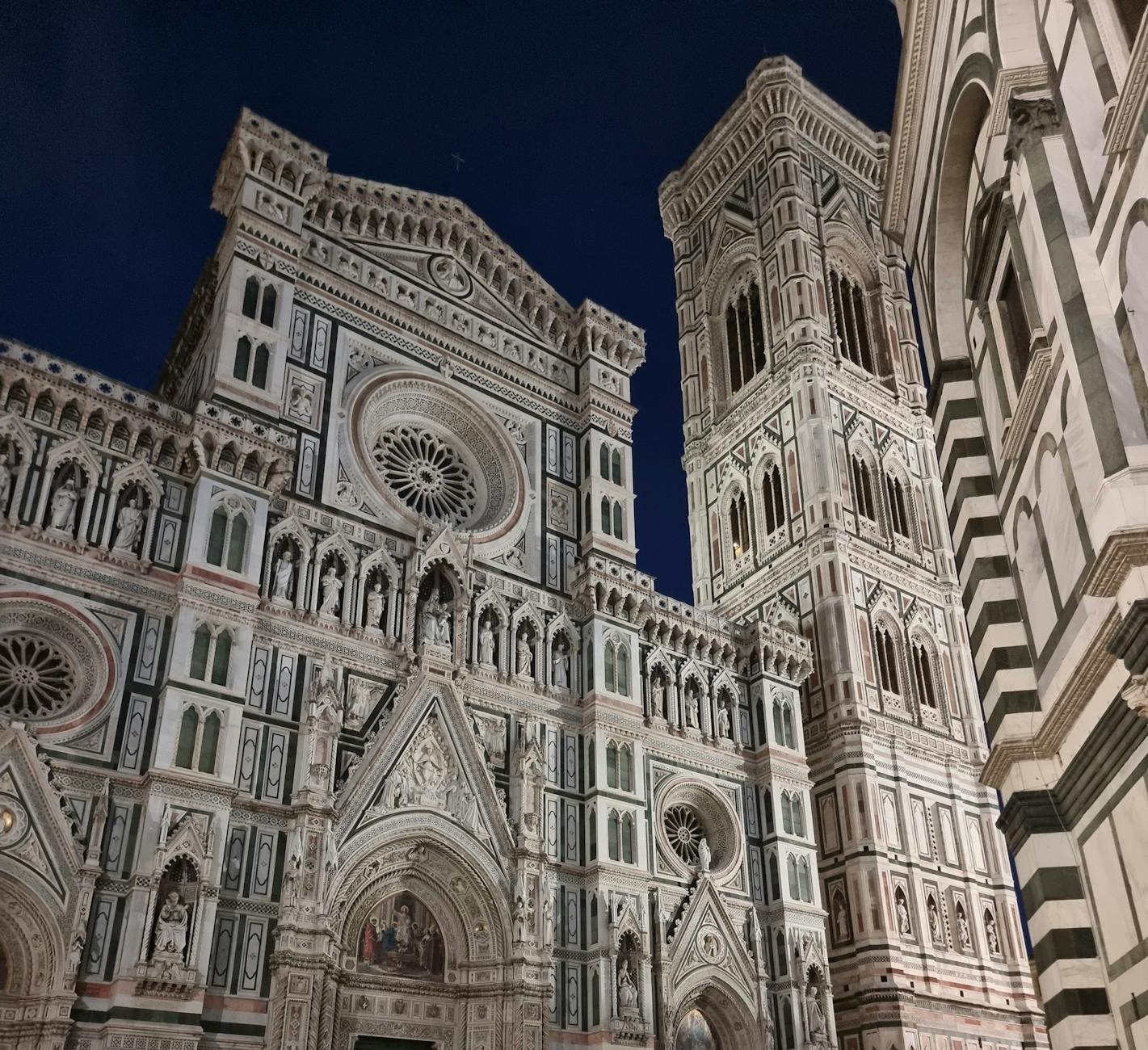
No building defines Florence history more completely than the Cathedral of Santa Maria del Fiore — the Duomo. Work on the cathedral began in 1296 to a design by Arnolfo di Cambio, with the city’s characteristic Gothic arches, marble cladding (green marble from Prato, pink from Maremma, white from Carrara), and ambitious scale. By 1375, the main body of the cathedral was complete, but the crossing — where the nave met the transepts — was left open to the sky. The original plans had specified a dome of unprecedented dimensions, and no one knew how to build it.
The Problem of the Dome
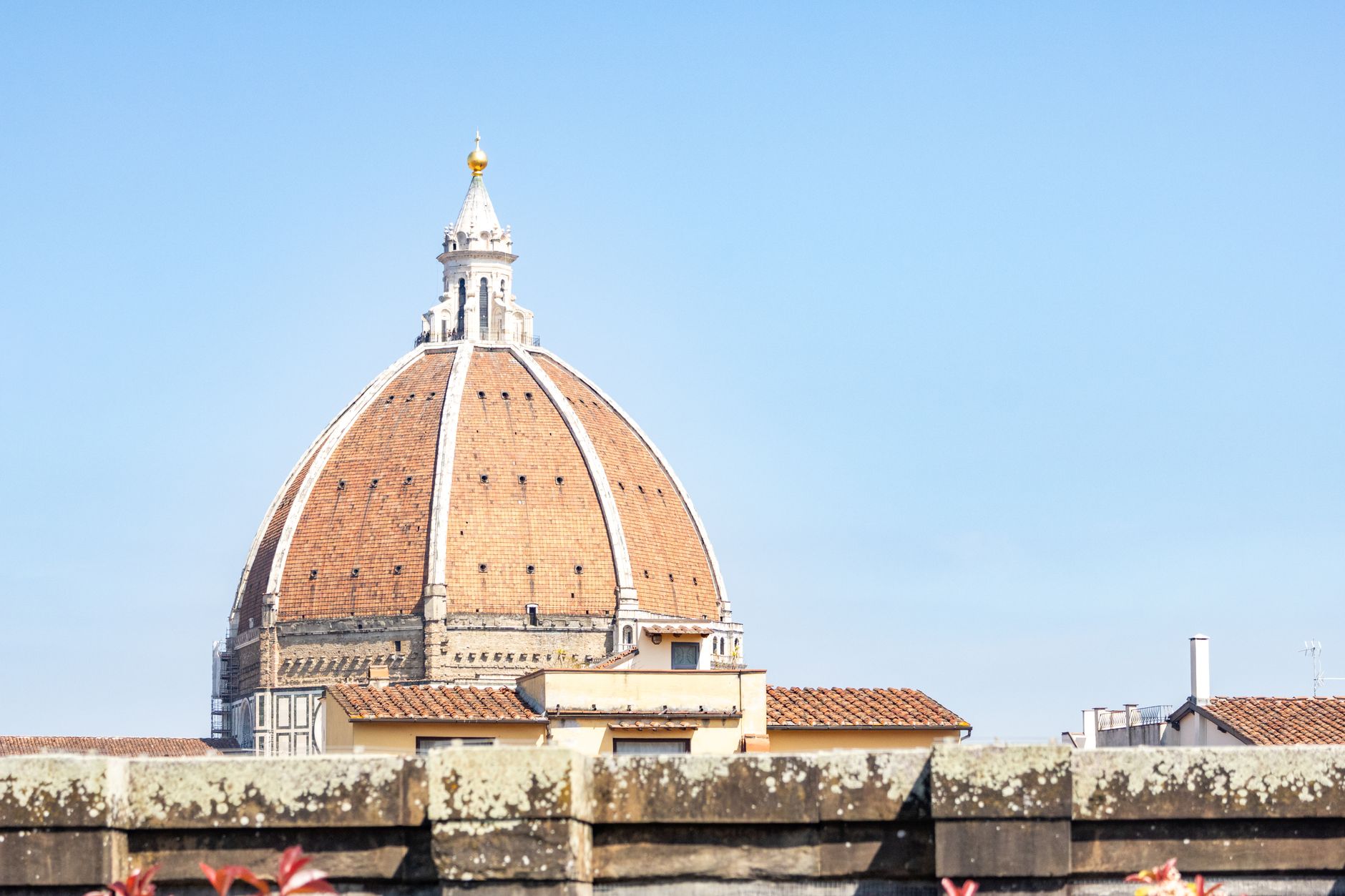
The opening at the top of the cathedral measured 45 metres across — wider than Rome’s Pantheon, which at 43 metres had been the largest dome ever built, and which used concrete techniques that had been lost for a thousand years. The Florentine design called for a pointed Gothic dome of brick and stone, rising from an octagonal base, with no external buttresses (the cathedral was already built to its full height). Conventional medieval practice would have required a vast wooden scaffolding — a centering — to support the masonry during construction. The problem: no one had trees tall enough or timber frames strong enough for the scale required. For decades, the open crossing sat exposed to weather, with the half-finished cathedral becoming a civic embarrassment.
Brunelleschi’s Solution
Filippo Brunelleschi, who had lost the 1401 Baptistery doors competition, spent much of the following two decades in Rome, studying the Pantheon and other ancient structures, and experimenting with scaled-down brick vaults. In 1418, he submitted a proposal for the Duomo dome that contained several radical innovations:
- A double shell — an inner structural dome and an outer weather-protective dome, connected by internal ribs. This reduced weight and created a working space between the shells.
- No centering. Brunelleschi proposed to build the dome free-standing, using a technique of herringbone brickwork that allowed each course to support itself and lean slightly inward until the next course was laid. Experts examining the dome today still find it structurally astonishing.
- Eight major ribs and sixteen minor ribs of stone, embedded in the masonry, to distribute weight.
- An internal tension chain of sandstone blocks girdling the dome’s base, essentially serving as an architectural belt to resist outward thrust.
- Custom machinery. Brunelleschi invented, patented (the world’s first patent, according to some historians), and operated several hoisting devices powered by oxen to lift materials.
Construction began in 1420 and finished in 1436 — 16 years, using over 4 million bricks, and remaining today the largest masonry dome in the world at 45.5 metres internal diameter. Six centuries after Brunelleschi’s death, structural engineers are still studying his methods; some aspects of his technique remain imperfectly understood. The lantern on top was completed in 1461, and the gilded copper ball (by Andrea del Verrocchio, assisted by a young Leonardo da Vinci) went up in 1471.
Visiting the Duomo Complex
The Cathedral complex — run by the Opera di Santa Maria del Fiore, an organisation continuously active since 1296 — consists of five buildings and sites that share a single ticket:
- The Cathedral itself — free to enter, often with 30–90 minute queues at peak times.
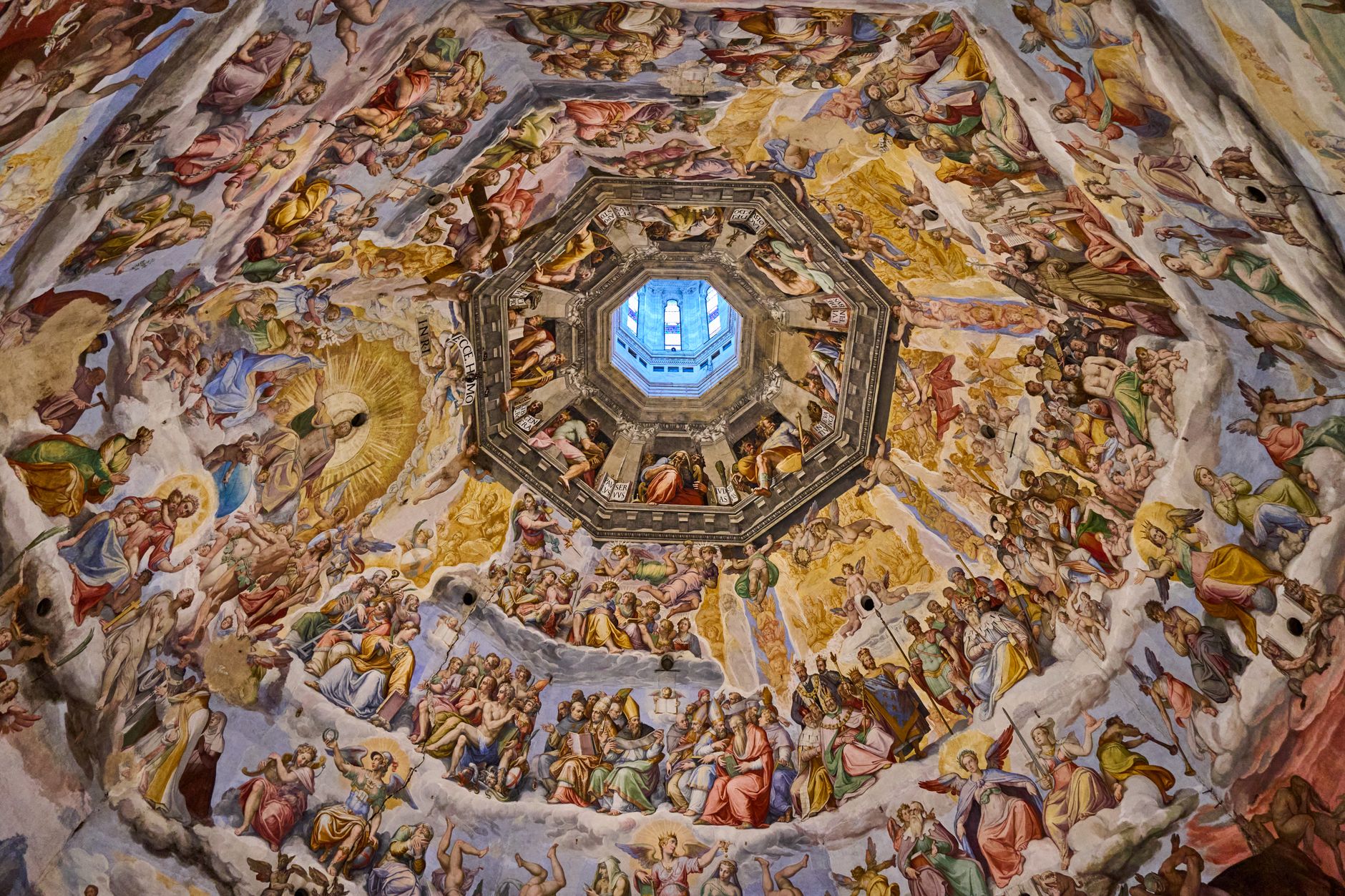
- Brunelleschi’s Dome climb — 463 steps, pre-booked timed entry required (tickets sell out 3–4 weeks in advance). The climb passes through the space between the two shells, and brings you out onto a 360° terrace over the city.
- Giotto’s Bell Tower (Campanile) — 414 steps, designed by Giotto in 1334 and completed by Andrea Pisano and Francesco Talenti. The terrace view from the Campanile actually beats the dome because you can see the dome itself.
- The Baptistery of San Giovanni — the oldest building in the complex, dated to the 11th century, with Ghiberti’s famous Gates of Paradise (originals now in the museum; copies on site).
- Opera del Duomo Museum — an excellent museum holding the originals of Ghiberti’s Gates, Donatello’s penitent Magdalene, Michelangelo’s late Bandini Pietà, and detailed models and tools from the dome’s construction. Often skipped by visitors and consistently the most rewarding single museum in the complex.
Tickets are tiered: a “Giotto Pass” covers the Campanile, Baptistery, and Museum (€20); a “Brunelleschi Pass” adds the Dome climb (€30); the “Ghiberti Pass” is Baptistery and Museum only (€15). Book at operaduomo.firenze.it — the Dome climb is the single most booking-critical item in the complex, and walk-ups are frequently turned away.
For a complete breakdown, see our dedicated Florence Duomo guide and the Brunelleschi dome climb guide.
The Medici Family: Bankers, Popes, Patrons
No family has influenced a European city more comprehensively than the Medici influenced Florence. Over about three and a half centuries — from the first significant Medici banker in the late 14th century to the last Medici grand duchess in 1743 — the family produced four Popes (Leo X, Clement VII, Pius IV, Leo XI), two Queens of France (Catherine and Maria de’ Medici), three grand dukes of Tuscany, and a constellation of art patrons whose commissions bought us the careers of Donatello, Michelangelo, Botticelli, Fra Angelico, Filippo Lippi, Benozzo Gozzoli, Bronzino, Vasari, and many others. The Uffizi, the Palazzo Pitti, the Boboli Gardens, the Laurentian Library, the Medici Chapels, the Medici Villas scattered around Tuscany, and the core holdings of every major Florentine museum are, in whole or in substantial part, Medici collections.
The Banking Revolution
The family’s rise began with Giovanni di Bicci de’ Medici (1360–1429), a relatively obscure Florentine banker who in 1397 founded the Banco dei Medici. His innovation was operational: he established branch offices across Europe (London, Bruges, Geneva, Rome, Venice, and elsewhere), ran them through partnerships with local managers who had capital skin in the game, and used the double-entry bookkeeping that Florentine merchants had pioneered. By the 1420s, the Medici Bank was the most profitable in Europe and held the Papal accounts, which meant the family effectively banked the largest single customer in medieval Christendom.
Giovanni’s son Cosimo de’ Medici (called il Vecchio, “the Elder”, 1389–1464) turned financial power into political dominance. He avoided holding formal office — a republican taboo — and instead governed Florence through his personal network of alliances, debts, and patronage. Exiled in 1433 after a factional dispute, he returned in triumph a year later and ruled the city unofficially until his death. Under Cosimo, the Medici became the leading patrons of the Florentine Renaissance: he commissioned Brunelleschi’s San Lorenzo and the Basilica of San Marco, funded Donatello throughout the sculptor’s later career, and created a humanist academy around Marsilio Ficino that translated Plato into Latin for the first time in a millennium.
Lorenzo the Magnificent
Cosimo’s grandson Lorenzo de’ Medici — il Magnifico (1449–1492) — is the Medici most people have heard of. Under his effective rule, Florence reached its cultural apex. Lorenzo was himself a respectable poet in Italian (his Canzoniere is still read); he supported Michelangelo as a teenager, hosted Botticelli, Ghirlandaio, Leonardo, and Poliziano at his Villa di Castello and the Palazzo Medici on Via Larga (now Via Cavour, the building is the Palazzo Medici-Riccardi, open to visitors). He survived the Pazzi Conspiracy of 1478, in which a rival banking family attempted to assassinate him and his brother Giuliano during High Mass at the Duomo — Giuliano was killed, Lorenzo escaped wounded, and the subsequent reprisals cemented Medici dominance.
The Medici After Lorenzo
Lorenzo’s death in 1492 began a turbulent century. His son Piero was expelled in 1494 during the French invasions; the city passed through Savonarola’s theocratic republic (1494–1498) and a second short republic before the Medici returned in 1512. The family produced Pope Leo X (Giovanni di Lorenzo) in 1513 and Pope Clement VII (Giulio di Giuliano) in 1523 — during the latter’s papacy Rome was sacked by imperial troops, a disaster that arguably ended the Roman Renaissance but drove many artists back to Florence.
In 1537, Cosimo I de’ Medici became Duke of Florence (later Grand Duke of Tuscany) at the age of 17, and under his long rule (until 1574) Florence was transformed from a fragile republic into a centralised absolutist state. Cosimo commissioned Vasari to build the Uffizi (originally administrative offices — uffici — for the Medici bureaucracy), and later linked the Uffizi to the Palazzo Pitti via the Vasari Corridor, the elevated passage that crosses the Ponte Vecchio. The corridor let the Grand Duke cross from his official office to his residence without walking the public streets — a security measure that also produced one of the most photographed architectural features in the world.
The Medici line ended in 1737 with Gian Gastone, the last male Medici. His sister Anna Maria Luisa de’ Medici, the Electress Palatine, made the single most consequential bequest in European cultural history: in 1737 she signed the Patto di Famiglia (“Family Pact”) deeding the entire Medici art collection to the new Habsburg-Lorraine rulers of Tuscany, on the condition that nothing ever be removed from Florence. That bequest is why the Uffizi, the Bargello, the Palazzo Pitti, the Archaeological Museum, the Medici Chapels, and most of the rest of the Florentine collection are still in Florence — and why Florence is still a capital of Renaissance art, 450 years after the last Medici masterpiece was painted. For more on this extraordinary dynasty, see our complete guide to the Medici family.
Piazza della Signoria & the Palazzo Vecchio

If the Duomo is the symbolic heart of Florentine Christendom, the Piazza della Signoria has been the heart of Florentine politics for seven centuries. The square took shape in the late 13th century around the Palazzo Vecchio (originally the Palazzo della Signoria), the fortress-like civic palace where the governing Signoria met. The building was designed, according to tradition, by Arnolfo di Cambio (the same architect who started the Duomo), begun in 1299, and completed around 1315; its rusticated stone walls and 94-metre bell tower made it the tallest and most defensible building in the city.
The Palazzo Vecchio
The Palazzo Vecchio has never stopped being a working civic building. It has housed, in turn, the medieval Signoria, the Medici Grand Dukes (Cosimo I used it as his residence before moving to Palazzo Pitti in 1549), the Parliament of the Kingdom of Italy (1865–1871 while Florence was briefly the capital of unified Italy), and today the Mayor of Florence and the city council. Much of the building is open as a museum. Essential rooms:
- Salone dei Cinquecento — the 54-metre hall built in 1494 as a meeting chamber for the short-lived Savonarola-era republic, and later decorated by Vasari and others for Cosimo I. Michelangelo and Leonardo were both commissioned to paint frescoes here (the Battle of Cascina and the Battle of Anghiari) — the definitive Renaissance head-to-head that never came to fruition. Both paintings were abandoned or lost; faint traces of Leonardo’s may survive beneath the later Vasari work.
- Studiolo of Francesco I — a tiny, panelled study decorated as a miniature Wunderkammer, hidden inside the larger state apartments.
- The private apartments of Eleonora of Toledo, Cosimo I’s duchess.
- The Roman theatre beneath — guided tours descend into excavations that reveal the 1st-century-AD theatre over which the palace was built.
- The tower — 416 steps up to a small terrace with views directly at the Duomo.
The Open-Air Museum
The piazza itself is the most concentrated collection of monumental sculpture outside an actual museum. Standing from north to south:
- Bartolomeo Ammannati’s Fountain of Neptune (1565) — the giant marble figure Florentines nicknamed il Biancone, “the big white one”.
- The Marzocco — the heraldic Florentine lion, a Donatello replica, symbol of the Republic.
- Donatello’s Judith and Holofernes (replica; original in the Palazzo Vecchio).
- Michelangelo’s David — replica where the original stood 1504 to 1873 before being moved indoors to the Accademia. The placement is not accidental: Florentines chose to put the young shepherd-king in front of the Palazzo della Signoria as a warning to tyrants.
- Hercules and Cacus by Baccio Bandinelli (1534) — next to the David, and often unfavourably compared to it.
- The Loggia dei Lanzi — a covered arcade housing, among others, Benvenuto Cellini’s Perseus with the Head of Medusa (1554), Giambologna’s Rape of the Sabine Women (1583), and a set of Roman statues.
Standing in the Piazza della Signoria is the nearest experience a modern visitor gets to Renaissance Florence as lived space: the political centre, the sculpture collection, the cafés, and the crossroads for the whole old city. For more detail see our Piazza della Signoria guide.
Ponte Vecchio: The Bridge That Survived Everything

The Ponte Vecchio is the oldest of Florence’s surviving bridges and the only one to survive the Second World War. Its current form dates to 1345, when a flood destroyed the previous wooden bridge and the rebuilt stone structure — three elegant segmental arches, with shops cantilevered out over the river along both parapets — replaced it. The design is credited to Taddeo Gaddi or Neri di Fioravante, and it was structurally innovative for its time: the segmental (flatter-than-semicircular) arches were one of the earliest surviving examples in medieval Europe.
The shops on the bridge were initially occupied by butchers, tanners, and fishmongers — the trades that needed access to the river for waste disposal. In 1593, Grand Duke Ferdinando I de’ Medici expelled these businesses (the stench was apparently intolerable to the court now crossing the bridge daily via Vasari’s Corridor above) and reserved the shops for goldsmiths and jewellers. The bridge’s gold-shop character has been continuous for 430 years — longer than any other commercial street in Europe, arguably.
The Vasari Corridor
Running above the Ponte Vecchio’s eastern parapet is the Vasari Corridor, a kilometre-long elevated passage built by Giorgio Vasari in five months in 1565 for Cosimo I, connecting the Palazzo Vecchio (the office) with the Palazzo Pitti (the residence) without ever touching public ground. It runs along the edge of the Uffizi, crosses the Arno on the bridge, threads through the Santa Felicita church, and arrives at Palazzo Pitti. For centuries it contained a remarkable self-portrait collection assembled by the Medici and their successors; the corridor closed for restoration in 2016 and reopened to visitors in 2024 as a Uffizi-ticketed extension. Booking is limited and fills weeks ahead.
Surviving the War
In August 1944, German forces retreating from Florence destroyed every bridge across the Arno except the Ponte Vecchio. The standard account is that Hitler personally ordered the bridge spared, reportedly impressed by its beauty from a 1938 visit. Whatever the truth, the adjoining streets at both ends were demolished to block Allied advance — the Via de’ Guicciardini on the south bank and the area around the Por Santa Maria on the north bank were both levelled. The rubble was cleared after the war, but the reconstructed buildings there date to the late 1940s — one of the few modern patches in the Renaissance core.
For a detailed look at the bridge itself, see our complete Ponte Vecchio history and visitor guide.
The Churches of Florence: Beyond the Duomo
Florence’s great churches are not incidental sites to visit after the major museums — they are major museums. Each of the medieval religious orders built a principal Florentine church, and each used its church as the working canvas for the best artists it could commission. A short tour of the essentials:
Santa Maria Novella (Dominican)
Begun in 1246 by Dominican friars, completed in structural form around 1360, and given its green-and-white marble façade by Leon Battista Alberti (1456–1470). Santa Maria Novella holds Masaccio’s Holy Trinity (c. 1427) — the first painting in European art to use mathematical linear perspective in a systematically correct way, and therefore arguably the single most important painting in the history of Western art. It also contains Giotto’s Crucifix, Ghirlandaio’s Tornabuoni Chapel frescoes (with a cameo of the young Michelangelo as apprentice), and the Spanish Chapel frescoes by Andrea di Bonaiuto. The adjoining perfumery, the Officina Profumo-Farmaceutica di Santa Maria Novella (founded 1221), is one of the oldest pharmacies in the world.
Santa Croce (Franciscan)
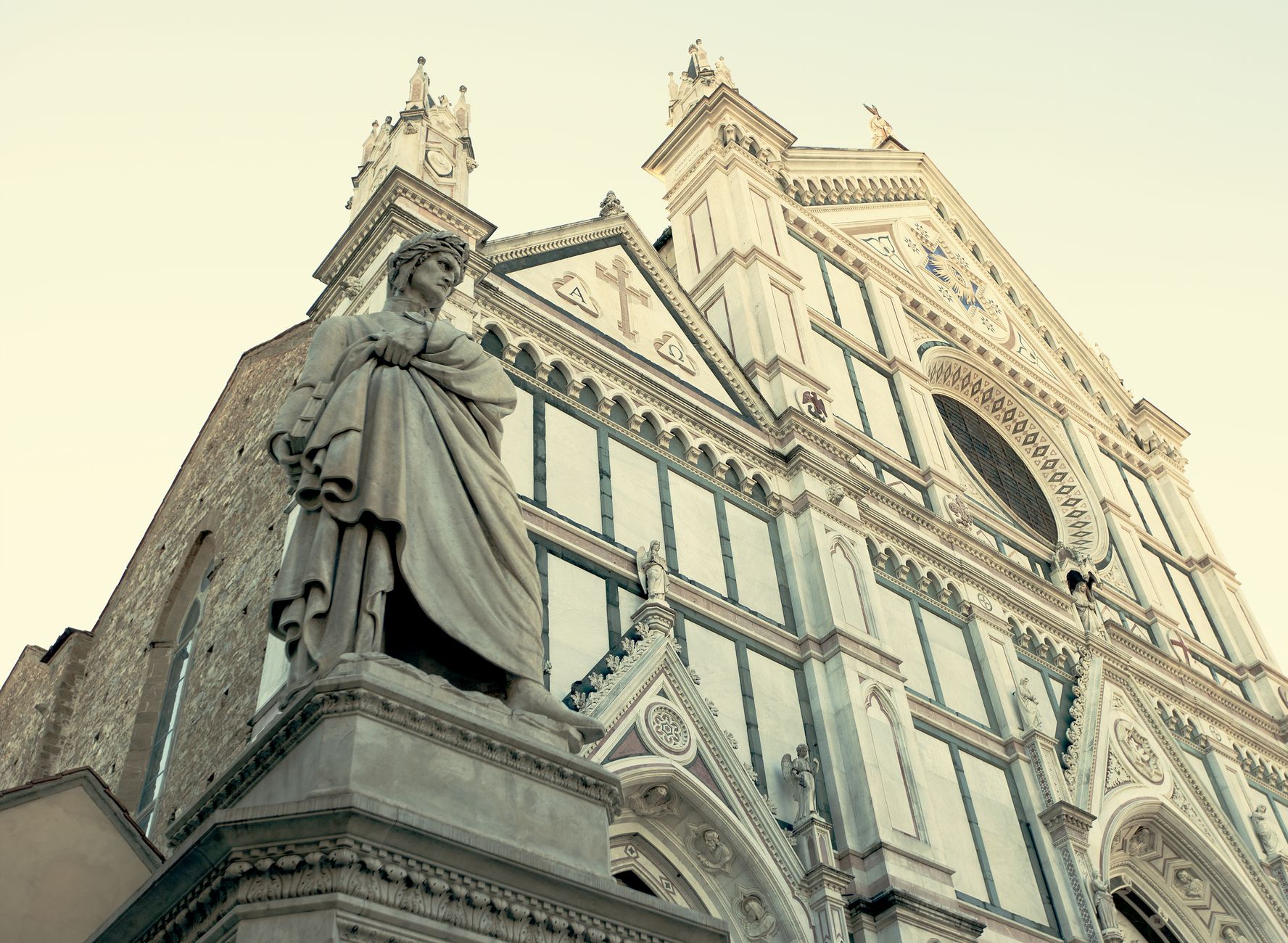
Begun in 1294 by Arnolfo di Cambio for the Franciscans, Santa Croce is Florence’s second-most-important Gothic church and, to most Florentines, more emotionally significant than the Duomo. The basilica is sometimes called the Tempio dell’Itale Glorie — the “Temple of Italian Glories” — because of the tombs it holds: Michelangelo, Galileo, Machiavelli, Rossini, the poet Ugo Foscolo, and a cenotaph to Dante (who is buried in Ravenna). The interior houses Giotto’s Bardi and Peruzzi chapels — the earliest monumental fresco cycles of the Florentine school — and the Cimabue Crucifix that was famously damaged in the 1966 flood. Brunelleschi’s Pazzi Chapel in the adjoining cloister is one of the purest statements of Early Renaissance architecture. See our Santa Croce guide for the detailed walkthrough.
San Lorenzo (Medici Parish)
The Medici family church, rebuilt by Brunelleschi between 1419 and 1459. The interior is an austere masterpiece of Early Renaissance proportions. The complex includes the Old Sacristy (Brunelleschi’s first large commission, with decorative work by Donatello), the New Sacristy by Michelangelo with his Medici tombs (including the famous allegorical figures of Night, Day, Dawn, and Dusk), and the Laurentian Library — Michelangelo’s extraordinarily inventive reading-room and staircase, which broke most conventions of Renaissance architecture and effectively founded Mannerism. The façade of San Lorenzo was never built, leaving a rough brick surface that survives as a kind of permanent architectural riddle.
Santo Spirito (Augustinian)
Brunelleschi’s last church, begun in 1444 and finished by pupils after his death. On the south bank of the Arno in the Oltrarno district, it is the most structurally pure Early Renaissance interior in the city. The lively Piazza Santo Spirito that sits in front of it is one of the most atmospheric squares in Florence.
San Miniato al Monte
High above the city, reached by the long climb up from Piazza Michelangelo, San Miniato is older than all the above — a Romanesque basilica begun in 1013, with a green-and-white marble façade (an obvious model for Santa Maria Novella centuries later) and a remarkable cosmatesque floor. A Benedictine community still lives here, and the monks sing Gregorian chant vespers daily around 5:30pm (check current hours). The view from its front terrace is one of the great views of Florence. For a fuller church tour, see our guide to the churches of Florence.
A Historic Walking Route
If you have one focused half-day to absorb Florence’s history and architecture, here is the route we recommend. It runs about 3.5 km, can be walked in 3–4 hours at a reflective pace, and covers the key buildings of the medieval-to-Renaissance transition in roughly the order they were built.
- Start: Piazza di San Giovanni, at the Baptistery (11th century). Look for the Pisano south doors (c. 1330) and the replicas of Ghiberti’s Gates of Paradise on the east side — then glance at the cathedral beginning to rise above. This is where the Renaissance argument arguably started in 1401.
- Into Piazza del Duomo. Circle the cathedral once at street level. Enter if you have time (free) or climb the Campanile (414 steps; no booking needed). If you have a dome-climb booking, do that now.
- Via del Proconsolo south to the Bargello. The Bargello, once the police headquarters, now holds the world’s greatest collection of Florentine sculpture — Donatello’s David (the nude bronze), Michelangelo’s Bacchus, Verrocchio’s David, and the 1401 trial panels by Brunelleschi and Ghiberti. Most visitors skip it. You should not.
- Via dei Calzaiuoli to Orsanmichele. Circle Orsanmichele once to see the 14th-century guild statues. Go inside for the 14th-century tabernacle and, upstairs, the sculpture museum with the originals of Donatello’s St George and the guild statues.
- Continue to Piazza della Signoria. Take ten minutes in the Loggia dei Lanzi. Enter the Palazzo Vecchio if you have the energy (allow 90 minutes). Otherwise just stand in front of the David replica and read the plaques.
- Through the Uffizi piazza to the Arno. Walk out to the river through the narrow passage between the Uffizi’s two wings. This view — of Ponte Vecchio to your right, the Arno stretching to Ponte Santa Trinita — is the one that has been photographed and painted more than any other in Florence.
- Cross the Ponte Vecchio slowly; stop at the central opening (the only section without shops) to look over the goldsmiths’ shutters and upstream to the next bridge.
- Into the Oltrarno. Walk to Piazza Santo Spirito via Borgo San Jacopo and Via Maggio. Rest in the square, have a coffee, and enter the church of Santo Spirito.
- Optional extension: up to Piazzale Michelangelo for the 270° city view at sunset — 25 minutes uphill via Via San Niccolò and the Rampe, or take the no. 12 bus.
For a more detailed self-guided route with timings and booking notes, see our Renaissance Florence walking guide.
Florence History Timeline
A compressed chronology of the dates that matter most to what you see today.
- 59 BC — Julius Caesar founds the Roman colony of Florentia in the Arno valley below Etruscan Fiesole.
- 313 AD — Christianity legalised under Constantine; early Christian community forms in Florence around the site of the present Baptistery.
- 5th–8th centuries — Gothic, Byzantine, and Lombard occupations; population contracts.
- 1059 — Current Baptistery consecrated (possibly begun earlier); it is the oldest complete building surviving in Florence.
- 1115 — Florence becomes an autonomous commune, effectively a self-governing city-state.
- 1252 — Florence issues the gold florin (fiorino d’oro), which becomes the standard European currency for over two centuries.
- 1266 — The Guelphs (supporters of the Pope) defeat the Ghibellines (supporters of the Emperor) and establish control; factional conflict continues.
- 1282 — Guild government consolidated; major guilds take control of the city.
- 1294 — Construction of Santa Croce begins.
- 1296 — Construction of the Duomo begins.
- 1299 — Construction of the Palazzo della Signoria (Vecchio) begins.
- 1302 — Dante Alighieri exiled from Florence, never to return; he writes the Divine Comedy during his exile.
- 1304 — Giotto paints the Scrovegni Chapel in Padua, helping launch Florentine-influenced naturalism in painting.
- 1348 — Bubonic plague (the Black Death) kills 60% of Florentines.
- 1401 — Baptistery doors competition; Ghiberti and Brunelleschi compete.
- 1420 — Construction of Brunelleschi’s dome begins.
- 1434 — Cosimo de’ Medici returns from exile and begins unofficial rule of Florence.
- 1436 — The Duomo dome is consecrated.
- 1469–1492 — Lorenzo the Magnificent rules Florence.
- 1494 — Medici expelled; Savonarola’s theocratic republic begins.
- 1498 — Savonarola executed in Piazza della Signoria.
- 1501–1504 — Michelangelo carves David.
- 1512 — Medici restored to power.
- 1537 — Cosimo I becomes Duke of Florence; begins the Medici Grand Duchy.
- 1565 — Vasari Corridor built.
- 1581 — Uffizi Gallery opens for public viewing (of the Medici collection).
- 1737 — Last Medici grand duke dies; Habsburg-Lorraines inherit Tuscany. Anna Maria Luisa de’ Medici’s Family Pact keeps the collection in Florence.
- 1861 — Italy unified; Florence becomes capital of the Kingdom of Italy.
- 1865–1871 — Florence is the capital; major urban renovations, including the demolition of the medieval market district to create Piazza della Repubblica.
- 1887 — Present Duomo façade completed (the third attempt since 1587).
- 1944 — German forces retreating from Florence destroy all bridges except Ponte Vecchio. The areas at either end of the bridge are demolished.
- 1966 — The Arno floods to a depth of over 6 metres, devastating the historic centre. International restoration effort saves most major artworks.
- 1982 — The historic centre of Florence is declared a UNESCO World Heritage Site.
- 2024 — Vasari Corridor reopens to public visits after restoration.
Frequently Asked Questions
Why is Florence called the birthplace of the Renaissance?
Florence is called the birthplace of the Renaissance because the intellectual and artistic movement we now label “Renaissance” emerged, in recognisable form, in Florence during the early 15th century. A cluster of Florentine innovations between roughly 1401 and 1450 — Brunelleschi’s discovery of linear perspective, the construction of the Duomo dome, Masaccio’s frescoes at Santa Maria del Carmine and Santa Maria Novella, Donatello’s freestanding sculptures, and the humanist scholarship promoted by Cosimo de’ Medici’s Platonic Academy — established the stylistic, technical, and intellectual vocabulary that the rest of Europe would adopt over the next two centuries.
How old is Florence, Italy?
Florence was founded as a Roman colony in 59 BC, making the city over 2,000 years old. The area had been inhabited earlier by the Etruscans (primarily in the hill town of Fiesole above the valley), with evidence of settlement dating to the 9th century BC. The main surviving Florentine structures today date from the 11th century onward, with the Baptistery (completed 1059) being the oldest major building still in use in the centre.
Who built the Florence Duomo?
The Cathedral of Santa Maria del Fiore was designed by Arnolfo di Cambio and begun in 1296. The building passed through several architects — including Giotto, who designed the bell tower — before the dome, the cathedral’s defining feature, was constructed by Filippo Brunelleschi between 1420 and 1436. Brunelleschi’s dome used innovative double-shell construction and herringbone brickwork, and remains the largest masonry dome in the world. The marble façade we see today was not completed until 1887, to a design by Emilio De Fabris, making the Duomo an almost six-century construction project.
Who were the Medici family?
The Medici were a Florentine banking dynasty who, over roughly three and a half centuries (c. 1397–1737), became one of Europe’s most powerful families. They produced four popes (Leo X, Clement VII, Pius IV, Leo XI), two queens of France (Catherine and Maria de’ Medici), and the first Grand Dukes of Tuscany. As patrons, they funded the careers of Brunelleschi, Donatello, Botticelli, Michelangelo, Leonardo da Vinci, and many other Renaissance artists. The Medici collection forms the core of the Uffizi, the Bargello, the Palazzo Pitti, and the Archaeological Museum — kept in Florence by the 1737 Family Pact of the last Medici heir, Anna Maria Luisa.
Why is the Ponte Vecchio famous?
The Ponte Vecchio is famous for three reasons: it is the oldest surviving bridge in Florence (current form 1345); it is the only Florentine bridge Nazi forces did not destroy during their 1944 retreat; and its shops have housed goldsmiths continuously since 1593, when Grand Duke Ferdinando I evicted the butchers, tanners, and fishmongers originally based there. The bridge is also notable for the Vasari Corridor, the enclosed passage built atop it in 1565 to connect the Palazzo Vecchio and Palazzo Pitti for private Medici use.
What does Florence look like today versus historically?
The historic centre of Florence has changed remarkably little since the late 15th century. The UNESCO-protected old town preserves almost all its major Renaissance buildings, the street grid dates from Roman times, and the city silhouette is dominated by the same dome and towers as it was in 1500. The major post-Renaissance changes are the 19th-century demolition of the old Jewish ghetto to create Piazza della Repubblica, the urban renovations when Florence was Italy’s capital (1865–1871), the rebuilding of the bridge approaches after 1944, and the restoration projects that followed the 1966 Arno flood. Outside the historic centre, modern suburbs and industrial zones ring the old town, but they are largely invisible from inside the walls.
What architectural styles are in Florence?
Florence preserves buildings in nearly every major Western architectural style of the past thousand years. The Baptistery is Romanesque (11th century). The Duomo, Palazzo Vecchio, and Santa Croce are Italian Gothic (13th–14th century). Brunelleschi’s dome, San Lorenzo, Santo Spirito, and the Pazzi Chapel are Early Renaissance (15th century). Alberti’s façade of Santa Maria Novella is also Early Renaissance. The Uffizi, Santa Trinita façade, and much of the Palazzo Pitti are Mannerist and late Renaissance (16th century). The Baroque is relatively rare in central Florence but present in interiors like Santa Maria del Carmine. The 19th-century Duomo façade and some Oltrarno buildings are neo-Gothic. Modernist and contemporary buildings are confined to the outer ring.
What is the oldest building in Florence?
The Baptistery of San Giovanni is widely considered the oldest continuously standing building in central Florence, with the present structure consecrated in 1059, though the octagonal core and foundations likely date earlier. Older Roman remains survive underground, including baths and theatre walls beneath the Palazzo Vecchio and foundations beneath the Baptistery, but the Baptistery itself is the oldest major building still in use as originally intended. Some scholars argue for earlier 5th–8th century dates for parts of the Baptistery’s structure.
How long does it take to explore Florence’s historic centre?
A casual overview of Florence’s historic centre takes about half a day’s walking. To visit the key museums and churches — the Uffizi, Accademia, Duomo complex, Palazzo Vecchio, Bargello, Santa Croce, Santa Maria Novella — requires at least three full days, ideally four. The full Renaissance itinerary, including Oltrarno churches, the Pitti Palace collections, and the Boboli Gardens, is well-served by five to seven days. The city rewards slow walking; rushing it defeats the experience.
What happened to Florence during World War II?
Florence was occupied by German forces from September 1943 and liberated by Allied troops (with substantial Italian partisan participation) on 11 August 1944. The retreating Germans destroyed all bridges across the Arno except the Ponte Vecchio (reportedly spared on Hitler’s personal order), along with the historic buildings on both sides of the bridge approaches. The Allies entered a damaged but largely intact historic centre. Post-war reconstruction rebuilt the bridge approaches in deliberately modern styles, which are the main architectural break in the Renaissance centre today.
Why is Florence a UNESCO World Heritage Site?
The historic centre of Florence was inscribed as a UNESCO World Heritage Site in 1982 for its outstanding universal value as the “symbolic centre of the Renaissance” and its unbroken architectural, artistic, and intellectual heritage from the medieval period through the 19th century. UNESCO specifically notes the unprecedented concentration of master artists (Brunelleschi, Donatello, Michelangelo, Leonardo, Botticelli, and others) who worked within its walls, and the exceptional architectural ensemble formed by the Duomo, Palazzo Vecchio, Uffizi, Ponte Vecchio, and the major churches.