This article contains advertising. Booking links on this site can be turned into paid links automatically by our partner Travelpayouts: if you book through one, we earn a commission from the provider, at no extra cost to you. It never affects what we recommend. Affiliate disclosure
Beyond the Duomo, Florence holds some of the most important churches in Italy. The city’s basilicas, friars’ churches, and parish chapels housed the artistic experimentation that became the Renaissance—Giotto frescoes that taught painting how to depict three-dimensional space, Brunelleschi naves that introduced classical proportions to Christian architecture, Masaccio panels that showed humans as believable bodies for the first time in a thousand years. Many of these churches are free to enter; others charge modest admission. All reward a visit. This guide covers the eight most important Florence churches beyond the cathedral: where they are, what to see, opening hours, dress codes, and how to fit them into a Florence itinerary.
Beyond the cathedral, Florence’s churches hold some of its greatest frescoes and cost little or nothing to enter — Santa Croce for the tombs, and the frescoed cells at San Marco for the quietest hour in the city. Dress for them: see our church dress code guide.
The Eight Essential Florence Churches
| Church | Highlight | Admission | Time Needed |
|---|---|---|---|
| Santa Croce | Tombs of Michelangelo, Galileo, Machiavelli | €10 (+€1 online) | 90 min |
| Santa Maria Novella | Masaccio Trinity; Tornabuoni Chapel frescoes | €7.50 | 60-75 min |
| San Lorenzo & Medici Chapels | Brunelleschi nave; Michelangelo New Sacristy | €11 (Medici Chapels) | 75-90 min |
| Santo Spirito | Brunelleschi’s other church; Michelangelo crucifix | Free | 30 min |
| San Miniato al Monte | Romanesque masterpiece; panoramic city view | Free | 45-60 min |
| Orsanmichele | Donatello statues; medieval grain market | Free (€3 museum) | 30-45 min |
| Santa Trinità | Ghirlandaio Sassetti Chapel frescoes | Free | 30 min |
| Santissima Annunziata | Renaissance frescoes; pilgrimage site | Free | 30 min |
1. Basilica di Santa Croce
The world’s largest Franciscan church, Santa Croce holds the tombs of Michelangelo, Galileo, Machiavelli, and Rossini, plus a cenotaph for Dante—it’s been called Italy’s Pantheon, the Temple of the Italian Glories. The basilica was begun in 1294 by Arnolfo di Cambio (also designer of the Duomo) on the site where St. Francis is said to have personally founded a Franciscan friary in the 1220s. Construction continued through the 14th century. The 19th-century neo-Gothic facade, in white-and-green Tuscan marble, was added between 1857 and 1863.
Inside, the wide Gothic nave (115 m long) houses an extraordinary collection of art and tombs. Michelangelo’s tomb, designed by his protégé Vasari, sits along the south aisle. Legend (probably apocryphal but beloved) holds that Michelangelo chose this spot because, on Judgment Day, the first thing he would see from his grave is Brunelleschi’s dome through the door. Galileo’s tomb stands opposite—Galileo was condemned by the Inquisition and initially denied a Christian burial; nearly a century after his 1642 death, he was finally reinterred in the main nave in 1737, marking how dramatically attitudes had changed. Machiavelli lies under an 18th-century monument; Rossini (composer of The Barber of Seville) was buried here in 1864; the empty Dante cenotaph reminds visitors that the poet died in exile in Ravenna and was never returned to his native Florence.
Beyond the tombs, Santa Croce holds 16 chapels with extraordinary frescoes. The Bardi Chapel by Giotto (c. 1325) depicts scenes from St. Francis’s life with revolutionary spatial depth and psychological realism—a foundational moment in Western painting. The Peruzzi Chapel, also by Giotto, shows John the Baptist and John the Evangelist. Don’t miss the magnificent Pazzi Chapel in the cloister, designed by Brunelleschi for the rival Pazzi family in the 1440s—a small jewel of Renaissance architecture with proportional purity that influenced architects for generations. The Scuola del Cuoio (Leather School) operates from a discreet doorway off the cloisters; founded by friars in 1950 to train war orphans, it still trains and sells fine leather goods.
Tickets are €10, plus a €1 booking fee online, for a combined entry to the basilica, both cloisters, the Pazzi Chapel, and the Opera Museum. Hours: Monday-Saturday 9:30-17:30, Sunday and holidays 14:00-17:30. Address: Piazza Santa Croce 16. See our complete Santa Croce guide.
2. Santa Maria Novella
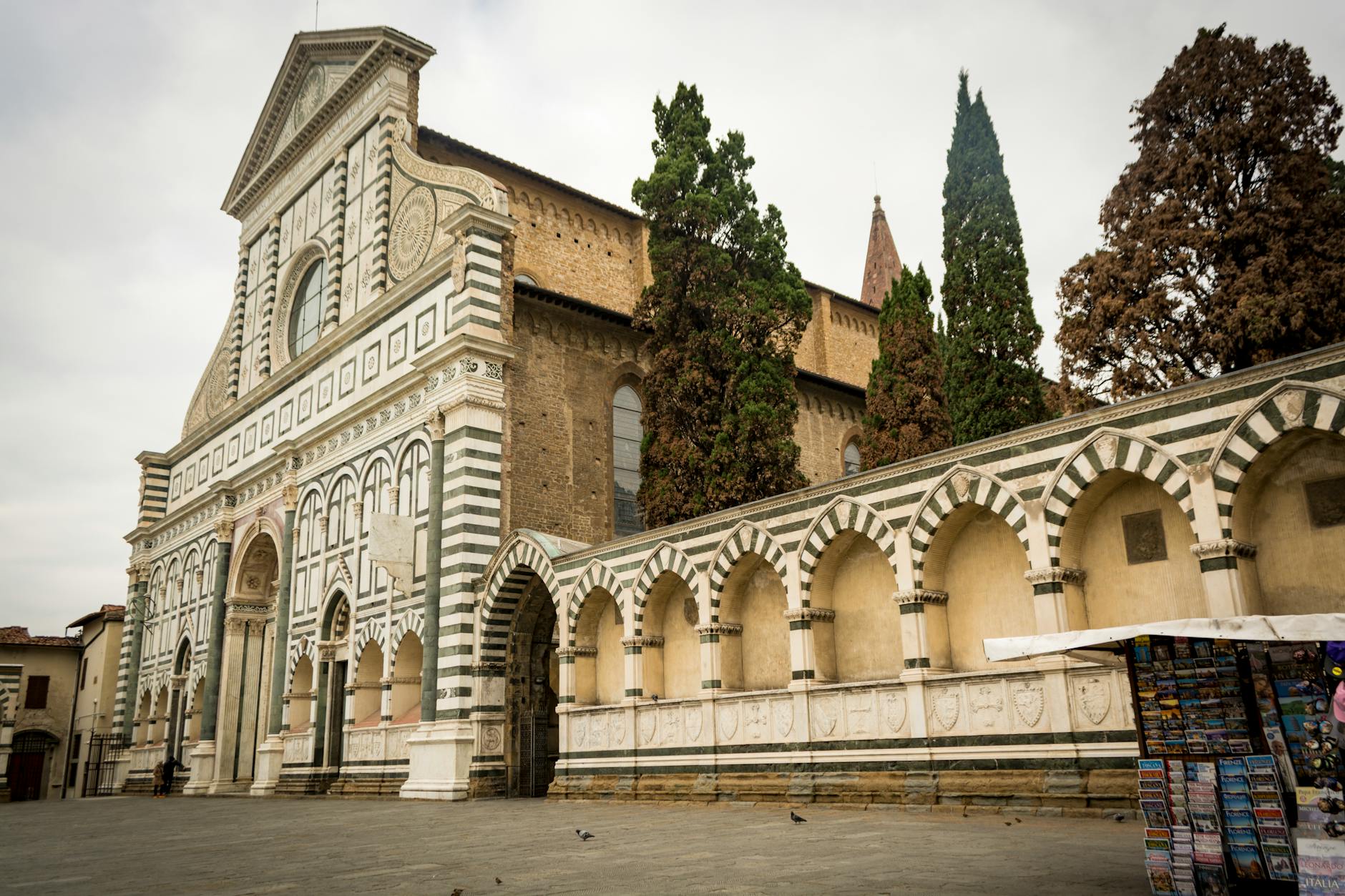
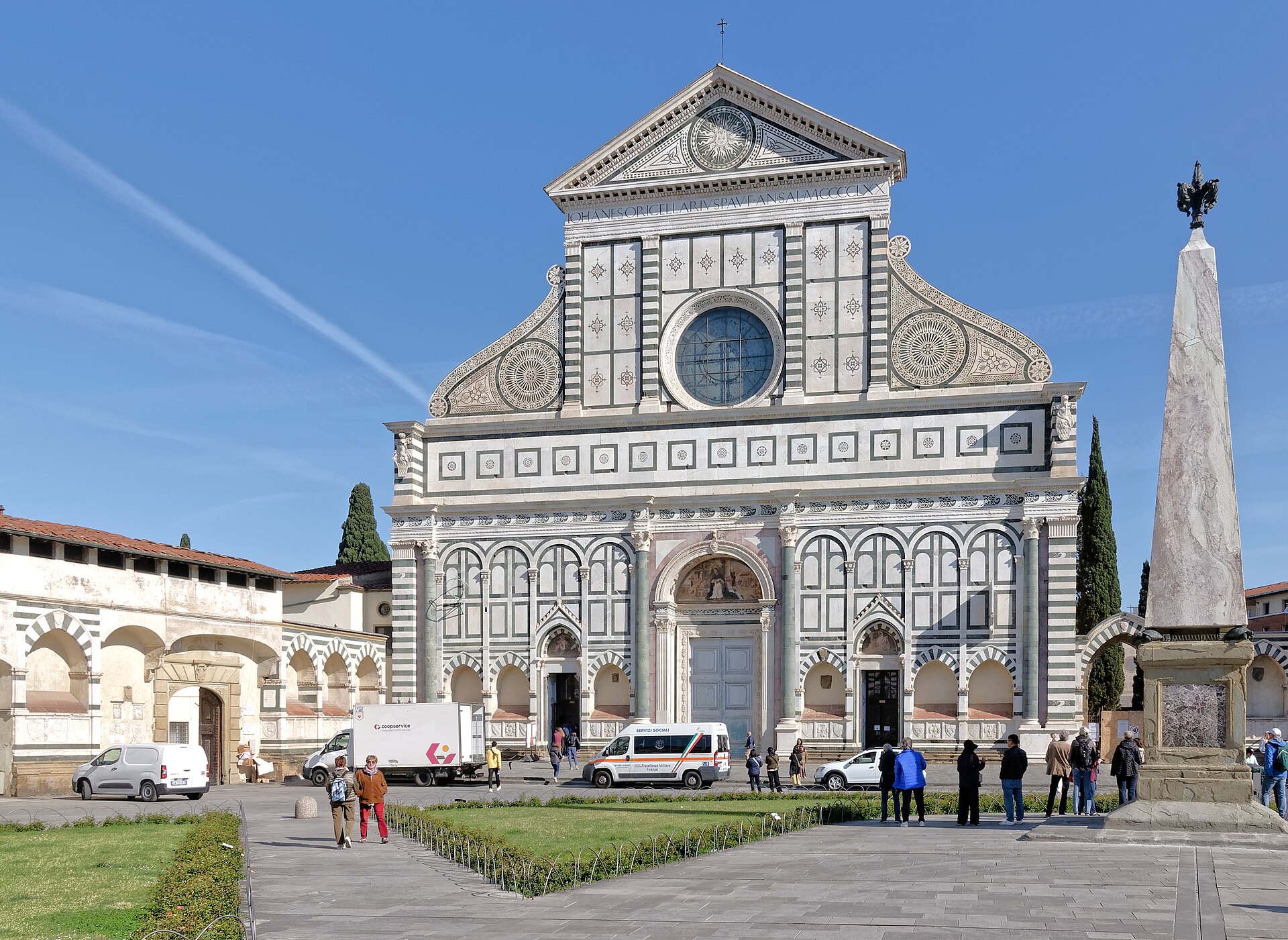
Just across from Florence’s main train station, Santa Maria Novella is the principal Dominican church in Florence and houses some of the most important Renaissance art in the city. The lower facade was begun in the 14th century in green-and-white Tuscan marble; the upper portion was completed in 1470 by Leon Battista Alberti, who designed the volutes (scrolls) connecting the nave to the lower side aisles—a Renaissance solution to a Gothic problem and one of the great moments in classical-meets-medieval architecture.
Inside, the church is famous above all for Masaccio’s Trinity (c. 1427), painted on the third bay of the north aisle. This fresco is widely considered the first true masterpiece of Renaissance painting—the first rigorous use of single-point linear perspective on a wall (architect Brunelleschi may have helped Masaccio set up the geometry), and a meditation on death featuring the figure of God the Father holding the cross with the Holy Spirit dove between his head and Christ’s. Below, a skeleton with the Latin warning: “I was once what you are; what I am you shall be.” Stop and study this for at least ten minutes.
The Tornabuoni Chapel in the apse, frescoed by Domenico Ghirlandaio between 1485-1490 with the help of his teenage apprentice Michelangelo Buonarroti, depicts scenes from the lives of Mary and John the Baptist. The fascination is the historical detail—Ghirlandaio populated the biblical scenes with portraits of contemporary Florentines including the Tornabuoni family who paid for the work. The young Michelangelo’s hand may be visible in some of the figures. The Strozzi Chapel by Filippino Lippi (1502) shows St. Philip raising a youth from the dead and St. John the Evangelist on Patmos, in densely populated Mannerist compositions.
The complex includes the Chiostro Verde (Green Cloister) with frescoes by Paolo Uccello on Genesis stories, and the Spanish Chapel (Cappellone degli Spagnoli) with frescoes by Andrea da Firenze celebrating Dominican thought. Adjoining the church is the historic Officina Profumo Farmaceutica di Santa Maria Novella, a 13th-century pharmacy still selling perfumes and herbal remedies based on Dominican recipes—worth a visit even if you don’t buy.
Tickets €7.50 (reduced €5). Hours: Monday-Thursday 9:00-19:00, Friday 11:00-19:00, Saturday 9:00-17:30, Sunday 12:00-17:30. Address: Piazza Santa Maria Novella 18.
3. San Lorenzo & the Medici Chapels
The Medici family parish church, founded in 393 AD on the site of an even earlier shrine and rebuilt by Brunelleschi from 1419 onward at Cosimo the Elder’s request. Brunelleschi died in 1446 with the project unfinished; the facade was never completed (Michelangelo designed a marble facade in 1518 but it was never built—the present rough brickwork is what visitors still see). The interior is the more important part, anyway. Brunelleschi’s nave is one of the founding works of Renaissance church architecture: gray pietra serena stone columns and arches against white-plastered walls, mathematical proportions clearly visible, classical detailing without medieval clutter.
The basilica has two pulpits by Donatello (his last works, late 1460s) showing scenes from the Passion. The Old Sacristy (Sagrestia Vecchia), designed by Brunelleschi 1421-1428, is a small cube of breathtaking architectural clarity, decorated by Donatello with terracotta medallions and bronze doors. Below the church floor lie the tombs of Cosimo the Elder, his father Giovanni di Bicci, and other early Medici.
Adjoining the basilica are the Medici Chapels—a separate ticketed visit. The Cappella dei Principi (Chapel of the Princes) is an enormous 17th-century mausoleum for the Grand Dukes, lined entirely with semi-precious stone inlay (pietre dure). Behind it, Michelangelo’s New Sacristy (Sagrestia Nuova, 1520-1534) holds the tombs of Lorenzo Duke of Urbino and Giuliano Duke of Nemours—two younger Medici whose effigies sit above sculptural allegories of Day, Night, Dawn, and Dusk that are among the most powerful works of Western sculpture.
Medici Chapels ticket €11, plus an optional €3 booking fee. Hours vary; basilica typically 10:00-17:30, chapels 8:15-18:50, both closed Sunday morning. Address: Piazza San Lorenzo.
4. Santo Spirito
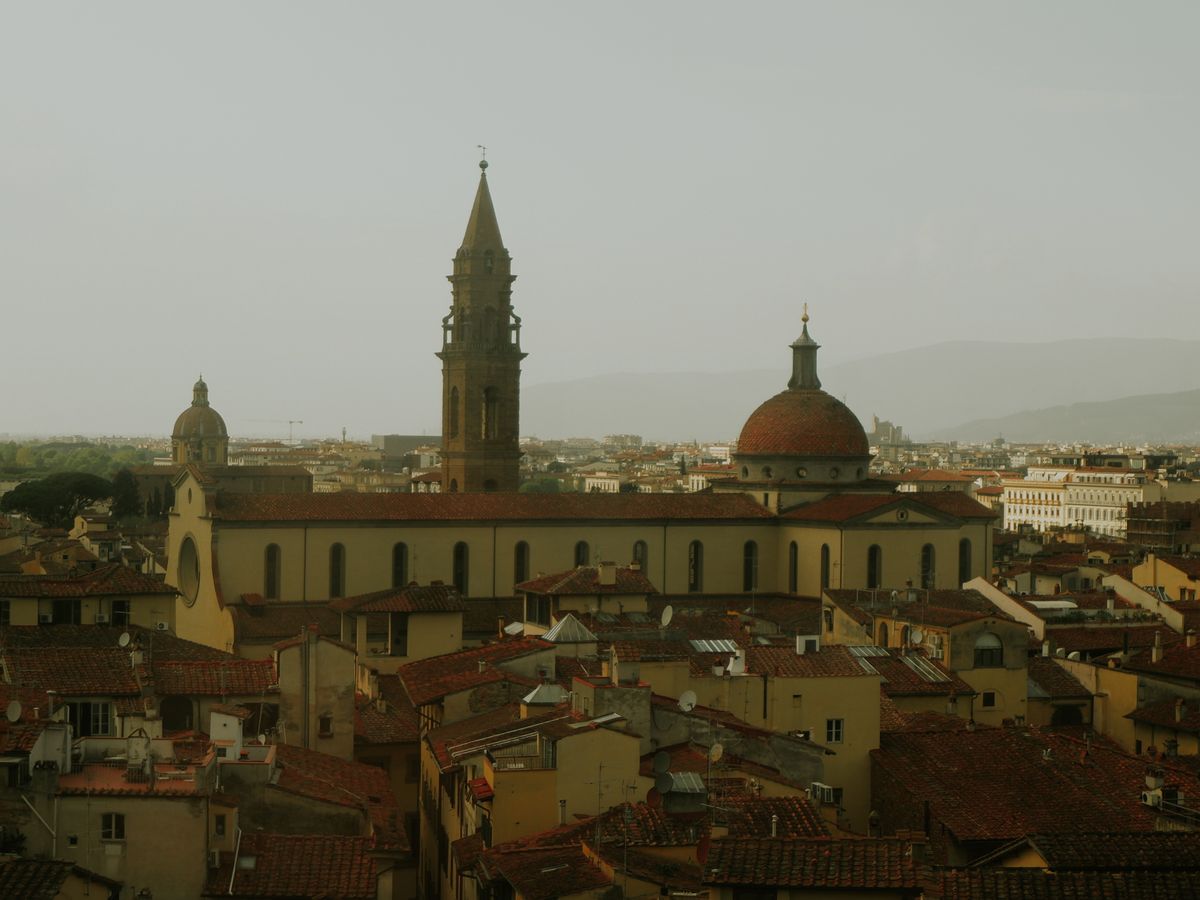
Across the Arno in Oltrarno, Santo Spirito is Brunelleschi’s other Florence church—and many architects argue it’s his finest. Designed in 1428, completed after his death, the basilica’s interior is a stripped-down geometric exercise in classical proportion: gray sandstone columns supporting a gridded ceiling, the spaces between perfectly modular, no medieval ornament to distract. The famously plain facade was deliberately left unadorned by Brunelleschi (later facings were never permanently added).
Inside, the chapels along the side aisles hold a remarkable collection of Renaissance altarpieces. The most important is the small wooden Crucifix by Michelangelo, carved when he was 17-18 years old as a gift to the prior in exchange for permission to dissect cadavers in the church’s hospital. The crucifix was lost for centuries and only positively re-identified in 1962. It depicts Christ with an unusual gentleness—still youthful, almost peaceful—and stands in a small chapel beside the church.
Santo Spirito is the spiritual center of the Oltrarno quarter. The piazza in front—Piazza Santo Spirito—is one of the great social hubs of Florence, with cafés and bars open into the night. There’s a daily morning food market (closed Sundays) and an antiques market on the second Sunday of each month.
Free admission. Hours: Monday-Tuesday 9:30-12:30 and 16:00-17:30; Wednesday closed; Thursday-Saturday 9:30-12:30 and 16:00-17:30; Sunday 11:30-13:30 and 16:00-17:30. Address: Piazza Santo Spirito.
5. San Miniato al Monte
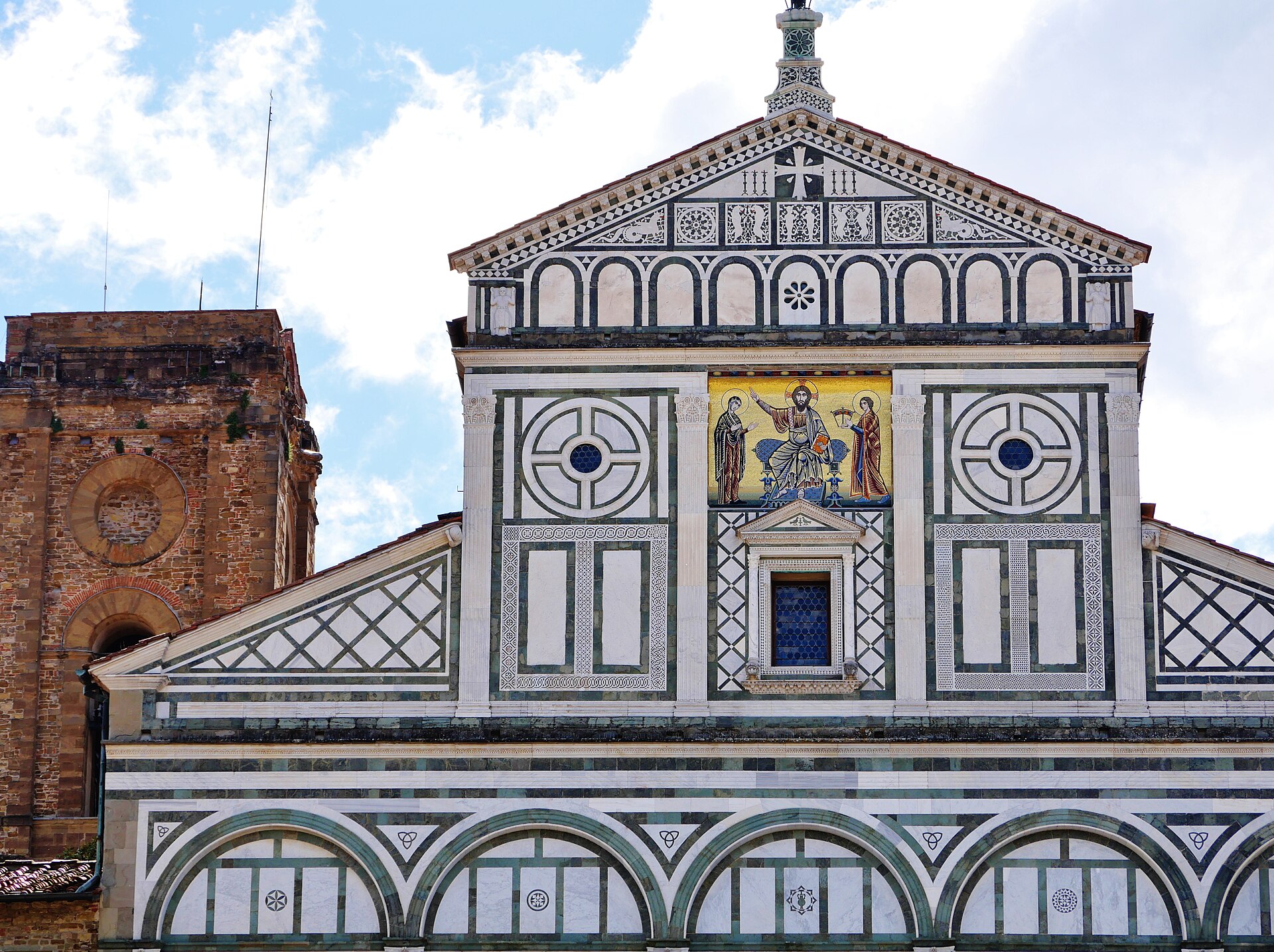
High above Florence on the city’s southern hills, San Miniato al Monte is the most beautiful Romanesque church in Tuscany and a stop you should make for the architecture, the art, the chanted services, and the panoramic views from its terrace. Begun in 1018 on the site where the early Christian martyr San Miniato was reportedly buried, the basilica was completed in the 13th century. Its facade of green Prato marble and white Carrara marble in geometric patterns directly inspired the much later Duomo facade.
The interior is structured on three levels (a main nave, a raised presbytery, and a crypt below) that echo the Roman basilica plan. The 13th-century inlaid marble pavement is one of the finest examples of medieval Italian floor work. The crypt holds the relics of San Miniato. The presbytery’s large 13th-century mosaic of Christ in Majesty between the Virgin and San Miniato is in the Byzantine tradition and was clearly influential on later Florentine art. The 15th-century Cappella del Cardinale del Portogallo (Cardinal of Portugal) features a porcelain tabernacle by the Della Robbia and a beautiful tomb of a young Portuguese prelate who died in Florence.
San Miniato is still home to a small Benedictine community, and the monks sing Vespers in Gregorian chant daily at 18:30—a free, deeply moving service that lasts about 30 minutes. The terrace beside the church offers one of the best panoramic views of Florence, similar to but less crowded than nearby Piazzale Michelangelo (which is just below the church). The walk up from the city takes about 25-30 minutes via the rose garden steps; Autolinee Toscane bus 12 reaches Piazzale Michelangelo, then walk up.
Free admission. Hours: daily 9:30-13:00 and 15:00-19:00 (until 17:30 in winter). Address: Via delle Porte Sante 34.
6. Orsanmichele
One of the most unusual churches in Florence, Orsanmichele began life in 1337 as an open-air grain market. The square pillars at the corners were sheathed in stone niches that originally held food displays. Within a few decades, the building had been converted into a church—the ground floor became a chapel; the upper two floors continued as the city grain reserves until the 16th century, when those rooms were given over to records storage.
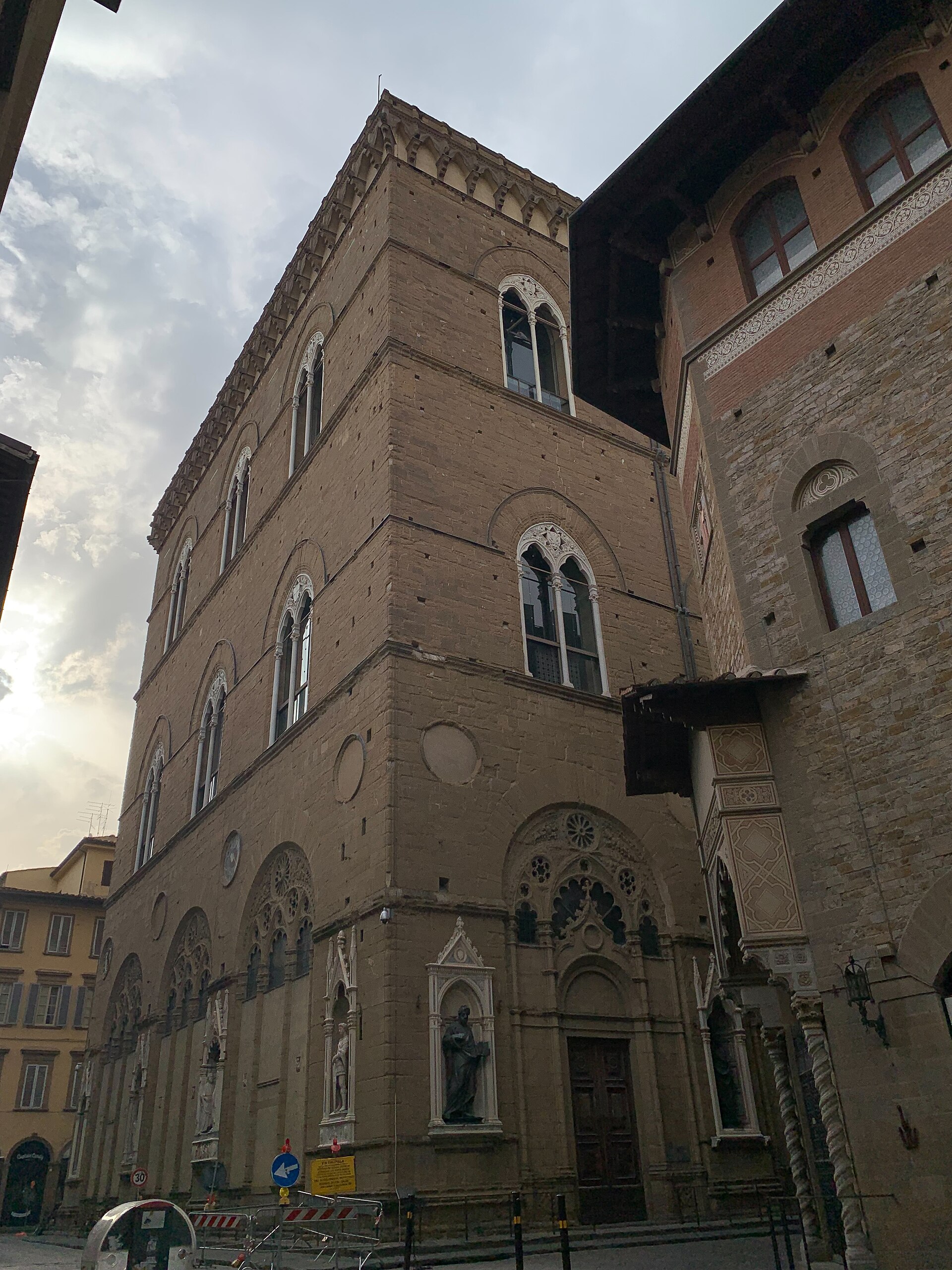
The famous feature of Orsanmichele is the cycle of 14 statues in niches around the building’s exterior. The various trade guilds of Florence each commissioned a statue of their patron saint from the leading sculptors of the era. The result is a remarkable 14th-15th-century outdoor sculpture museum: Donatello’s St. George (linen guild, c. 1416, the original now in the Bargello), Donatello’s St. Mark (linen merchants, 1411), Ghiberti’s St. Matthew (bankers, 1419), Verrocchio’s Christ and St. Thomas (Mercatanzia tribunal, 1467-1483, an early masterpiece of his pupil Leonardo’s training environment), and many others. The original statues are now mostly in the upstairs museum (added in 2010); replicas occupy the niches.
Inside, Orsanmichele’s tabernacle by Andrea Orcagna (1359) is one of the masterpieces of Trecento Gothic sculpture in Italy. The rest of the dim interior houses additional altars and frescoes, smaller in scale than the great basilicas but worth the brief visit.
The ground-floor church is free. The upstairs museum (containing the original statues) is €3 and only opens specific hours: typically Monday and Saturday 10:00-17:00. Address: Via dell’Arte della Lana 1, between the Duomo and Piazza della Signoria—on a main pedestrian route, easy to walk past without realizing what you’re seeing.
7. Santa Trinità
Hidden on the south side of Piazza Santa Trinità, this 11th-century Vallumbrosan church is a quiet jewel that most tourists walk past on their way to Ponte Santa Trinità. The Gothic interior dates to the 14th century. The facade was redone in late Renaissance style in 1593 by Bernardo Buontalenti.
The reason to visit is the Sassetti Chapel, frescoed by Domenico Ghirlandaio between 1483-1485 with scenes from the life of St. Francis—but populated, in Ghirlandaio’s characteristic style, with portraits of contemporary Florentines including Lorenzo the Magnificent’s children, Florentine bankers, and a self-portrait of Ghirlandaio himself. The altarpiece in the chapel, the Adoration of the Shepherds, is also by Ghirlandaio, with portraits of the Sassetti family and a self-portrait. It’s one of the great visual records of late 15th-century Florence.
Free admission. Hours: Monday-Saturday 7:30-12:00 and 16:00-19:00; Sunday 8:00-10:45 and 16:00-19:00. Address: Piazza Santa Trinità 1.
8. Santissima Annunziata
The mother church of the Servite Order, Santissima Annunziata sits at the head of Piazza Santissima Annunziata—one of the most harmonious public squares in Florence (designed by Brunelleschi in 1419, anchored by his Hospital of the Innocents). Florentines have a long tradition of bringing their newborn babies here to be presented to the church’s miraculous fresco of the Annunciation, said to have been completed by an angel in the 13th century.
The interior is sumptuously baroque, having been redecorated in the 17th century—surprising after the relatively austere atmosphere of other Florentine churches. The Chiostrino dei Voti (the entrance cloister, 1447) houses fresco cycles by some of the leading early-16th-century painters: Andrea del Sarto’s Birth of the Virgin (1514), Pontormo’s Visitation, and Rosso Fiorentino’s contributions—works showing the transition from High Renaissance to Mannerism. These frescoes are visible without entering the church proper.
Free admission. Hours: daily 7:30-12:30 and 16:00-18:30. Address: Piazza della Santissima Annunziata.
Honorable Mentions
Santa Felicita: Just past Ponte Vecchio in Oltrarno, this small church houses Pontormo’s Mannerist Deposition (1525-1528), one of the strangest and most beautiful paintings in Florence—a swirl of pastel-colored figures with no perspective and unsettling expressions. Free.
San Marco: The former Dominican monastery now houses Beato Angelico’s frescoes painted directly on the cell walls, including the iconic Annunciation. €4. See our San Marco guide.
Ognissanti: A Franciscan church on the lungarno containing Botticelli’s St. Augustine and Ghirlandaio’s St. Jerome facing each other, plus Botticelli’s tomb. Free.
Santa Maria del Carmine (Brancacci Chapel): Holds Masaccio’s revolutionary 1424-1428 fresco cycle of The Tribute Money, Expulsion from Eden, and other scenes that essentially invented Renaissance painting. €10 with timed entry.
Church Visiting Etiquette in Florence
Most Florence churches enforce a dress code: shoulders covered, shorts and skirts to the knees, hats removed indoors. Some churches (especially Santa Croce, Santa Maria Novella, and the Duomo) have door staff who turn away inappropriately dressed visitors. Carry a light scarf or shawl for cover-up if you’re touring in summer wearing tank tops.
Photography is generally allowed without flash. Tripods, selfie sticks, and large bags are typically prohibited. Silence is requested in all churches; conversations should be whispered. Most churches close to tourists during religious services—Sunday morning especially is reserved for worshippers, with most churches reopening to tourists by early afternoon.
Donations are appreciated even when admission is free. Each church usually has a candle stand where small offerings (€0.50-€2) can be made to support maintenance. Do not eat or drink inside churches. Switch phones to silent.
Suggested Two-Day Florence Church Itinerary
Day 1 (North bank, half-day): Begin at Santa Maria Novella at 9:00 (60 min). Walk to San Lorenzo and the Medici Chapels (90 min). Lunch in the San Lorenzo market area. Walk south to Orsanmichele (30 min). End at Santa Trinità (30 min). Dinner near Piazza Santa Croce. Note: this route can be done in one full day with a more leisurely pace and lunch break.
Day 2 (south bank + Santa Croce, half-day): Morning: Santa Croce (90 min). Walk west, cross the river. Santo Spirito (30 min). Light lunch in Piazza Santo Spirito. Walk up to San Miniato al Monte (60 min, including the climb). Stay for the 18:30 Vespers chant. Watch the sunset from the church terrace before descending.
Frequently Asked Questions
Are Florence churches free to enter?
Most are free, but several major basilicas with art collections charge admission. Free: Santo Spirito, San Miniato al Monte, Orsanmichele (church only), Santa Trinità, Santissima Annunziata, Ognissanti, Santa Felicita. Paid: Santa Croce (€10, plus €1 online), Santa Maria Novella (€7.50), the Medici Chapels (€11, plus an optional €3 booking fee), San Marco Museum (€11), Brancacci Chapel (€15, reduced €10), Duomo (€15-30 for various passes).
What is the most beautiful church in Florence?
Subjective, but Santa Maria Novella and San Miniato al Monte are widely considered the most beautiful—Santa Maria Novella for its Alberti facade and Masaccio Trinity, San Miniato for its Romanesque purity and panoramic setting. Brunelleschi’s Santo Spirito is the architect’s connoisseur favorite. The Duomo is the most spectacular for sheer scale. Choose based on what you most want to experience.
Can you visit Florence churches on Sunday?
Most are closed to tourists Sunday morning until afternoon services finish. Santa Maria Novella opens at 12:00, Santa Croce at 14:00, San Lorenzo and the Medici Chapels typically have shorter Sunday hours. Plan to visit churches on a Sunday afternoon or any other day. Mass services are open to genuine worshippers any time.
Is there a dress code for Florence churches?
Yes, especially at major basilicas. Shoulders must be covered (no tank tops or sleeveless dresses), shorts and skirts must reach the knees, hats must be removed indoors. Visitors not meeting the code are turned away at Santa Croce, Santa Maria Novella, and the Duomo complex. Carry a scarf or light shawl to cover up if needed.
Where are the tombs of Michelangelo and Galileo in Florence?
Both are in the Basilica of Santa Croce. Michelangelo’s tomb (designed by Vasari) is on the south aisle. Galileo’s tomb is across from Michelangelo’s on the north aisle—he was reinterred in the main church in 1737, nearly a century after his death and Inquisition condemnation. Machiavelli, Rossini, and other notable Italians are also buried in Santa Croce.
How much time should I plan for Florence churches?
For a focused church-only itinerary covering the eight main churches, allow two days with church visits taking 4-5 hours per day plus walking and meals. For a single-day overview hitting the highlights (Santa Maria Novella, San Lorenzo, Santa Croce, plus the free quick stops at Orsanmichele and Santa Trinità), allow 6-7 hours.
Can I attend Mass at Florence churches?
Yes. Mass is celebrated in all major Florence churches throughout the day, especially Sundays. Tourist visits suspend during Mass. The most atmospheric services are Sunday morning at the Duomo, Sunday Mass at San Marco (with Dominican chant), and Vespers at San Miniato al Monte (Gregorian chant, daily 18:30). All services are open to anyone respectfully present.
Are Florence churches wheelchair accessible?
Major basilicas (Santa Croce, Santa Maria Novella, San Lorenzo, Santo Spirito) are wheelchair-accessible at the main entrance. Smaller churches and historical sites may have steps. San Miniato al Monte requires climbing or driving up the hill. The Duomo crypt and bell tower/dome climb are not accessible.
What’s the difference between a basilica and a church?
“Basilica” is an honorary title granted by the Pope to important Catholic churches. Florence has several basilicas: Santa Croce, Santa Maria Novella, San Lorenzo, Santissima Annunziata, San Miniato al Monte, and the Duomo (Santa Maria del Fiore). The architectural plan is similar to other churches, but basilicas are recognized for historical or pastoral importance.