This article contains advertising. Booking links on this site can be turned into paid links automatically by our partner Travelpayouts: if you book through one, we earn a commission from the provider, at no extra cost to you. It never affects what we recommend. Affiliate disclosure
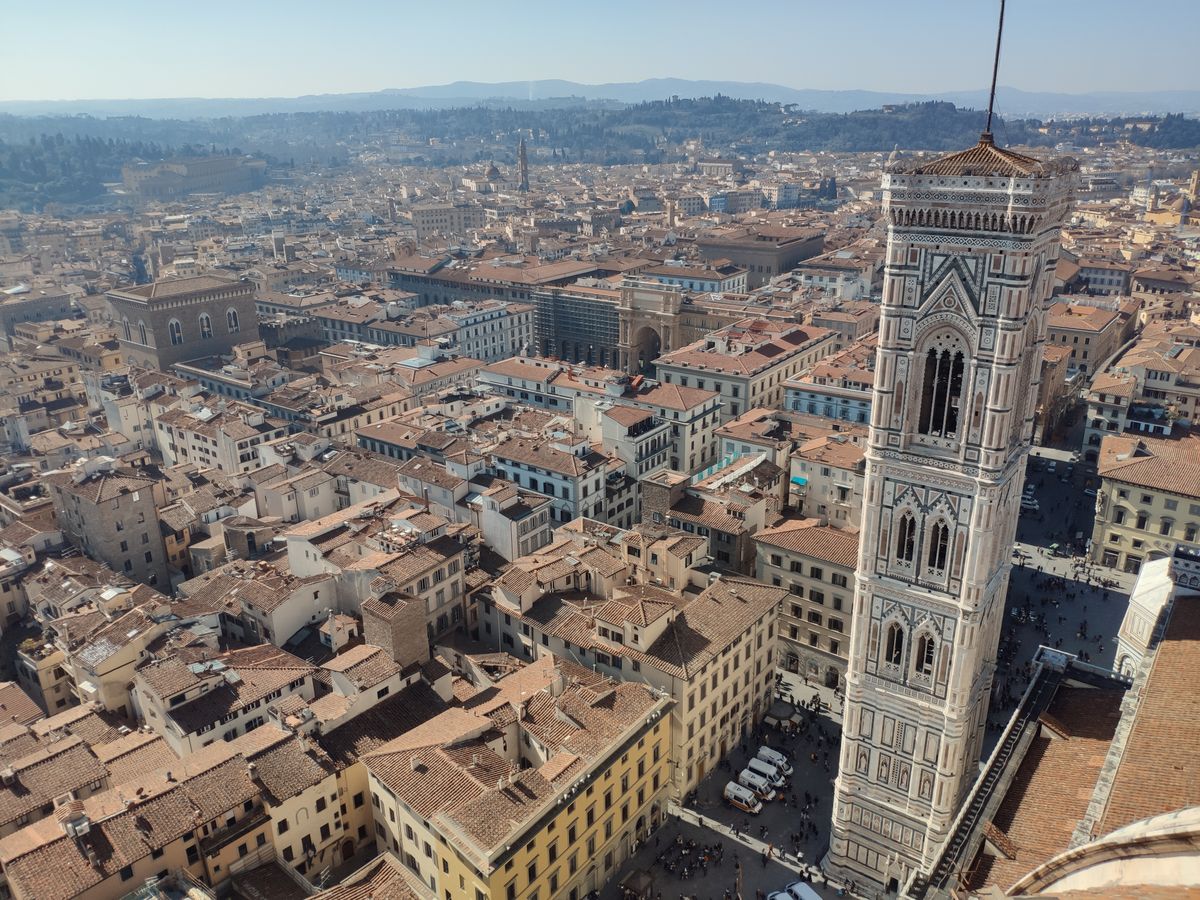
Giotto’s Bell Tower—the Campanile di Giotto—is the elegant 84.7-meter tower beside Florence Cathedral, one of the most beautiful pieces of Italian Gothic architecture and one of the city’s three great climbable towers. Designed by the painter Giotto in 1334, finished by Andrea Pisano and Francesco Talenti by 1359, the bell tower offers the classic photograph of the Duomo (with Brunelleschi’s dome rising in the foreground) and a 360-degree panorama of Florence. This guide covers everything about climbing Giotto’s Bell Tower: tickets, hours, what to expect on the 414-step climb, photography tips, accessibility, and how the campanile compares to other Florence climbs.
The campanile is the climb to choose if you want the dome in your photographs rather than under your feet — compare it with the dome climb itself in our Duomo guide, and see the viewpoints guide for the panoramas that need no stairs at all.
The bell tower needs no reservation, which is half of why it is the smarter climb. It is included on both the €20 Giotto Pass and the €30 Brunelleschi — see our Florence Duomo tickets guide for the full comparison.
Giotto’s Bell Tower at a Glance
| Detail | Information |
|---|---|
| Architect | Giotto di Bondone (lower level), Andrea Pisano, Francesco Talenti |
| Built | 1334-1359 |
| Height | 84.7 meters (278 feet) |
| Steps to top | 414 (no elevator) |
| Climb time | 30-45 minutes one way; 60-75 minutes total |
| Ticket required | Giotto Pass (€20) or Brunelleschi Pass (€30) |
| Reservation | Required timed entry; book in advance |
| Hours | Daily 8:15-19:30 |
| Levels with views | 3 main viewing terraces + summit |
| Best photo angle | Top terrace looking northwest at Duomo dome |
A Brief History
In 1334, the Florentine government appointed Giotto di Bondone—then 65 years old and the most celebrated painter in Italy—as Master of the Cathedral Works (capomaestro). One of his first acts was to design a bell tower for the still-incomplete cathedral. He produced a complete drawing of the tower (which survives) and began construction in July 1334. Giotto died in January 1337 with only the lowest level of the tower complete.
Andrea Pisano took over and completed the second level. Francesco Talenti finished the upper portions between 1348 and 1359. The completed tower differed from Giotto’s original design—Talenti changed proportions and added more elaborate Gothic windows on the upper levels—but the lower section remains essentially Giotto’s vision. The tower’s polychrome marble cladding (white Carrara, green Prato, pink Maremma) matches the cathedral and creates a unified architectural composition.
Decorating the tower’s lower facade are two registers of relief sculptures. The lower row, by Andrea Pisano (and a young Luca della Robbia for some panels), depicts the Creation, biblical scenes, and the activities of human civilization—agriculture, music, justice, the planets. The upper row shows the seven sacraments and seven virtues. These reliefs are an encyclopedia in stone of medieval Christian thought about humanity and society. The originals are now in the Cathedral Museum (Museo dell’Opera del Duomo) for protection; replicas are on the building.
The Climb: What to Expect
The climb begins at the bell tower’s main entrance on the south side (facing the cathedral). Visitors with a Giotto or Brunelleschi Pass present their reservation at security, place large bags in the required luggage storage at Piazza Duomo 38r (small backpacks are usually fine to take with you), and enter through the door at the base.
The staircase is narrow—barely one person fits in each direction at the climbing sections—and runs in a square spiral around a central core. Unlike the dome climb, which becomes increasingly disorienting as you ascend through the curving shells, the bell tower’s straight rectangular plan is easier to navigate. There are three main intermediate landings with windows or terraces:
- First terrace (~150 steps): A wide indoor balcony just above the lower facade. You can see the Cathedral up close at this level—the dome is just to your left as you face out. Catch your breath here.
- Second terrace (~270 steps): A higher viewpoint looking out over Piazza San Giovanni and the Baptistery. The Cathedral roof is at eye level. Most climbers pause here.
- Third terrace (~350 steps): Even higher, with sweeping views over the historic center.
- Summit terrace (414 steps): An open-air rectangular platform around the bell chamber, with the famous view of Florence and Brunelleschi’s dome.
The climb takes 30-45 minutes one way at a steady pace. With pauses on each terrace and time at the top, the full experience is 60-75 minutes. Compared to Brunelleschi’s dome (463 steps inside the cone of the dome with one major frescoed gallery), the bell tower is easier and less claustrophobic—you have multiple intermediate stops and the upper terraces are open to the air.
The View From the Top
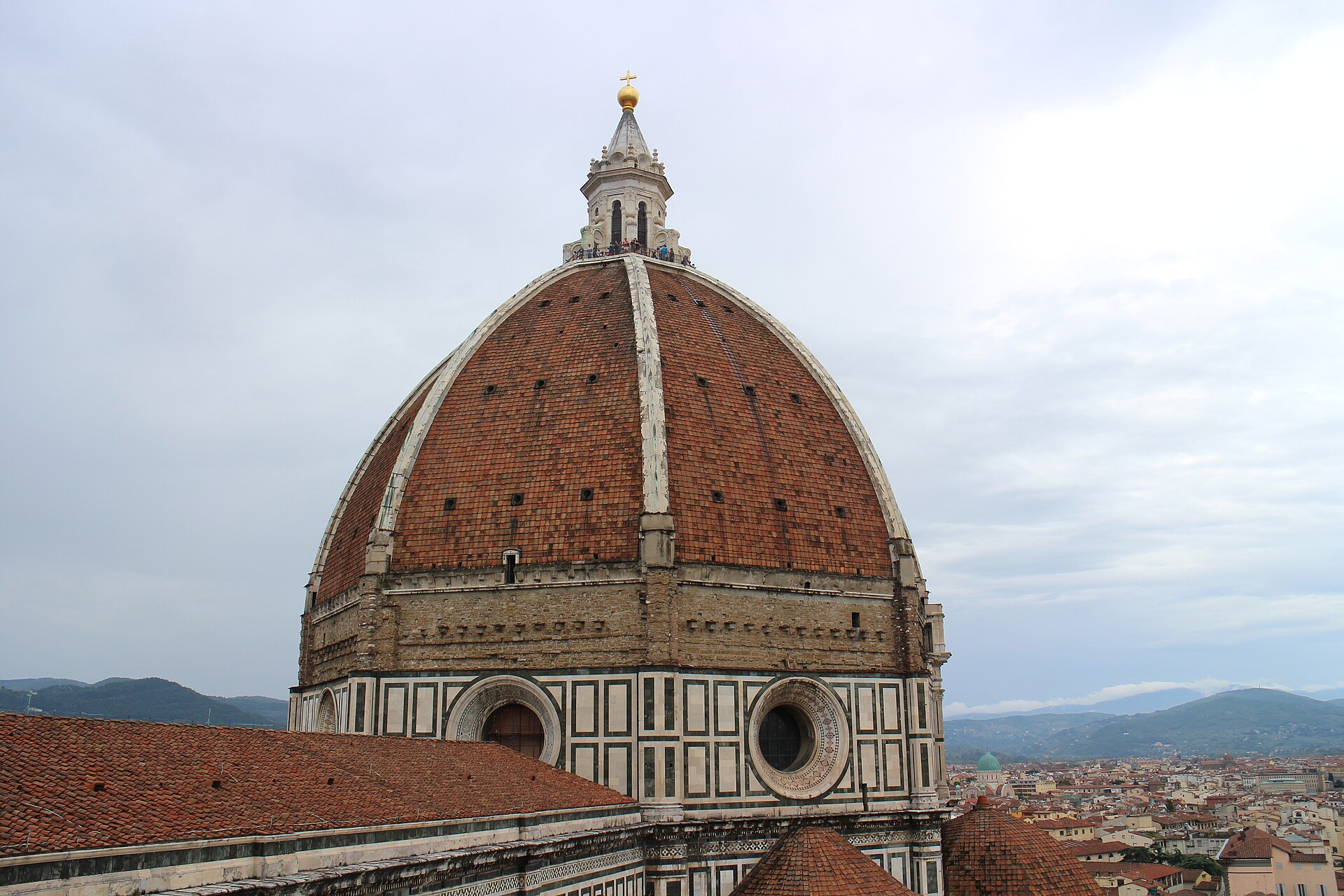
The summit terrace gives the postcard photograph of Florence: the cathedral and its dome in the foreground, the city spread out below, the green hills of Fiesole and the Apennines in the distance. Looking northwest, the Duomo’s dome dominates the view—you’re almost at the same elevation as the dome’s lantern, which means you photograph the dome, not from it. This is the unique advantage of climbing the bell tower over the dome: you can capture the iconic Florence silhouette including the dome itself, which is impossible from inside the dome’s lantern platform.
Other prominent landmarks visible from the top: Palazzo Vecchio’s tower to the south; Santa Croce’s facade and bell tower to the southeast; Santa Maria Novella to the west; the Synagogue’s distinctive copper dome to the east; the Boboli Gardens slope rising south of the Arno; the river itself snaking through the city; San Miniato al Monte and Piazzale Michelangelo on the southern hill; the green Apennines beyond.
The summit terrace is enclosed by tall metal grating about 1.8 meters high—this is for safety and to prevent climbing on the parapets, but it does mean photographs through the grating require positioning your phone or camera lens through one of the larger square openings. Most photographers handle this fine; tripod-and-DSLR users find it more limiting. The grating was added in the 20th century after several incidents.
Tickets and Reservations
Climbing Giotto’s Bell Tower requires either:
- Giotto Pass (€20) — includes Bell Tower + Baptistery + Crypt of Santa Reparata + Cathedral Museum. No dome climb. Valid 3 consecutive days.
- Brunelleschi Pass (€30) — includes everything: Bell Tower + Dome + Baptistery + Crypt + Cathedral Museum. Valid 3 days.
You cannot buy a “bell tower only” ticket—Florence’s Opera del Duomo discontinued single-monument tickets in favor of the combined passes. Children aged 7-14 receive reduced rates: Giotto Pass €7 (€12 Brunelleschi). Children under 7 enter free.
The bell tower requires a timed entry slot reserved at the time of ticket purchase. Reservations cannot be changed after booking. From May through September, slots regularly fill 1-2 weeks in advance for prime times (early morning, late afternoon). Book online at duomo.firenze.it or via the official Opera del Duomo app at least 10 days ahead in summer, longer for the most popular slots.
Cash is not accepted at the ticket office or on-site for any climbs—electronic payment only. All passes are non-refundable.
Hours and Best Time to Climb
The Bell Tower is open daily 8:15-19:30. There are no Sunday morning closures (unlike the Cathedral). Closures occur on January 1, Easter Sunday, June 24 (Festa di San Giovanni), and December 25.
The first slot at 8:15 has the smallest crowds, coolest temperatures, and morning light hitting the cathedral facade. Late afternoon slots (about 17:00-19:00 in summer) offer warm golden hour light and dramatic photographs but are hot in summer due to the unconditioned interior. Avoid 11:00-15:00 in summer—the climb is hot, the terraces are crowded, and the light is harsh.
The last slot of the day usually has fewer climbers as tour groups head to dinner. If you want the Bell Tower nearly to yourself, book the last slot.
Photography from Giotto’s Bell Tower
The classic shot: From the summit terrace, position yourself at the western parapet looking northwest. Frame the dome in the upper third of the image with the cathedral roof and city spread below. Best lighting: morning (the dome catches sunrise from the east) or golden hour (warm light, dramatic shadows on the dome’s terracotta tiles).
Aerial cityscape: Walk around the summit terrace to capture all four cardinal directions. The view east toward the Apennines is best in mid-morning; the view south toward Piazzale Michelangelo and the Tuscan hills is best in late afternoon.
From the lower terraces: The first terrace gives close-up views of the cathedral dome from below—a different angle showing the dome’s massive scale. The second terrace’s vantage point on Baptistery and Piazza San Giovanni below is a good detail shot.
Equipment notes: Smartphones work well. The metal grating at the summit requires positioning your lens through the openings; phone cameras handle this fine. Wide-angle lenses (16-24mm) capture more of the panorama. No tripods or selfie sticks permitted. Flash photography prohibited on stairs.
Accessibility and Health
The Bell Tower is not wheelchair accessible. There is no elevator. The 414 steps must be climbed.
Mobility: The climb requires moderate cardiovascular fitness. Healthy adults of average fitness handle it without major issue. Anyone with knee, hip, or back problems should consider carefully—the descent is hard on joints. The square plan and frequent landings make it less disorienting than the dome’s curving spiral.
Cardiac: The climb is roughly equivalent to climbing 22 flights of stairs. People with significant heart conditions should consult their doctor or skip the climb.
Claustrophobia: Less of an issue than the dome climb. The bell tower’s wider stairs and frequent open terraces give you breathing room. Some narrow stair sections, but the overall experience is more open.
Children: Minimum age is 6, accompanied by adult. Strollers and child carriers cannot be used.
Pregnancy: Generally not recommended. Consult your doctor.
Bell Tower vs. Dome Climb: Which to Choose?
If you can do both, do both—they’re different experiences and the Brunelleschi Pass gives you everything for €30. If you can only do one:
- Climb the dome if: you want the historically iconic experience (Brunelleschi’s engineering achievement); you want to see the Vasari Last Judgement frescoes from inches away; you don’t mind some claustrophobia and harder climb.
- Climb the bell tower if: you primarily want photographs of Florence including the dome itself; you have any concern about claustrophobia (the bell tower has more open air); you want a slightly easier climb (414 vs 463 steps); you want to climb with kids who might find the dome’s tighter spaces harder.
Many photographers prefer the bell tower for the photograph because you can see the dome from there, while from the dome’s lantern platform you can’t see the dome you’re standing on. From an architecture-history standpoint, the dome is more important. The view of Florence itself is roughly equivalent from both.
What to Bring
Footwear: Comfortable closed-toe shoes with good grip. The stone steps are smooth and slippery from centuries of feet, especially on descent.
Clothing: Layers. The interior is unconditioned and warm in summer; the summit terrace can be 10-15°C cooler than ground level due to wind exposure. Bring a light jacket. There’s no formal dress code (it’s a climb, not a sacred space).
Bags: Small backpacks only. Larger bags must be left at the official luggage storage at Piazza Duomo 38r. Tripods, selfie sticks, and oversized objects are prohibited.
Water: Bring a small water bottle. There are no toilets on the route—use them at the base before entering. Florence has free public drinking fountains in the area for refilling.
How to Get There
The Bell Tower entrance is in Piazza del Duomo on the southern (cathedral-facing) side of the campanile. From Santa Maria Novella station: 10-minute walk. From Ponte Vecchio: 8-minute walk. Autolinee Toscane (AT) buses 14, 23, and C1 stop within a block.
The luggage storage at Piazza Duomo 38r is essential if you have any bag larger than a small backpack. It’s open the same hours as the climbs and costs €1-€2 per item.
Frequently Asked Questions
How many steps to climb Giotto’s Bell Tower?
414 steps to the top. The climb takes 30-45 minutes one way at a steady pace. There is no elevator. Multiple intermediate terraces offer rest stops.
Is Giotto’s Bell Tower easier to climb than Brunelleschi’s dome?
Slightly, yes. The bell tower has 49 fewer steps (414 vs 463), a square staircase rather than a spiral, more frequent open terraces for rest, and less claustrophobia. The dome has the more dramatic interior experience but is harder physically and psychologically. Both are similar climbs in cardiovascular demand.
Can I buy a separate ticket just for the Bell Tower?
No. The Opera del Duomo only sells combined passes. The cheapest pass that includes Giotto’s Bell Tower is the Giotto Pass (€20), which also includes the Baptistery, Crypt, and Cathedral Museum. The Brunelleschi Pass (€30) adds the dome climb.
Do I need to reserve a time slot?
Yes. Bell tower climbs require a timed entry slot reserved at the time of ticket purchase. Slots cannot be changed after booking. In high season (May-September), slots fill 1-2 weeks in advance for popular times.
What’s the best time to climb Giotto’s Bell Tower?
The first slot at 8:15 has the smallest crowds, coolest temperatures, and best morning light. Late afternoon (17:00-19:00) offers warm golden hour photography but is hot in summer. Avoid midday in summer (11:00-15:00).
Can children climb Giotto’s Bell Tower?
Children 6 and older may climb when accompanied by an adult. Children under 6 are not permitted. Strollers and child carriers cannot be used inside.
Is photography permitted on the Bell Tower?
Yes, without flash. Tripods and selfie sticks are not permitted. Smartphones work great for the views; the summit terrace’s safety grating requires positioning your lens through the openings.
How much time do I need at the Bell Tower?
Allow 60-90 minutes total: 30-45 minutes climbing, 10-15 minutes at the top, 20-30 minutes descending. With multiple terrace stops and photographs, the experience can extend to 90 minutes.
Are the original Andrea Pisano sculptures on the Bell Tower?
No. The original 14th-century relief sculptures by Andrea Pisano (and Luca della Robbia) are now in the Cathedral Museum (Museo dell’Opera del Duomo) for protection from weather. Replicas are on the building. To see the originals, visit the Cathedral Museum (included in all three passes).