This article contains advertising. Booking links on this site can be turned into paid links automatically by our partner Travelpayouts: if you book through one, we earn a commission from the provider, at no extra cost to you. It never affects what we recommend. Affiliate disclosure
Florence’s public transport system — buses run by Autolinee Toscane since 1 November 2021, when it took over from the old ATAF, and trams run by GEST — is dense, cheap and well-mapped, but most first-time visitors don’t actually need it. The historic centre is compact enough to cross on foot. The exception is when you’re going to or from the airport, climbing to Piazzale Michelangelo, heading to Fiesole, or staying outside the immediate centre. This 2026 guide covers Florence’s bus and tram network — routes, tickets, the at bus app, the airport tram, late-night service, etiquette and the few times when public transport beats walking.
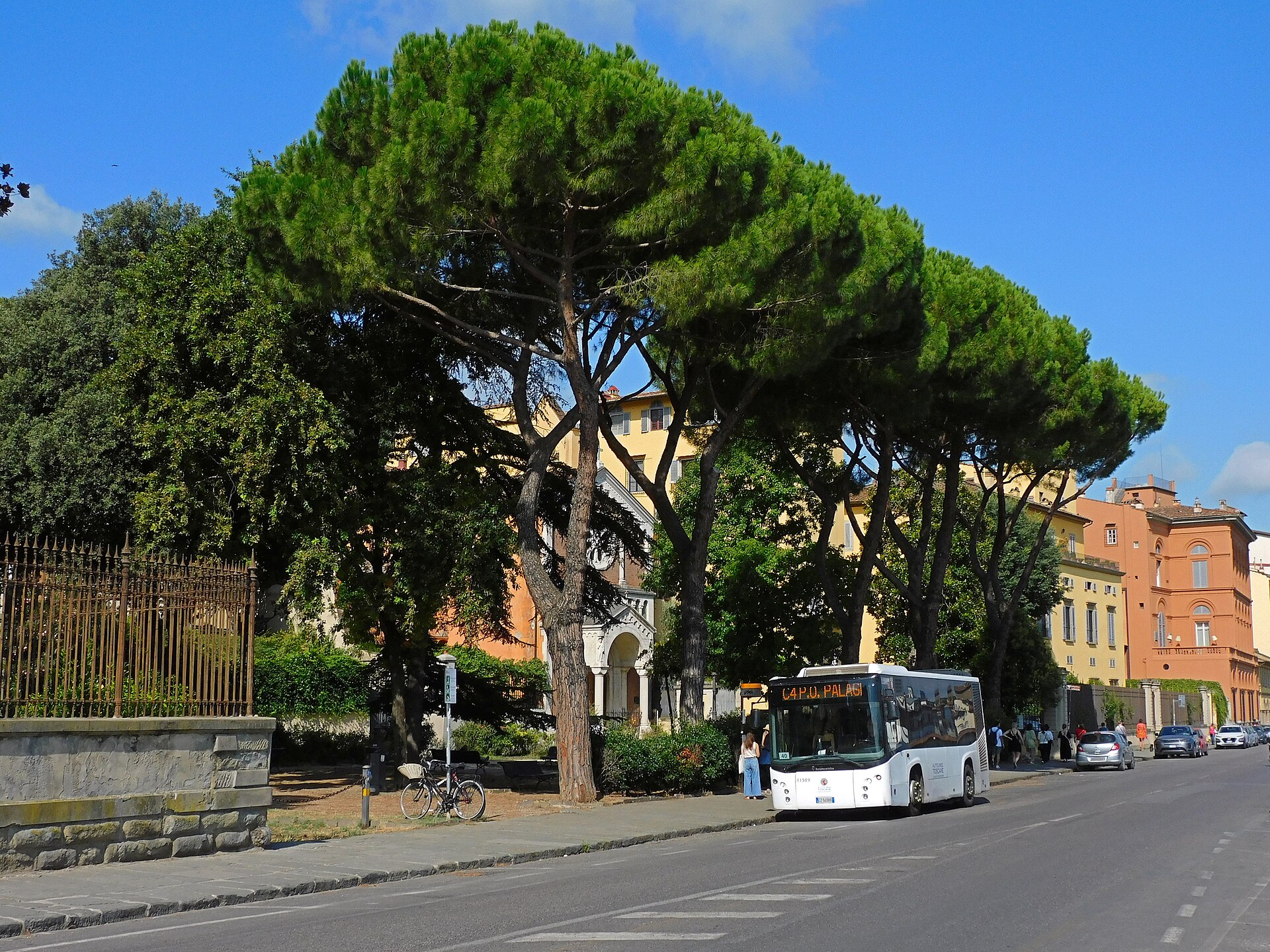
You will mostly walk in Florence, so buses and trams matter for the edges of the map: the T2 tram to the airport in our airport transfer guide, the 12 and 13 up to Piazzale Michelangelo for sunset, and the connections at Santa Maria Novella station.
Lines 7, 12 and 13 cover the two places a tour bus is actually useful for, at €2.00 rather than a day ticket. Our hop-on hop-off guide compares them directly and is honest about when the tour bus still wins.
Do You Actually Need Florence Public Transport?
For most first-time tourists, the honest answer is “rarely.” The historic centre — Cathedral, Uffizi, Accademia, Pitti, Bargello, San Marco, Santa Croce, Mercato Centrale, Ponte Vecchio — covers 505 hectares (about 5 square kilometres) by UNESCO’s measure, and its sights sit within walking distance of each other. Walking is faster than buses (which detour around the ZTL traffic-restriction zone), and it’s free.
Public transport actually matters in five specific cases:
- Florence Airport (FLR) Peretola transfer — the T2 tram line is the low-cost link (€2.00, about 20 minutes to the station area).
- Piazzale Michelangelo — bus 12 or 13 climbs the hill if you don’t want to walk up via the Rose Garden.
- Fiesole day trip — bus 7 runs from Libertà (Porta San Gallo) up to the hilltown.
- Hotels in the suburbs (Sesto Fiorentino, Scandicci, Bagno a Ripoli) — buses are the way in.
- Mobility issues, heavy rain, late at night — buses replace walking in these conditions.
If your trip is solely centro storico walking, you might never buy a single transit ticket. That’s a normal Florence trip — many seasoned travellers cover the city without using public transport at all.
Florence Tram (Tramvia) Lines
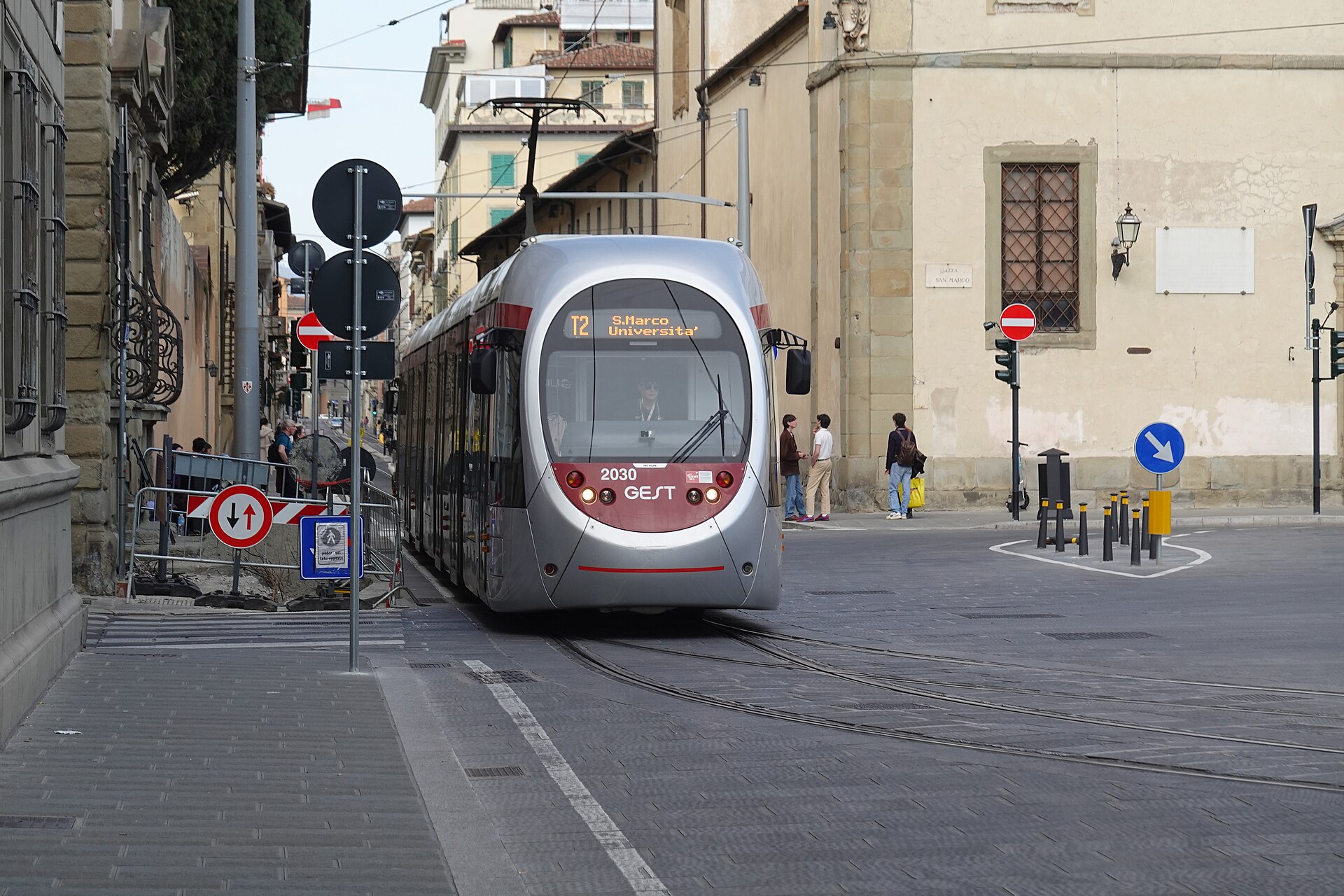
Florence’s modern tram system has two lines (with a third under construction).
Line T1 (Villa Costanza – Careggi)
- Route: Villa Costanza (Scandicci, west) → Santa Maria Novella → Careggi (Florence’s main hospital, north)
- Useful stops for tourists: “Alamanni” (Santa Maria Novella station), “Unità” (near Cathedral), “Cascine” (large city park)
- Frequency: Every 4–5 minutes on school-term weekdays (06:30–20:30) and every 5–6 minutes on Saturdays; waits are longer in the evening and on Sundays, up to 25 minutes late at night (see the GEST timetables)
- Operating hours: 05:00–00:30 daily; until 02:00 Friday/Saturday nights
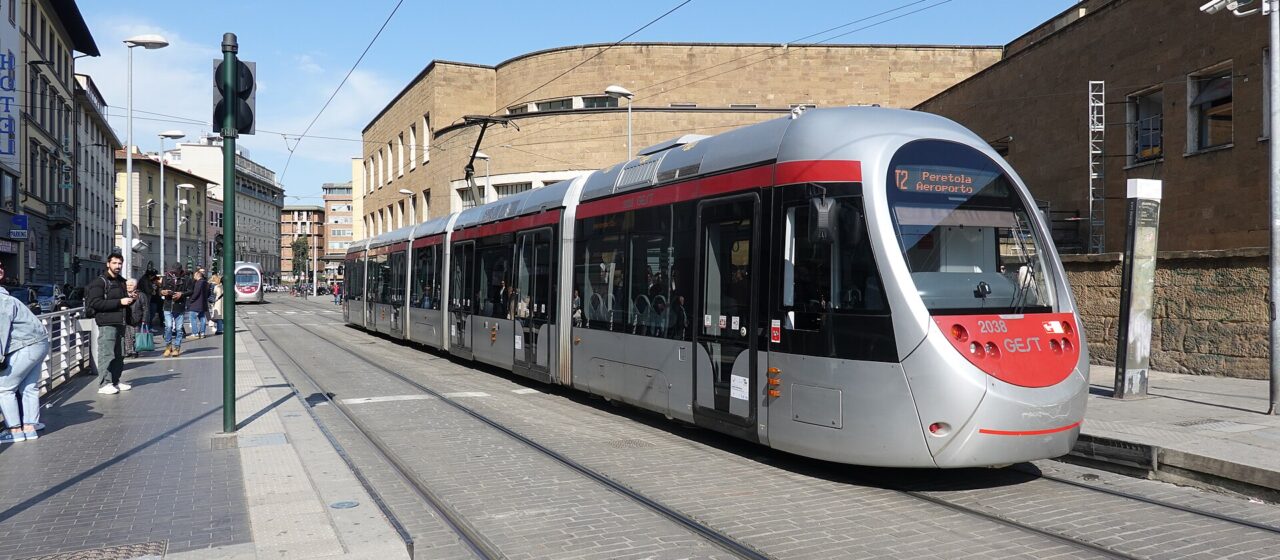
Line T2 (Aeroporto – San Marco)
- Route: Florence Airport (FLR Peretola) → Santa Maria Novella → San Marco–Università (Piazza San Marco)
- Useful stops for tourists: “Peretola Aeroporto” (the airport), “Alamanni” (SMN station), “San Marco” (the terminus)
- Frequency: Same pattern as T1: every 4–5 minutes on school-term weekdays, 5–6 minutes on Saturdays, with gaps of up to 22 minutes late at night
- Operating hours: 05:00–00:30 daily; until 02:00 Friday/Saturday nights
- Journey time: about 20 minutes airport to SMN (the timetable gives 19 minutes to Alamanni and 21 to Valfonda)
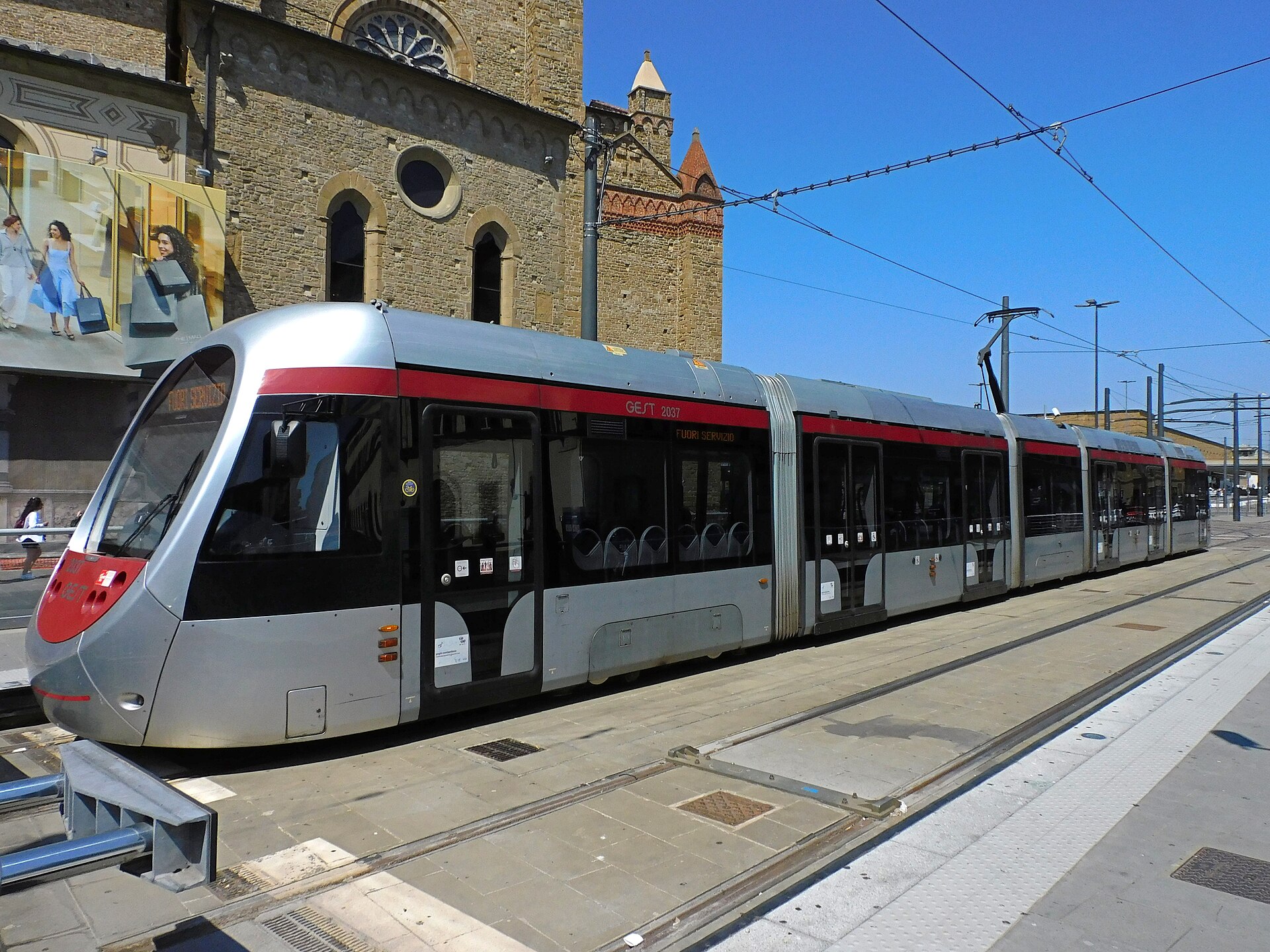
The T2 is the most-used tram for tourists — the low-cost airport link. Trams have wide doors, dedicated luggage spaces, level boarding for wheelchairs and strollers, and clear English announcements at each stop.
Line T3 (Bagno a Ripoli, Under Construction)
The T3 line connecting the centre to Bagno a Ripoli (south-east suburbs) is under construction, and the city is aiming to start passenger service in summer 2027, once works and testing are complete. It won’t be running for 2026 visitors.
Florence Bus Network
Autolinee Toscane runs an extensive urban bus network across Florence; every current route is on its lines and timetables page. The lines fall into broad categories:
Tourist-Useful Bus Routes
- Bus 7 — Libertà (Porta San Gallo) → Fiesole Piazza Mino. The Fiesole day-trip line: the 07:18 departure from Libertà is timed to reach the hilltown at 07:38, a 20-minute ride.
- Bus 12 — Santa Maria Novella → south of the river → Piazzale Michelangelo. Check the at bus app for the journey time from the station to the panoramic terrace at your hour.
- Bus 13 — The 12’s loop (Piazzale Michelangelo – Stazione SMN – Rotonda Barbetti) run in the opposite direction.
- Bus C1 — Small electric bus through the centre, running Parterre – Santa Maria Soprarno/Porta Romana. Useful for crossing the centre when tired.
- Bus C2 — Mini-electric bus on a partly different historic-centre route.
- Bus C3 — Runs between Piazza Beccaria and Leopolda.
- Bus C4 — Links Santa Maria Maggiore with P.O. Palagi.
- Bus 23 — From the T2 tram stop at Guidoni to Sorgane/Bagno a Ripoli.
The C1, C2, C3 and C4 mini-electric buses are particularly useful — they’re small enough to navigate the narrow historic-centre streets, and they’re slower than walking only when traffic is light. They’re also the only way for elderly or mobility-impaired travellers to comfortably cross the historic centre.
Outer Neighbourhood Buses
Other routes run out to the residential neighbourhoods and nearby towns: 14 to Il Girone/via Rocca Tedalda, 22 from largo Caruso to Settignano, 28 from T1 Piazza Dalmazia to Sesto Fiorentino Volpaia, and 31 from Piazzale Montelungo to Grassina. Check AT’s route list for your own area. Useful only if you’re staying in one of these areas; not relevant to typical centro storico tourist itineraries.
Tickets & Fares (2026)
Florence has a single integrated ticket valid on all urban buses and trams within the Florence fare area:
| Ticket | Price 2026 | Validity |
|---|---|---|
| Single ticket (Biglietto Urbano) | €2.00 | 90 minutes, unlimited bus/tram transfers |
| On-board single ticket | €3.00 | Same as above; pay driver in cash |
| Carnet 10 tickets | €18.20 | 10× single tickets, valid until used |
| Monthly pass | €42.20 | Unlimited transport for residents/longer stays; register on the AT e-shop |
The €2.00 single ticket is the standard option for most tourists, and one ticket already covers bus and tram changes within its 90 minutes. If you expect several separate trips over your stay, the €18.20 carnet of ten tickets brings the cost per ride down. Most tourists actually use 0–2 tickets per day, so single tickets remain the default.
Critical Ticket Rules
- Validate before boarding — paper tickets must be inserted into the small yellow validator at tram stops or near the bus driver. Unvalidated tickets are treated as fare evasion: the fine is €40 plus €3 costs if paid within 15 days, €80 plus €3 in days 16–60, and €240 plus €3 after that.
- The 90-minute window starts at validation, not purchase. Buy ahead, validate when you board.
- On-board cash purchases cost €3 (50% more than the €2.00 fare). Always buy in advance.
- Inspectors do exist — don’t risk it. Even paid promptly, the fine is €40 + €3 against a €2.00 ticket.
- One child under 11 travels free with an accompanying adult; any other under-11s with that adult need ordinary tickets.
Where to Buy Tickets
- Tabaccherie (tobacconist shops with white “T” sign on a black background) — most common option. Florence has hundreds; ask “un biglietto urbano per favore“.
- Edicole (newsstands)
- Tram stop ticket vending machines — accept coins, banknotes and contactless cards. English language option.
- Florence Santa Maria Novella station kiosks and machines — main transit hub.
- at bus app (free, iOS/Android) — buy and validate tickets digitally on your phone. Recommended for 2026 visitors.
- Contactless on-board payment — tap your contactless card on the validator near the driver/door. Charged at the €2.00 single rate. Available on most buses and trams.
The at bus app is the easiest 2026 option for tourists. Download before arrival, register a card, buy and validate tickets entirely on your phone (no paper, no fumbling at the validator). The app also shows real-time bus and tram arrivals — useful for planning a Piazzale Michelangelo run.
How to Use Florence Buses & Trams
Boarding
Trams use any door — board at front, middle or rear. Buses use the front door for boarding (showing/validating ticket), middle and rear doors for exiting. Some routes (especially the C-series electric buses) use any door.
If you’re paying on board with cash (€3), board through the front door and pay the driver. If you’re using contactless or app, validate at any of the small electronic readers near each door.
Validation Process
- Paper ticket: insert long-side first into the small yellow validator near the doors. The machine prints date and time on the back. Keep the validated ticket for the journey — inspectors check.
- App ticket: tap “Validate” in the app when you board. Show the screen if asked.
- Contactless card: tap on the validator. Wait for green light. The card itself is your “ticket” — keep it accessible.
- Carnet (10-ticket book): each ticket is its own paper to validate. Don’t validate the entire booklet at once.
Getting Off
Buses don’t stop at every stop automatically — press the red “STOP” button (typically near doors and on overhead handrails) to request the next stop. Trams stop at every stop on the route.
Stop announcements are made in Italian and English on most modern fleet vehicles. Older buses sometimes announce only in Italian — listen for the stop name on the digital display above the driver.
Smart Tourist Strategies
Airport Tram (T2) — The Default
Buy a single €2.00 ticket from the vending machine at the FLR airport tram stop. Validate at the platform. Board at “Peretola Aeroporto” stop (2-minute walk from arrivals hall). Get off at “Alamanni” for Santa Maria Novella station; regular trams carry on to San Marco. Total: €2.00 and about 20 minutes.
Piazzale Michelangelo (Bus 12 or 13)
Bus 12 or 13 from the Santa Maria Novella station area: the two lines run the same loop (Piazzale Michelangelo – Stazione SMN – Rotonda Barbetti) in opposite directions. Buy a €2.00 ticket, validate on boarding and get off at the “Piazzale Michelangelo” stop. The bus saves you the climb (steep but rewarding via the Rose Garden); the walk down after sunset is the recommended return.
Fiesole (Bus 7)
Bus 7 from Libertà (Porta San Gallo). €2.00 single. The timetable allows about 20 minutes to “Fiesole Piazza Mino” (the hilltown’s main square), plus whatever it takes you to reach the departure stop. Combined with one ticket back, your half-day Fiesole trip costs €4.00 in transit.
When the Carnet Pays Off
Autolinee Toscane sells no 24-hour, 3-day or other tourist pass for Florence, so even a busy day — airport arrival + Piazzale Michelangelo + Fiesole + a return ride to the airport — runs on single tickets. If your stay adds up to that many rides, the €18.20 ten-ticket carnet is the saving. Otherwise stick with single tickets.
Night Services & Safety
Trams T1 and T2 run until 00:30 daily and until 02:00 on Friday and Saturday nights — useful for late dinners and bar-hopping in the centre. After tram service ends, taxis are the standard late-night option.
Night buses run on a limited schedule (the “Notturna” lines) connecting Santa Maria Novella to a few major outer areas. Departures are sparse, so check the times in the at bus app before you count on one. For most travellers, night buses are not a primary option.
Pickpocket awareness — pickpockets work crowded buses and trams in Florence, as in any city. Front-of-body bag, no phone in back pocket, no loose wallets in back pockets. The boarding crush is the typical strike moment.
Strikes (Sciopero)
Italian public transport unions occasionally call sciopero (strike) days — typically 24 or 8 hour stoppages. Check Autolinee Toscane’s at-bus.it/en notices and press releases for upcoming sciopero dates. During a bus strike AT guarantees full service from 04:15 to 08:14 and from 12:30 to 14:29; tram guarantees appear in GEST’s own notice for each strike.
If your travel plans coincide with a strike, taxi backup is the standard answer. The Italian transit-strike system is highly regulated and stoppages are announced 10+ days in advance.
Accessibility
All trams (T1, T2) are fully accessible: low-floor boarding, wheelchair-spaces, audio and visual announcements, dedicated wheelchair-anchor zones. Most modern Autolinee Toscane buses are also low-floor with kneeling capability and wheelchair ramps.
Some older bus models (especially on routes serving outer suburbs) are still high-floor with steps. Plan the trip with Autolinee Toscane’s accessible Travel Planner and confirm step-free access with AT before you travel.
Visually impaired travellers can use the at bus app’s accessibility features and the audio-announcement system on all modern fleet vehicles. Hearing-impaired travellers benefit from the digital displays inside trams and modern buses.
Florence Transport vs Other Italian Cities
Compared to Rome (subway, six tram lines and 363 daytime bus, trolleybus and tram routes at the end of 2025), Florence has a much smaller transport network. The compact historic centre is the reason — Florence simply doesn’t need the metro and dense bus grid that bigger Italian cities have.
Compared to Venice (vaporetto water-bus only, no land transport), Florence is much more conventional and faster.
Compared to Milan (extensive metro, dense tram network, integrated airport rail), Florence is smaller-scale but just as easy to navigate once you understand the tram lines and the limited useful bus routes.
Insider Tips
Tip 1: The at bus app’s real-time arrival display saves time at unfamiliar stops. Frequencies vary by line, stop and time of day, so a quick look at the next arrival beats guessing.
Tip 2: Validate every paper ticket. Inspectors treat an unvalidated ticket exactly like no ticket at all.
Tip 3: Don’t pay €3 cash to the bus driver for a “single ticket” — the same ticket bought at a tabaccheria or app costs €2.00.
Tip 4: Bus 7 ends at “Fiesole Piazza Mino”, the hilltown centre — stay on to the terminus rather than getting off earlier.
Tip 5: The Cascine Park (Florence’s largest urban green space) is on the T1 tram line — useful for runners or families needing playground space.
Tip 6: If you’re carrying heavy luggage and arriving at SMN station, the tram to “Unità” brings you closer to the Cathedral — save the cobble-pulling pain by riding one stop.
Florence Bus & Tram FAQ
Do I need to use the bus or tram in Florence?
For most first-time tourists, no — the historic centre is small enough to cover on foot. Public transport matters mainly for the airport (T2 tram), Piazzale Michelangelo (bus 12/13), Fiesole (bus 7), and outer-suburb hotels.
How much is a Florence bus ticket?
€2.00 for a single ticket valid 90 minutes on buses and trams within the urban Florence fare area. €3 if bought on board from the driver. There is no day pass; a carnet of 10 tickets costs €18.20.
Where can I buy bus tickets?
Tabaccherie (tobacconist shops with the “T” sign), edicole (newsstands), tram-stop vending machines, the Santa Maria Novella station kiosks, the at bus app, or contactless card on board.
Do Florence buses run at night?
Trams run until 00:30 daily, 02:00 on Friday and Saturday nights. A limited night-bus network (“Notturna”) runs after that on selected outer routes. For most late-night returns to a centro storico hotel, taxis are the standard option.
How do I validate a bus ticket in Florence?
Insert paper tickets into the small yellow validator near the bus or tram doors immediately on boarding. The machine prints the date and time. Unvalidated tickets are treated as fare evasion (a €40 fine plus €3 costs if paid within 15 days, €80 in days 16–60, €240 after that). App tickets are validated within the app on boarding.
How do I take the tram from Florence Airport?
Walk 2 minutes from FLR arrivals to “Peretola Aeroporto” tram stop. Buy a €2.00 ticket from the vending machine. Validate at the platform. Board the T2 tram. Get off at “Alamanni” for Santa Maria Novella station, about 20 minutes from the airport.
Does the Firenze Card cover public transport?
No — the €85 Firenze Card is a museum pass, valid for 72 hours from your first museum entry, and it doesn’t include Florence buses, trams or transport to and from the airport. Cardholders buy transit tickets separately, though most will spend only €5–10 on them.
Can children ride free?
Partly — one child under 11 rides free with an accompanying adult, and any other under-11s with that adult need an ordinary ticket. Children 11+ pay full fare.
Florence’s bus and tram network is small, well-organised and dramatically less essential to tourists than the corresponding networks in Rome or Milan. Most centro-storico-only itineraries use 0–2 tickets across a 4-day trip. The exceptions — airport transfer (T2), Piazzale Michelangelo (12/13), Fiesole (7) — are exactly the moments when €2.00 saves you 30 minutes of walking. Download the at bus app, validate every ticket, and forget about transport the rest of the time. Walking remains the right answer.