This article contains advertising. Booking links on this site can be turned into paid links automatically by our partner Travelpayouts: if you book through one, we earn a commission from the provider, at no extra cost to you. It never affects what we recommend. Affiliate disclosure
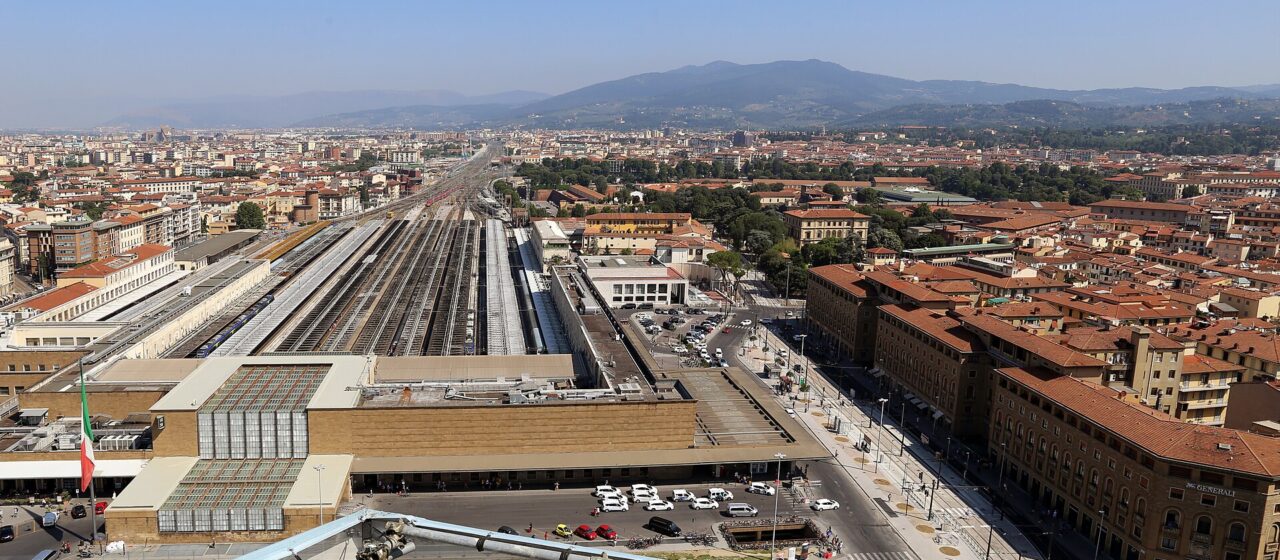
Santa Maria Novella (SMN) is Florence’s main train station — the start and end point of nearly every visit by rail. It’s a Modernist landmark in its own right (opened in 1935 to a design by the Gruppo Toscano, the team of rationalist architects led by Giovanni Michelucci), it sits within easy walking distance of the Cathedral, and its operator counts some 59 million visits a year across Frecciarossa, Italo, regional, and intercity trains. This 2026 guide covers everything you need to know about Florence’s main station: arrivals and departures, ticket buying, luggage storage, station services, the secondary Florence stations, transit connections, late-night service, accessibility, and the dos-and-don’ts that every transit-using traveller should know.
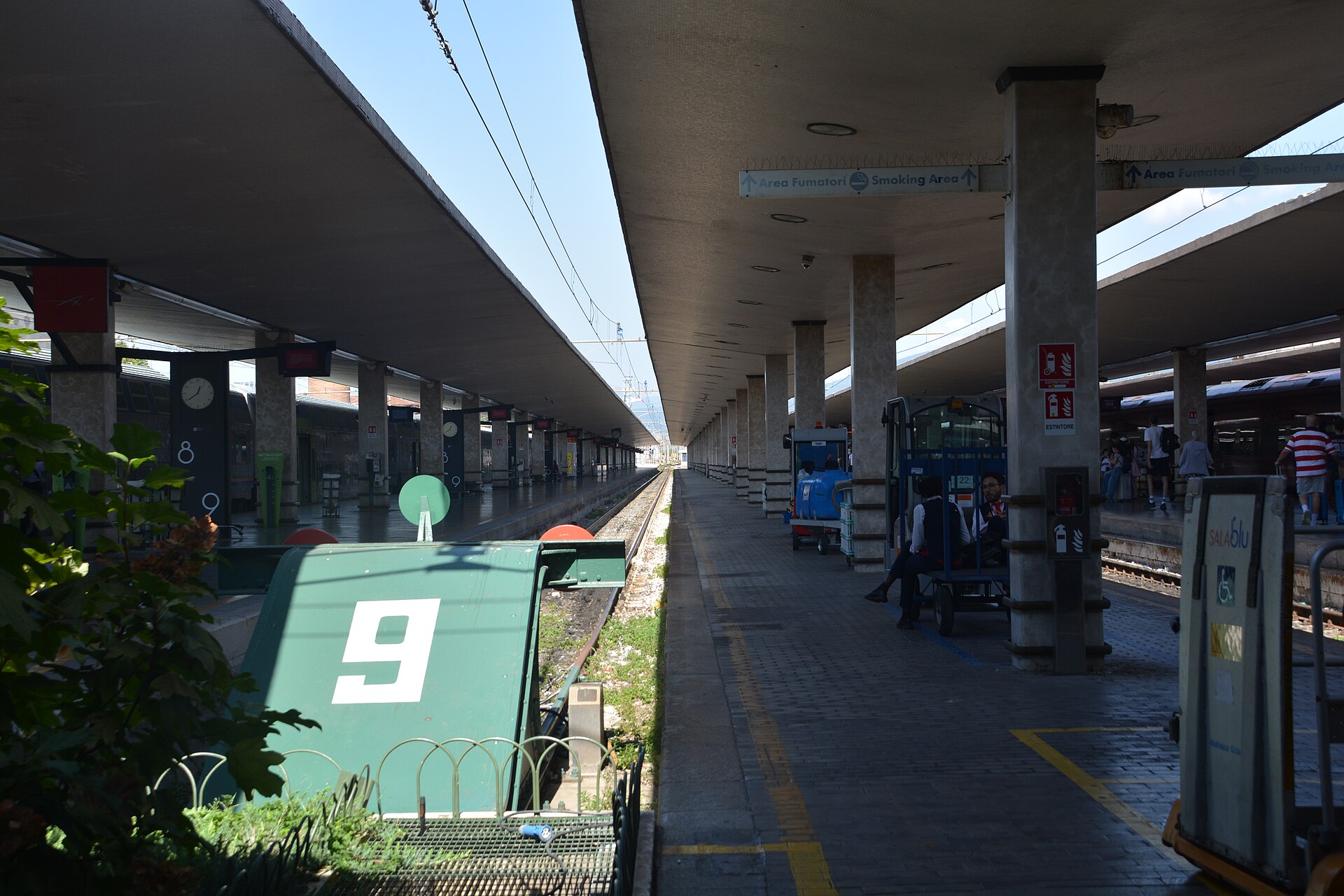
Santa Maria Novella is where most Florence trips begin and end, and it is a ten-minute walk from the Duomo. Our guides to Rome to Florence, Venice to Florence and Florence to Pisa cover the routes that use it most.
The T1 tram from the Villa Costanza motorway car park reaches Santa Maria Novella in about twenty-two minutes, which is the cleanest way to arrive with a car and never meet a camera. Our guide to the Florence ZTL and parking has the park-and-ride options in full.
The other end of most arrivals is four kilometres away at Peretola. Our Florence airport guide covers what to expect there — the check-in peaks, the bus-and-steps boarding and why bad weather sends flights to Pisa or Bologna.
Most arrivals from Pisa end on these platforms, about fifty to eighty minutes after leaving Pisa Centrale. Our guide to getting from Pisa airport to Florence has the PisaMover fares, the train timings and the ticket-validation rule that catches people out.
On cruise days the platforms fill with passengers from Livorno, many of them on the direct regional trains that run roughly hourly. Our guide to Livorno to Florence for cruise passengers covers which trains to catch and how late is too late for the return.
Naples is about three hours from these platforms on a direct high-speed train, with departures through the day. Our guide to the Florence to Naples train covers both operators, the fare levels and why booking three weeks ahead pays.
Milan is under two hours from these platforms, with a Frecciarossa every hour. Our guide to the Florence to Milan train explains which trains reach Milano Centrale and which stop short at Rogoredo, and how to pay less.
Santa Maria Novella: What You Need to Know
- Location: Piazza della Stazione, 50123 Florence — at the western edge of the historic centre.
- Walking distance: an easy walk to the Cathedral; the Santa Maria Novella basilica faces the station across its square; Mercato Centrale is about 900 metres away.
- Platforms: 19 platforms (binari 1–19).
- Train types served: Frecciarossa (Trenitalia high-speed), Italo (NTV high-speed), Frecciargento, Frecciabianca, Intercity, Regional Veloce, Regionale, plus international services to Munich and Paris.
- Daily services: 250+ departures and arrivals.
- Architectural status: A major work of Italian rationalism, opened in 1935 and designed by the Gruppo Toscano led by Giovanni Michelucci.
- Annual visitors: about 59 million, by the station operator’s count.
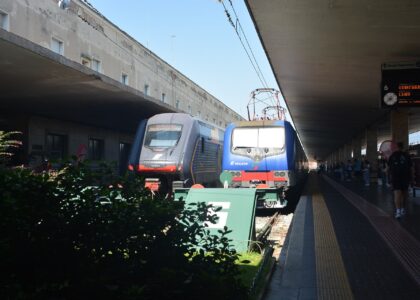
SMN is a “head station” (stazione di testa) — trains terminate here rather than passing through. This means platforms run dead-end into a covered concourse called the galleria di testa; trains arrive and back out the way they came.
Station Orientation: Where Things Are
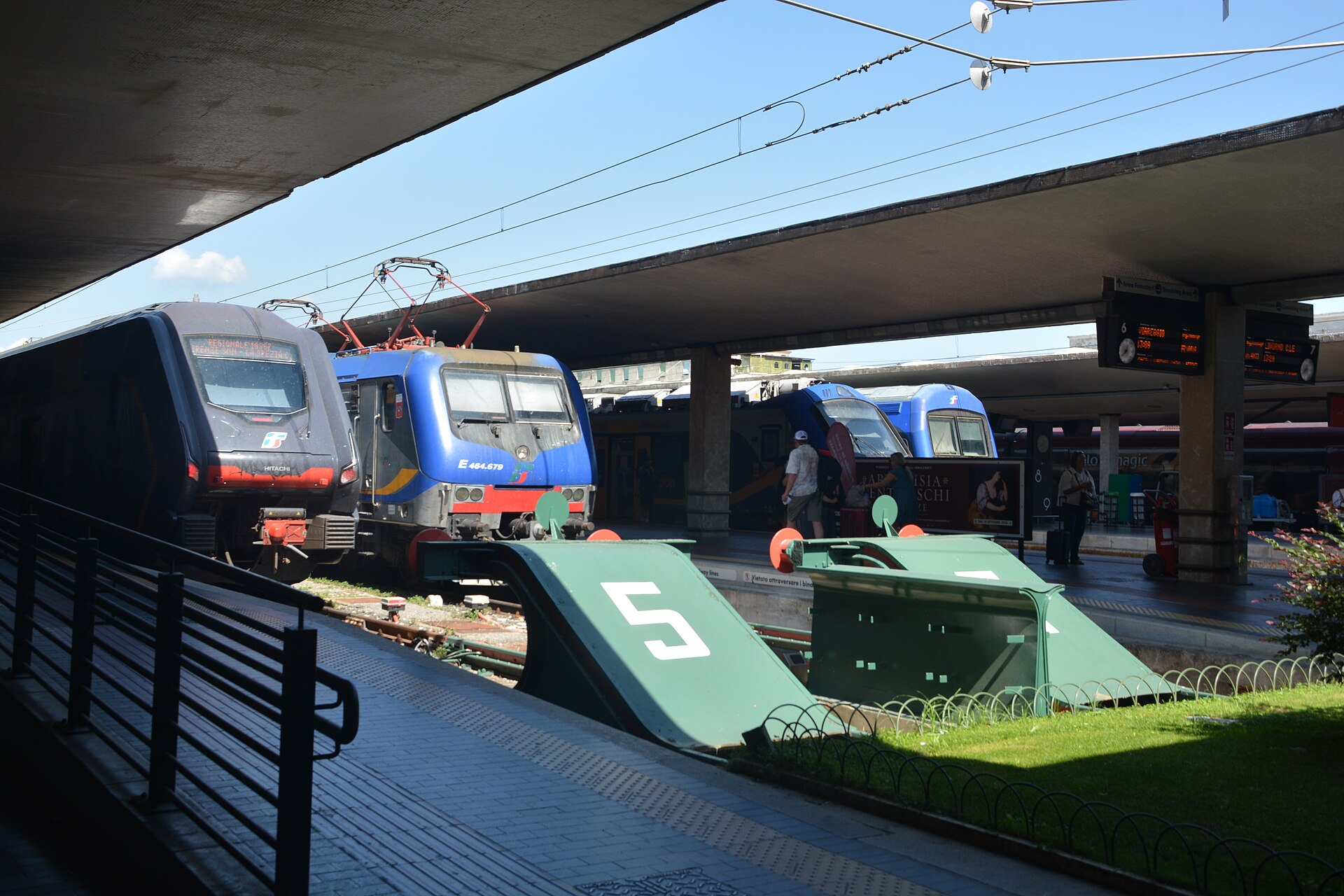
The main concourse runs east-west with the platform heads facing east. Working from the platforms back toward the city:
- Platforms (Binari) 1–16 — under the covered train hall, where trains arrive; platforms 17 and 18 extend beyond platform 16. Departure boards posted overhead.
- Galleria di Testa — the wide cross-corridor at platform ends with shops, ticket offices, lockers, and exits.
- Galleria Centrale — perpendicular to the platforms, with the original 1930s ticket hall still in use (now mainly tourist-information and exhibitions).
- Atrio Partenze (departure hall) — at the south end, with seating and electronic departure boards.
- Atrio Arrivi — near the platform exits.
- Piazza della Stazione — the main exit onto the public square outside, with bus stops, taxi rank and the T2 tram stop (Unità, by the station).
The station has multiple street-level exits — the main one opens onto Piazza della Stazione (with taxis and buses), the side exits onto Via degli Orti Oricellari and Via Valfonda. Most tourists use only the main exit.
Buying Train Tickets at SMN

- Trenitalia ticket counters — staffed sales desks for every Trenitalia service. Long lines at peak times.
- Italo ticket counters — separate from Trenitalia; smaller area near the platforms.
- Self-service vending machines (Trenitalia) — Italian, English, French, German, Spanish. Accept cash, cards and contactless.
- Italo self-service machines — similar, smaller area.
- Trenitalia and Italo mobile apps — buy and validate tickets entirely on phone, no station queue needed.
- Third-party kiosks (Trainline, Omio) — at some stations but mostly mobile-app based now.
For Frecciarossa or Italo high-speed trains, advance booking via the official websites or apps is dramatically cheaper than walk-up — €15–20 instead of €70–90. Same-day Frecciarossa walk-up at the station ticket counter is the most expensive option.
For regional trains (Pisa, Lucca, Siena, smaller Tuscan stops), fares are set by distance (€9.80 to Pisa Centrale and €10.80 to Siena in second class; the bus up into Siena’s centre is a separate ticket) — there’s no need to book ahead, and walk-up at the station is fine.
Station Services & Amenities
Left Luggage (Deposito Bagagli)
- KiPoint (booked through KiBag) — the station’s official luggage storage, inside the station along Platform 16, with a second entrance from via Valfonda. From €6. Open daily 07:00–21:00.
- Bounce — third-party luggage network with partner shops and cafés around the station and centre. Prices vary by location and bag, with listings near the station from €3.50 per day in October 2026; book online via bounce.com or app.
- Stasher — similar to Bounce, with Florence listings from €1.49 per bag per day; rates depend on the location.
- Hotel storage — most central hotels store luggage free for guests on check-in/check-out days.
Food & Shopping
- Food court — McDonald’s, Italian fast-food chains, panini bars, gelato.
- Conad supermarket — useful for travel snacks, water, basics.
- La Feltrinelli bookshop — Italian and English bestsellers, travel guides, magazines.
- Tabaccheria for tickets, stamps, lottery, public transport tickets.
- Pharmacy on the ground floor of the station concourse (Farmacia Comunale 13).
- Public toilets — in the station, accessible toilets included.
- Money exchange — multiple currency exchange counters; rates are poor compared to bank ATMs.
Wi-Fi & Tech
Free public Wi-Fi (FS_Wifi) operates throughout the station — register a phone number to access. Charging stations available at platform-adjacent waiting areas. Cellular signal is generally strong (Italian carriers TIM, Vodafone, Iliad all serve the station).
Connecting from SMN to the Centre
Most arriving travellers walk to their hotel — SMN is within easy walking distance of the Cathedral. Other options:
- Walking — main exit through Piazza della Stazione, then Via Panzani straight to the Cathedral. A short, direct route.
- T1 tram — to Cascine Park, Careggi hospital, or western suburbs. €2.00 single ticket, valid 90 minutes.
- T2 tram — to Florence Airport (FLR Peretola). €2.00 urban ticket, about 20 minutes.
- Bus 14 — runs from Santa Maria Maggiore out to Il Girone and via Rocca Tedalda, on the city’s eastern edge.
- Bus 22, 23 — outer neighbourhoods.
- Taxi rank — outside the main exit. Metered fares €5–14 for typical centre destinations.
The taxi rank is regulated and reliable. Drivers won’t usually quote a flat rate for short city trips — meter rate is fine. Tip by rounding up to the nearest euro.
Secondary Florence Stations
Florence has several smaller train stations beyond SMN:
- Firenze Campo di Marte — secondary station in the north-east of the city. Check the arrival station on your ticket and in the live timetable, as a train calling here rather than at SMN leaves you outside the centre. Inconvenient for tourists — €10–15 taxi or 25-minute walk to centre.
- Firenze Rifredi — northern Florence, mostly regional and Frecciarossa direct services. Useful if your Florence accommodation is in Rifredi/Novoli.
- Firenze Statuto — north-central, secondary regional stops. Rarely used by tourists.
- Firenze Cascine — minor stop on western city; rarely used.
When booking high-speed trains, always check whether the train stops at SMN (“Firenze Santa Maria Novella”) or Campo di Marte (“Firenze Campo di Marte” or “Firenze CdM”). The 10-minute travel-time saving at Campo di Marte is more than offset by the 25-minute extra journey to the centre afterward. Pick SMN unless your hotel is specifically near Campo di Marte.
Arriving at SMN: First Steps
The typical sequence after disembarking your train:
- Walk along the platform toward the head of the station (the wide cross-corridor with shops)
- Validate ticket if it was a regional train (high-speed tickets don’t need validation)
- Exit through the main concourse into Piazza della Stazione
- Take the main exit and orient yourself: the Cathedral is straight ahead via Via Panzani
- Pickpocket awareness — SMN is one of Florence’s main pickpocket zones; keep luggage between your feet, wallet in front pocket, no phone in back pocket
If you have heavy luggage and a hotel within 10 minutes’ walk, walking is fine — most central streets have pavement smooth enough to roll suitcases. If you have heavy luggage and an Oltrarno destination (15+ minutes’ walk including Ponte Vecchio), a taxi is worth €10–14.
Departing from SMN: Pre-Travel Workflow
Plan to arrive at SMN 15–20 minutes before scheduled departure for high-speed trains, 10 minutes for regional. The actual workflow:
- Arrive at the station via taxi, tram, walk, or T2 from the airport
- Check the departure board (large electronic boards in the main concourse) and listen for announcements — your train and platform number appear there before departure
- Collect or print your ticket if needed; mobile QR-code tickets work fine
- Walk to the assigned platform (binario)
- Validate the ticket if it’s a regional train (validate at the small yellow validator on the platform)
- Board the train; find your assigned seat for high-speed trains, any seat for regional
- Stow luggage at end-of-carriage racks (large suitcases) or overhead racks (carry-ons)
Delays on Italian high-speed lines do happen: FS puts its high-speed punctuality at 77% within ten minutes for January–November 2025. Plan as if yours will leave on the dot all the same. Don’t be late.
SMN Station Pickpocket Awareness
Santa Maria Novella, like any major station, draws pickpockets — the dense crowds of arriving and departing tourists, distracted by luggage and unfamiliar surroundings, are textbook targets. Common tactics:
- Distraction at ticket machines — someone “helps” you with the unfamiliar machine while an accomplice removes valuables from a side pocket or open bag
- Crowded platform boarding — pickpockets work the boarding crush, particularly at high-speed train doors
- Lost-and-asking-for-help — the “I’m lost, can you help with this map?” approach with an accomplice working behind you
- The tampered baggage tag scam — someone points out a “smudge” or “torn label” on your suitcase to distract while another reaches for your pocket
Defence: Crossbody bag worn front-of-body, zipped pockets only, phone in zipped bag (never back pocket), keep luggage between your feet at machines and in seating areas. The Polfer (railway police) has a post in the station. Report any incidents immediately.
Late-Night & Early-Morning Service
SMN opens and closes with the first and last trains of the day, and services thin out late at night:
- Last Frecciarossa departures leave in the evening; check the Trenitalia timetable for your date
- First morning Frecciarossa at 06:00, to Naples via Rome, in the June–December 2026 timetable (check it runs on your date)
- Overnight trains are sparse: a 00:40 to Pisa runs on most days, and the first regional departures leave at 04:30 (not on holidays) and 04:32 daily; check your travel date
- Late tickets: buy in the Trenitalia or Italo app before you travel, so you are not relying on counter or machine access
- T2 tram to airport runs 05:00 to 00:30 (until 02:00 Friday/Saturday)
- Taxis wait outside the station at most times, though there are fewer late at night
- Pharmacy on the station’s ground floor, open 08:00–21:00
If you arrive at SMN after midnight on a regional or international late train, taxi to your hotel — buses and trams are limited, and walking with heavy luggage at 01:00 isn’t ideal. Late at night a taxi depends on which cars are free, so call one as your train pulls in rather than counting on the rank.
Accessibility
SMN is well-equipped for accessibility:
- Lifts and ramps on all platform entries — wheelchair-friendly throughout
- Sala Blu (Blue Room) — RFI’s assistance service for travellers with disabilities. Pre-book on +39 02 32 32 32 or at [email protected]; RFI’s booking rules set how much notice each time of day needs, so book as early as you can.
- Tactile path for visually impaired travellers leading from main exit through ticketing to platforms
- Accessible toilets in the station
- Audio announcements in Italian and English on all major departure/arrival information
- Accessible taxi service — Florence’s CO.TA.FI. (055 4242) operates wheelchair-accessible taxis on request
Should You Use Campo di Marte Instead?
Campo di Marte is a perfectly functional small station in the north-east of the city, away from the historic centre. Some travellers arrive here by accident (their Frecciarossa ticket lists “Firenze Campo di Marte” without making clear it’s not central). The reality:
- Only stop here intentionally if your hotel is in the Campo di Marte / Sant’Ambrogio area
- If you arrive here by accident: take a taxi to your hotel (€10–15) or walk 25 minutes to the centre
- Buses link Campo di Marte with the historic centre on the €2.00 urban single ticket; check the lines and stops on Autolinee Toscane’s site
- SMN, Florence’s principal station, remains the default for tourist travel
SMN Station Tips
Tip 1: Watch the departure boards and listen for announcements: your platform number goes up there before departure. Wait for it rather than heading to a platform on a guess.
Tip 2: The ticket hall of the 1935 station, designed by Michelucci’s Gruppo Toscano, is worth a 5-minute architectural detour — the building is one of the key works of Italian rationalism.
Tip 3: The “lounges” advertised at the station (Sala Frecciaclub, Italo Lounge) aren’t open to every traveller: entry comes with certain tickets or loyalty status, and both operators sell access (Trenitalia charges €25 for a single day in Florence; Italo sells it with Smart and Prima Business tickets). Everyone else waits in the public seating areas.
Tip 4: The station’s Conad supermarket is useful for travel snacks, water and basics before you board.
Tip 5: Avoid the currency exchange counters — the rates are poor. Use bank-branch ATMs in the historic centre (Intesa Sanpaolo, BNL, Unicredit) instead.
Tip 6: The Polfer (railway police) is present in the station — report any pickpocket or scam incidents straight away for the police report needed by your travel insurance.
Tip 7: The KiPoint luggage office opens daily 07:00–21:00, so plan drop-off and collection inside those hours. Bounce/Stasher partner locations are the alternatives.
Florence Train Station FAQ
Which Florence station should I use?
Santa Maria Novella (SMN) — the central station, within walking distance of the Cathedral. Use Campo di Marte only if your hotel is specifically in the eastern Sant’Ambrogio/Campo di Marte area.
How far is SMN from the Cathedral?
An easy walk via Via Panzani. The route is straightforward, well-lit and pedestrian-friendly with smooth pavement most of the way.
Where can I leave my luggage at the Florence station?
KiPoint (booked through KiBag), the official station luggage office along Platform 16, from €6 and open daily 07:00–21:00. Or third-party services like Bounce and Stasher at partner businesses around the station, where rates vary by location: Bounce from €3.50 per day, Stasher from €1.49 per bag per day.
Where can I buy train tickets at SMN?
Trenitalia and Italo ticket counters, self-service vending machines (multilingual), or via the official Trenitalia and Italo mobile apps. For Frecciarossa or Italo high-speed, advance online booking is dramatically cheaper than walk-up.
Is Santa Maria Novella station safe?
Generally safe, but as at any busy station, pickpockets work the crowds. Crossbody bag worn front-of-body, zipped pockets only, phone in zipped bag (never back pocket), keep luggage between your feet at machines and in seating areas. The Polfer (railway police) is present in the station.
What facilities are at SMN station?
Ticket counters and vending machines, food court, Conad supermarket, La Feltrinelli bookshop, pharmacy (Farmacia Comunale on the ground floor, 08:00–21:00), public and accessible toilets, free Wi-Fi, T2 airport tram, taxi rank, Polfer railway police, accessible taxi service, and the Sala Blu disability assistance.
Is the Florence station open 24 hours?
No. Its opening and closing hours follow the first and last trains of the day. A handful of trains run in the small hours (a 00:40 to Pisa on most days, regional departures from 04:30), so check the timetable for your date. Taxis wait outside most of the time, with fewer around late at night.
How do I get from SMN to Florence Airport?
T2 tram from the Unità stop (by the station) directly to “Peretola Aeroporto.” €2.00 single ticket (valid 90 minutes), about 20 minutes. Trams run from about 05:00 to 00:30, until 02:00 on Friday and Saturday nights; on school-term weekdays they come every 4–5 minutes in the daytime, while late at night the gap can reach 22 minutes, so check GEST’s timetable for your direction.
Santa Maria Novella is Florence’s main gateway — a working transport hub that doubles as a 1930s architectural landmark. Allow 15–20 minutes’ arrival buffer for high-speed trains, validate regional tickets, watch your bag in crowds, and you’ll move in and out smoothly. The station’s compact layout, multilingual signage and quick walk to the Cathedral make Florence’s rail experience one of the most tourist-friendly in Italy.