This article contains advertising. Booking links on this site can be turned into paid links automatically by our partner Travelpayouts: if you book through one, we earn a commission from the provider, at no extra cost to you. It never affects what we recommend. Affiliate disclosure
The Florence Baptistery—Battistero di San Giovanni—is the oldest building in the Duomo complex and one of the most important Romanesque structures in Italy. Its three sets of bronze doors, especially Lorenzo Ghiberti’s Gates of Paradise (1425-1452), are foundational works of Renaissance sculpture; its 13th-century Byzantine-style mosaic dome rivals anything in Italy. For nearly seven centuries, every Florentine baptized Catholic—including Dante—received their first sacrament inside this small octagonal building. This guide covers the Baptistery’s architecture, the three doors (and the famous 1401 competition), the mosaics, tickets, hours, and how to plan a visit.
Ghiberti’s competition win here is often taken as the opening move of the Renaissance, and the losing panel by Brunelleschi hangs in the Bargello. The Baptistery is one of the five Duomo complex tickets, and the panels outdoors today are copies — the originals are in the cathedral museum.
The Baptistery is on all three Duomo passes, including the cheapest — our Florence Duomo tickets guide explains what each tier covers and why the €15 Ghiberti Pass is quietly the best value on the square.
Baptistery Quick Facts
| Detail | Information |
|---|---|
| Official name | Battistero di San Giovanni |
| Dedicated to | St. John the Baptist (patron saint of Florence) |
| Built | 11th-13th centuries (some claims of 4th-century origin) |
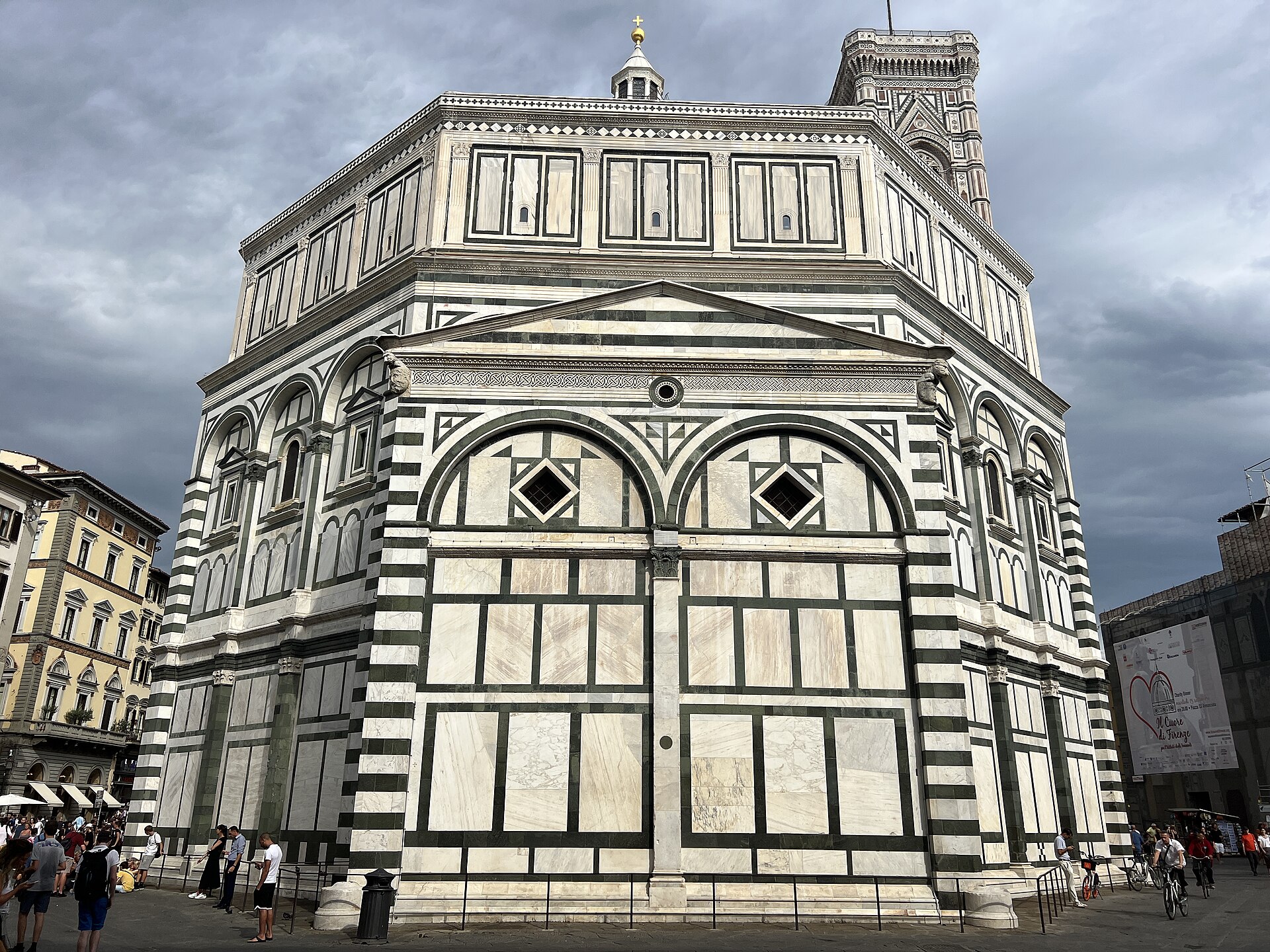
| Shape | Octagonal, marble-clad |
| Three doors | South (Andrea Pisano, 1330-1336), North (Ghiberti, 1403-1424), East (Ghiberti’s Gates of Paradise, 1425-1452) |
| Dome mosaics | 13th century, over 1,000 sq m |
| Tickets | Included in Giotto Pass (€20), Brunelleschi Pass (€30), or Ghiberti Pass (€15) |
| Hours | Mon-Sat 8:15-19:30; Sun 8:15-13:30 |
A Mysterious Origin
How old is the Florence Baptistery? Florentine tradition long held that it was originally a Roman temple of Mars, converted to Christian use in the 4th or 5th century. Modern archaeology has not fully confirmed this, but it has revealed Roman foundations beneath the building—ancient walls of a 1st-century Roman public structure (possibly a public bath or a small temple) on which the medieval baptistery was built.
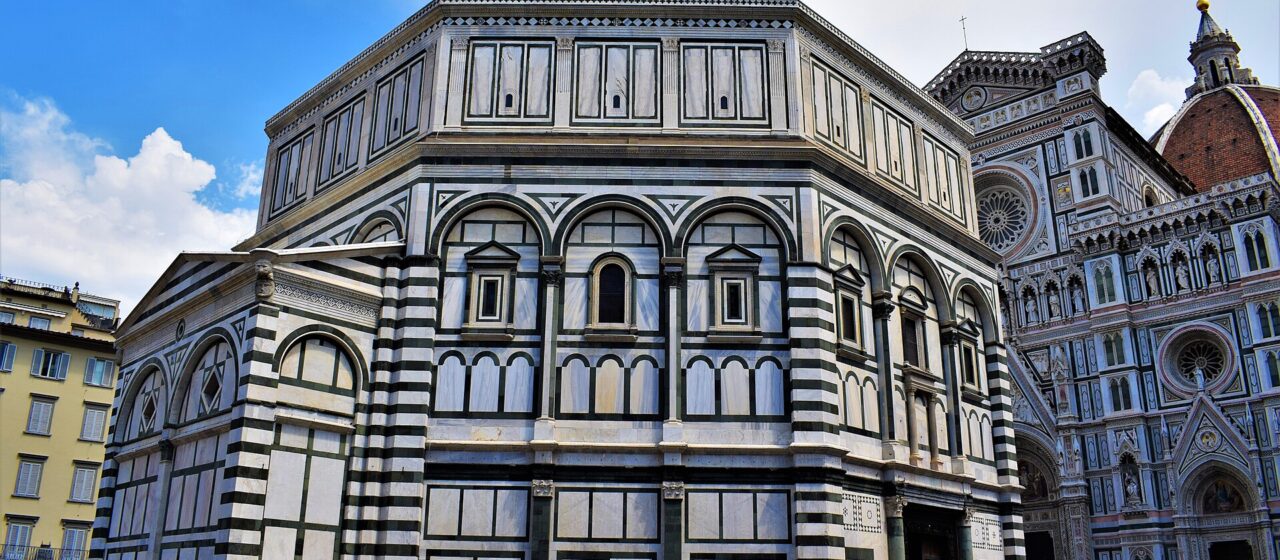
The building we see today—an octagonal structure of about 25 meters in diameter, clad in green Prato marble and white Carrara marble in geometric patterns—was largely complete by the 11th century. The polychrome marble exterior was extended through the 13th century. Above the dome, the lantern was added in the 13th-14th centuries.
The Baptistery served as Florence’s only baptistery until the 19th century. Catholic Florentines (and Catholics from satellite towns) brought their newborn babies here for the sacrament of baptism. Dante was baptized here in 1265; his godfather was the famous goldsmith Brunetto Latini. The font Dante was baptized in survives—reduced in size and modified over the centuries, but the same building.
The Three Doors
The Baptistery’s most famous feature is its three sets of bronze doors. Each was a major commission and each represents a milestone in Italian sculpture:
South Doors (Andrea Pisano, 1330-1336)
The oldest doors face south, toward the cathedral facade. Andrea Pisano (no relation to the cathedral pulpit’s Pisanos) cast them in 28 panels—20 scenes from the life of John the Baptist plus 8 panels with allegories of the cardinal and theological virtues. The style is late Gothic, with elegant figures in shallow relief. The doors are an important early example of European bronze casting; before Pisano, bronze doors of this scale were rare in Italy.
North Doors (Lorenzo Ghiberti, 1403-1424)
The famous 1401 competition for the second set of doors marks the conventional starting point of the Italian Renaissance. The Florentine wool merchants’ guild (the Calimala) held a public contest to design new doors. Among the seven competitors were Lorenzo Ghiberti and Filippo Brunelleschi. Each was asked to submit a bronze panel depicting the Sacrifice of Isaac. The two finalists were Ghiberti and Brunelleschi—both panels survive and are displayed in the Bargello Museum, allowing direct comparison.
Ghiberti won. He was 23 years old and beat the slightly older Brunelleschi by a single vote (some accounts say they were declared joint winners but Brunelleschi refused to share the commission). Brunelleschi left Florence in frustration and traveled to Rome with Donatello to study Roman architecture—the years that ultimately produced the Brunelleschi dome.
Ghiberti’s North Doors took 21 years to complete. They depict 28 panels: 20 New Testament scenes plus 8 panels with Evangelists and Church Fathers. The style is more naturalistic than Pisano’s earlier doors—the figures have more weight, more individual character, and the architectural backgrounds are more developed. The doors are positioned on the north side of the Baptistery, facing the side of the cathedral.
East Doors—The Gates of Paradise (Ghiberti, 1425-1452)
Pleased with the North Doors, the Calimala guild commissioned Ghiberti to make a third set—the East Doors facing the Duomo. He worked on these from 1425 to 1452, supervising a workshop that included his sons and many of the leading sculptors of the next Renaissance generation (Donatello, Masolino, Uccello all worked under or alongside Ghiberti at various times).
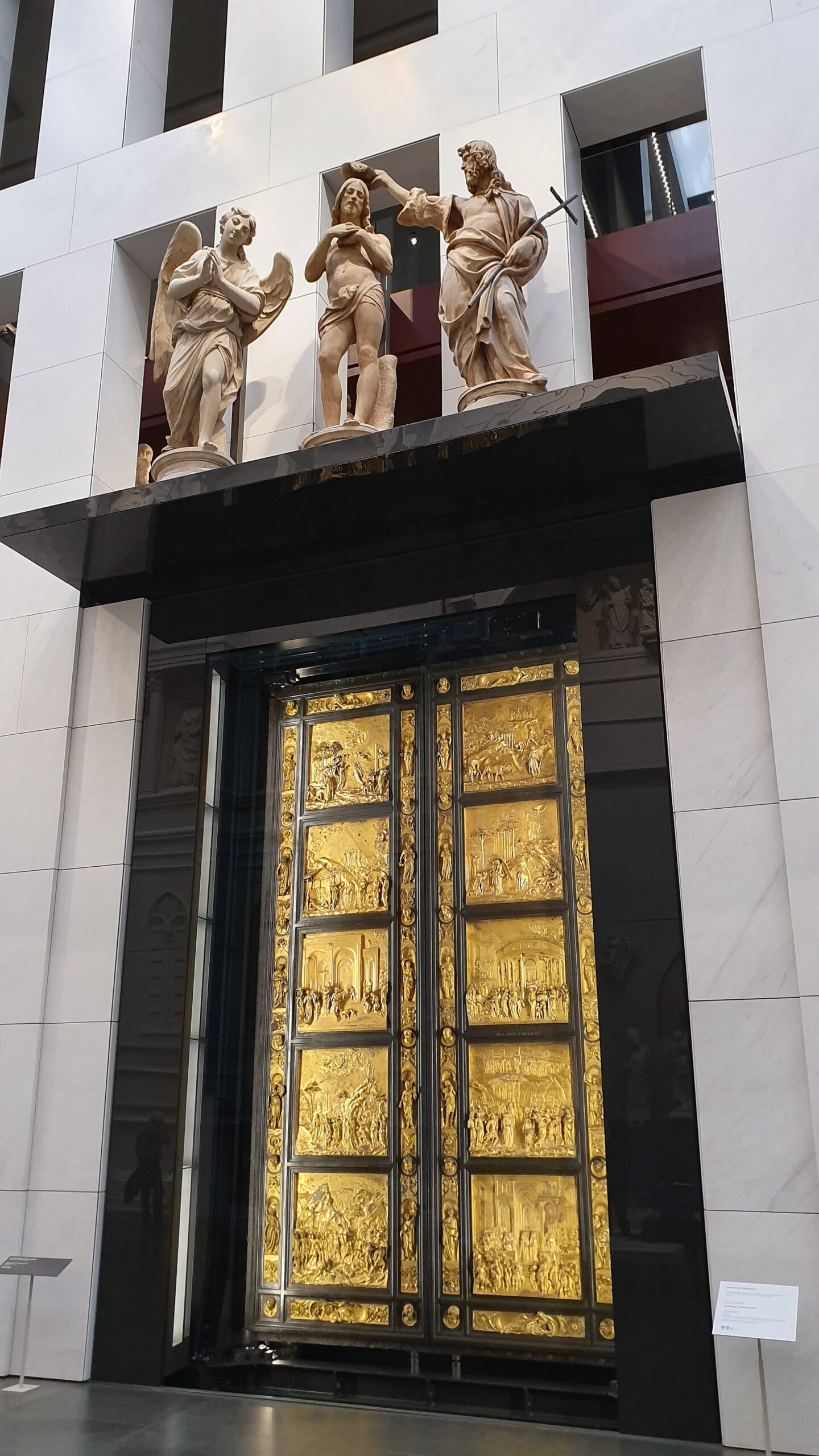
Ghiberti changed the format: instead of 28 small Gothic-frame panels, he made just 10 large square panels. Each depicts an Old Testament scene in deep relief with multiple narrative episodes per panel. The style is fully Renaissance—linear perspective is rigorously applied, figures have classical proportions, architectural backgrounds extend to convincing distance, and many panels include direct portraits of Florentine contemporaries. Ghiberti included a self-portrait among the 24 small bust medallions framing the panels.
According to Vasari, Michelangelo declared these doors so beautiful that they “deserved to be placed at the entrance to Paradise.” The nickname stuck. They were renamed the Porta del Paradiso—the Gates of Paradise—and remained on the Baptistery’s east side for nearly five centuries. In 1990 the doors were removed for restoration after damage from the 1966 flood, pollution, and weathering. The originals are now in the Cathedral Museum; precise gilded bronze copies (cast from gypsum molds made in the 1940s-1950s) are on the Baptistery exterior since 1990. The originals can be seen in the museum.
The Gates of Paradise: The 10 Panels
The 10 panels depict scenes from Genesis and the early books of the Old Testament. From top to bottom, left then right:
- Adam and Eve (Creation, Temptation, Expulsion)
- Cain and Abel (and the murder)
- Noah (the Ark, drunkenness)
- Abraham (sacrifice of Isaac)
- Isaac (Esau and Jacob)
- Joseph (sold into slavery, brothers)
- Moses (receiving the Tablets)
- Joshua (fall of Jericho)
- David (defeating Goliath)
- Solomon (meeting the Queen of Sheba)
Each panel is a small narrative landscape. Take a few minutes to study individual panels—the Joseph panel is particularly admired for its spatial complexity, with multiple narrative episodes arranged in a continuous architectural setting. The Solomon panel shows Renaissance perspective at its most ambitious, with the Queen’s procession converging into deep architectural recession.
Inside the Baptistery
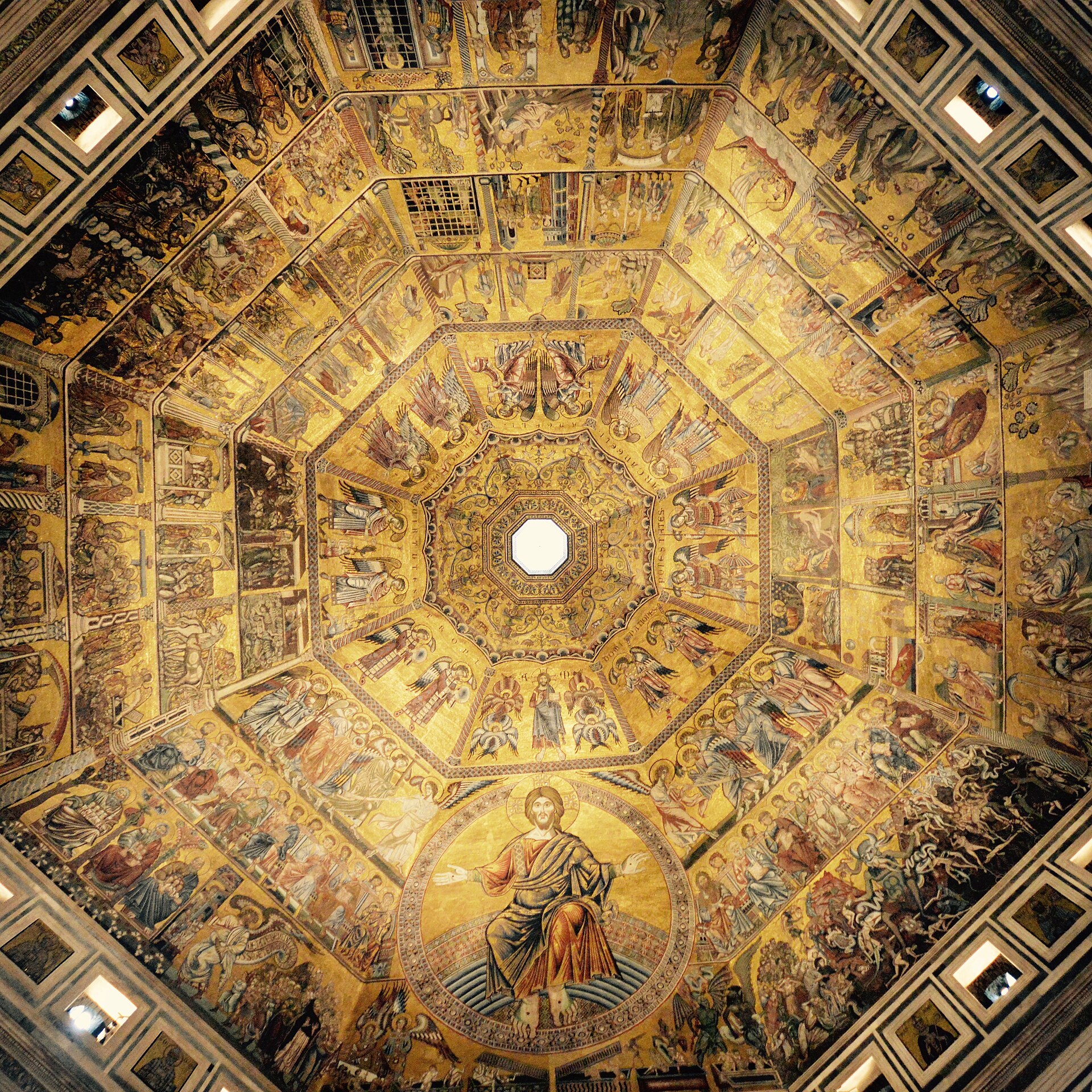
The Baptistery interior is small (only about 25 meters across) but spectacular. The octagonal space is centered on an octagonal baptismal font dating to the 13th century. The walls are covered in intricate marble decoration; the floor is patterned in geometric inlay.
The most extraordinary feature is the mosaic dome—a complete program of mosaic decoration covering over 1,000 square meters. The mosaics were created in the 13th century by a series of artisans, partly trained in Venice (which preserved Byzantine mosaic traditions). The composition shows:
- The huge Christ in Majesty on the eastern segment, eight meters tall, raising his right hand in blessing and holding an open book.
- The Last Judgment below Christ, with the saved on his right and the damned being dragged into a horrifying hell mouth on his left.
- Genesis stories (Creation, Adam and Eve, Cain and Abel, Noah) in concentric bands.
- Lives of John the Baptist and Joseph in further bands.
- Choirs of angels and biblical figures throughout.
Lie back on a bench and look up. The mosaics are best appreciated slowly. The hell scene with its monstrous demons is one of the most memorable and frightening images in Florence. The whole composition is set against gold-leaf backgrounds that catch and reflect light, giving the dome a luminous quality. In the Middle Ages, when this was the only large interior Christian space many Florentines would ever see, the impact must have been overwhelming.
Other interior features: the medieval pavement (some of which is original), the tomb of Antipope John XXIII (Baldassare Cossa, deposed 1415, the only papal tomb in Florence) by Donatello and Michelozzo (1419-1428), and various smaller altars and decorations along the walls.
Tickets and Hours
The Baptistery is included in all three of the Opera del Duomo passes:
- Brunelleschi Pass (€30): Dome + Bell Tower + Baptistery + Crypt + Cathedral Museum.
- Giotto Pass (€20): Bell Tower + Baptistery + Crypt + Cathedral Museum.
- Ghiberti Pass (€15): Baptistery + Crypt + Cathedral Museum only.
The Ghiberti Pass is the cheapest option for visitors who want to focus on the Baptistery and Cathedral Museum (which holds the original Gates of Paradise) without doing climbs. It’s particularly suitable for travelers with mobility issues or those visiting in a single day.
Hours: Monday-Saturday 8:15-19:30; Sunday 8:15-13:30. Closed January 1, Easter Sunday, June 24 (Festa di San Giovanni, the Baptistery’s saint’s day), and December 25.
The Baptistery does not require a timed reservation slot—your pass is valid for any time during opening hours. This makes it more flexible than the dome or bell tower climbs.
Tickets: buy online at duomo.firenze.it or via the official app. The combined ticket office is at Piazza San Giovanni 7 (opposite the Baptistery). Cash is not accepted; electronic payment only.
Best Time to Visit
The Baptistery is small and gets crowded in summer. Best times to visit:
- Early morning (8:15-9:30): First entry of the day, smallest crowds, good light through the lantern.
- Late afternoon (16:00-18:00): Light angles change in the dome mosaics; the gold leaf catches different reflections than in the morning.
- Avoid: 11:00-15:00 in summer when groups overlap.
The Baptistery is also magical at night when illuminated from outside. The lights catch the marble in ways that make the building feel more sculptural. You can’t enter at night, but a walk through Piazza San Giovanni after 21:00 is worth it.
Combine With Cathedral Museum
If you want to fully appreciate the Gates of Paradise, plan to visit both the Baptistery (where the replicas are on the building exterior) and the Cathedral Museum (where the originals are displayed under climate control). The museum is at Piazza del Duomo 9, just behind the Cathedral, and is included in all three passes.
In the museum, the Gates of Paradise are displayed in a dedicated hall. You can stand within feet of the panels, study individual figures and tools used in their making, see Ghiberti’s signature panels, and read the museum’s detailed conservation history. Allow at least 30 minutes for the doors alone, plus another 30-60 minutes for the rest of the museum.
Practical Tips
- Time needed: 30-45 minutes for the Baptistery interior, longer if studying the doors closely from outside.
- Photography: Allowed without flash inside. Tripods not permitted. Smartphone cameras handle the dim interior reasonably; the dome mosaics are most striking in person and don’t always photograph well.
- Dress code: Standard Florence church code—shoulders covered, knees covered, hats off. The dress code is enforced.
- Accessibility: The Baptistery is wheelchair-accessible at ground level via a side ramp. The interior is one level. The Cathedral Museum is fully accessible with elevators.
- Children: Welcome and free under 6. The dome mosaics fascinate kids—particularly the hell scene with its monsters.
- Combining with cathedral: Plan your route. The cathedral interior is free but only opens 10:15 (Sunday 13:30); the Baptistery opens at 8:15. Visit the Baptistery first, then the cathedral when it opens.
Frequently Asked Questions
Are the Gates of Paradise on the Baptistery the originals?
No. The doors on the Baptistery exterior are precise gilded bronze copies installed in 1990. The originals were removed for protection after damage from the 1966 flood, pollution, and weathering. The originals are now displayed in the Cathedral Museum (Museo dell’Opera del Duomo) under climate control.
Why is it called the Gates of Paradise?
According to Giorgio Vasari’s Lives of the Artists, Michelangelo declared the doors so beautiful that they “deserved to be placed at the entrance to Paradise.” The name stuck and became the standard term for these specific doors.
How much does it cost to enter the Baptistery?
The Baptistery is included in all three Opera del Duomo passes: Ghiberti Pass €15 (cheapest, Baptistery + Crypt + Museum), Giotto Pass €20 (adds Bell Tower), and Brunelleschi Pass €30 (adds dome climb). You cannot buy a Baptistery-only ticket.
What are the Baptistery hours?
Monday-Saturday 8:15-19:30; Sunday 8:15-13:30. Closed January 1, Easter Sunday, June 24 (the Baptistery’s patron saint day), and December 25.
How old is the Florence Baptistery?
The current octagonal building largely dates to the 11th-13th centuries. Roman foundations beneath it suggest a much older structure (possibly 1st-century AD) on the site, but the building visitors see today is essentially medieval.
Was Dante baptized here?
Yes. Dante Alighieri was baptized in this Baptistery in 1265. For centuries, every Catholic Florentine received their baptism here—it was the only baptistery in the city. Dante refers to “il mio bel San Giovanni” (my beautiful Saint John) in the Divine Comedy.
What’s inside the Baptistery?
The interior features a 13th-century octagonal baptismal font, intricate marble pavement, the tomb of Antipope John XXIII (by Donatello and Michelozzo), and most importantly the spectacular 13th-century mosaic dome covering over 1,000 square meters with scenes of the Last Judgment, Genesis, and the lives of John the Baptist and Joseph.
How long do I need at the Baptistery?
Allow 30-45 minutes for a thorough visit including time looking at the door panels from outside (the replicas) and studying the mosaic dome inside. Add another 30-60 minutes if also visiting the Cathedral Museum to see the original Gates of Paradise.
Is the Baptistery wheelchair accessible?
Yes. The Baptistery has a wheelchair-accessible side entrance via a ramp. The interior is on a single level and fully accessible. The Cathedral Museum (where the original doors are displayed) has full elevator access.