This article contains advertising. Booking links on this site can be turned into paid links automatically by our partner Travelpayouts: if you book through one, we earn a commission from the provider, at no extra cost to you. It never affects what we recommend. Affiliate disclosure
Easter in Florence & the Scoppio del Carro Explained
Easter in Florence involves a thirty-foot eighteenth-century wagon full of fireworks, two pairs of white oxen, a mechanical dove fired down a wire from the high altar of the cathedral, and a crowd of several thousand people watching the whole apparatus explode in front of the Duomo at eleven in the morning. It is called the Scoppio del Carro, it has been going on in some form since the First Crusade, and almost nobody plans a trip around it. They should.
One of the great set pieces on the Florence festivals and events calendar — and it happens in the one square everybody visits anyway, which our Duomo complex guide covers in full.
Roughly one year in three, Easter falls in March and takes the cheapest month of the year with it — in 2027 it lands on the 28th, the same Sunday the clocks go forward. Our guide to Florence in March covers how to book around it.
Easter falls in April about two years in three, and when it does it sets the price of the whole month. Our guide to Florence in April covers the booking consequences, the 25 April holiday behind it and what to do in the days either side.
What Actually Happens
On Easter Sunday morning a wagon called the Brindellone — nine metres tall, painted, gilded, three centuries old and packed with fireworks — is dragged through Florence by two pairs of white oxen and parked in the gap between the Baptistery and the front doors of the cathedral.
Inside, Mass is under way. At the moment the choir reaches the Gloria, the Archbishop lights a rocket shaped like a dove — the colombina — on the high altar. It runs down a wire the length of the nave, out through the open central doors, across the piazza, and into the cart. The cart then explodes, continuously, for several minutes: catherine wheels, roman candles, mortars, smoke, the lot, twenty metres from a thirteenth-century marble facade in the middle of a city centre.
Then the dove is supposed to run back up the wire to the altar. If it does, cleanly, the harvest will be good and the year will go well. If it stalls halfway, the city takes note. That is the entire mechanism and it is, as a piece of civic theatre, unimprovable.
The short version
Easter Sunday, Piazza del Duomo, ignition at 11:00. Free, outdoors, no ticket. Be in position by 09:30 for anything resembling a view. It lasts about twenty minutes end to end, and the procession beforehand is worth as much as the explosion.
Dates and the Running Order
Easter moves. The Scoppio del Carro is always on Easter Sunday, which means:
| Year | Easter Sunday | Easter Monday (Pasquetta) |
|---|---|---|
| 2026 | 5 April | 6 April |
| 2027 | 28 March | 29 March |
| 2028 | 16 April | 17 April |
The programme is fixed year to year within a few minutes. The city publishes the exact timings and the road closures about a week beforehand, but the shape of the morning does not change:
| Time | What | Where |
|---|---|---|
| Sat 20:00 | Historical procession sets off for the church of the flints | Palagio di Parte Guelfa → Santi Apostoli |
| 07:30 | The Brindellone leaves its depot, drawn by the oxen | Via il Prato |
| 08:10 | Flag-throwers — the Bandierai degli Uffizi — perform | Piazza del Duomo |
| 08:20 | Procession of civic authorities sets off | Piazza di Parte Guelfa |
| ~10:00 | Cart in position, wire strung, crowd fills the piazza | Between Baptistery and cathedral |
| 11:00 | The colombina flies. The cart goes up. | Piazza del Duomo |
The oxen are the detail people remember. The cart is not motorised and never has been: it is pulled from Via il Prato, on the western edge of the centre, all the way to the Duomo, at the speed four oxen walk. That journey starts at half past seven and takes a couple of hours, and following it through waking, empty streets is genuinely a better experience than standing in the packed piazza waiting.
Follow the cart, do not wait for it
Almost everyone converges on Piazza del Duomo and stands still for ninety minutes. The better plan is to pick the cart up near Via il Prato at around eight, walk with it, and peel off into the piazza when it arrives — by which point you will have seen the oxen, the drivers, the costumes and the whole slow absurd procession at arm’s length, and you will still have half an hour to find a spot.
Where to Stand
Piazza del Duomo is not a large square and it is an awkward shape. The cart sits between the Baptistery and the cathedral doors, and the fireworks go upward and outward from there, so there is a substantial cleared safety zone that you cannot enter.
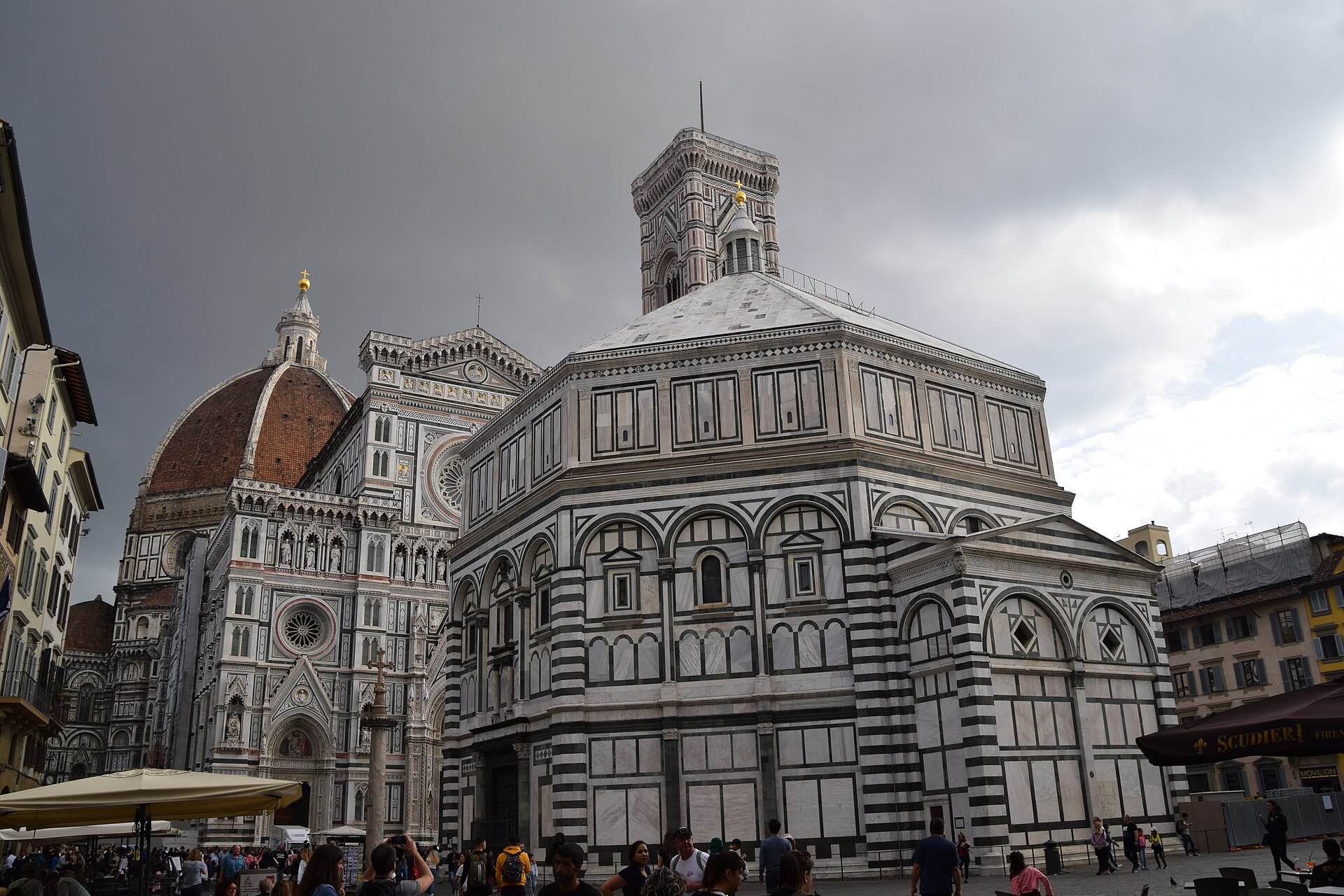
- Piazza San Giovanni, west of the Baptistery. The classic view, straight down the axis. Full by 09:30. This is where you stand if you want the photograph everyone takes.
- The north side, towards Via de’ Martelli. Better crowd flow, easier to get out of, still a clear line to the cart. This is the practical choice.
- Via dei Calzaiuoli end. You will see the smoke and hear everything and see very little of the cart. Avoid.
- A restaurant balcony or a hotel window. Some places on the piazza sell breakfast slots. Prices are what you would expect for a first-floor window over a firework display. If you are travelling with anyone who cannot stand for two hours in a crush, this is money well spent.
The other thing to know: it is extremely loud. Not festival loud — artillery loud, echoing off marble on three sides, for several minutes without a break. Take ear protection for children. Take it for yourself, honestly. And be aware that the crowd cannot easily disperse mid-event, so if you dislike being hemmed in, stand at the outer edge near a street you can leave down.
If you are up early anyway, the walk from Piazza della Repubblica to the Duomo at seven in the morning on Easter Sunday is one of the best half-hours in the Florentine year. Our guide to the best photo spots in Florence covers where the light lands at that hour.
Why Any of This Exists
The story runs back to 1099 and the First Crusade. A Florentine named Pazzino de’ Pazzi was, by the family’s account, the first man over the walls at Jerusalem. He was rewarded with three splinters of flint from the Holy Sepulchre, brought them home, and the city began using them to strike the sacred fire that relit every hearth in Florence on Easter morning.
The flints are still kept at the church of Santi Apostoli, a small, austere, very old church tucked away off Borgo Santi Apostoli that almost no visitor finds. They are still used. The fire is still struck from them, still carried to the cathedral, and still what lights the colombina. The whole thing has been running, with interruptions for plague, war and one pandemic, for well over nine hundred years.
The Pazzi paid for the cart and ran the ceremony for centuries. They are better known now for the Pazzi Conspiracy of 1478, the attempt to murder Lorenzo and Giuliano de’ Medici during Mass in this same cathedral, which succeeded in killing Giuliano and ended with the family destroyed, exiled and its name chiselled off buildings. The cart kept going regardless. Florence has always been better at institutions than at grudges — eventually.
The Brindellone Itself
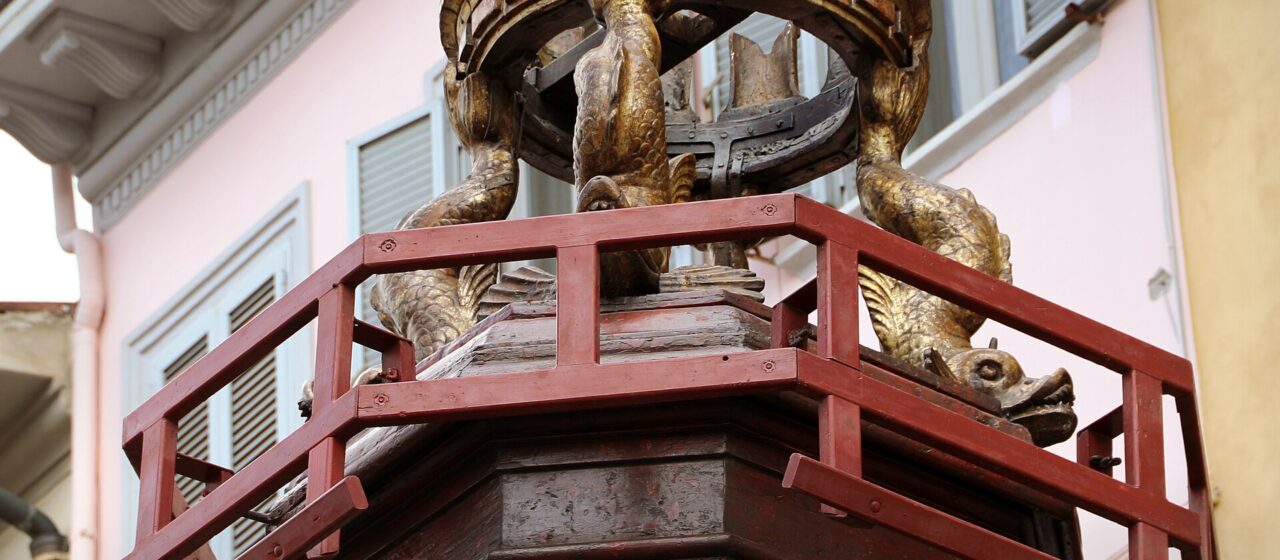
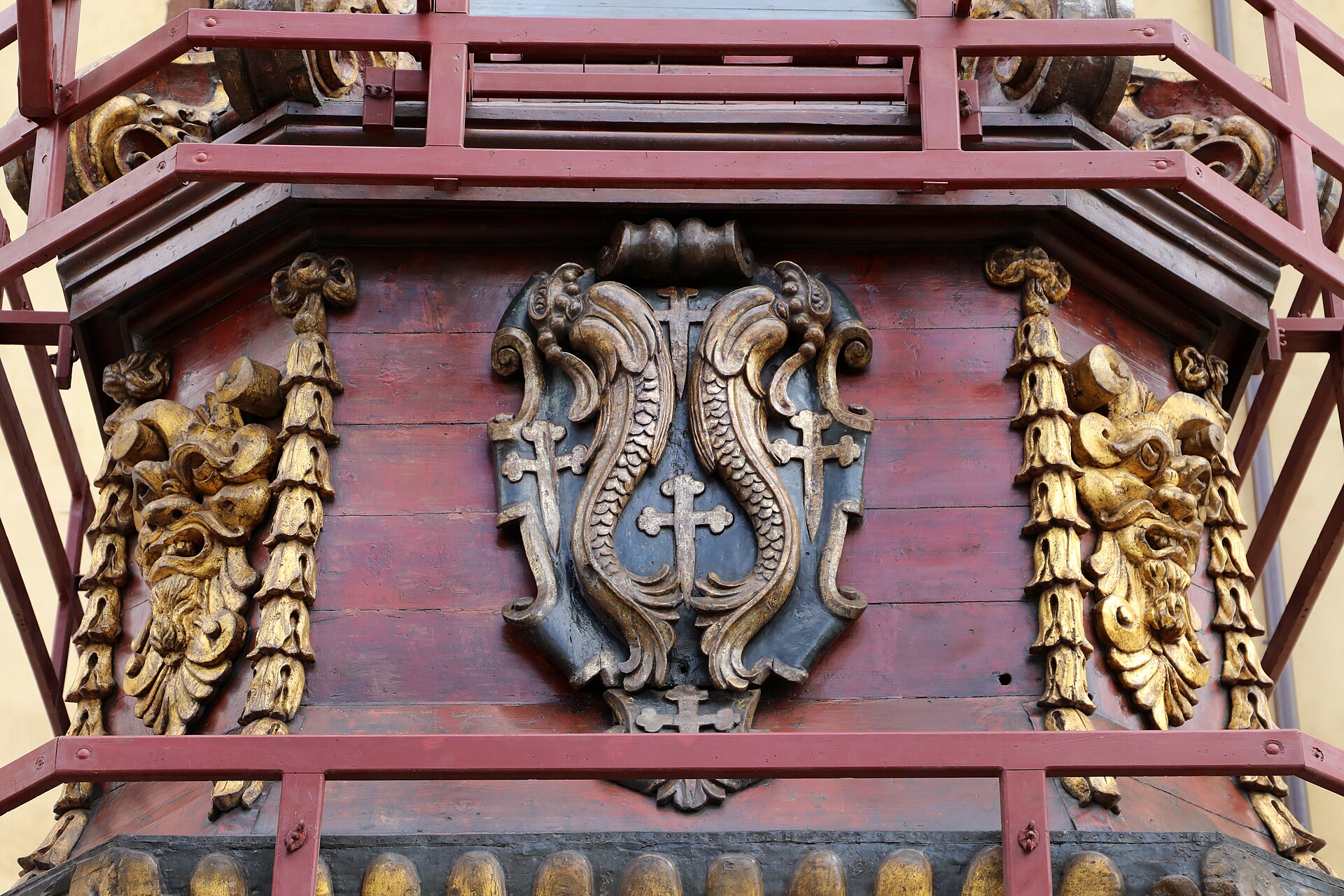
The cart is the reason to look closely. It is not a float built for the occasion — it is a permanent, elaborate, three-tiered wooden structure that has been repaired and repainted rather than replaced. Tradition dates it to 1494, though most of the visible decoration looks to be from around 1590 to 1610: gilded dolphins, grotesque masks, swags of carved fruit, the quarter emblems of the city, and a crenellated golden crown on top.
“Brindellone” is Florentine dialect and not flattering — roughly, a large shambling thing that goes about in rags. The name comes from the way it lurches when the oxen pull it. Florentines have called it that for centuries and use the affectionate register when they do.
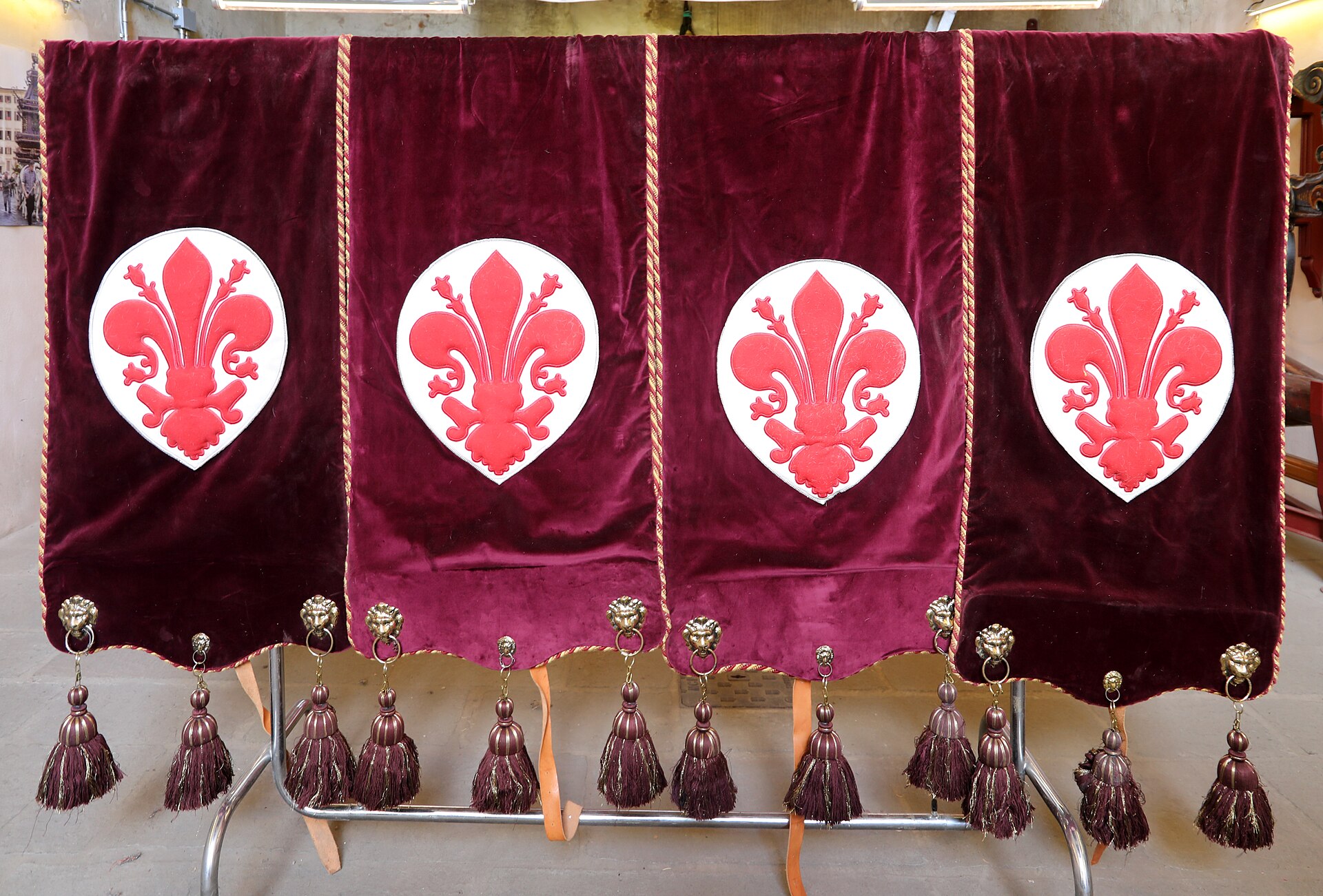
The cart lives the rest of the year in a garage on Via il Prato, which is not a museum and is not routinely open, though it is occasionally opened for visits in the week before Easter. If you are in Florence in Holy Week, ask at the tourist office — seeing it standing still, indoors, at close range, is a completely different experience from seeing it burn.
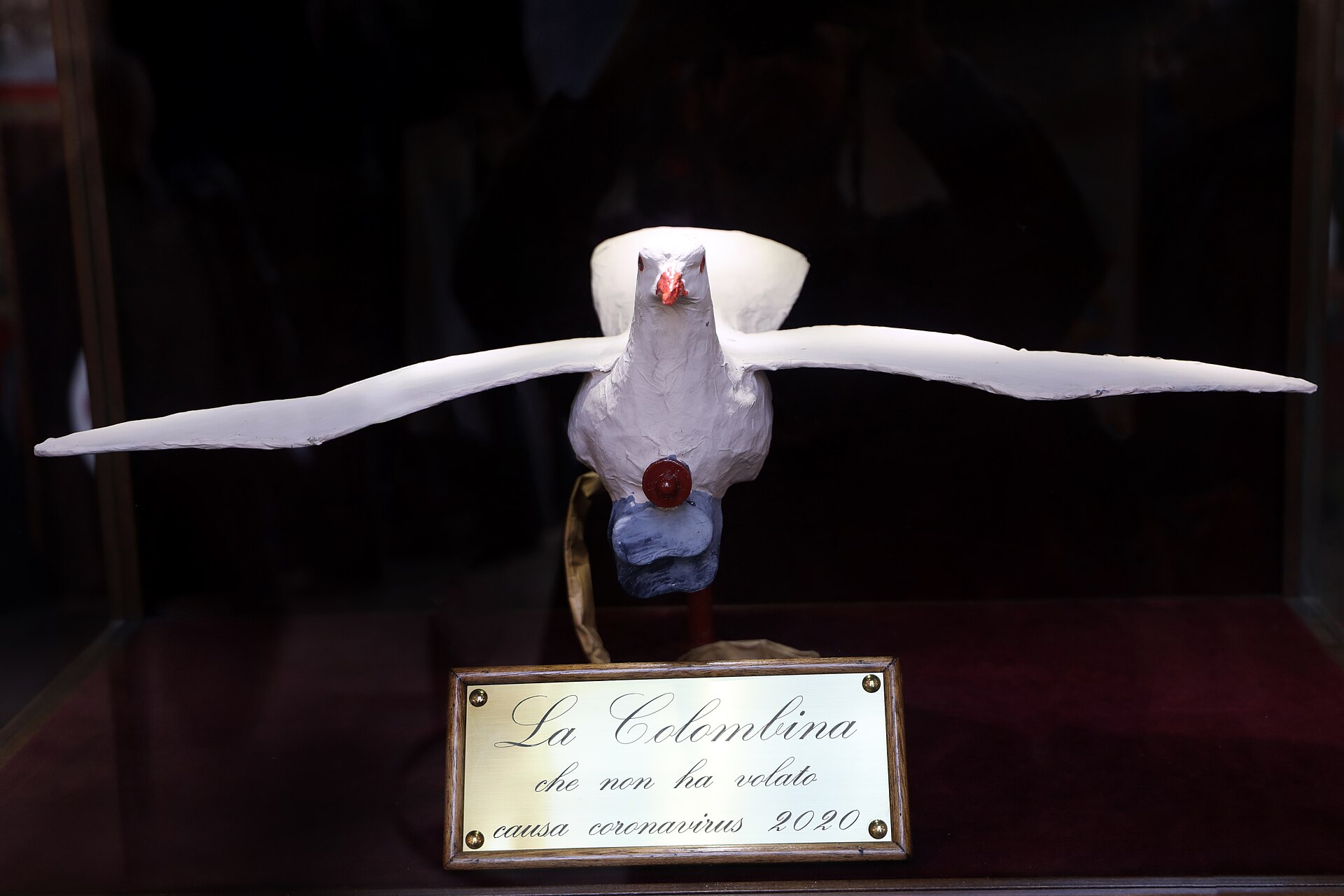
The colombina is rebuilt every year: a rocket in a dove’s shape, with a fuse, that runs on a wire strung the length of the nave and out into the piazza. It has to leave the altar, reach the cart, ignite it, and come back. The photograph above is the one from 2020, which never left the church, kept and labelled — a small, dry, very Florentine piece of record-keeping.
Holy Week: The Rest of the Programme
Easter Sunday takes the attention, but the preceding week has its own texture and far fewer people watching.
- Palm Sunday. Olive branches rather than palms, blessed and handed out at every church in the city. You will see people carrying them all day.
- Holy Thursday. The sepolcri — altars of repose, dressed with flowers and candles — are set up in churches across the centre, and the tradition is to walk between them in the evening, visiting an odd number. It is quiet, largely local, and one of the better free evenings in the Florentine year.
- Good Friday. Processions and Via Crucis services, some of them outdoors. Note that Good Friday is not a public holiday in Italy — shops, offices and museums run normally, which surprises visitors from northern Europe.
- Holy Saturday, 20:00. The Corteo della Repubblica Fiorentina walks from the Palagio di Parte Guelfa to Santi Apostoli for the striking of the fire. A hundred-odd people in Renaissance costume, in the dark, with almost no audience. Go to this.
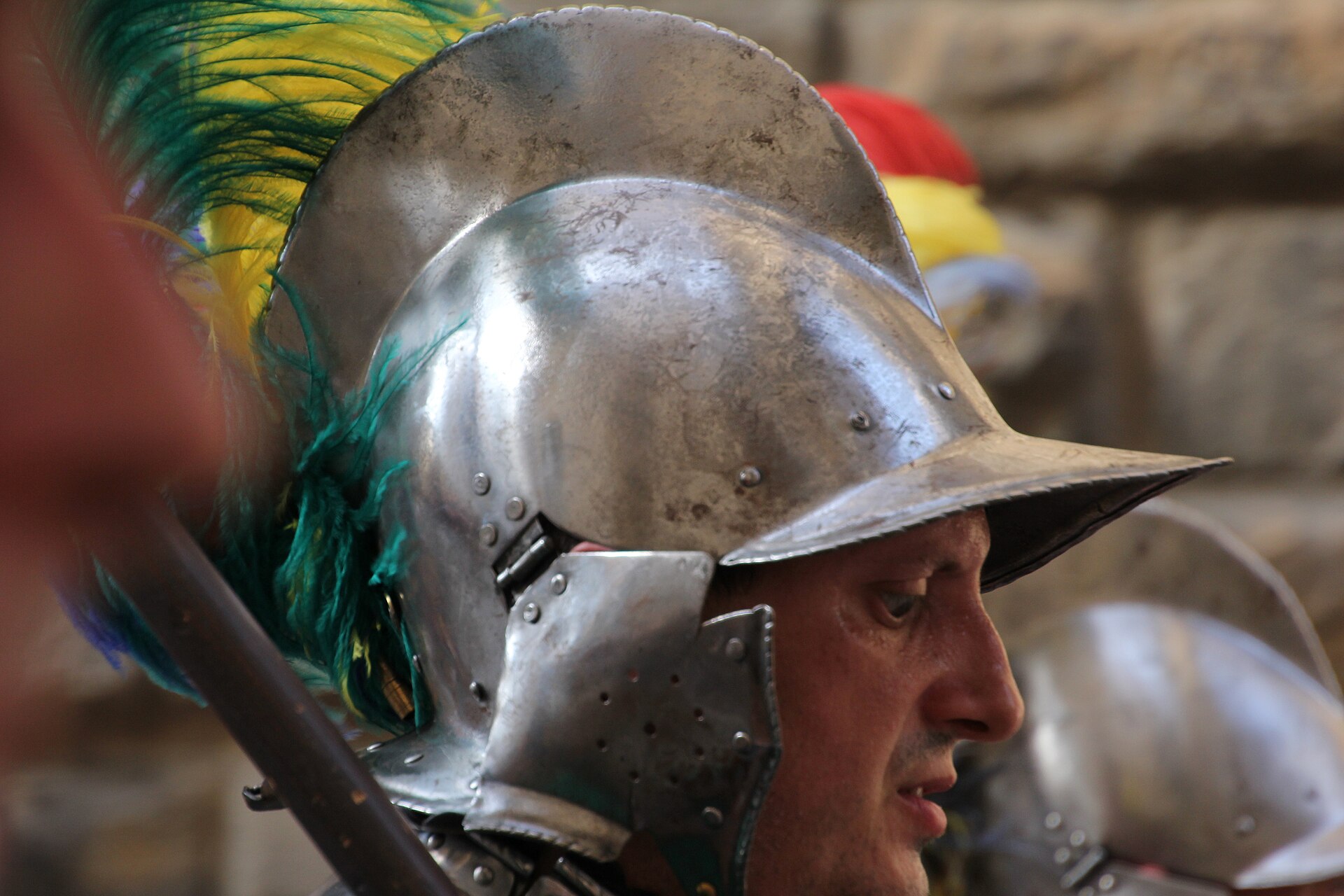
The corteo is the same organisation that appears at the Calcio Storico in June and at the Cavalcata dei Magi on 6 January. It is a serious, long-standing civic institution rather than a tourist re-enactment, which is why it looks the way it does.
If your trip lands in the wider spring window, our Florence in April guide covers the weather, the prices and what else is on.
What Opens Over Easter
Easter is much easier than Christmas. Italy’s two hard closure days are 25 December and 1 January; Easter is not one of them, and most things run.
| Day | Museums | Shops and restaurants |
|---|---|---|
| Good Friday | Normal hours — not a holiday | Normal |
| Holy Saturday | Normal hours | Normal, busy |
| Easter Sunday | Most open; some open late after the Scoppio | Restaurants open and full; shops mostly shut |
| Easter Monday | Generally open — Mondays are the catch | Restaurants open; many shops shut |
The catch is Monday. Several major Florentine museums close on Mondays as a matter of routine — the Uffizi, the Accademia and the Bargello all do — and when Easter Monday falls they often open specially, but not always, and not on the same pattern every year. Check the individual museum for Pasquetta before you build a day around it.
Note also that the cathedral is closed to sightseeing on Easter Sunday: it is in continuous liturgical use. The dome climb, bell tower and Baptistery run on the Duomo pass system with reduced holiday hours, and the piazza is closed to circulation for much of the morning, so a dome slot booked for Easter Sunday morning is a slot you will struggle to reach. Book it for the Saturday or the Monday.
| Ticket | Price | Note |
|---|---|---|
| Scoppio del Carro | Free | No ticket, outdoors, Piazza del Duomo |
| Cathedral entry | Free | Closed to sightseeing on Easter Sunday |
| Brunelleschi Pass | €30 | Dome, tower, museum, Baptistery; dome is timed |
| Ghiberti Pass | €15 | Museum, Baptistery, Santa Reparata |
| Uffizi, booked ahead | €29 | Book two to three weeks out over Easter |
| Accademia, booked ahead | €20 + €4 | Book about a month ahead in spring |
Crowds, Prices and Whether to Come
Here is the honest position. Easter is one of the two or three busiest weeks in the Florentine year, alongside the first week of May and the middle of October. Italian schools are on holiday, the weather has usually turned, and every coach tour in Tuscany converges on the same six streets.
What that means in practice:
- Hotel rates over the Easter weekend are close to their summer peak. Book by January for anything good.
- Uffizi and Accademia slots go weeks out. The Accademia in particular wants about a month’s notice in spring.
- Restaurants run Easter Sunday fixed menus at fixed prices, in the €45–80 range, and they sell out.
- The queue for the dome climb without a pre-booked slot is not a queue, it is a refusal — the slots are all sold.
So: is it worth it? If the Scoppio del Carro is the reason you are coming, yes, unambiguously. It is a genuinely unrepeatable thing, it is free, it takes one morning, and there is no equivalent anywhere else. Build the trip around Sunday morning and treat the rest as a bonus.
If you were coming to Florence anyway and Easter is simply when you can travel, it is fine, but go in knowing you are paying peak rates for peak crowds. The last week of March or the second half of April — depending on where Easter lands that year — give you the same weather, the same daylight and forty per cent fewer people. Our best time to visit Florence page has the comparison in full.
What Florence Eats at Easter
Easter lunch in Tuscany is a spring meal, and lamb is the centre of it.
- Agnello — roast lamb, usually with rosemary and potatoes, sometimes as scottadito, small rib chops eaten with the fingers while too hot, which is what the name means.
- Torta pasqualina — a savoury spinach, ricotta and egg pie, more Ligurian than Tuscan but everywhere in Italy at Easter.
- Crostini and affettati to start, as always, with the addition of hard-boiled eggs, which are blessed at church and eaten first.
- Colomba pasquale — the Easter cake, the same enriched dough as panettone, baked in the shape of a dove and topped with pearl sugar and whole almonds. Bought from a pasticceria it is a different object from the supermarket version.
- Chocolate eggs, enormous, foil-wrapped, with a sorpresa sealed inside — a small gift chosen by the manufacturer, or by the shop if you have one made up.
- Schiacciata and the ordinary Florentine bakery repertoire carry on regardless, and are what you should actually eat for breakfast before standing in the piazza.
Book Easter lunch. Florentine families eat out on Easter Sunday in numbers, restaurants switch to set menus, and walking in at half past one without a reservation is not a plan. Our guide to dining etiquette in Florence covers how the meal runs once you are seated.
Pasquetta: Easter Monday
Pasquetta — “little Easter” — is a full public holiday in Italy, and the tradition is unambiguous: you leave the city and eat outdoors. Half of Florence drives into the Tuscan countryside on Easter Monday with a cold lunch, and the roads out are busy from mid-morning.
You can join in without a car. Fiesole is twenty to thirty-five minutes on bus 7 from Santa Maria Novella or San Marco, running roughly every twenty minutes, and puts you on a hillside with a Roman theatre, olive terraces and a view back over the whole city. The Boboli Gardens, at €10 on the day (€13 booked), are the in-town version — they open at 08:15, and on a warm Pasquetta the lawns behind the Pitti are exactly where you want to be.
Bear in mind that Monday closures are real and Pasquetta does not automatically override them, so check before you plan a museum. The city’s green spaces, the Oltrarno and a long lunch are the better use of the day anyway.
Single bus tickets are €2.00, valid 90 minutes, from machines, tobacconists and bars showing the AT sticker — and €3.00 from the driver in exact change, which on a public holiday when the tobacconists are shut is a distinction worth planning around.
Frequently Asked Questions
What time is the Scoppio del Carro?
The cart is ignited at 11:00 on Easter Sunday, at the Gloria of the Mass. The cart leaves its depot on Via il Prato at 07:30, flag-throwers perform in Piazza del Duomo at about 08:10, and the civic procession sets off at 08:20. Be in the piazza by 09:30 for a usable view.
Do you need tickets for the Scoppio del Carro?
No. It happens outdoors in Piazza del Duomo, it is free, and there is no ticketed seating. Some restaurants and hotels on the square sell breakfast or window packages, which is worth considering if standing in a crush for two hours is not an option for your group.
What is the colombina?
A dove-shaped rocket. It is lit at the high altar of the cathedral, runs down a wire the length of the nave and out through the doors into the piazza, ignites the cart, and is meant to return to the altar. A clean return is read as a good omen for the harvest and the year.
Are museums open in Florence at Easter?
Mostly yes. Good Friday is not a public holiday in Italy and everything runs normally. Most museums open on Easter Sunday, some on adjusted hours. Easter Monday is the one to check — the Uffizi, Accademia and Bargello close on ordinary Mondays and open specially for Pasquetta in some years but not all.
Is Florence very busy at Easter?
Yes — it is one of the two or three busiest weeks of the year, with hotel rates near their summer peak. Book accommodation by January, Uffizi slots two to three weeks ahead, the Accademia about a month ahead, and Easter lunch as early as you can.
Why is the cart called the Brindellone?
It is Florentine dialect for something large, shabby and lurching — a description of how the nine-metre wagon moves when four oxen drag it through the streets. The cart is traditionally dated to 1494, though most of its carving and gilding appears to be from around 1590–1610.
What do Italians do on Easter Monday?
They leave town and eat outside. Pasquetta is a public holiday and the custom is a countryside picnic. Without a car, bus 7 to Fiesole from Santa Maria Novella or San Marco is the easy version, or the Boboli Gardens at €10 on the day (€13 booked) for the in-town alternative.
Keep Reading
- Florence festivals and events calendar — the whole civic year, month by month.
- The Duomo complex — passes, the dome climb and what the three tiers include.
- Best time to visit Florence — where Easter sits against the rest of the calendar.
- Church dress codes — what gets turned away at the door in Holy Week.
- Italian dining etiquette — how a long Easter lunch actually works.
- Best photo spots in Florence — including the piazza at seven in the morning.