This article contains advertising. Booking links on this site can be turned into paid links automatically by our partner Travelpayouts: if you book through one, we earn a commission from the provider, at no extra cost to you. It never affects what we recommend. Affiliate disclosure
Florence in April: Easter, Gardens & the First Crowds
Florence in April is the month the city stops being a bargain and starts being beautiful. The wisteria comes out at Bardini, the Iris Garden opens on the 25th for a window of about four weeks, the Maggio Musicale begins in spite of its name, and twenty-degree afternoons make the whole place suddenly worth sitting outside in. All of which the rest of Europe has also worked out. April is where Florence’s queues, room rates and booking windows all step up at once, and the difference between a good April trip and a frustrating one is almost entirely a matter of what you reserved, and when.
Part of our month-by-month series — the best time to visit Florence compares all twelve, and Florence in March covers the cheaper month just behind it.
The month after is the one with the best weather in the Florentine year and the second-biggest crowds. Our guide to Florence in May covers the Rose Garden, the last three weeks of the Iris Garden and the three habits that make a peak month bearable.
The Short Verdict
April is the month most people should book, and it is also the month most people book badly. The weather is genuinely good — twenty degrees in the afternoon, six hours of sun a day, light until well past eight by the end of the month. The gardens do the thing the gardens are famous for. And unlike May, the heat has not yet turned the walk up to San Miniato into work.
The trade is crowds and money. Room rates step up at Easter and mostly do not come back down. The Accademia goes from a week’s notice to a month’s. Queues appear at the Duomo that were not there in March. And April carries two public holidays at its far end, both of which fill the trains and empty the offices.
The other thing to know is that April is not uniformly busy. The spikes are specific and they are predictable: Easter week, the 25 April weekend, and whatever days sit between the 25th and 1 May. Outside those, a Tuesday in the middle of April is calmer than most people expect.
Honest caveat: April is the wettest month of the Florentine spring by rain days — nearly nine of them — and the showers are the heavy, sudden, twenty-minute kind rather than the grey drizzle of November. That is not a reason to avoid April. It is a reason not to build a six-day itinerary with no indoor fallback in it.
Weather: Warm Afternoons, Wet Days
| Measure | March | April | May |
|---|---|---|---|
| Average high | 16.2 °C | 20.0 °C | 24.3 °C |
| Average low | 5.1 °C | 8.1 °C | 11.9 °C |
| Rainfall | 61 mm | 67 mm | 63 mm |
| Wet days | 7.0 | 8.7 | 7.6 |
| Sunshine per month | 155 hrs | 186 hrs | 242 hrs |
Twenty degrees and six hours of sun is the headline, and it is a fair one. What the table also shows, and what almost nobody mentions, is that April has more wet days than either of its neighbours. Not more rainfall — the millimetres barely move — but more days on which some of it falls. April in Tuscany does showers: bright morning, black cloud over the Apennines by two, twenty violent minutes, and the stones steaming by four.
The daily swing is still twelve degrees. Eight in the morning is genuinely cool, and if you are queuing for the Duomo at 08:30 you will want a jacket you can then carry all day. By the end of the month sunset is past eight — the clocks went forward on the last Sunday of March — which changes the shape of a day completely. You can do a museum until six, walk up to Piazzale Michelangelo, and still be eating by nine.
Build in the wet afternoon
Do not book a garden, a hill walk and a day trip on three consecutive afternoons and hope. Keep one unbooked indoor option in reserve — the Bargello, Palazzo Vecchio, the Museo dell’Opera del Duomo — and move it into the hole when the sky goes over. An April shower in Florence is short enough that the right response is a museum and a coffee, not a ruined day.
Easter — Usually April, But Not Always
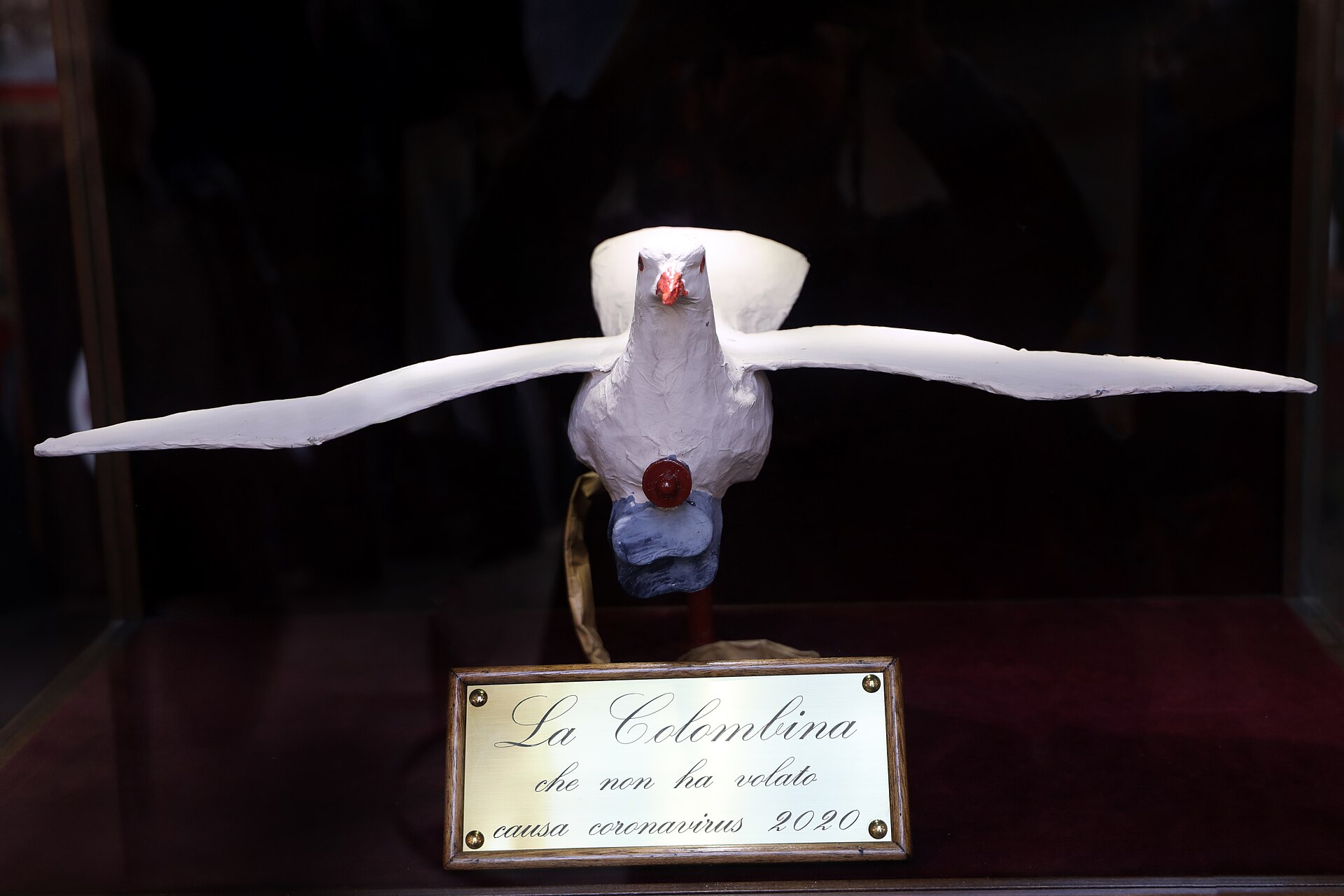
Easter falls in April in roughly two years out of three, and when it does it is the single biggest thing in the Florentine calendar between Christmas and June. The Scoppio del Carro — a thirty-foot cart hauled to the cathedral by white oxen and detonated at eleven o’clock by a rocket shaped like a dove — is close to nine hundred years old and is free to watch.
The dates matter more than usual here. Easter Sunday was 5 April in 2026. In 2027 it is 28 March — it falls out of April entirely, which makes that year’s April unusually clean and that year’s March unusually expensive. In 2028 it returns to 16 April. Check the year before you assume.
If Easter has moved out of April in your year, the crowd pressure shifts forward instead — our guide to Florence in May covers the month that inherits it.
What Easter does to prices is blunt. Hotels move to a peak rate for the whole week, not just the weekend; the Accademia and the Uffizi book out a month ahead; and Florentine restaurants run fixed Easter menus at fixed Easter prices, which are worth checking before you sit down. Easter Monday — Pasquetta — is a full public holiday in Italy and traditionally a day out of town, so the Chianti roads and the trains to the coast are busy while the city itself is briefly calmer. Good Friday is not a public holiday in Italy.
The full running order — where the Brindellone starts, when the flag-throwers perform, where to stand to see the cart rather than a forest of phones — is in our guide to Easter in Florence. And if you are deciding between cities for Holy Week, Florence versus Rome is a real choice with a real answer: Rome has the papal liturgies and the scale, Florence has one spectacular morning and a city you can still cross on foot.
The Wisteria at Bardini
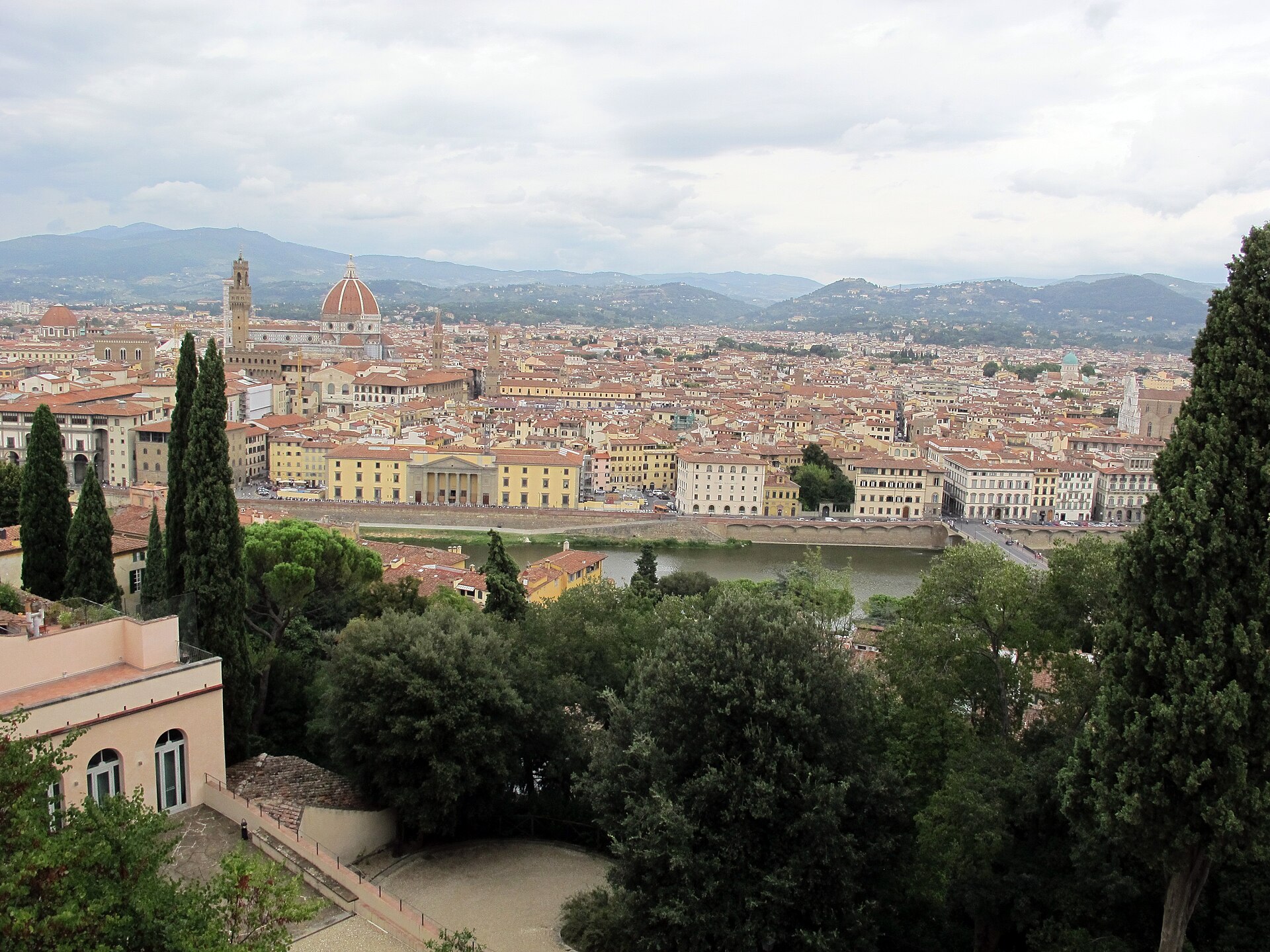
This is the picture that sells Florence in spring: a tunnel of hanging wisteria on a hillside with the dome behind it. It is real, it is at the Giardino Bardini, and the window is short.
The pergola is seventy metres long and four and a half wide, and it was only completed in 2005 — it is a modern piece of planting in a very old garden, which is part of why it photographs so well. It is deliberately planted with several varieties, including Wisteria floribunda Black Dragon, Royal Purple and Showa Beni, so the tunnel does not all flower at once. It shifts through lilac, deep violet, mauve and pale pink over a couple of weeks.
Giardino Bardini, practically
- When: the wisteria flowers from April into about mid-May. The true peak is a window of a fortnight and it moves with the year — a cold March pushes it late, a warm one pulls it forward. Nobody can give you a date in advance, including the garden.
- Price: €10 full, €2 reduced for 18–24s. The ticket runs all day and covers Boboli as well, which makes it one of the better-value tickets in Florence — two large gardens for the price of one.
- Hours: daily from 10:00, closing somewhere between 18:00 and 19:30 depending on the season, last entry an hour before. Closed the first and last Monday of the month, exactly like Boboli. People get caught by this constantly.
- Timing: go at opening. By midday in peak wisteria week the pergola is a queue of people waiting to photograph an empty tunnel, which it never is.
The honest note: the tunnel is seventy metres of one thing. It is genuinely lovely and it takes about ten minutes. What justifies the ticket is the rest of the garden — the baroque staircase, the terraces, the view back over the roofs — plus Boboli on the same stub. If you turn up solely for the pergola on a grey Tuesday in the second week of May, you will have paid ten euros for a photograph of some leaves. Look at what people are posting that week before you commit.
More on where in the city actually repays a camera, in any month, in our guide to the best photo spots in Florence.
The Iris Garden, 25 April
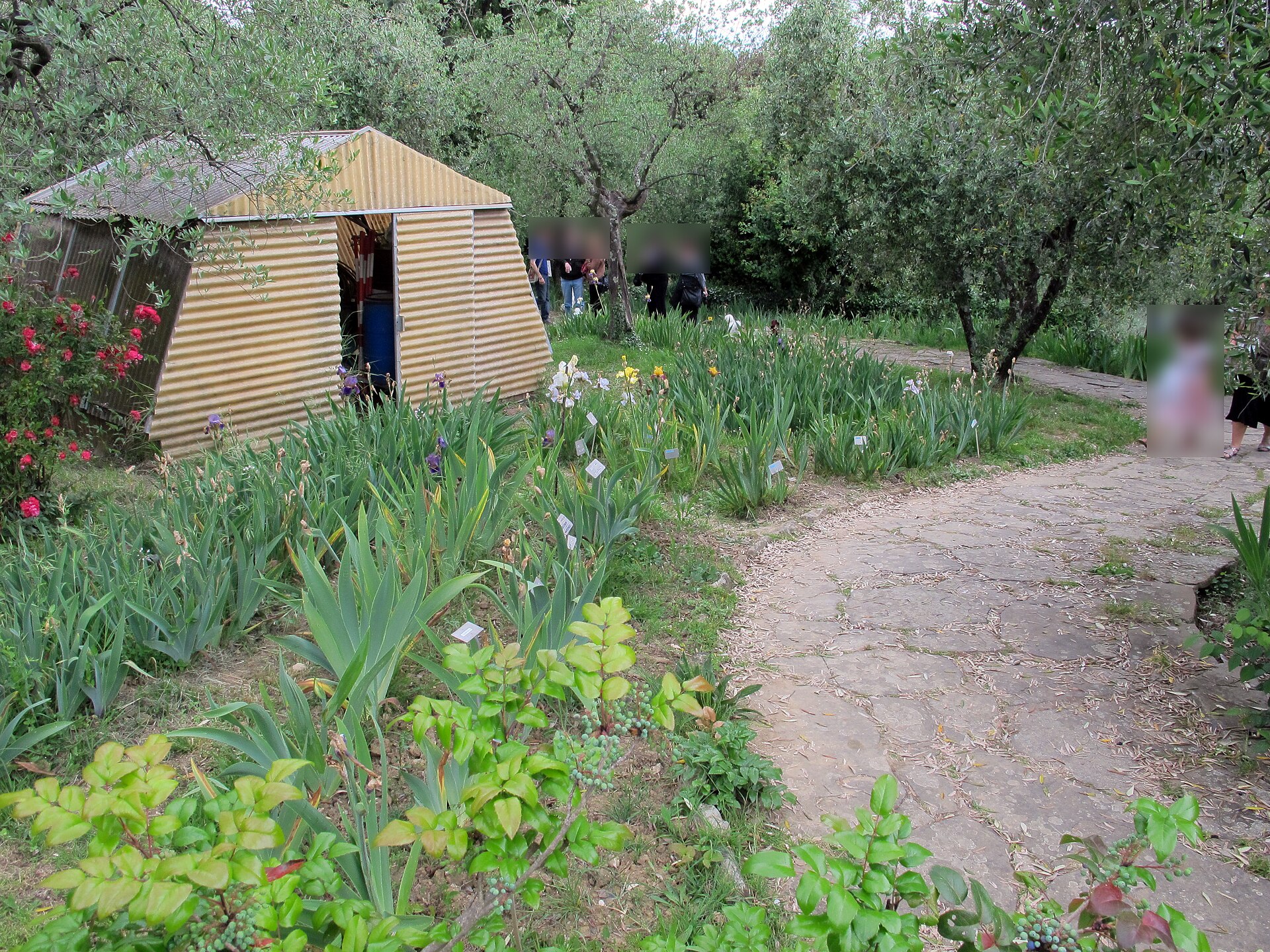
The iris is not a decorative choice in Florence. The red giglio on the city’s coat of arms is a stylised iris, not a lily, and it has been the symbol of the city since the eleventh century. The Giardino dell’Iris exists because of that, and it opens for about four weeks a year.
- Where: Viale Michelangelo 82, on the slope immediately below Piazzale Michelangelo. If you have walked up to the viewpoint, you have walked past the gate.
- When: from 25 April to around 20 May. The start date is fixed by tradition — it opens on Liberation Day.
- Price: free.
- Hours: daily 10:00–18:00, last entry 17:30. Groups of more than ten need to email at least three days ahead and cannot exceed twenty-five.
Set expectations properly. This is not a formal Italian garden and it is not trying to be. It is a competition and collection garden run by the Italian Iris Society: labelled beds of named cultivars laid out on a terraced olive slope, with a shed, and the city spread out below. It is scruffy in the way a serious plantsman’s garden is scruffy. If you arrive expecting Boboli you will be baffled; if you arrive expecting a free hillside of several hundred varieties of iris with a view over Florence, you will be delighted.
Practical sequencing: do the Iris Garden and Piazzale Michelangelo in the same trip, late afternoon, and stay up for sunset. The Rose Garden is on the same slope, also free, also open — though its roses are a May event rather than an April one.
25 April, 1 May and the Bridge
Two Italian public holidays sit at the end of April and the start of May, and they behave as one event.
25 April is the Festa della Liberazione, marking the end of Nazi occupation and Fascist rule in 1945. In Florence it means wreath-layings, civic ceremonies and partisan songs rather than a parade you can watch. It is a full public holiday: banks and offices shut, most museums stay open, and the trains fill.
1 May is the Festa dei Lavoratori, and it is the more disruptive of the two for a visitor. A great many restaurants and family-run shops close outright, and public transport runs a holiday timetable.
What matters is where they fall in the week. When 25 April lands on a Tuesday or a Thursday, Italians take the ponte — the bridge — and turn it into a four-day weekend, and Florence fills with domestic tourism on top of the international kind. That is the worst-case version.
2027 is a rare easy year
In 2027, 25 April falls on a Sunday and 1 May falls on a Saturday. Both holidays land on days that were already weekends, so there is no bridge to take and no four-day exodus — the two busiest fixed dates of the Florentine spring largely defuse themselves. Combined with Easter having moved back into March that year, the last week of April 2027 is unusually gettable. That will not be true in 2028.
Maggio Musicale Starts in April
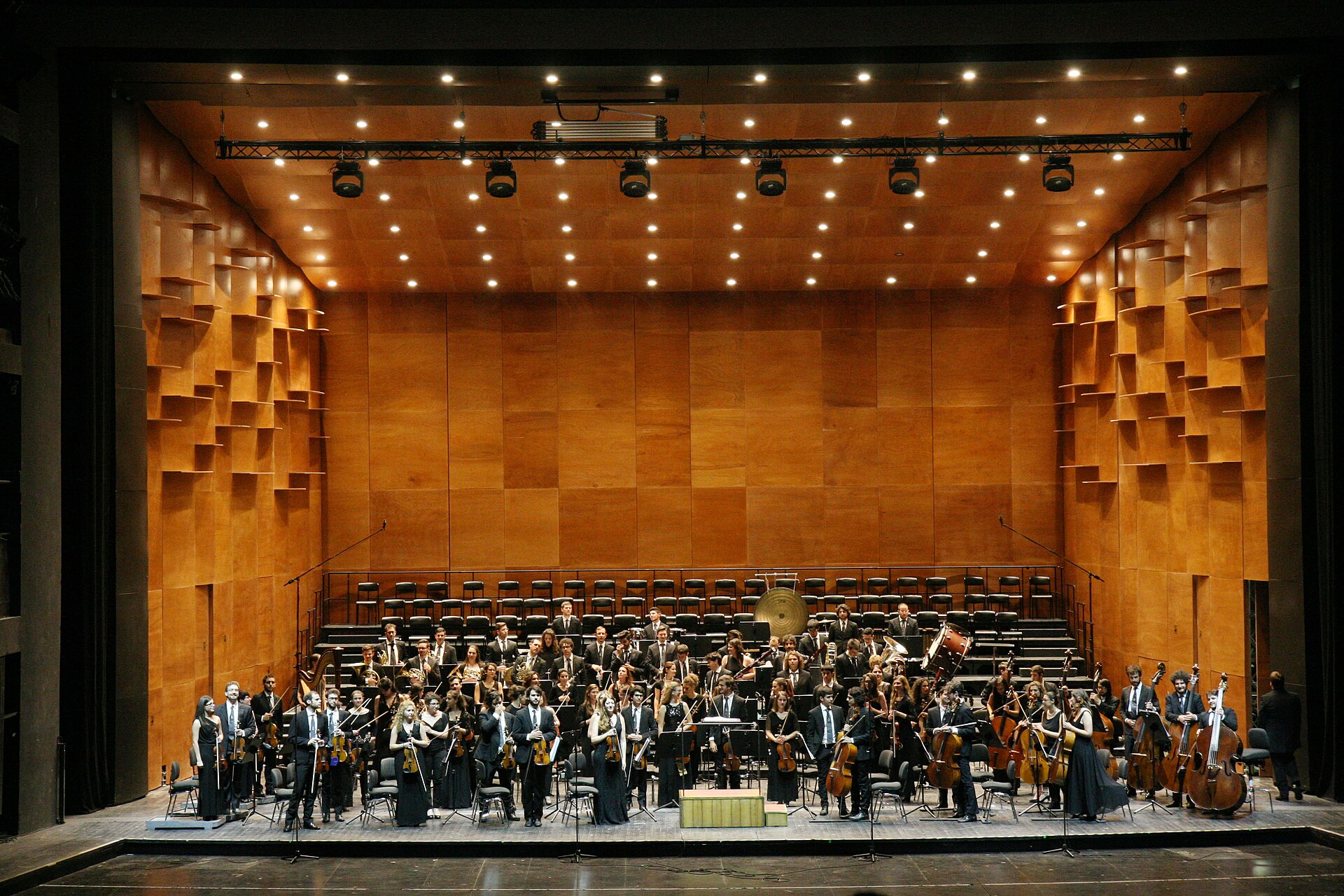
The Maggio Musicale Fiorentino is the oldest music festival in Italy, running since 1933, and despite being named after May it opens in April and runs into July. The 88th edition ran from 19 April to 1 July 2026.
It is a serious international festival, not a tourist add-on. The 2026 programme opened with John Adams’s The Death of Klinghoffer staged by the film director Luca Guadagnino, ran Verdi’s Un ballo in maschera from 12 May and Handel’s Giulio Cesare from 14 June, and had music director Daniele Gatti conducting all nine Beethoven symphonies across four concerts. Each year’s festival is announced the previous autumn.
Performances are at the Teatro del Maggio, the modern opera house on the edge of the Cascine park — about twenty-five minutes’ walk west of the Duomo, or a short tram ride. Tickets span a wide range and the cheap seats in a house this size are a genuine bargain by European opera standards. Book directly rather than through a reseller.
The verdict: if you like opera, arranging an April trip around one performance is easy and worth doing. If you do not, this is not the thing that will convert you — and a first night in an unfamiliar contemporary opera is an expensive way to find that out.
The First Crowds, and What to Book
April is when the booking rules change. In March you could be casual. In April you cannot.
| What | Book ahead | Price |
|---|---|---|
| Accademia (David) | About a month | €20 + €4 booking |
| Uffizi | Two to three weeks | €25 day / €29 booked; €16 from 16:00 |
| Duomo dome climb | Two weeks; the slot is timed | Brunelleschi Pass €30 |
| Vasari Corridor | As early as you can; 25 people per group | €43 day / €47 booked, with the Uffizi |
| Brancacci Chapel | A week; ten people per 30-minute slot | €15 (€10 reduced) |
| Boboli + Bardini | Not sold in advance | €15, at the ticket offices only |
| Restaurants, Thu–Sat | Two to three days | — |
The single most useful booking habit in April is the early slot. The Uffizi opens at 08:15 and stays genuinely civilised until about ten; the Accademia is the same; Boboli opens at 08:15 and is empty for an hour. An April morning that starts at eight buys you the same city that March gave you for free.
The other lever is the afternoon Uffizi ticket — €16, entry from 16:00. In April the gallery is open until 18:30, so you get two hours in a thinning room for well under half the standard fare. It is the best-value ticket in Florence and it is under-used. The full mechanics are in our Uffizi tickets guide.
Skip the free first Sunday of the month entirely in April. In January it is a gift. In April it is two hours of queue for a gallery you will then share with a thousand people.

What to Do
The month for the outdoors
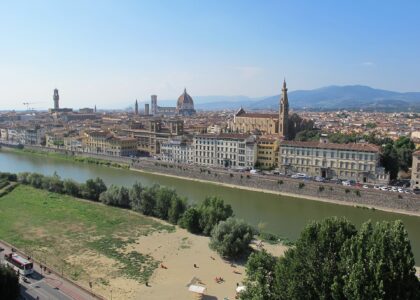
April is the first month of the year when Florence outdoors is unambiguously better than Florence indoors. The obvious circuit — Ponte alle Grazie, up through the Rose Garden, Piazzale Michelangelo, San Miniato al Monte, back down through the Porta San Miniato — takes an easy half day and costs nothing. In April you can do it in the afternoon without arriving at the top wrung out, which is not true from June.
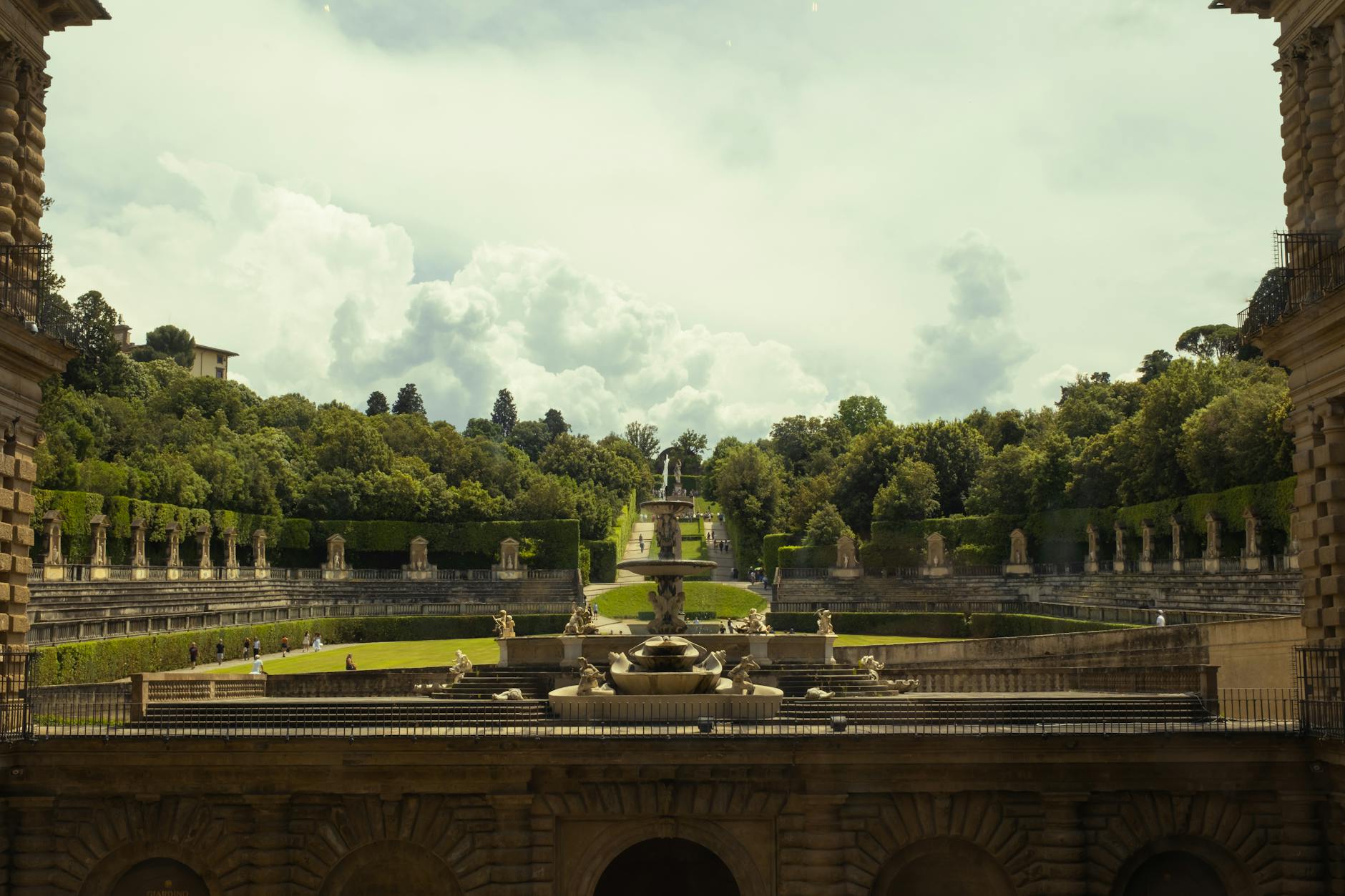
Boboli deserves a proper visit rather than a lap. It is eleven acres of Medici garden behind the Pitti, it opens at 08:15, and in April the Viottolone and the amphitheatre are at their best. Go with the Bardini ticket and do both.
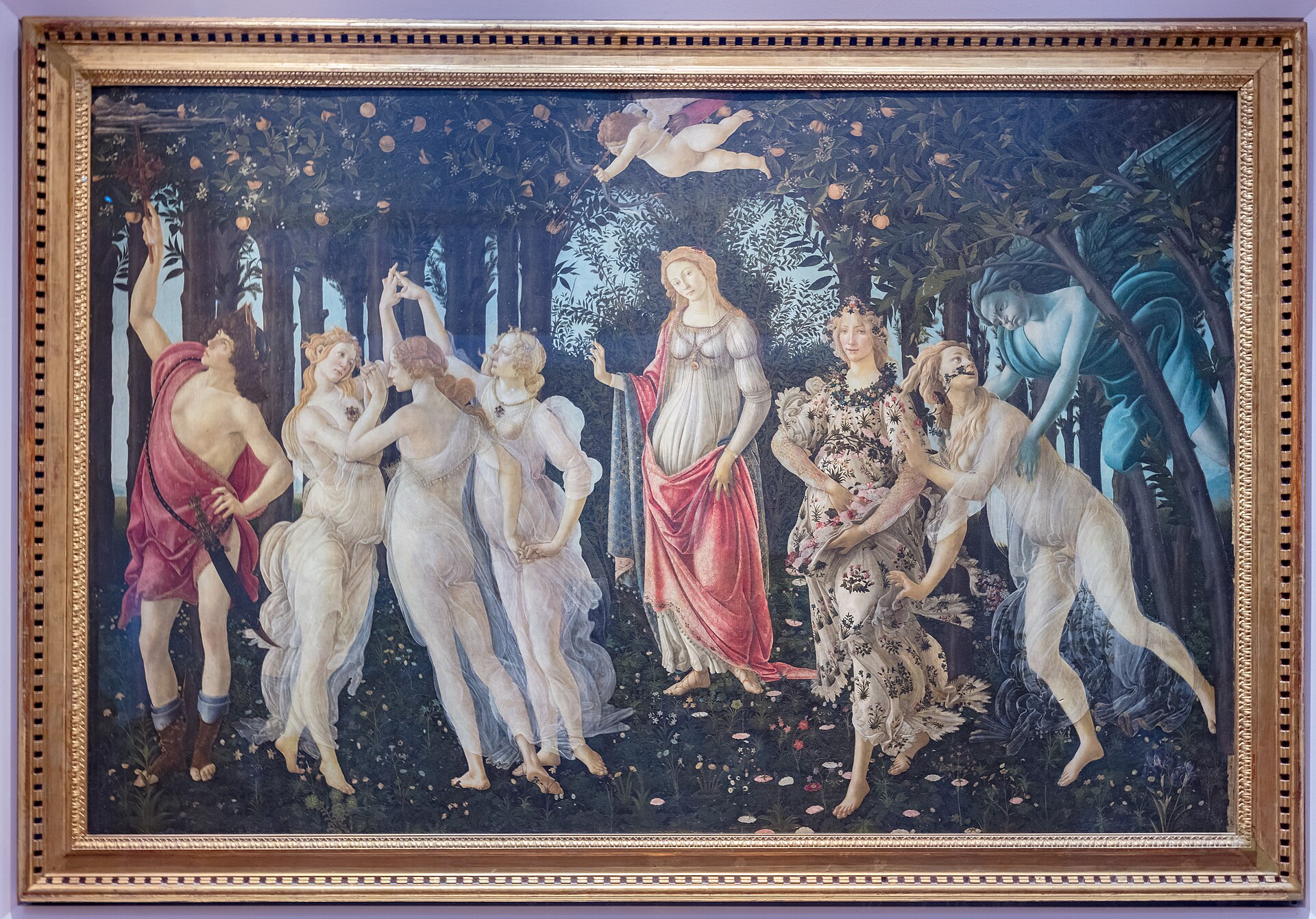
The Uffizi has a seasonal argument in April too. Botticelli’s Primavera is upstairs, it is about the arrival of spring, and it is one of the few cases where seeing a painting in the right month genuinely does something.
Out of the city
Chianti in April is what people imagine Tuscany looks like: green, budding, wildflowers in the verges, and not yet the bleached gold of August. The tasting rooms are open and not yet overrun. Siena, Lucca and Pisa all work — see day trips from Florence for times and fares, and the Pisa day trip if you want the leaning tower without the August scrum.
Fiesole is bus 7 from Santa Maria Novella or San Marco, twenty to thirty-five minutes, roughly every twenty. The Roman theatre and the view back down the valley are an easy half day, and in April the walk between Fiesole and San Domenico is a genuine pleasure rather than a hot slog.
Three April mistakes
- Turning up for the wisteria on fixed dates. It moves by up to a fortnight. Book Florence, not the flower.
- Assuming Easter is in April. In 2027 it is not. Check the year.
- Leaving the Accademia to the last week. In April the David slots go about a month out, and the walk-up queue in Via Ricasoli is an hour of your holiday.
Eating in April
April is when the Tuscan table turns properly green, and it happens fast. The winter soups go, and in their place: baccelli with pecorino — young broad beans, raw, podded at the table, eaten with a wedge of sheep’s cheese and nothing else. It is the most Tuscan thing you can be handed in spring and it is gone by the start of summer.
Alongside it: wild asparagus, thin and bitter and worth the price; the last of the artichokes; the first peas; and new olive oil that is no longer new but is still very good. Strawberries arrive in the markets from the south towards the end of the month.
If Easter is in your April, the food changes for a week. Every bakery carries schiacciata di Pasqua, every butcher sells lamb, and restaurants across the city run fixed-price Easter Sunday menus — often four courses and often not optional. Check the price before you sit down. Easter Monday is a picnic day by tradition, and buying the components at Sant’Ambrogio and eating them at the Rose Garden is a better use of a holiday than queuing for a table.
The practical change from March: from April you should book. Not everywhere, and not far out, but any restaurant you have specifically chosen, on a Thursday, Friday or Saturday, wants two or three days’ notice. Walking in at eight stops working this month. Our Florence food guide has where to go, and Italian dining etiquette covers the coperto and the rest of the unwritten rules.
What to Pack
- A light waterproof. Nearly nine wet days, and April showers here are sudden and heavy rather than persistent. A hood beats an umbrella.
- Layers for a twelve-degree swing. Eight degrees at breakfast, twenty by three. A jumper you are happy to carry in a bag all afternoon.
- Sunglasses and sunscreen. Six hours of sun a day, and the spring sun off pale stone catches people out badly in the second half of the month.
- Proper walking shoes. April is the month you will actually walk up to San Miniato rather than talking about it.
- Covered shoulders and knees for churches — enforced, and more annoying in warm weather when you have not brought a layer. See the church dress code.
The full list is in our Florence packing list.
Frequently Asked Questions
Is April a good time to visit Florence?
Yes — it is probably the best month for a first visit. Twenty-degree afternoons, six hours of sun a day, the gardens at their peak and light until past eight by month’s end. The cost is money and company: rates step up at Easter and the booking windows roughly double. Go, but book earlier than feels necessary.
How warm is Florence in April?
Average high around 20 °C and average low around 8 °C, with roughly 67 mm of rain spread over nearly nine days. Afternoons are comfortably warm; mornings still need a layer. It is a twelve-degree daily swing, so dress in things you can take off.
When does the wisteria flower at the Bardini Garden?
From April into about mid-May, with a peak of roughly two weeks that shifts by up to a fortnight depending on the winter. The seventy-metre pergola is planted with several varieties so it changes colour as it goes. Entry is €10 and covers Boboli too. Go at 10:00 opening — by midday in peak week it is a queue.
Is Easter always in April in Florence?
No, about two years in three. Easter Sunday was 5 April in 2026, falls on 28 March in 2027 and returns to 16 April in 2028. When Easter lands in March it takes the price spike with it, which makes that year’s April noticeably easier to book. Always check the year before planning around it.
What happens in Florence on 25 April?
It is the Festa della Liberazione, a national public holiday marking the end of Nazi occupation and Fascist rule in 1945 — civic ceremonies and wreath-layings rather than a parade. Offices and banks close, most museums stay open, and trains are busy. It is also the day the free Iris Garden opens for its four-week season.
How far ahead should I book museums for April?
About a month for the Accademia, two to three weeks for the Uffizi, two weeks for the timed dome slot, and as early as possible for the Vasari Corridor, which runs groups of twenty-five. Treat Easter week as a month for everything. The Bargello and the Museo dell’Opera del Duomo still rarely need booking.
Is the Maggio Musicale Fiorentino in May?
Not only. Despite the name it opens in April and runs into the start of July — the 88th edition ran 19 April to 1 July 2026. It is Italy’s oldest music festival, founded in 1933, and performances are at the Teatro del Maggio near the Cascine park. Programmes are announced the previous autumn.
April or May in Florence?
April if you want the gardens and a manageable temperature; May if you want long warm evenings and the roses, and can live with more people and higher rates. April has more wet days, May has more sun. The real difference is heat on the hill walks: April is comfortable, and by late May the climb to San Miniato is work.
Keep Reading
- Florence in March — the cheaper month just behind, and the one that takes Easter in some years.
- The best time to visit Florence — all twelve months compared.
- Florence weather by month — the full climate tables.
- Easter in Florence — the Scoppio del Carro hour by hour.
- Outdoor activities in Florence — what the warmer weather opens up.
- Florence museums guide — the whole collection, ranked honestly.
- Florence festivals and events calendar — the year at a glance.