This article contains advertising. Booking links on this site can be turned into paid links automatically by our partner Travelpayouts: if you book through one, we earn a commission from the provider, at no extra cost to you. It never affects what we recommend. Affiliate disclosure
Siena is the most rewarding single Tuscan day trip from Florence — a perfectly preserved Gothic medieval city of red brick and travertine, organised around the world’s most beautiful piazza, packed with Renaissance art equal to anything in Florence, and home to Italy’s most famous traditional festival (the Palio horse race, twice each summer). Florence to Siena is 70km south, easily reachable by bus (1h15) or train+bus combination. This 2026 guide covers every realistic Siena day-trip option, what to see in a single day, the Cathedral and Palazzo Pubblico, the Palio dates and access, and how Siena differs from Florence’s medieval/Renaissance offering.
Siena is the classic first pick among day trips from Florence. Many visitors pair it with San Gimignano on the same tour, and if you plan to drive yourself, read our notes on renting a car in Florence before booking.
Why Siena?
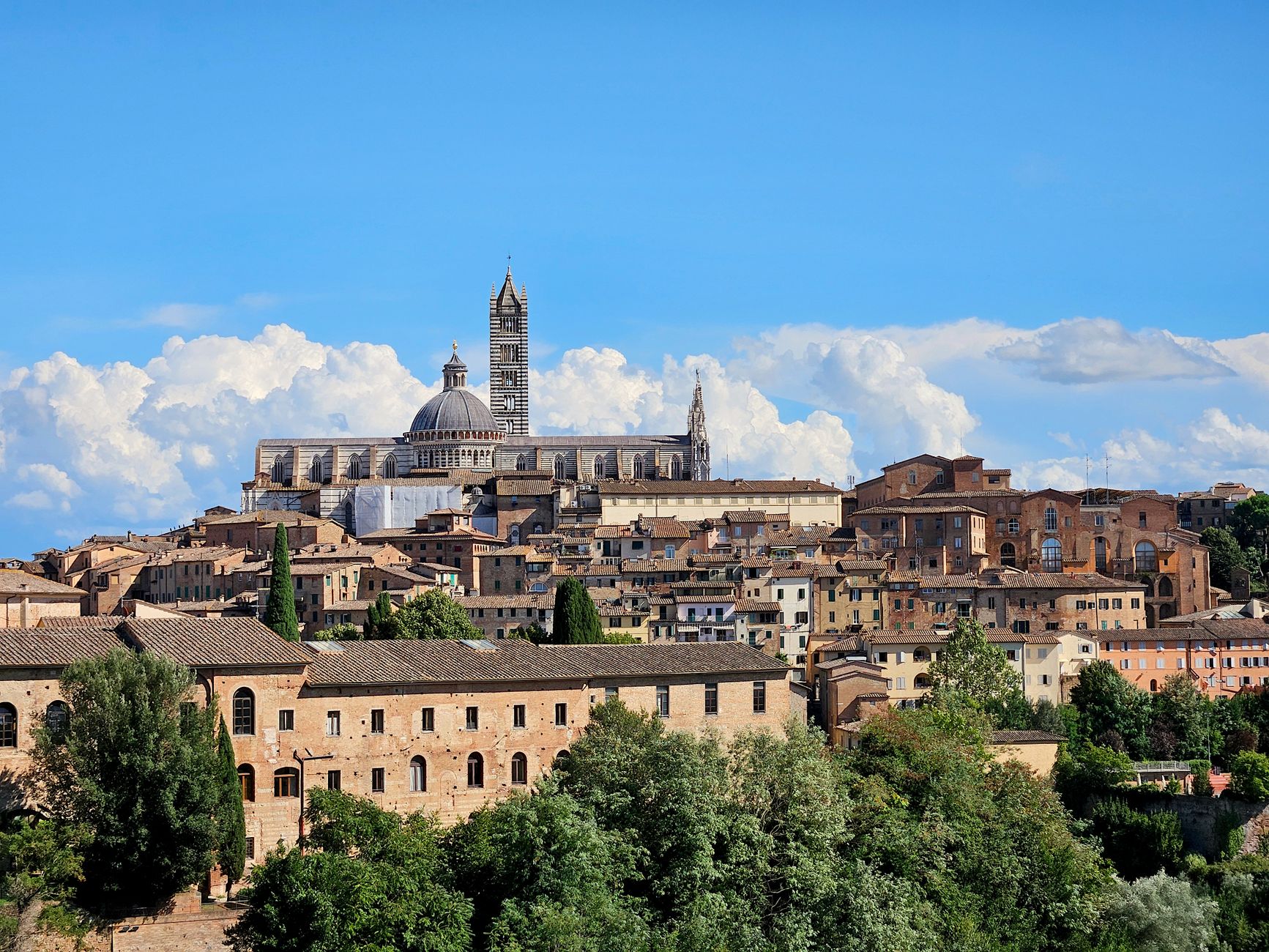
Siena was Florence’s medieval rival — a wealthy, banking-driven city-state of 50,000+ inhabitants in the 13th century, often equal in size and prosperity to Florence itself. The 1348 Black Plague killed 60% of Siena’s population in three months, ending the city’s expansion forever. Florence overtook it in the late 14th century and dominated by 1555, when the Medici annexed Siena entirely.
The result is a city frozen in 1348 — Siena’s centro storico is the most complete Gothic urban environment in Italy, with no significant Renaissance overlay (the city couldn’t afford the era’s monumental rebuilding). The Cathedral, Piazza del Campo, Palazzo Pubblico, Pinacoteca and the seventeen contrade (parish neighbourhoods) all retain their medieval character.
For travellers, Siena offers something Florence does not: pre-Renaissance Italian art (Duccio, Simone Martini, the Lorenzetti brothers), Gothic architecture rather than Renaissance, and a smaller, slower-paced city you can comfortably absorb in one day. UNESCO inscribed Siena’s centro storico as a World Heritage site in 1995.
Getting to Siena from Florence
By Bus or Train
Monday to Saturday, take the Autolinee Toscane rapid coach, line 131R, from the coach station beside Santa Maria Novella. It is timetabled at about an hour and a quarter and finishes at Via Tozzi, by Piazza Gramsci, on the edge of the old town. The direct regional train takes about an hour and a half and arrives at Siena station in the valley below, leaving an escalator ride and a long walk up to the centre. On Sundays, when the coach runs only a few times, the train is often the better choice. Our guide to getting from Florence to Siena has the timetables, fares and last departures for both.
By Car
- Distance: 70km via the SS222 (FI-SI) superstrada
- Driving time: 1 hour 5 minutes non-stop
- Tolls: Free (the SS222 is a non-tolled superstrada)
- Parking: Siena has its own ZTL traffic-restriction zone covering the historic centre. Park outside at Parcheggio Il Campo, Parcheggio Stadio, or Parcheggio Santa Caterina (€2/hour, €15–20/day). Each has escalator access up to the centre.
Driving makes sense for groups of 3–4 sharing fuel costs or for travellers combining Siena with other Tuscan stops (San Gimignano, Chianti).
Guided Day Tour
Many Florence operators offer guided Siena day tours, often combined with San Gimignano and a Chianti winery:
- Siena half-day tour (€60–90): bus + 2-hour guided walk + free time, return.
- Siena + San Gimignano full-day (€85–120): two-stop tour with 2.5 hours each.
- Siena + San Gimignano + Chianti winery + lunch (€100–150): the comprehensive Tuscan day.
Guided tours are useful for travellers wanting commentary or those who don’t want to figure out bus logistics. Self-organised bus + walk is the most economical and gives more time at each location.
What to See in Siena
Piazza del Campo

Siena’s central piazza — a clam-shaped sloping square paved in herringbone red brick, divided into nine sections (the “Nove” of medieval Siena’s governing body). The Palazzo Pubblico’s Torre del Mangia anchors one end; the Fonte Gaia (a Jacopo della Quercia marble fountain, the original now in the Palazzo Pubblico Museum) anchors the other. Cafés and gelaterias line the perimeter.
The Piazza is the heart of Siena’s identity — the seventeen contrade (parish neighbourhoods) parade through here on Palio race days. Sitting on the slope with a coffee, watching the city circulate, is itself one of Italy’s signature experiences.
Siena Cathedral (Duomo)

One of Italy’s three greatest Cathedrals (alongside Florence’s Duomo and St Peter’s in Rome). Siena’s Cathedral is striped black and white marble inside and out, executed in a hybrid Romanesque-Gothic style between 1196 and 1370. Highlights:
- Marble pavement — 56 inlaid panels (1369–1547) by Sienese masters; the most ambitious medieval inlay in Europe. Most are covered for protection; uncovered for ~6 weeks each summer-autumn (the “Pavement Reveal,” typically late August–early October).
- Pulpit by Nicola Pisano (1265–1268) — proto-Renaissance masterpiece in marble.
- Piccolomini Library (1502) — Pinturicchio frescoes celebrating Pope Pius II’s life. The most colourful single room in any Italian cathedral.
- The Cathedral Crypt (rediscovered 1999) — 13th-century frescoes that survived burial under the Cathedral floor.
- Donatello’s St John the Baptist bronze in the Baptistery.
Tickets 2026: €8 Cathedral only, €15 OPA SI Pass (Cathedral + Crypt + Baptistery + Cathedral Museum + Piccolomini Library), €30 “Gate of Heaven” tour (rooftop access). Book at operaduomo.siena.it.
Hours: 10:30–17:30 most days, with lunch closures and reduced Sunday morning hours during Mass.
Palazzo Pubblico & Museo Civico
The 14th-century town hall on Piazza del Campo, now home to the Museo Civico. The most important room is the Sala dei Nove (Hall of the Nine) where Ambrogio Lorenzetti’s 1338 frescoes Allegory of Good and Bad Government are painted on three walls — the first secular fresco cycle of European art and one of the most important paintings of the Trecento.
Other highlights:
- Simone Martini’s Maestà (1315) — vast enthroned Madonna fresco
- Simone Martini’s Guidoriccio da Fogliano (disputed attribution, c. 1330)
- The Sala del Mappamondo (Hall of the World Map)
- The original Fonte Gaia by Jacopo della Quercia (the marble panels relocated indoors for preservation)
Tickets: €10 Museum, €20 Museum + Torre del Mangia combo. Hours: 10:00–18:00 (last admission 17:00).
Torre del Mangia

The 88-metre brick bell-tower attached to Palazzo Pubblico. Built 1325–1348, it’s the second-tallest medieval tower in Italy (just shorter than Cremona’s Torrazzo). 400 steps to the top via narrow medieval staircases. The view encompasses the entire Siena historic centre, the Cathedral, the contrada districts, and the surrounding Tuscan countryside.
Tickets: €10 alone, €20 with Museo Civico combo. Hours: 10:00–18:00 most days. Climb closed in heavy rain or on Palio race days.
Pinacoteca Nazionale
Siena’s national art gallery — the world’s most important collection of Sienese painting from 1250 to 1500. Highlights:
- Duccio di Buoninsegna — the Sienese rival to Florence’s Cimabue/Giotto; his Madonna and saints panels
- Simone Martini — the Maestà-tradition continuator with delicate tempera
- Pietro and Ambrogio Lorenzetti — the brothers who pushed Sienese painting toward early naturalism in the 1330s
- Sassetta (Stefano di Giovanni) — 15th-century narrative painter
- Giovanni di Paolo — late-Gothic Sienese
The Pinacoteca is for serious Sienese art lovers — first-time visitors with one Siena day might skip in favour of more time at the Cathedral and Piazza del Campo, but specialists shouldn’t miss it.
Tickets: €4. Hours: 09:00–13:30 (some days reduced).
Other Sites
- Battistero di San Giovanni (Baptistery) — Donatello and Ghiberti reliefs on the font; included in OPA SI Pass.
- Cathedral Museum (Museo dell’Opera del Duomo) — Duccio’s Maestà from the Cathedral high altar (1311) and the rooftop “Gate of Heaven” panorama.
- Santa Maria della Scala — former hospital across from the Cathedral, now museum complex with detached frescoes and antiquities. Often skipped but extraordinary.
- Basilica di San Domenico — Catherine of Siena’s incorrupt head (yes, really) and the chapel where she had visions.
- Basilica di San Francesco — Franciscan church with extensive Lorenzetti and Sienese fresco fragments.
A Perfect Siena Day Itinerary
Departing Florence at 09:00, arriving Siena 10:15, returning Florence around 19:00 (8 hours total in Siena):
- 10:15: Arrive Piazza Gramsci bus terminal. Walk 10 minutes via Banchi di Sopra to Piazza del Campo.
- 10:30–11:00: Coffee on the Campo, take in the square’s geometry and the Torre del Mangia.
- 11:00–12:30: Cathedral + Piccolomini Library + Crypt + Cathedral Museum (OPA SI Pass €15).
- 12:30–13:30: Lunch — try Osteria Nonna Gina, Hosteria Il Carroccio, or Tre Cristi for proper Sienese pici (hand-rolled pasta) and pappardelle.
- 13:30–14:30: Palazzo Pubblico + Museo Civico + Lorenzetti frescoes (€10).
- 14:30–15:00: Climb Torre del Mangia (€10, 400 steps, 30 minutes round trip including the view).
- 15:00–16:00: Stroll Banchi di Sotto, visit Pinacoteca if interested in Sienese painting (€4).
- 16:00–17:00: Wander a contrada district — Pantera, Onda, or Aquila are particularly atmospheric (free).
- 17:00: Final coffee on the Campo. Walk to Piazza Gramsci.
- 17:30: Bus back to Florence (1h15 journey).
- 19:00: Arrive Florence Autostazione.
This itinerary is comfortable but not exhaustive. Add 1–2 hours if visiting on a Cathedral pavement-uncovered day or if you want to add Santa Maria della Scala.
The Palio (2 July & 16 August)
Italy’s most famous traditional festival — a bareback horse race around Piazza del Campo, held twice each summer:
- 2 July (Palio di Provenzano) — first race of the year, dedicated to the Madonna di Provenzano
- 16 August (Palio dell’Assunta) — second race, dedicated to the Assumption of Mary
Each Palio is run by 10 of Siena’s 17 contrade (parish neighbourhoods), chosen by lottery. Three turns of the Campo (about 90 seconds total) decide the winner; the prize is a silk banner, a year of bragging rights, and the contrada’s communal honour for centuries to come.
Visiting on Palio day:
- The race itself is around 19:00 (later in August due to long daylight)
- Free standing access to the centre of the Piazza del Campo — arrive by 14:00 for a good spot, expect to stay until 21:00 with limited toilet access
- Hotel rates in Siena double or triple for Palio nights; book 12+ months ahead
- The four days before each Palio (28 June–1 July; 13–15 August) feature trial runs, contrada banquets and procession rehearsals — atmospheric and crowd-free
- Reserved seating at piazza-side balcony stands €350–800 (reservation only via private hotels and contrada sponsors)
Visiting Siena outside Palio days is the better choice for most first-time visitors — the city is much more navigable and you can actually see the museums and Cathedral.
Sienese Food
Siena has its own distinctive cuisine:
- Pici — hand-rolled thick spaghetti, served with cacio e pepe, ragù, or aglione (garlic-tomato sauce)
- Pappardelle al cinghiale — wide ribbon pasta with wild boar ragù
- Crostini neri — Tuscan toasts with chicken liver pâté
- Ribollita — bread-thickened vegetable soup
- Panforte — dense Sienese fruit-and-nut cake; the original Christmas confection of Italy
- Ricciarelli — almond-paste cookies with powdered sugar
- Cantuccini — almond biscuits dipped in Vin Santo dessert wine
Restaurants for serious Sienese food: Osteria Nonna Gina (homely, family-run), Hosteria Il Carroccio (working trattoria, 50 years on the Campo), Trattoria Papei (locals’ favourite), Trattoria La Taverna del Capitano (mid-range, reliable). Avoid the immediate Piazza del Campo restaurants — overpriced tourist traps; walk 2 streets back.
Siena vs Florence: How They Compare
- Florence is Renaissance; Siena is Gothic. Florence has Botticelli, Michelangelo and Brunelleschi. Siena has Duccio, Simone Martini and the Lorenzetti — earlier, more decorative, less anatomically focused.
- Florence is bigger and more crowded; Siena is smaller and slower. Half the population, lower visitor density, more breathing room.
- Florence has more world-class art; Siena has the world’s best medieval painting collection. If you’ve already done the Uffizi, the Sienese Pinacoteca is a logical next step.
- Florence’s Cathedral is iconic; Siena’s is arguably more beautiful inside. The black-and-white striping, marble pavement and Pinturicchio library at Siena are sometimes preferred to Florence’s more famous Brunelleschi dome.
- Both are walking cities — but Siena is hillier, with steeper grades and more steps.
Visiting Siena is a complement to Florence rather than a substitute — the two cities together cover the full arc of Italian medieval and Renaissance art-history.
Insider Tips
Tip 1: Buy the OPA SI Pass (€15) immediately on arrival at the Cathedral — covers Cathedral + Crypt + Baptistery + Cathedral Museum + Piccolomini Library. Saves €8 versus single tickets.
Tip 2: Visit the Cathedral when the marble pavement is uncovered — typically late August through early October. Check operaduomo.siena.it for exact dates.
Tip 3: Climb the Torre del Mangia at 11:00 or 16:00 for the best Tuscan light; avoid 13:00–15:00 when summer heat at the top is brutal.
Tip 4: Lunch at a working trattoria 2–3 streets back from Piazza del Campo — the immediate-Campo restaurants are tourist traps with €18 pasta. Locals eat at Trattoria Papei or Osteria Nonna Gina.
Tip 5: Sit on the brick floor of the Campo with a coffee for 15 minutes. The slope and the herringbone pattern are the city’s identity; experience them by sitting.
Tip 6: The Pinacoteca is undertouristed but the world’s best Sienese painting collection. €4 entry, 60 minutes well spent for art-history travellers.
Tip 7: Walk one of the contrada districts (Pantera, Onda, Aquila) to see the parish flag, the contrada museum (some open to visitors), and the medieval streetscape that has barely changed in 700 years.
Best Time to Visit
- Late September–October — Cathedral pavement uncovered, harvest activity in surrounding hills, mild temperatures.
- April–May — green countryside, comfortable weather, longer days.
- Late June and September — manageable crowds, warm weather.
- July and August — hot and crowded, but Palio dates (2 July, 16 August) are unique cultural events for those who can plan ahead.
- November–February — quiet and atmospheric, but reduced museum hours and shorter days; some restaurants close.
Siena Day Trip FAQ
How long does Florence to Siena take?
1 hour 15 minutes by Autolinee Toscane “Rapida” bus from Florence Autostazione to Piazza Gramsci. 1 hour 30 minutes by Trenitalia regional train to Siena station (with extra walk/bus time to the Cathedral). 1 hour 5 minutes by car via SS222 superstrada.
Should I take the bus or train?
Bus is the better option — the Autolinee Toscane Rapida bus from Florence’s Autostazione (3-minute walk from SMN station) arrives at Siena’s Piazza Gramsci, 5 minutes’ walk from Piazza del Campo. The train arrives at Siena’s lower station, 1.5km from the Cathedral, requiring an escalator climb or city bus.
How much does a Siena day trip cost?
Two rapid-coach singles, each €8.10–€10.90 depending on the fare band, plus €15 OPA SI Pass for the Cathedral complex, €10 Museo Civico, €10 Torre del Mangia climb, €15–25 for lunch, €5–10 in coffee/gelato. Total around €70–90 per person for a full self-organised day. Guided tours run €60–150.
What’s the must-see in Siena?
Piazza del Campo, the Cathedral (with Pinturicchio Piccolomini Library and the Crypt), Palazzo Pubblico’s Lorenzetti Good Government frescoes, and the Torre del Mangia climb. The Pinacoteca for serious Sienese art enthusiasts.
Is one day enough for Siena?
Yes for the major sights (Cathedral, Piazza del Campo, Palazzo Pubblico, Torre del Mangia, Pinacoteca, plus a long lunch). Two days lets you add Santa Maria della Scala, San Francesco basilica, San Domenico, and slower neighbourhood exploration.
Should I plan around the Palio?
The Palio (2 July, 16 August) is one of Italy’s most distinctive cultural events but adds significant complications — Siena fills with crowds, hotel rates triple, museums close partially. For first-time visitors wanting to see Siena’s monuments, plan to visit outside Palio dates. For travellers specifically interested in the Palio experience, book accommodation 12+ months ahead.
Is Siena good for children?
Yes — the Cathedral pavement panels (when uncovered), the Torre del Mangia climb, the Lorenzetti frescoes’ detail-rich scenes (including the famous medieval city panorama), and Piazza del Campo’s openness all engage children. The Pinacoteca is challenging for younger kids; the Cathedral and tower are the highlights.
Should I do Siena or San Gimignano?
If you can only choose one, choose Siena — it’s the larger, more substantively important medieval city. San Gimignano is a smaller medieval village famous for its 14 surviving towers; lovely but a 3-hour visit, not a full day. Many travellers do both in a combined Tuscany day tour.
Siena is the day trip that justifies a full extra day in your Florence trip. The Gothic Cathedral, Piazza del Campo and Lorenzetti frescoes alone are unmissable Italian art and architecture; the slower pace, smaller scale and contrada-based urban culture offer a Tuscan experience that complements rather than competes with Florence’s Renaissance grandeur. Take the Autolinee Toscane Rapida bus, buy the OPA SI Pass on arrival, eat at a working trattoria off the Campo, and you’ll return to Florence by sunset with one of the best single-day experiences in Italy.