
This article contains advertising. Our booking links are routed through a partner that adds commission tracking automatically, so if you book through one we earn a commission from the provider, at no extra cost to you. It never affects what we recommend. Affiliate disclosure
The Florence Duomo—officially the Cattedrale di Santa Maria del Fiore—dominates the city’s skyline with a 114.5-meter terracotta dome that has defined Florence for nearly six centuries. Construction began in 1296 under Arnolfo di Cambio, the polychrome marble facade was completed in 1887, and Filippo Brunelleschi’s revolutionary dome (1418-1436) remains the largest masonry dome in the world. This complete guide covers tickets, opening hours, what to see inside the cathedral, the Baptistery, Giotto’s Bell Tower, the Crypt of Santa Reparata, and the Cathedral Museum—everything you need to plan a visit to the most important monument in Florence.
The cathedral complex is the centrepiece of our Florence history and architecture guide and the first stop in Florence’s top tourist attractions. The dome climb also delivers one of the best views in Florence.
Working out what to pay for here is its own small project — three passes, one timed climb and a cathedral that costs nothing. Our Florence Duomo tickets guide compares the Brunelleschi, Giotto and Ghiberti tiers and says which one most visitors should actually buy.
One morning a year this piazza is closed off and a nine-metre wagon full of fireworks is parked between the Baptistery and the cathedral doors. Our guide to Easter in Florence covers the Scoppio del Carro and why an Easter Sunday dome slot is a slot you cannot reach.
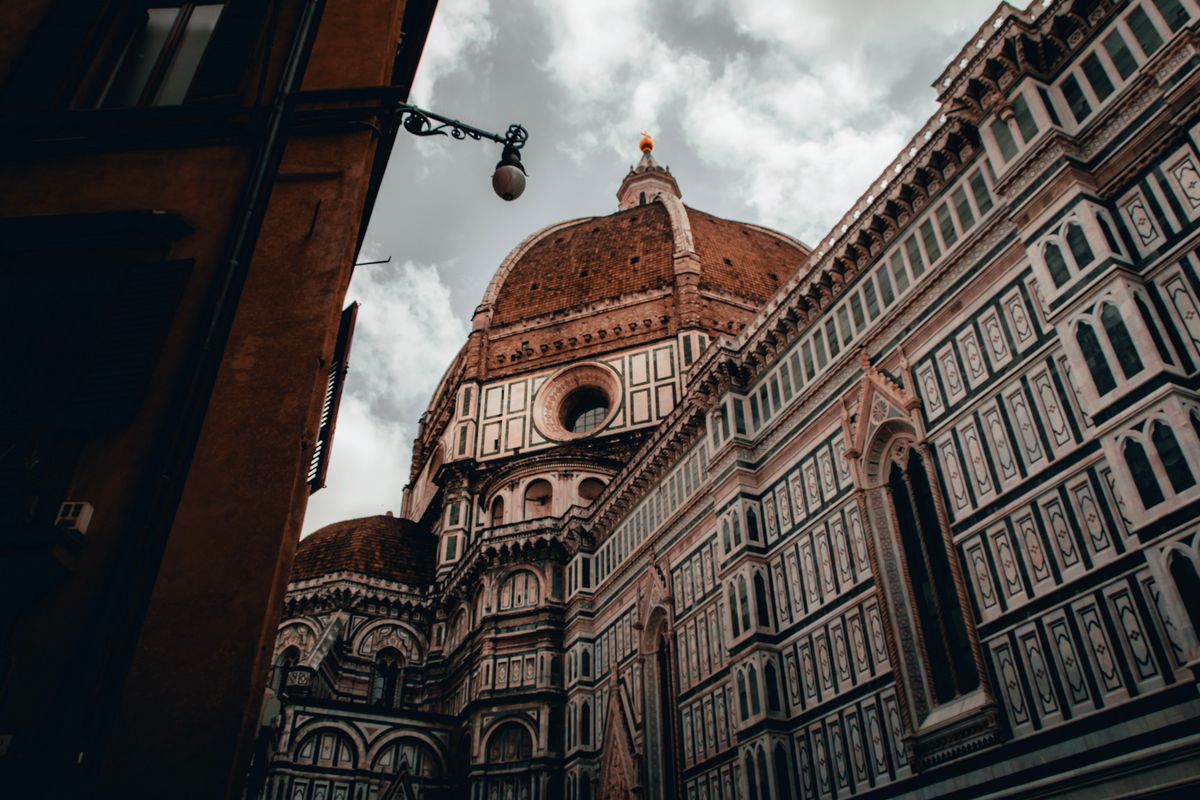
Florence Duomo Quick Facts (2026)
| Detail | Information |
|---|---|
| Official name | Cattedrale di Santa Maria del Fiore |
| Construction | 1296-1436 (cathedral); facade 1871-1887 |
| Architects | Arnolfo di Cambio, Francesco Talenti, Filippo Brunelleschi, Emilio De Fabris |
| Length | 153 meters (502 feet) |
| Dome height | 114.5 meters (376 feet) from ground |
| Dome diameter | 45.5 meters (149 feet) |
| Steps to dome | 463 |
| Steps to bell tower | 414 |
| Cathedral entrance | Free (Porta della Mandorla, north side) |
| Brunelleschi Pass | €30 (all monuments + dome climb) |
| Giotto Pass | €20 (all monuments except dome) |
| Ghiberti Pass | €15 (Baptistery, Crypt, Museum only) |
| UNESCO designation | 1982 (Historic Centre of Florence) |
A Brief History of Florence Cathedral
By the late 13th century, Florence had outgrown its old cathedral, the modest Santa Reparata. The republic was rich, ambitious, and determined to surpass rivals like Pisa and Siena, both of which had built grand cathedrals. In 1294, the city commissioned Arnolfo di Cambio—who had already designed the Palazzo Vecchio and Santa Croce—to draft plans for a new cathedral that would be the largest in Christendom. The first stone was laid on September 8, 1296, the feast of the Nativity of the Virgin Mary, after whom the church would be dedicated as Santa Maria del Fiore (Saint Mary of the Flower)—a reference to the lily, Florence’s emblem.
Arnolfo died around 1302, and construction stalled. After plague outbreaks and a series of architects—including Giotto, who designed the bell tower in 1334—the cathedral’s nave was finally finished by 1380. But the most ambitious feature, an enormous octagonal dome over the crossing, remained an unsolved engineering problem. The opening was 45.5 meters wide, far too large to span with traditional Gothic methods using interior wooden centering. Roman concrete techniques had been lost. For four decades, the cathedral stood roofless at its eastern end, a stone shell waiting for someone to figure out how to cap it.
In 1418, the cathedral’s wool guild (the Arte della Lana, which oversaw construction) announced a public competition for a dome design. A goldsmith and clockmaker named Filippo Brunelleschi presented a radical solution: a double-shell dome with no internal scaffolding, built using a self-supporting herringbone brick pattern and rings of stone and iron to manage outward thrust. He refused to share full details, fearing his ideas would be stolen, and was paired with rival Lorenzo Ghiberti as co-supervisor. By 1436, when Pope Eugenius IV consecrated the cathedral, Brunelleschi’s dome had been completed—a 37,000-ton miracle of engineering that has stood for nearly 600 years.
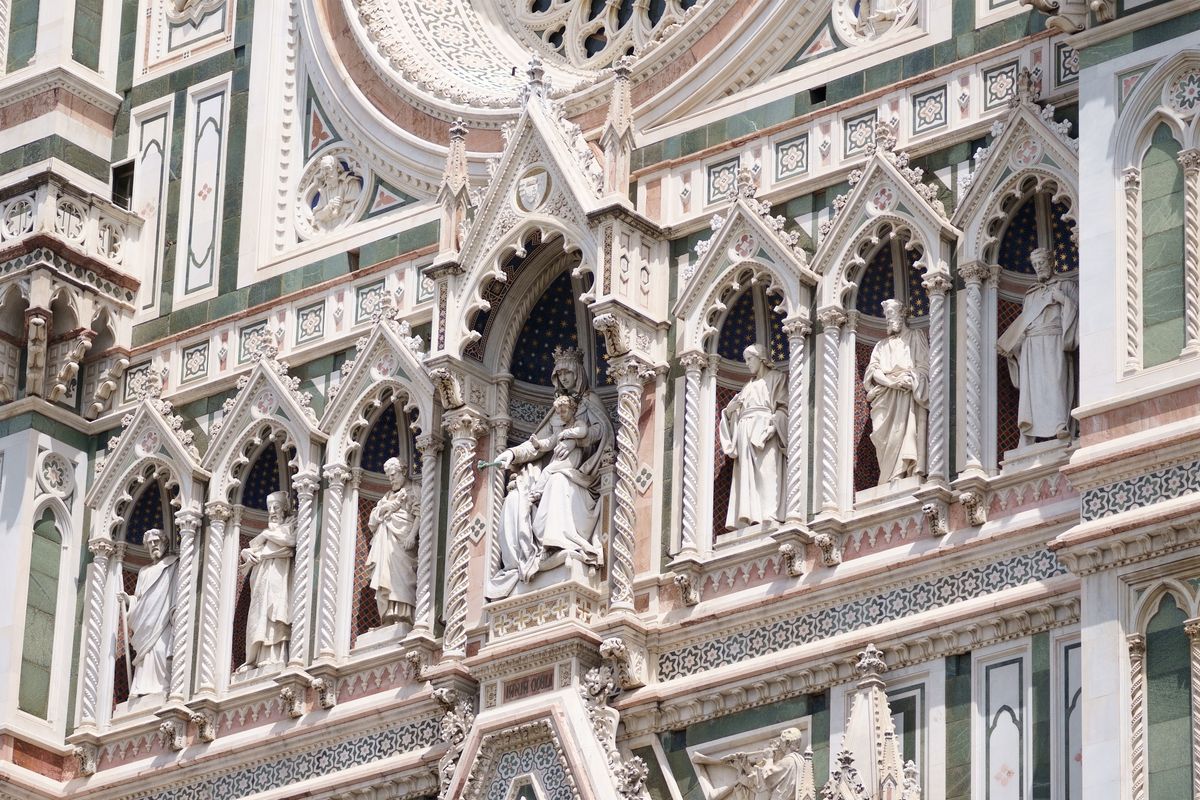
The cathedral’s exterior remained unfinished for another four centuries. The original facade by Arnolfo was dismantled in 1587 by the Medici, who planned a grander replacement that never materialized. The current Neo-Gothic facade, designed by Emilio De Fabris with three colors of Tuscan marble—white Carrara, green Prato (verde di Prato), and pink Maremma (rosso di Maremma)—was built between 1871 and 1887, completing the cathedral nearly 600 years after Arnolfo first laid its foundation stone.
Florence Duomo Tickets and Passes (2026 Pricing)
Entry to the cathedral itself is free, but the dome climb, Baptistery, Bell Tower, Crypt, and Cathedral Museum require a ticket. Rather than buying separate tickets, the Opera del Duomo sells three combined passes (named after the three architects most associated with the complex). All passes are valid for 3 days from first use, except the Brunelleschi Pass which can be activated for the dome climb at a specific reserved time.
| Pass | Adult Price | What’s Included |
|---|---|---|
| Brunelleschi Pass | €30 | Dome climb (timed entry) + Baptistery + Bell Tower + Crypt + Museum |
| Giotto Pass | €20 | Bell Tower + Baptistery + Crypt + Museum (NO dome) |
| Ghiberti Pass | €15 | Baptistery + Crypt + Museum only (no climbing) |
Children 6-11 receive reduced rates (€12 Brunelleschi, €7 Giotto, €5 Ghiberti). Children under 6 enter free but are not allowed on the dome climb for safety reasons. EU residents under 18 also get reduced rates. The Brunelleschi Pass is the most popular option and the only way to climb the dome, but it requires you to book a specific time slot for the dome climb—the rest of the monuments are flexible within the 3-day validity. If you only want to see the inside of the Duomo and skip the climbs, the Ghiberti Pass at €15 is the budget option that still gets you into the spectacular Baptistery and the often-overlooked but excellent Cathedral Museum.
Buy tickets online in advance at duomo.firenze.it or via the official Opera del Duomo app. Brunelleschi Pass dome slots sell out 1-2 weeks ahead in summer—book at least 10 days in advance from May through September, longer for early-morning or late-afternoon slots which have the best light for photography. The combined ticket office is at Piazza San Giovanni 7, opposite the Baptistery, and there’s a “fast pass” pickup if you’ve prepaid online.
Opening Hours and Best Time to Visit
| Site | Hours |
|---|---|
| Cathedral interior | Mon-Sat 10:15-16:45; Sun 13:30-16:45 (closed during Mass) |
| Brunelleschi Dome | Mon-Fri 8:15-19:30; Sat 8:15-17:15; Sun 12:45-17:15 |
| Bell Tower (Giotto) | Daily 8:15-19:30 |
| Baptistery | Mon-Sat 8:15-19:30; Sun 8:15-13:30 |
| Crypt of Santa Reparata | Mon-Sat 10:15-16:45 (closed Sunday) |
| Cathedral Museum | Daily 8:30-19:45 (last entry 19:00) |
The cathedral interior is closed to tourists during religious services. On Sunday mornings (until 13:30), Catholic Mass is celebrated and only worshippers may enter through a side door. Special closures occur on Christmas, Easter, and the Feast of the Annunciation (March 25, the Florentine New Year in the old calendar). The dome and bell tower close on January 1, Easter Sunday, the Feast of San Giovanni (June 24, Florence’s patron saint), and Christmas. Always check duomo.firenze.it before visiting on a holiday.
The best time to climb the dome or bell tower is the first slot of the day (8:15) or the last hour before closing—lower temperatures, fewer people, and dramatic light. Midday in summer can be brutal: the dome interior climb has no air conditioning, the masonry retains heat, and 463 steps in 35°C feels much hotter. For photographing the cathedral exterior, golden hour (about 30 minutes before sunset) lights the marble dramatically; the best vantage points are the Bell Tower itself, Piazzale Michelangelo, or the rooftop bar of the Hotel Cavour.
Inside the Cathedral: What to See
After the spectacle of the exterior, the cathedral’s interior is famously austere. The Florentines spent their decorative budget on the outside; inside, the vast Gothic nave (153 meters long, 38 meters wide) feels surprisingly empty—a deliberate aesthetic choice that emphasizes scale and verticality. Most movable artworks have been transferred to the Cathedral Museum to preserve them, but several monumental works remain in situ.
The Last Judgment Frescoes
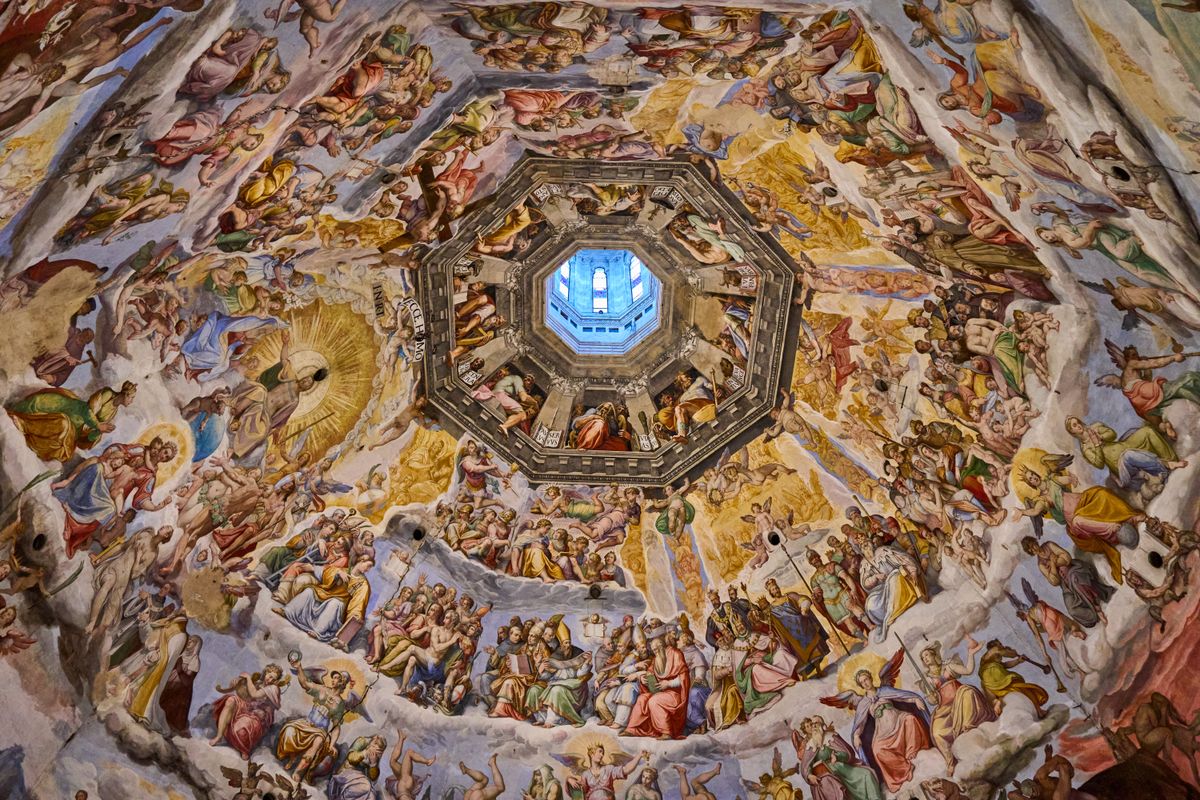
The most spectacular feature visible from the cathedral floor is the fresco cycle covering the inside of Brunelleschi’s dome. Commissioned by Cosimo I de’ Medici in 1572 and painted by Giorgio Vasari and Federico Zuccari between 1572 and 1579, the Giudizio Universale (Last Judgment) covers 3,600 square meters—one of the largest frescoes ever created. The composition is divided into six concentric bands: angelic choirs at the top around Christ in glory, the elders of the Apocalypse, personifications of the gifts of the Holy Spirit, the beatitudes, saints and martyrs, and at the bottom, the damned descending into Hell. Vasari died in 1574 with only a portion finished; Zuccari completed the rest in a darker, more mannerist style. The contrast between the two artists’ sections is visible from the dome’s interior gallery, accessed during the climb.
The Florentine Pavement
The cathedral floor, designed in the 16th century by Baccio d’Agnolo and Francesco da Sangallo with later additions, is an underrated masterpiece of Renaissance pavement art. Made from inlaid colored marbles in geometric patterns and floral motifs, it cost more than the entire 19th-century facade. The best views are from the elevated areas near the choir, but visitors are usually kept to a marked path to preserve the marble.
Funerary Monuments and Frescoes
Look for two famous “equestrian” frescoes on the left aisle—monochrome images of military leaders painted to imitate sculpture. Paolo Uccello’s Funerary Monument to Sir John Hawkwood (1436) commemorates an English mercenary captain who served Florence; the perspective experiments here were revolutionary for their time. Beside it, Andrea del Castagno’s Niccolò da Tolentino (1456) is a more dramatic composition. Further along, Domenico di Michelino’s 1465 painting Dante and His Poem shows the poet holding the Divine Comedy with Florence and Mount Purgatory in the background—a key image in Florentine identity.
The Clock
Above the main entrance is a fascinating hour-clock painted by Paolo Uccello in 1443. It runs counterclockwise on the Italian system (where 24 hours begin at sunset), with a single hand and dramatic prophet portraits at the corners. It’s still operational—one of the oldest functioning clocks of its kind in the world.
Climbing Brunelleschi’s Dome
The dome climb is the unforgettable experience of any Florence trip. Entry is at the Porta della Mandorla on the cathedral’s north side, and the climb takes 30-45 minutes including time at the top. The route ascends 463 steps through the space between Brunelleschi’s two shells—the inner dome you see from the cathedral floor and the outer terracotta dome visible from outside. About halfway up, the route emerges onto an interior balcony that runs around the base of the cupola, giving the closest possible view of the Vasari frescoes (you can read the names of the painters scratched into the wet plaster from over 400 years ago).
From there, the climb gets steeper as you wind through the curving space between the shells, ascending narrow staircases that follow the dome’s geometry. The last section is a tight spiral staircase. You emerge at the lantern at the top of the dome (the marble cap with the spiral lantern that crowns the structure), where a 360-degree platform offers what is unanimously considered the best panoramic view of Florence. Descend the same way you came up; allow at least 90 minutes total for the experience including waiting and the descent.
Important practical notes: there is no elevator and no alternative route; the climb requires reasonable mobility. Anyone with claustrophobia should reconsider—some sections are narrow and the descent passes through people climbing up. Children under 6 are not permitted; children 6 and older must be accompanied. There are no toilets en route; use them at the base before entering. Bring water (you’ll be hot at the top in summer) but no large bags—small backpacks only. We cover the dome climb in detail in our dedicated Brunelleschi Dome climb guide.
Giotto’s Bell Tower (Campanile)
The 84.7-meter bell tower beside the cathedral was designed by Giotto in 1334 (he died in 1337 with only the lowest level finished) and completed by Andrea Pisano and Francesco Talenti by 1359. Its colored marble paneling matches the cathedral and creates a unified composition. The exterior features two registers of relief sculptures—originals are in the Cathedral Museum, replicas remain on the building—depicting the Creation, biblical scenes, the planets, the virtues, the liberal arts, and the seven sacraments, an encyclopedia in stone of medieval thought.
Climbing Giotto’s Bell Tower involves 414 steps (49 fewer than the dome) on a more standard staircase—square in plan, not narrowing into the cone of a dome. Each level has a viewing platform: the first looks at the cathedral itself, the second offers wider city views, and the top gives the iconic photograph of the Duomo with the Brunelleschi dome in the foreground. Many visitors actually prefer the Bell Tower for photography because you’re looking at the dome from outside, while from atop the dome you can’t see the dome itself. Both climbs are included in the Brunelleschi Pass; if you have to pick one, climb the dome and photograph from the bell tower terrace if you have time.
The Baptistery and the Gates of Paradise
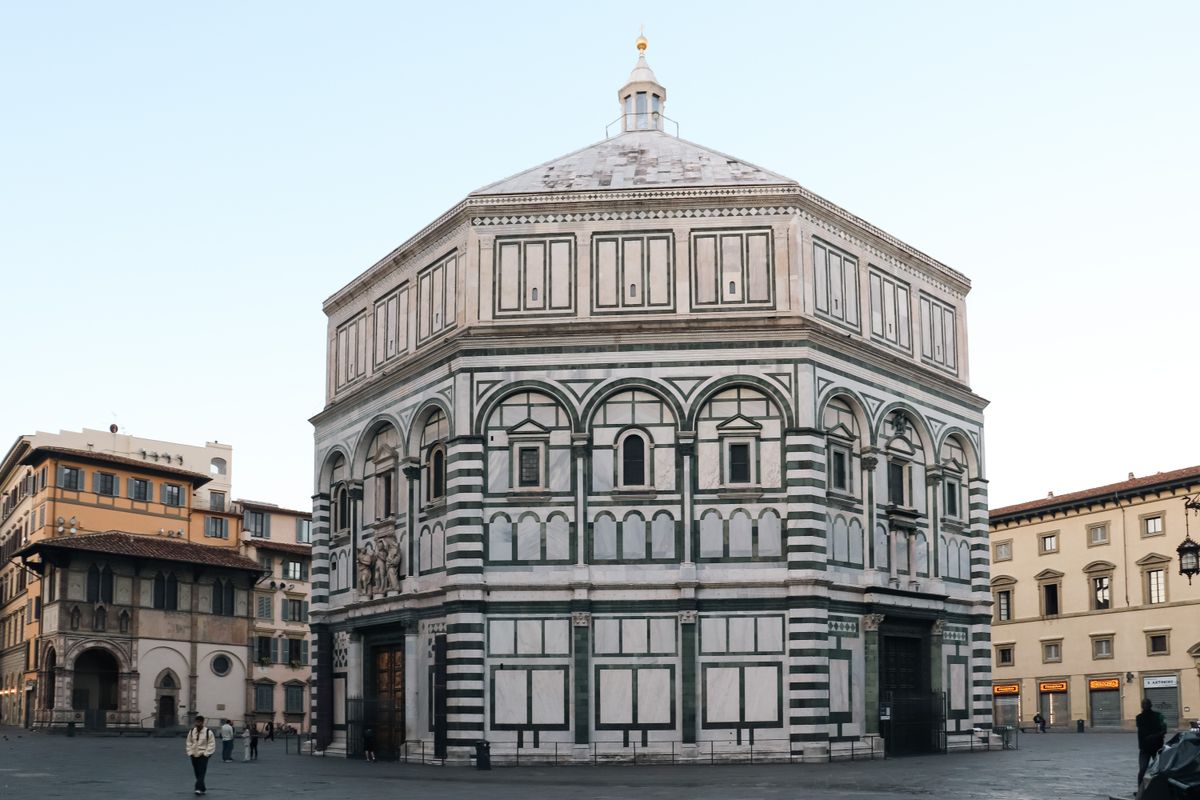
Across from the cathedral entrance stands the Battistero di San Giovanni, the oldest building in the complex. Its octagonal Romanesque structure of green and white marble dates to the 11th century (consecrated 1059), though some scholars believe parts may go back further. For centuries, the Florentines—including Dante—were baptized here; even into the 19th century, all Catholic babies in the city received their first sacrament inside this building.
The Baptistery is famous for three sets of gilt bronze doors. The south doors (the oldest, by Andrea Pisano, 1330-1336) depict the life of John the Baptist. The north doors by Lorenzo Ghiberti (1403-1424) show New Testament scenes—Ghiberti won the famous 1401 competition that included Brunelleschi as a finalist (Brunelleschi was so frustrated by the loss that he left for Rome and ultimately developed the dome solution). But Ghiberti’s masterpiece is the east doors (1425-1452), which Michelangelo christened the Porte del Paradiso—the Gates of Paradise—because they were so beautiful they belonged at heaven’s entrance. Ten panels depict Old Testament scenes in Renaissance perspective, with figures in deep relief that practically emerge from the bronze. The doors at the Baptistery today are precise replicas; the original Gates of Paradise are displayed in the Cathedral Museum and are unmissable.
Inside the Baptistery, look up. The octagonal dome is covered with 13th-century Byzantine-style mosaics depicting the Last Judgment, the lives of John the Baptist and Joseph, and Genesis stories. They cover over 1,000 square meters and include a fearsome eight-meter-tall Christ in Majesty over a mouth of Hell. The interior is small but visit time should not be rushed—the mosaics reward sustained looking.
Crypt of Santa Reparata
Beneath the cathedral floor, accessed by stairs in the right aisle, lie the excavated remains of Santa Reparata, the early Christian church that occupied this site from the 4th-5th century until it was demolished to make way for the new cathedral in the 14th century. Excavations from the 1960s-70s revealed Roman pavements, paleochristian mosaics, medieval frescoes, and tombs—including Brunelleschi’s grave (he was the only person allowed burial inside the cathedral after its consecration). The crypt is small (allow 20-30 minutes), poorly lit (deliberately, to evoke its underground nature), and frequently bypassed—but for anyone interested in Florentine history before the Renaissance, it’s a quiet, rewarding stop. The Brunelleschi tomb is on the right, marked by a small slab.
The Cathedral Museum (Museo dell’Opera del Duomo)
Reopened in 2015 after a major renovation, the Cathedral Museum at Piazza del Duomo 9 (just behind the apse of the cathedral) is one of the great underrated museums in Florence. It houses the original sculptures and artworks once in or on the cathedral, Baptistery, and Bell Tower—removed for preservation and replaced outside with replicas. The collection is small enough to see in 90 minutes but contains some of the most important Renaissance works in existence.
Highlights include: Michelangelo’s Bandini Pietà, an unfinished late work the artist intended for his own tomb (he became frustrated and broke the figure of Christ; the museum displays it in dedicated lighting). Donatello’s Mary Magdalene, a haunting wood carving of an emaciated, ravaged ascetic that may be the most psychologically intense Renaissance sculpture. The original Gates of Paradise, restored and displayed in climate-controlled cases—you can see Ghiberti’s signature panel, the perspective experiments, and the gilding. The reconstructed cathedral facade hall (Sala del Paradiso), featuring the original 14th-century Arnolfo statues that once stood on the medieval facade, is staged at full scale to show how the cathedral looked before the 19th-century rebuild. The museum is included in all three duomo passes—skip it at your loss.
Dress Code and Visitor Rules
Florence Cathedral and the Baptistery are active places of worship, and the dress code is enforced. Shoulders must be covered; shorts or skirts must reach the knees. Sleeveless tops, miniskirts, and gym shorts will be turned away at the door. Hats must be removed inside. The Bell Tower and dome climbs have no dress code (it’s a workout, not a religious site), but bring a layer for the Bell Tower top platform—it can be windy and cool even in summer. Photography without flash is generally allowed in the cathedral and the dome climb; tripods and selfie sticks are not. Silence is requested in the cathedral and Baptistery.
How to Get to Florence Duomo
The Duomo is in Florence’s exact historic center, a 10-minute walk from Santa Maria Novella station, 5 minutes from the Uffizi, 8 minutes from Ponte Vecchio. The historic center is largely pedestrianized, so most visitors arrive on foot. From the airport, taxi or tram (T2 line) to Santa Maria Novella, then walk. The Duomo has no parking; if you’re driving, park outside the ZTL (limited traffic zone) at Santa Maria Novella underground or Parterre, then walk in.
The closest train stops are Santa Maria Novella (main station, 10 min walk) and the smaller Firenze Campo di Marte. ATAF buses 14, 23, and C1 all run within a block of the Duomo. For accessibility, most of the cathedral and the Baptistery interior are wheelchair-accessible at ground level (entrance via Porta dei Canonici, south side of cathedral); the dome and bell tower climbs are not. The Cathedral Museum has elevators throughout.
Where to Eat and Stay Near the Duomo
The streets immediately surrounding the Duomo are dense with mediocre tourist restaurants—avoid anything with photos in the menu. For a quick bite that’s actually good, walk 3-4 minutes south to Via dei Servi for All’Antico Vinaio’s stuffed schiacciate or 5 minutes north to Trattoria Mario for traditional Tuscan lunch (cash only, no reservations, lines start at 12:00). For coffee with a view, the rooftop bar at Hotel Cavour or the cafe at La Rinascente department store both face the dome at eye level.
For accommodation in the Duomo area, expect to pay €250-€400 per night in high season for mid-range hotels with cathedral views. Hotel Cavour, Hotel Brunelleschi (built around an actual medieval tower), and Hotel Davanzati are well-reviewed mid-range options. For luxury, the Helvetia & Bristol or Four Seasons (a 15-minute walk away in the Borgo Pinti district) are top-tier. Budget travelers can find better value 10-15 minutes from the Duomo in San Frediano or San Niccolò.
Florence Duomo Itinerary Suggestions
If You Have 3 Hours (Brunelleschi Pass)
Arrive at 8:00 for first dome climb slot. Climb the dome (90 min including descent). Visit the cathedral interior briefly. Cross to the Baptistery (30 min). Have lunch nearby. Return for the Cathedral Museum (90 min). Skip the Bell Tower if pressed for time.
If You Have a Full Day (Brunelleschi Pass)
Climb the dome at 8:15 (90 min). Visit the cathedral interior and Crypt (45 min). Lunch break. Cathedral Museum (90 min). Bell Tower around 15:00 for afternoon light (60 min). Baptistery before closing (30 min).
If You’re Skipping the Climbs (Ghiberti Pass)
Cathedral interior (free, 30 min) → Baptistery (30 min) → Crypt (20 min) → Cathedral Museum (90 min). All in 3 hours, perfect for travelers with limited time or mobility issues.
Frequently Asked Questions
Is entrance to Florence Cathedral free?
Yes, entrance to the cathedral interior is free. However, you must enter through specific doors at specific times, and you need a paid ticket (Brunelleschi, Giotto, or Ghiberti Pass) to access the dome, bell tower, Baptistery, Crypt, or Cathedral Museum.
Do I need to book Florence Duomo tickets in advance?
Yes, especially the Brunelleschi Pass with the dome climb time slot. Book 1-2 weeks in advance from May through September, longer for early-morning or late-afternoon slots. Tickets only for the cathedral interior are not needed (it’s free). Buy at duomo.firenze.it.
How many steps to climb Brunelleschi’s dome?
463 steps. The climb takes 30-45 minutes one way; allow at least 90 minutes including the descent and time at the top. There is no elevator. The route is narrow, windowless in places, and not suitable for people with claustrophobia or significant mobility issues.
What’s the difference between the Brunelleschi Pass and Giotto Pass?
The Brunelleschi Pass (€30) includes the dome climb and all other monuments; the Giotto Pass (€20) includes everything except the dome. If you want to climb to the top of the dome (the unique experience), you must buy the Brunelleschi Pass. The Giotto Pass is for visitors who want to see the cathedral, climb the bell tower, and visit the Baptistery and museum but not the dome itself.
Is there a dress code at the Florence Duomo?
Yes. Shoulders must be covered (no tank tops or sleeveless dresses) and shorts/skirts must reach the knees. Hats must be removed indoors. The dress code is enforced—visitors who don’t comply will be turned away. The same rules apply to the Baptistery. The bell tower and dome climbs do not require modest dress.
Can I climb both the dome and the bell tower in one day?
Yes, both climbs are included in the Brunelleschi Pass, and you can do them on the same day if you’re physically able—they’re 877 steps total. Most visitors find one climb tiring and space them across two days. If you can only do one, climb the dome (it’s the iconic Florence experience) and photograph it from elsewhere (Piazzale Michelangelo or the rooftop of La Rinascente).
What is the best time to visit Florence Duomo to avoid crowds?
The first dome climb slot at 8:15 has the smallest crowds and best light. Visit the cathedral interior right when it opens at 10:15. Avoid weekends in spring and autumn and the entire June-August window if possible. Winter (November-February) sees significantly fewer visitors and is the most pleasant time for a relaxed visit, though some afternoons close earlier.
Are children allowed to climb the dome?
Children must be 6 or older to climb Brunelleschi’s dome and must be accompanied by an adult. The Bell Tower has the same rule. The cathedral, Baptistery, Crypt, and Museum are accessible to all ages including babies and strollers.
How long should I plan for visiting the Duomo complex?
For the full Brunelleschi Pass experience (dome + bell tower + cathedral + Baptistery + crypt + museum), plan for a full day or split across two days using the 3-day pass validity. A more focused visit (cathedral interior + dome + Baptistery + museum, skipping the bell tower) takes about 4-5 hours. The free cathedral interior alone takes 30-45 minutes.
Why is Florence Cathedral called Santa Maria del Fiore?
“Saint Mary of the Flower”—the flower being the lily, Florence’s emblem, which appears on the city’s coat of arms. The dedication was set in 1296 when construction began. “Duomo” is simply the Italian word for cathedral (derived from Latin domus, “house [of God]”), and is used colloquially for any major Italian cathedral.


