This article contains advertising. Booking links on this site can be turned into paid links automatically by our partner Travelpayouts: if you book through one, we earn a commission from the provider, at no extra cost to you. It never affects what we recommend. Affiliate disclosure
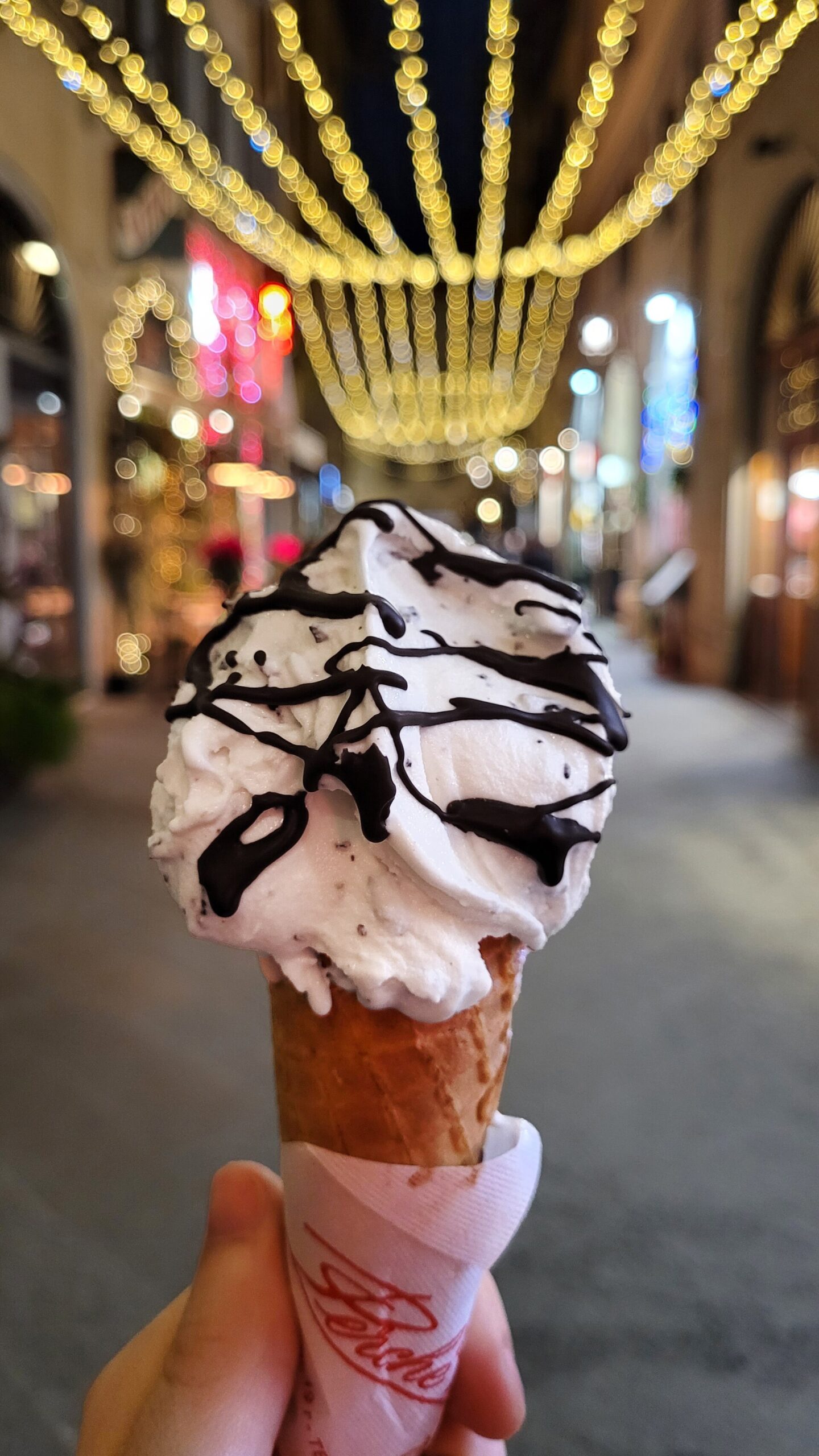
The best gelato in Florence isn’t difficult to find if you know what to look for — and almost impossible to find if you don’t. Florence has a deep gelato tradition (Florentine tradition credits Bernardo Buontalenti, the Renaissance architect who built the Boboli Grotto, with creating gelato for the Medici court in 1565), and at Vivoli the same family is now in its fourth generation behind the counter. The catch: along the Duomo and Ponte Vecchio strips, dozens of tourist-trap gelaterias serve industrial gelato dressed up in tall, brightly-coloured towers and synthetic-banana-yellow bowls. This 2026 guide tells you exactly where to find authentic gelato in Florence, what the visual and texture markers of real gelato are, the must-order flavours, and the local-favourite gelaterias that haven’t yet been overrun by tour groups.
For broader food context see our Florence Food Guide pillar; for restaurant lists see Best Restaurants in Florence.
Gelato is a walking food in Florence, which makes it the natural companion to a self-guided walking route or an evening climb to one of the panoramic viewpoints. It also survives bad weather better than you would expect — see our rainy day guide.
What is real gelato?
Gelato is technically a category of frozen-dairy dessert with three core differences from American ice cream:
- Lower fat content — gelato carries less milkfat than ice cream. The lower fat lets fruit and chocolate flavours come through more vividly.
- Lower overrun — overrun is the air whipped into frozen dessert. Industrial ice cream is whipped with far more air than real gelato. The result is denser, more elastic, more intensely flavoured.
- Warmer serving temperature — gelato is served a few degrees warmer than ice cream. The warmer temperature lets it spread on the spoon and release flavour faster.
An honest artisan gelateria (“gelateria artigianale”) in Florence:
- Makes gelato fresh on the premises, daily, in small batches.
- Uses fresh fruit, real chocolate, dairy from local farms — no powdered bases or pre-mixed industrial syrups.
- Rotates flavours seasonally (no fresh strawberry in January, no fresh fig in March).
- Stores gelato in stainless-steel pozzetti (covered round tubs) below the counter, or under a hinged metal lid, rather than in the tall plastic mountains visible through glass.
- Has natural-coloured gelato — pistachio is muted khaki-green, not fluorescent green; banana is creamy yellow-grey, not banana-paint yellow; mint is white-grey, not minty teal.
- Charges €2.50–€4.50 for a small cup or cone (one or two scoops).
How to spot tourist-trap gelato
Florence has dozens of “gelaterias” along Via dei Calzaiuoli, around the Duomo and on Via Por Santa Maria approaching Ponte Vecchio that serve industrial gelato to time-pressed tourists. Telltale signs:
- Tall fluorescent mountains in glass display cases. Real gelato is too dense to hold those tall whipped peaks; the tall format requires industrial overrun and stabilisers.
- Banana yellow that’s actually yellow. Real banana gelato is grey-cream because banana flesh oxidises. If it’s banana-paint yellow, it’s flavoured industrial base.
- Pistachio that’s bright green. Real pistachio is muted khaki-green or even brown-green. Bright green = synthetic colouring.
- Mint that’s teal. Real mint gelato is white-grey with mint specks. Teal-coloured mint is dye.
- Smurf-blue “blue raspberry” or “bubble gum” — these are industrial flavours, not Italian.
- “Pre-portioned” cones served already-loaded in a refrigerator case — real gelato is scooped to order.
- Cones offered free with every order — many gelaterias sell only cups (Vivoli explicitly does so) or charge for cones; tourists’ free-cone-with-purchase is a marketing trick.
- Open into the small hours with no queue — artisan gelaterias make fresh batches through the day and tend to shut earlier in the evening.
- Aggressive English-only barkers outside — authentic gelaterias don’t need barkers.
Vivoli — one of Florence’s oldest gelaterias
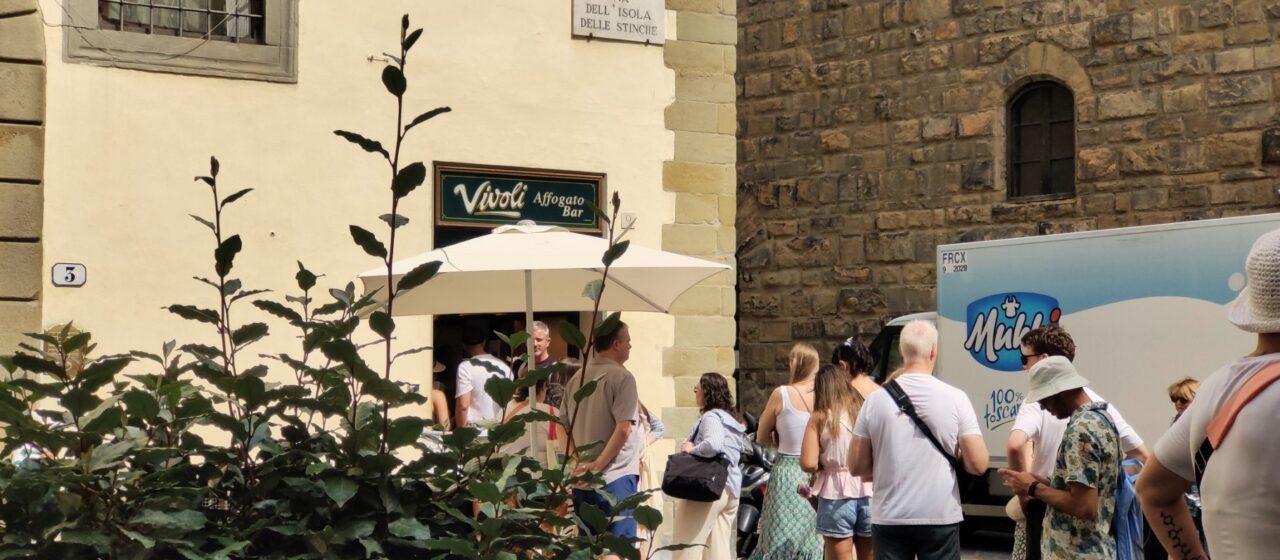
Via Isola delle Stinche 7r, near Santa Croce. Since 1929, when it opened as a dairy; gelato followed in 1932, and four generations of the same Vivoli family have run it.
The order: a small cup (Vivoli serves no cones — the founder believed cones detract from flavour). Best-known flavours: riso (rice gelato — like rice pudding frozen), fragolina (wild-strawberry, June–September), crema (egg-cream), meringa (meringue). The affogato (espresso poured over a scoop of crema gelato) is the signature dessert. Around €4 for a small cup; €5 for a medium.
Vivoli’s cake counter sells slices for take-home (chocolate, ricotta, ricotta-and-fig).
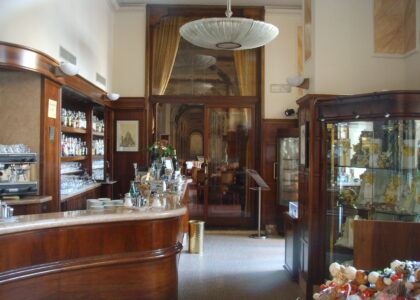
The shop is small. Closed Mondays. The decor hasn’t changed in decades — wooden counters, vintage Italian gelato signage. A genuine institution.
La Carraia — the Oltrarno favourite
Piazza Nazario Sauro 25r, Oltrarno, at the southern end of Ponte alla Carraia. The bridge gives the gelateria its name. Making and selling gelato here since 1990.
The proposition: €1.50 small cup or cone; €2.50 medium; €4 large. Flavours change with the seasons. Standout creations: delizia La Carraia (white chocolate and pistachio), marmo di Carraia (panna cotta with chocolate-waffle pieces), biscotto (cookies-and-cream done correctly), cioccolato fondente (rich dark chocolate).
Open daily 11:00–00:00; winter hours are 11:00–22:00. A second branch on Via dei Benci near Santa Croce (technically over the river, but with the same family’s gelato).
8 more excellent Florence gelaterias
Gelateria della Passera (Oltrarno)
Tiny shop on Piazza della Passera, Oltrarno. Small batches; intense flavours. Standouts: rosmarino-miele (rosemary-honey), pera-caramello (pear-caramel), cioccolato (chocolate). €3 a small cone. The regulars love it.
Perché No! (centro storico)
Via dei Tavolini 19r, near Piazza della Repubblica. Since 1939. Long pedigree. Pistachio specialist; their pistacchio di Bronte uses certified Sicilian pistachios; arguably the city’s best. Also strong on caffè (coffee), cassata siciliana, nocciola (hazelnut). €3.50–€5 per cone.
Gelateria de’ Medici (north of centre)
Via dello Statuto 3-5r, slightly outside the historic centre but a Florentine-favourite. Strong on nocciola, fior di latte and melone (cantaloupe melon, in summer). €3 a cone.
Gelateria Edoardo (centro storico)
Piazza del Duomo 45r, across from the cathedral. Biological / organic gelato; certified organic milk and seasonal organic fruit. Strong dairy-free and vegan options.
My Sugar (north of centre)
Via dei Ginori 49r, near San Lorenzo. Newer (2010s), smaller, and beloved by locals for inventive flavours. Try basilico-limone (basil-lemon), mandorla-pistacchio (almond-pistachio), and any of the rotating chocolate-cream combinations. €3 small cone.
Gelateria Cavini (north-east)
Old-school neighbourhood gelateria; less famous outside the locals’ circuit. Strong classic flavours; €2.50 small cone.
Gelateria dei Neri (Santa Croce)
Another solid Santa Croce option. Big portions; €3.50 cone. Often crowded with after-Antico-Vinaio sandwich crowds.
Le Botteghe di Leonardo
Slightly more touristy than the artisan-only places but consistently good. €3.50–€5 per cone.
Must-try flavours in Florence
Cream-based flavours
- Crema — egg-cream gelato; the test of the gelateria. Should taste of fresh egg yolk and milk, not sugar.
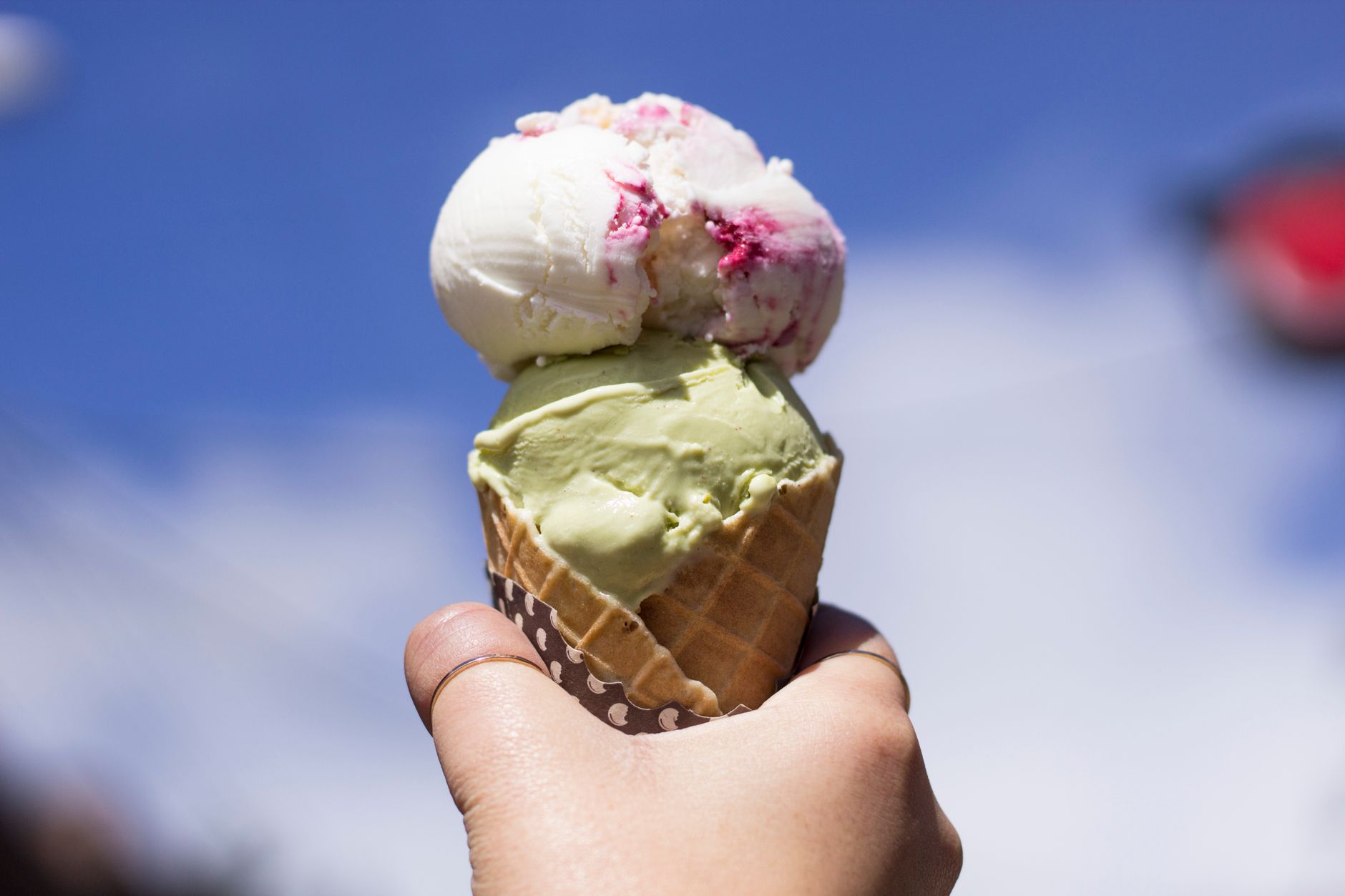
- Pistacchio di Bronte — certified Sicilian pistachios; muted green, intensely nutty.
- Nocciola — hazelnut from Piedmont; richer than pistachio, deeply aromatic.
- Cioccolato fondente — dark chocolate; should taste of cocoa more than sugar.
- Stracciatella — fior di latte (sweet milk) base with chocolate shavings.
- Fior di latte — pure sweet milk, no flavour added; the gelato equivalent of a chef’s tasting his own butter.
- Bacio — chocolate-hazelnut.
- Tiramisu — coffee-mascarpone-cocoa; works as a frozen dessert.
- Caffè — espresso gelato.
- Riso — rice gelato (the Vivoli signature); like rice pudding frozen.
Fruit-based flavours (seasonal)
- Fragola / fragolina — strawberry / wild strawberry; June–September only.
- Melone — cantaloupe; July–August.
- Pesca — peach; July–August.
- Limone — Sicilian lemon; year-round.
- Frutti di bosco — mixed berries; June–September.
- Pera — pear; September–November.
- Mela verde — green apple; autumn.
- Cocomero — watermelon (rare; July–August).
- Mandorla — almond; year-round.
Florentine specialties
- Buontalenti — named after Bernardo Buontalenti, whom Florentine tradition credits with creating gelato for the Medici court in 1565. Several gelaterias serve this; flavour is similar to crema with subtle differences.
- Zuccotto — frozen dessert version of the Florentine cake.
- Cantucci — almond-biscotti gelato; works as a flavour version of the classic dessert.
- Vin santo — sweet-Tuscan-wine gelato; rare but excellent at My Sugar and Gelateria della Passera.
- Rosmarino-miele — rosemary-honey; not a Florentine tradition strictly but the Passera signature.
Gelato with kids
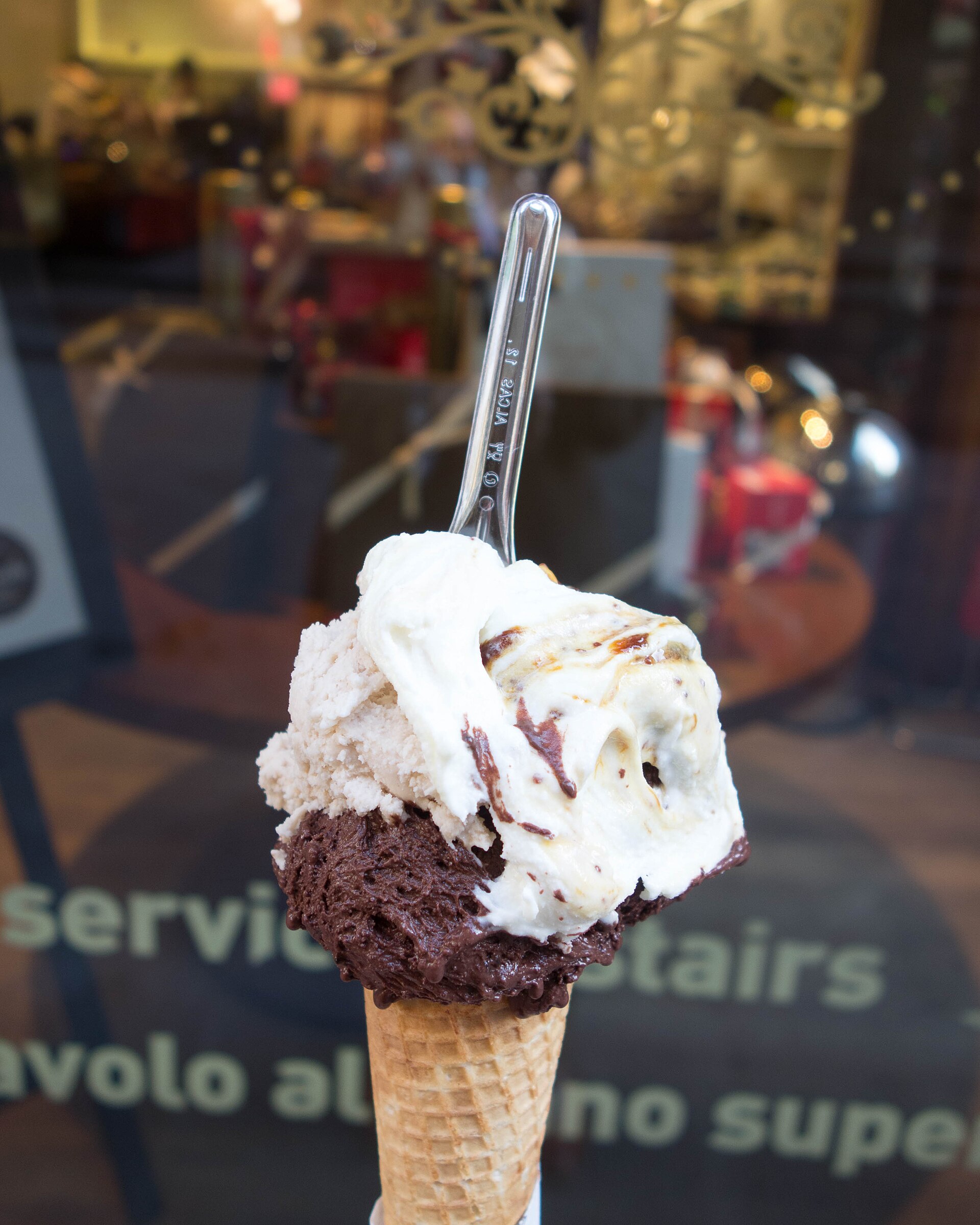
Florence with kids works on a 3-gelato-a-day schedule. Recommendations:
- La Carraia — €1.50 small cones; classic flavours kids actually like (chocolate, vanilla, strawberry), with plenty of choice for picky eaters.
- Vivoli — small cups only (no cones), which suits older kids better than toddlers.
- Edoardo — organic gelato; ask at the counter which flavours suit lactose-intolerant kids.
- Perché No! — old-school feel; the staff often offer kids a free taste-spoon of multiple flavours.
- Le Botteghe di Leonardo — good for spontaneous “we need gelato now” moments.
Tactical note: let small kids order their own at the counter. The “una pallina al cioccolato per favore” interaction (one scoop of chocolate, please) becomes a trip highlight. Have small euro coins ready.
Dairy-free, vegan & sugar-free options
Florence’s gelato scene has gradually expanded its alternative-dietary offerings:
- Sorbetto — water-based fruit gelato; naturally vegan and dairy-free. Available at every gelateria. Ask for “sorbetto” rather than “gelato”.
- Vegan gelato — typically soy- or rice-milk-based. Edoardo (organic) has a strong programme; Carduccio (the vegan Oltrarno restaurant) sells excellent vegan gelato by the cup; Gelateria della Passera has vegan options too, though some of its fruit sorbets contain honey, so ask first.
- Lactose-free — ask at the counter which flavours are lactose-free before you order.
- Sugar-free — rare. Some gelaterias offer “senza zucchero aggiunto” (no added sugar) options sweetened with stevia or fruit; Edoardo and Perché No! occasionally have these.
- Gluten-free — most gelato is naturally gluten-free; the cones are not. Ask for “in coppa” (in a cup) to avoid the wheat cone.
Best gelato by Florence neighbourhood
Centro storico (Duomo cluster)
Perché No! (the pistachio stop). Edoardo (organic). Le Botteghe di Leonardo. Gelateria dei Neri.
Santa Croce / Sant’Ambrogio
Vivoli (the institution). Gelateria dei Neri. Cavini.
Oltrarno (Santo Spirito + San Frediano + San Niccolò)
La Carraia (low prices). Gelateria della Passera (small-batch favourite). My Sugar (technically further north).
San Lorenzo / San Marco
Gelateria de’ Medici (north of the centre but a Florentine local-favourite). Le Botteghe di Leonardo.
SMN station area
Le Botteghe di Leonardo (reliable). Avoid the gelaterias on Via Faenza approaching the station — the most-touristed strip.
Gelato ordering etiquette
- Order at the cashier first in many shops — pay, get a receipt, then take it to the counter for your scoops.
- “Una pallina” = one scoop (literally “a small ball”). “Due palline” = two scoops.
- Cup or cone — “in coppa” or “in cono”. Both usually included in the price; some artisan shops only do cups.
- Choose two flavours per scoop if you can’t decide; serious gelaterias don’t mind.
- Whipped cream on top — “con la panna?” — usually free; nod yes for the full Florentine experience.
- Don’t ask to taste before deciding at a busy artisan shop; small free tastes are often offered to children but rarely volunteered to adults.
- Tipping — not expected at a gelateria.
- Eating the gelato — the streets around the Uffizi are crowded, so step into a side street or sit on a bench.
- Closing times — artisan shops usually wind down earlier than the tourist traps, which keep scooping late because they don’t run out.
A perfect gelato-tasting day in Florence
For travellers serious about gelato, a full-day comparative tasting structure:
11:00 — Vivoli morning
Start at Vivoli for the institution. Order a small cup with crema + riso.
14:00 — Perché No! pistachio test
After lunch, walk to Perché No! Order pistacchio di Bronte plus one chocolate flavour. Compare pistachio quality.
16:30 — Gelateria della Passera
Cross to the Oltrarno. Order rosemary-honey plus pear-caramel. Small-batch artisan format.
19:00 — La Carraia evening
Finish at La Carraia on Piazza Nazario Sauro for a €1.50 cone with delizia La Carraia and marmo di Carraia.
21:30 — Late-night optional
Edoardo across from the Duomo for an organic finish, or a take-home cup from any of the above. Close out at midnight with a final affogato (espresso over crema gelato) at Vivoli if it’s still open.
That’s six gelaterias and 8–12 scoops total. Probably too much; spread across two days for sustainability. €25–€35 per person across the day.
Photographing gelato in Florence
For travellers documenting their food trip:
- Vivoli’s small cup against the gelateria’s wooden counter is the classic shot. Natural light; no flash.
- La Carraia’s piazza setting works at golden hour — the Piazza Nazario Sauro at 19:00 with Ponte alla Carraia in the background.
- A small cup of crema at Vivoli, with the wooden counter behind it, makes a classic Florence-with-gelato shot.
- Affogato at any decent gelateria — the espresso-pour moment is photogenic.
- Avoid the inside of tourist-trap shops with fluorescent gelato towers; the shots look fake (because the gelato is) and the social-media performance falls flat.
- Pistachio close-up — Perché No!’s muted-khaki pistacchio di Bronte against a marble counter shows the difference from industrial bright-green.
Best gelato by trip type
For first-time visitors (3 days)
Vivoli once (the historical institution); La Carraia once (low prices); and one experimental shop — Perché No! or Gelateria della Passera — for variety. Three gelato breaks across three days is plenty.
For families with kids
La Carraia repeatedly (€1.50 cones make repeat visits affordable); Edoardo for organic gelato; Vivoli for a taste of the city’s gelato history. Avoid the queue-heavy late evenings; mid-afternoon (15:00–17:00) is the family-friendly window.
For honeymoons
Vivoli at 11:00 (quiet morning), then a sunset stop at La Carraia after Piazzale Michelangelo, then a digestivo affogato at Vivoli the next afternoon. Three for the trip.
For solo travellers
The artisan small-batch shops are easiest to enjoy solo — Gelateria della Passera and My Sugar specifically. Quick service, no group dynamics, intense flavours that reward attention.
For repeat-Florence visitors
Skip the headliners and explore the second-tier: My Sugar, Gelateria de’ Medici, Cavini, Le Botteghe di Leonardo. The depth becomes obvious; “best gelato” stops being a singular question and becomes a portfolio.
Beyond eating: gelato experiences in Florence
- Gelato-making class at La Carraia — 90 minutes, €60 per person; learn the science of milk fat percentages, overrun and natural flavour bases.
- Mama Florence gelato class — a private gelato-and-biscotti class, priced per booking (€475 on the October 2026 listing); confirm the party size and total before you book.
- Cibreo gelato courses — occasional advanced workshops with Cibreo’s pastry chef. Check availability.
- Self-guided “gelato crawl” — see the day-tasting itinerary above; no booking required.
- Gelato-themed walking tour — Eating Europe and Curious Appetite both run gelato-included food walks.
Florence gelato through the year
Spring (March–May)
The first wild strawberry (fragolina) of the year arrives at the better gelaterias in spring. Spring asparagus and citrus flavours appear at experimental shops like My Sugar.
Summer (June–August)
The full fruit programme: peach, melon, watermelon, fig, plum, raspberry. Some shops stay open until midnight; La Carraia is one. Hot afternoons make gelato breaks essential.
Autumn (September–November)
Fig (fico), pear (pera), grape (uva), green apple (mela verde) come into season. Chestnut (castagne) flavours follow later in the autumn. Pumpkin and squash gelato at experimental shops. Lines are noticeably shorter than summer.
Winter (December–February)
Plenty of gelaterias keep going through the winter, though some artisan shops close for a break in the quieter months. Winter flavours skew toward chocolate-cream-nut combinations rather than fresh fruit. Vivoli runs strong at Christmas; Perché No! reduces its hours but stays open.
A short history of Florence gelato
Modern gelato has Renaissance-Florentine origins. Florentine tradition credits Bernardo Buontalenti — the architect who built the Boboli Grotto — with creating gelato for the Medici court in 1565. A “gelato Buontalenti” flavour named after him is still served at several Florence gelaterias today.
The technique spread first through Italian aristocratic circles, then to Naples and Sicily where it merged with Arab-influenced sorbetto traditions, then to Paris and finally globally. The 19th-century industrial revolution brought ice-cream-making machinery to commercial scale; American ice cream evolved as a higher-fat, higher-overrun cousin in the early 20th century.
Florence’s modern artisan-gelato wave took off in the 1920s and 1930s. Vivoli opened as a dairy in 1929 and started making gelato in 1932. Perché No! followed in 1939. La Carraia opened in 1990, and the 2010s brought a wave of natural-ingredient pioneers: Gelateria della Passera (from 2010), My Sugar, Edoardo and Carapina.
The 2020s have brought a renewed emphasis on local-sourced ingredients — biological milk, single-origin Bronte pistachios, single-estate hazelnuts, fresh seasonal fruit only, no powdered bases.
Best gelato in Florence — FAQ
What is the best gelato in Florence?
Vivoli, a dairy from 1929 and a gelateria since 1932, is one of the city’s oldest; order its affogato. La Carraia on Piazza Nazario Sauro is the Oltrarno pick (€1.50 small cones). Perché No! (since 1939) is the place for pistachio. Gelateria della Passera is the small-batch favourite. Edoardo for organic gelato.
How much does gelato cost in Florence?
€1.50–€2 for a small cup at La Carraia. €3–€4 at Vivoli, Perché No!, Edoardo, della Passera. Tourist-trap gelaterias charge €4–€6 for bigger industrial portions.
How can I tell real gelato from tourist-trap gelato?
Real gelato sits low in stainless-steel pozzetti tubs, not piled high in colourful plastic mountains. Pistachio is muted khaki-green, not fluorescent. Banana is creamy yellow-grey, not yellow. Mint is white-grey, not teal. The shop tends to close earlier than the tourist traps. Scoops are small to medium (€2.50–€4), not huge cones with whipped-cream towers.
Is Vivoli the best gelato in Florence?
Vivoli is the most famous and historic, but “best” depends on flavour priority. Vivoli is the one for rice gelato and crema. La Carraia is the one for low prices. Perché No! wins on pistachio. Della Passera wins on inventive small-batch flavours. All four are excellent in 2026.
Why is Florence gelato better than ice cream?
Less fat lets fruit and chocolate flavours come through. Less air whipped in makes gelato denser and more intensely flavoured. Served a few degrees warmer, it spreads on the spoon and releases flavour faster. The combination is why Italian gelato tastes more vivid than industrial ice cream.
What’s the best Florence gelato for vegetarians and vegans?
Sorbetto (water-fruit-sugar) is naturally vegan and available at every gelateria. For dedicated vegan gelato, Edoardo (organic) and Carduccio (vegan restaurant) have the strongest programmes. Gelateria della Passera usually has vegan flavours on the counter too; ask the staff, as some of its fruit sorbets contain honey.
Should I order gelato in a cup or cone?
Both work, but Vivoli serves only cups. Florentine convention is “una coppetta” (a small cup) for serious tasting because the cone competes with the gelato’s flavour. Cones are fine but less “purist”. Adding panna (whipped cream) on top is normal and usually free.