This article contains advertising. Booking links on this site can be turned into paid links automatically by our partner Travelpayouts: if you book through one, we earn a commission from the provider, at no extra cost to you. It never affects what we recommend. Affiliate disclosure
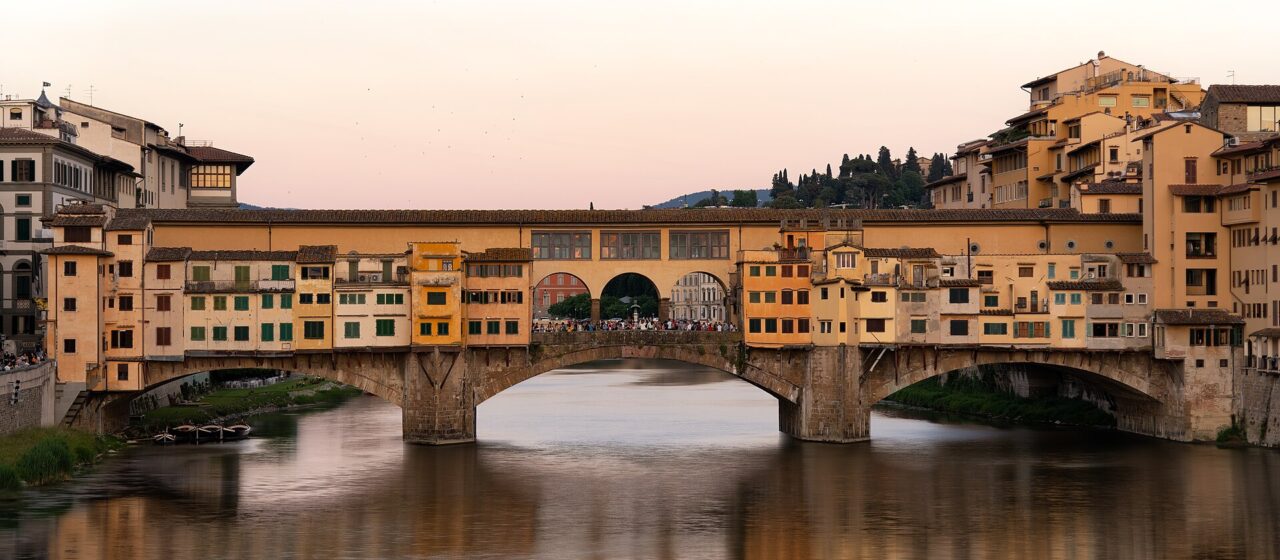
The Ponte Vecchio—literally the “Old Bridge”—is Florence’s most famous landmark after the Duomo and arguably the most photographed bridge in Italy. Built in its current form in 1345, it has stood across the Arno at Florence’s narrowest crossing point for nearly seven centuries, surviving floods, world wars, and tourism alike. Its overhanging shops, the medieval stonework, the elevated Vasari Corridor running along its southern flank, and the way the late afternoon sun glints off the goldsmiths’ windows make it a place that earns every cliché. This complete guide covers Ponte Vecchio’s history, what to see, jewelry shopping on the bridge, the Vasari Corridor, photography tips, and the broader sweep of why this bridge matters.
The bridge has carried goldsmiths since 1593, and the shops are still working jewellers — our Ponte Vecchio jewellery guide explains how to buy there. It is also the best place to stand at dusk, as our sunset spots guide and photography guide both note.
The plain storey with the small square windows above the shops is Vasari’s passage, and it is the reason the bridge sells gold rather than meat. Our Vasari Corridor guide covers what it costs to walk it and whether the view from up there justifies the supplement.
The bridge is stranger from underneath — medieval arches, shops hanging off brackets, and almost nobody looking at you. Our Arno boat tours guide covers the flat-bottomed barchetti that pass beneath it.
Ponte Vecchio Quick Facts
| Detail | Information |
|---|---|
| Location | Across the Arno at the narrowest point in central Florence |
| Built (current bridge) | 1345 |
| Architect | Taddeo Gaddi or Neri di Fioravanti (disputed) |
| Length | About 94 meters (308 feet) |
| Spans | 3 segmental arches |
| Shops | Mostly goldsmiths and jewelers, from family ateliers to international brands |
| Vasari Corridor | Built 1565, crosses the bridge above the shops |
| Famous decree | 1593—Ferdinand I banned all but goldsmiths |
| Opening hours | Bridge: open pedestrian crossing (free); shops: hours vary, so check with each shop |
| Cost to walk across | Free |
A Bridge with a Long Memory
A bridge is believed to have stood at this spot since Roman times, when the Via Cassia, the Roman highway from Rome to northern Italy, crossed the Arno here—the original Ponte Vecchio. The early medieval bridge appears in a document of 996 AD as a working crossing.
The bridge has been destroyed twice and rebuilt: once by a flood in 1117, again by the catastrophic Arno flood of November 1333 that ravaged the medieval city. The current bridge was built between 1340 and 1345, traditionally attributed to architect Taddeo Gaddi (a pupil of Giotto), though some scholars credit Neri di Fioravanti. Its three segmental arches—rather than the semicircular Roman style—were a structural innovation that allowed a flatter, lower bridge less vulnerable to flood debris.
Shops have been on the bridge from the start. The 1345 design included built-in masonry shops along both sides; the back rooms that jut out over the Arno, seen from upriver, were added in the seventeenth century. Originally these were occupied by butchers, fishmongers, and tanners—trades that benefited from immediate disposal of waste into the river but produced a stench so notorious that wealthy Florentines complained about crossing the bridge.
The decisive change came in 1593. Grand Duke Ferdinand I de’ Medici, walking across the bridge with his Austrian guests, found the smell intolerable—it was on the route between Pitti Palace (the ducal residence) and Palazzo Vecchio (the seat of government), connected by the elevated Vasari Corridor that ran along the bridge’s eastern side. Ferdinand expelled the butchers and fishmongers by decree and replaced them with goldsmiths, jewelers, and silversmiths. The reasoning was practical: precious metalwork was a clean trade, suited to noble eyes, and Florence had a long tradition of fine goldsmithing. The replacement stuck. For the past 430 years, almost every Ponte Vecchio shop has been a goldsmith’s workshop or jeweler’s storefront.
The Vasari Corridor: The Medici’s Private Skywalk
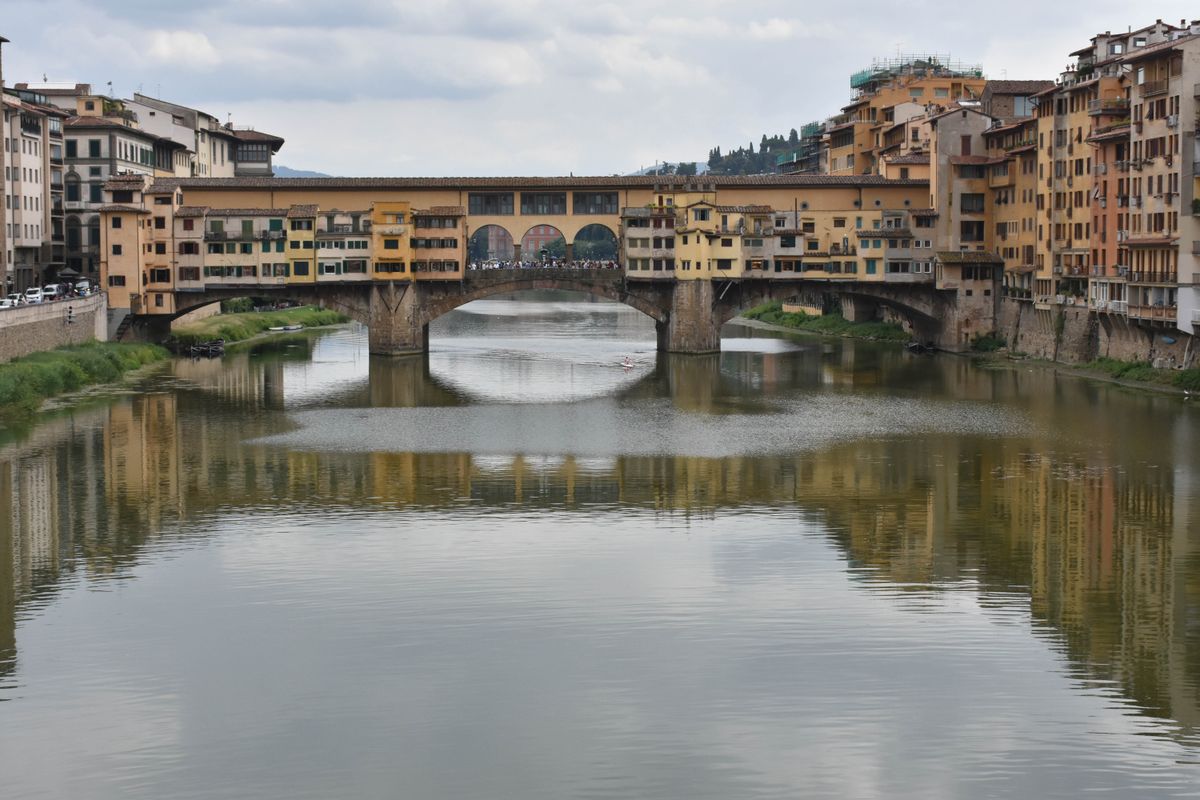
Look carefully at the bridge’s eastern side—you’ll notice an enclosed corridor running along the upper level above the shops, supported by row of corbels and columns and continuing past the bridge in both directions. This is the Corridoio Vasariano, a kilometer-long elevated passageway commissioned by Cosimo I de’ Medici in 1565 and built by Giorgio Vasari in just five months for the wedding of Francesco I de’ Medici and Joanna of Austria.
The Corridor connected Palazzo Vecchio (the Grand Duke’s offices) to Pitti Palace (his residence), passing through the Uffizi, then crossing the Ponte Vecchio, then over the houses of Oltrarno, before terminating at the Boboli Gardens. It allowed the Medici to move between their workplaces and their home without descending to the public streets—useful for security, conveniant for moving in inclement weather, and a constant reminder of who ruled the city.
The Corridor runs above the shops as it crosses the bridge. Look at the windows on the bridge’s eastern side: those are the corridor windows, not shop windows. The largest are the three at the bridge’s midpoint, which took their present form in 1860, for the celebrations welcoming Victor Emmanuel II.
The Vasari Corridor was closed to the public for nearly a decade until reopening in late 2024 after extensive restoration. Visiting requires a timed Uffizi + Vasari Corridor ticket (€43 on the day, €47 booked in advance). Inside, the corridor is austere—mostly bare stone walls, a few small windows looking out over Florence and the Arno. The famous self-portrait collection that once hung here has been removed for the museum proper. The experience is more about the architecture and the historical sensation of walking the Medici’s private path than about art viewing. If you have time and budget, it’s a memorable add-on to any Uffizi visit; if you only have time for one, the Uffizi itself is the higher priority.
How the Bridge Survived World War II
On the night of August 4, 1944, retreating German forces blew up the bridges of central Florence to slow the Allied advance from the south. The Ponte Vecchio was spared.
The exact reasons remain debated. One widely repeated account credits an express order from Hitler. Another version credits Gerhard Wolf, the German consul in Florence, who lobbied tirelessly to save Florentine art and may have intervened with the demolition orders. A third version attributes the survival to the bridge’s historic prestige and the SS commander on site, who decided independently to spare it. Whatever the actual mechanism, the Germans destroyed the buildings at either end of the bridge instead, burying its approaches in rubble so that it could not be used. Civilians escaped over the bridge before the demolition. The medieval and Renaissance buildings approaching it were lost.
The Ponte Vecchio thus stands today as a medieval engineering feat that still links the two banks of the Arno, as it has since 1345. The buildings around both ends of the bridge were rebuilt after the war.
The 1966 Flood and Its Aftermath
On November 4, 1966, the Arno burst its banks during one of the worst floods in Florentine history. Water reached six meters in some streets. Some 14,000 movable works of art were affected across the city, and more than a million books were damaged at the National Central Library alone. The Ponte Vecchio survived, but its goldsmiths’ shops were devastated.
The flood prompted long-overdue work on the Arno’s flood defenses—river-channel works, the Bilancino reservoir and far better forecasting—though the risk has never gone away. The bridge has held, its medieval structure strengthened by later consolidation of the foundations.
Visiting Ponte Vecchio
Best Time of Day
Ponte Vecchio is most beautiful at sunrise (low light catches the eastern facade, almost no people) and at golden hour about 30 minutes before sunset (the famous warm light). The bridge fills up as the day goes on, so come early for quieter photographs. Evening is also magical—the shops are shut, the bridge is lit, and the medieval architecture takes on a different character without the modern bustle.
Best Photography Spots
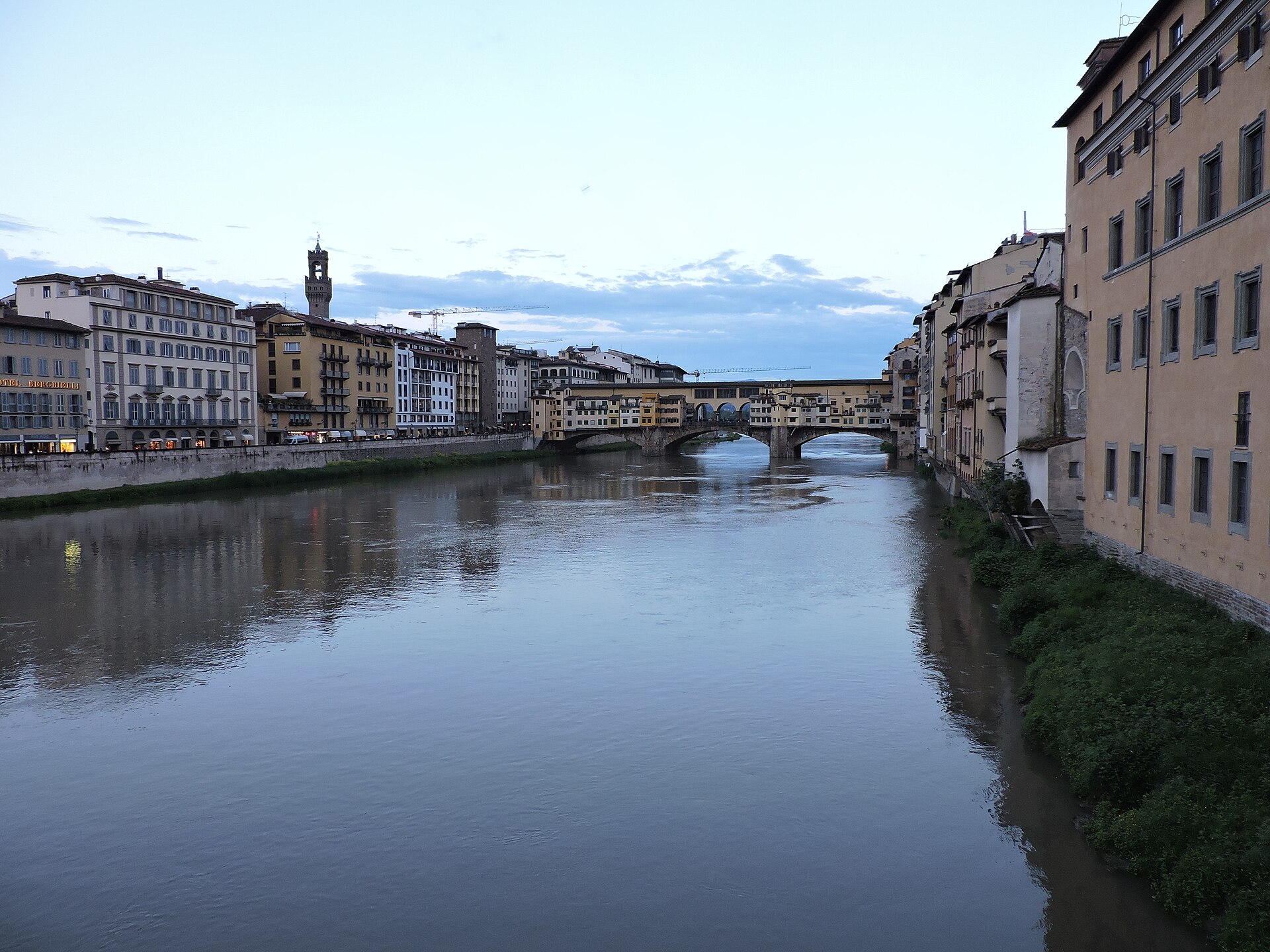
For the iconic photograph showing the bridge from the side: walk one bridge upstream (Ponte alle Grazie) or one bridge downstream (Ponte Santa Trinita). Ponte Santa Trinita gives the classic view with the bridge’s eastern facade and the rear of the Vasari Corridor. From the lungarni embankments below the bridge level, you can capture the bridge with reflections in the Arno (best in calm weather and morning light). For aerial views, walk uphill on the Oltrarno side to Piazzale Michelangelo or San Miniato al Monte to see the bridge from above with the city beyond.
What to See On the Bridge Itself
Walking across, look for: the central archway opening on the eastern side, where the bridge widens into a small piazza with parapets overlooking the Arno; the bronze bust of Benvenuto Cellini—the 16th-century goldsmith who created Perseus and the Medici saltcellar—added in 1900 in honor of the goldsmith trade; the locks attached to the Cellini railing (a recent and frowned-upon tradition that municipal cleaners regularly remove); the plaque honoring Gerhard Wolf, the German consul whose intervention helped spare the bridge in 1944; the narrow side alleys you can spot through gaps in the shop frontages where workshops still occupy back rooms; and the medieval sundial.
Jewelry Shopping on Ponte Vecchio
The shops on the bridge today range from small family-run goldsmith ateliers to larger boutiques selling international luxury brands. The traditional Ponte Vecchio offering is Italian-made gold jewelry, with the local 18-karat (750/1000) standard hallmark for fine pieces. Italian gold tends toward warmer, more yellow tones than American 18K because Italians use a copper alloy mix that brings out the color of the gold. Many bridge jewelers also sell silver, antique pieces, and modern designs.
Reputable establishments with deep history on the bridge include Cassetti, Fratelli Piccini and Vaggi, all family-run with multi-generational reputations. Several offer commissioned pieces—a good option if you want a unique design or are matching a family heirloom. Compare prices and workmanship piece by piece before you buy; the setting, at least, is like nowhere else.
Beware: tourist-trap shops selling mass-produced imported pieces also exist on the bridge. Look for the proper hallmark stamps (the fineness mark, such as Italy’s “750” on 18K gold, plus the maker’s identification mark, which carries a number and the initials of the province), ask whether items are made in Italy, and be willing to walk away from anything that seems pushy or unusually cheap. For full guidance see our Ponte Vecchio jewelry shopping guide. Non-EU residents may qualify for VAT relief on eligible purchases over €70 per invoice (VAT included), though refund-service fees reduce what you get back.
Around Ponte Vecchio: Things to Do Nearby
Ponte Vecchio sits at the heart of Florence’s tourist circuit. A short walk takes you to the Uffizi Gallery (north end of the bridge, on the lungarno); Palazzo Vecchio and Piazza della Signoria (just north); the Pitti Palace and Boboli Gardens (south, across the bridge in Oltrarno); and the Santa Trinita bridge and church (west).
Just south of the bridge, the Borgo San Jacopo and Via Maggio streets have the densest concentration of antique shops and small artisan workshops in Florence. The Oltrarno quarter beginning right at the south end of Ponte Vecchio is the artisan and bohemian district—quieter, less polished than the north bank, with the city’s best hand-craft workshops, traditional trattorias, and the Piazza Santo Spirito for evening aperitivo.
For a coffee or aperitivo near the bridge: La Terrazza at the Hotel Continentale (north end of the bridge, hotel rooftop bar); Cosimo Rooftop Restaurant & Bar at The Excelsior (rooftop with panoramic views over the Arno); Caffè Rivoire in Piazza della Signoria (a short walk, classic Florentine cafe).
Ponte Vecchio at Different Times of Year
Spring (March-May): Mild weather, plenty of light, manageable crowds outside Easter week. The lungarni are at their best with cherry blossoms.
Summer (June-August): Peak tourism, and the bridge at its most crowded. Heat radiates off the stone. Sunset photographs are most dramatic in late summer when the sun aligns with the river. Go early in the morning or late in the evening to avoid the worst of the crowds.
Autumn (September-November): The most beautiful season for Ponte Vecchio. Soft golden light, fewer tourists after mid-October, occasional dramatic weather. November rains can swell the Arno but flooding is rare due to modern controls.
Winter (December-February): The lowest tourist numbers of the year and surprisingly atmospheric, with the bridge often illuminated by Christmas lights December through January. Days are cool and nights colder, so pack layers.
How to Get to Ponte Vecchio
The Ponte Vecchio is in central Florence, an easy walk from Santa Maria Novella station. From the Duomo, walk south through Via Calzaiuoli (about 10 minutes). From the Uffizi exit, follow the Lungarno embankment a short way to the bridge. Florence’s buses are run by Autolinee Toscane: check its lines and timetables for the stops nearest the bridge.
The bridge is fully pedestrian (cars are banned). It’s wheelchair-accessible but cobblestoned, and the slope on either approach is gentle. Bicycle riders must dismount and walk. Public toilets are not on the bridge itself; the closest are at the Uffizi (north end) and at cafés along Borgo San Jacopo (south end).
Local Curiosities and Stories
The “old guild” markings: The narrow medieval shops on the bridge follow the surveyed plan of the medieval goldsmith corporation. Some stones in the bridge’s parapet are marked with old guild devices—a difficulty to spot, but local guides will show you.
The 1944 plaque: A discreet plaque in the small piazza under the loggias at the bridge’s center honors Gerhard Wolf, the German consul whose intervention helped spare the bridge in 1944. Many tourists miss it.
The “Sundial” of Taddeo Gaddi: An astronomical sundial dating to the 14th century is reportedly carved into one of the bridge’s earliest masonry blocks; it’s nearly invisible to casual observers and locals will sometimes point it out as part of long walking tours.
Love locks: A modern habit of attaching padlocks to the bridge’s railings (especially around Cellini’s bust) is banned, and the city cleared the locks in a big removal in 2005–2006. The fines reached €160 per offender. Municipal workers cut the locks off regularly.
Dante and Beatrice: Florentine legend links the pair to the riverside, but the traditional account places Dante Alighieri’s first sight of Beatrice Portinari at a May Day party at the Portinari house in 1274. The encounter (real or invented) became foundational to La Vita Nuova and ultimately the Divine Comedy.
Frequently Asked Questions
How old is Ponte Vecchio?
The current bridge dates to 1345, making it 681 years old in 2026. A crossing here is believed to date back to Roman times, but the present structure was built after the previous bridge was swept away by the 1333 Arno flood.
Can you walk across Ponte Vecchio for free?
Yes. The bridge is a public pedestrian street and walking across it is completely free. There is no admission fee, no ticket required. Shop hours vary, so check with the shop itself if you plan to buy.
Why are there only jewelry shops on Ponte Vecchio?
Because of a 1593 decree by Grand Duke Ferdinand I de’ Medici. Before then, the bridge housed butchers and fishmongers whose smell offended Ferdinand and his guests. He ordered them removed and replaced by goldsmiths, jewelers, and silversmiths. The decree has continued in spirit ever since—almost every shop on the bridge today is a goldsmith or jeweler.
What is the Vasari Corridor?
An elevated covered passageway built in 1565 by Giorgio Vasari for Cosimo I de’ Medici. It runs from Palazzo Vecchio through the Uffizi, over Ponte Vecchio’s eastern side, and across Oltrarno rooftops to Pitti Palace. It allowed the Medici to move privately between their offices and home. Reopened to visitors in 2024 as part of the Uffizi complex with separate timed-entry tickets.
Did Ponte Vecchio survive World War II?
Yes. It was the only Florentine bridge spared by the retreating German army on August 4, 1944. The exact reason is debated—Hitler’s personal order, the German consul Wolf’s lobbying, or the SS commander’s own decision. The Germans destroyed buildings at both ends of the bridge instead, but the bridge itself was preserved.
What’s the best time to visit Ponte Vecchio?
Early morning (before 9:00) for crowd-free walking and atmospheric light, or sunset golden hour for dramatic photography. Avoid 10:00-18:00 in summer when the bridge is shoulder-to-shoulder. Late evening (after 21:00) is also beautiful and atmospheric.
Are the jewelry shops on Ponte Vecchio worth visiting?
Yes, especially established family ateliers like Cassetti, Fratelli Piccini and Vaggi for traditional Italian gold work. Compare prices and workmanship piece by piece. Avoid pushy shops with mass-produced imports; look for proper hallmarks and Italian provenance.
Can you take photos of Ponte Vecchio?
Yes, freely from the bridge or from any public viewpoint. The best photography spots are Ponte Santa Trinita upstream (for the iconic side view with Vasari Corridor), the lungarni embankments at river level (for reflection shots), and Piazzale Michelangelo or San Miniato al Monte (for elevated views of the bridge in context). No tripods on the bridge itself in busy hours.
Is Ponte Vecchio wheelchair accessible?
Yes. The bridge is fully pedestrian and the approach slopes are gentle. The surface is cobblestoned but smooth enough for most wheelchairs. Most jewelry shops have stepped entrances and are not wheelchair-accessible inside, though some have accessible entrances with assistance.
What’s underneath Ponte Vecchio?
The Arno flows through three segmental arches; in the spaces between the arches and the shop floors above are the old foundations of the bridge, including remnants of the Roman and earlier medieval structures. Some restaurants on the south bank have terraces directly under the bridge’s foundations—a rare way to see the underside.