This article contains advertising. Booking links on this site can be turned into paid links automatically by our partner Travelpayouts: if you book through one, we earn a commission from the provider, at no extra cost to you. It never affects what we recommend. Affiliate disclosure
Florence sits in an Apennine river valley with a transitional Mediterranean climate — mild winters, hot dry summers, wetter springs and autumns. Temperatures swing from around 2°C overnight in January to summer afternoons that can top 35°C, the city radiates heat from its stone-built centre, and rainfall concentrates in November and October. This 2026 climate guide covers Florence’s weather month by month, what to expect from each season, the daily temperature curves you’ll actually feel as a tourist, and how the climate affects sightseeing, packing and travel decisions.
Turn the forecast into a suitcase with our Florence packing list, and keep our rainy day guide to Florence bookmarked for the days it does not cooperate.
Florence’s Climate: The Big Picture
Florence’s official Köppen classification is Cfa — humid subtropical, also referred to as transitional Mediterranean. Three local features make it different from the textbook Mediterranean of Rome or Naples:
- Inland valley geography. Florence sits inland in a basin surrounded by the Apennine foothills. Air movement is limited, which exaggerates summer heat (no sea breezes) and autumn humidity (moisture pools).
- Hotter summers than coastal Tuscany. July and August run noticeably hotter here than on the Versilia coast, because the sea breezes that cool the beaches don’t reach the city.
- Wetter than Mediterranean stereotype. Florence receives about 788mm of rain annually, distributed across all four seasons, with peaks in November (115mm) and October (105mm). It is not the dry Mediterranean climate of southern Italy.
Florence Weather Month by Month
| Month | Avg High | Avg Low | Rainfall | Rainy Days | Sunshine | Humidity |
|---|---|---|---|---|---|---|
| January | 11°C / 52°F | 2°C / 36°F | 58mm | 7.5 | 3 hrs | 72% |
| February | 13°C / 55°F | 3°C / 37°F | 64mm | 7.2 | 4 hrs | 67% |
| March | 16°C / 61°F | 5°C / 41°F | 61mm | 7.0 | 5 hrs | 65% |
| April | 20°C / 68°F | 8°C / 47°F | 67mm | 8.7 | 6 hrs | 65% |
| May | 24°C / 76°F | 12°C / 53°F | 63mm | 7.6 | 8 hrs | 65% |
| June | 29°C / 84°F | 16°C / 61°F | 45mm | 5.2 | 9 hrs | 63% |
| July | 32°C / 90°F | 18°C / 65°F | 25mm | 2.9 | 10 hrs | 61% |
| August | 32°C / 90°F | 19°C / 65°F | 37mm | 4.0 | 9 hrs | 61% |
| September | 27°C / 81°F | 15°C / 59°F | 67mm | 6.2 | 7 hrs | 64% |
| October | 22°C / 71°F | 11°C / 52°F | 105mm | 8.8 | 5 hrs | 71% |
| November | 16°C / 60°F | 6°C / 44°F | 115mm | 10.0 | 4 hrs | 75% |
| December | 11°C / 53°F | 3°C / 37°F | 81mm | 9.6 | 4 hrs | 74% |
Florence has more than 800mm of total annual rainfall — wetter than London or Madrid, drier than Dublin. The two driest months are July and August; the wettest is November.
January in Florence
Florence’s coldest month. Daytime highs average about 11°C, overnight lows about 2°C. Frost on cars in the early morning is possible, and snow, when it comes, is usually light. The days lengthen through the month: sunrise moves from about 07:48 to 07:33 and sunset from about 16:48 to 17:24.
Rain falls on about 7 or 8 days of the month (around 58mm in all), but the city’s defining January weather is cold humidity — damp grey days that feel colder than the thermometer suggests. Layered wool clothing is essential. Most January days are walkable for sightseeing if you dress for it.
The single most affecting January phenomenon: the surrounding Apennines turn snow-capped, and sunny days produce dramatic mountain views from Piazzale Michelangelo and the Boboli upper terraces. The city itself rarely gets snow, but the mountain backdrop is more visible in January than any other month.
February in Florence
Slightly warmer than January, with the first hints of spring in the second half of the month. Highs average about 13°C, lows about 3°C. When the first blossom appears in the Boboli and Bardini gardens depends on each year’s weather.
February averages about 64mm of rain over seven wet days, slightly more rain than January on slightly fewer days. The biggest February characteristic is variability — a single week can bring mild sunny afternoons and raw mornings, with the odd snow flurry. Pack for both.
March in Florence
Spring’s official start. Highs average about 16°C, warming as the month goes on, and the first spring flowers start to open in city gardens.
March is wet — about seven rainy days and around 61mm of rain. The classic March Florence weather is “three days sunny, two days raining”; pack a packable rain jacket and an umbrella. Crowds remain low and museums walkable.
April in Florence
April is when Florence visibly becomes a spring city. Highs average about 20°C. The Bardini Garden’s wisteria flowers in spring, its timing set by the weather, and the Iris Garden opens in late April (25 April in 2026; check the Società Italiana dell’Iris for the coming season). Easter falls between late March and late April depending on the year (28 March in 2027); the Scoppio del Carro in Piazza del Duomo on Easter Sunday is a major local event.
April is moderately rainy — about 9 days, 67mm. The defining April pattern is April showers: rain can turn up on any day, so keep an indoor plan in reserve. Outdoor sightseeing remains comfortable; layers and an umbrella suffice.
May in Florence
May is widely considered Florence’s most beautiful month. Long sunny days (about 8 hours of sunshine), highs around 24°C, about 63mm of rain, peak garden colour, and roses climb every Oltrarno wall.
Some afternoons late in the month already feel like summer, but the city remains easily walkable. Crowds rise visibly through May, so check museum availability and book your slots early.
June in Florence
Summer’s first month. Highs average about 29°C, and the historical centre’s stone holds the heat, so midday there feels hotter still. Long days — sunset around 21:00 — make outdoor evening dining the norm.
June is drier than most of the year, though July and August are drier still — about 5 rainy days, 45mm total. Major events include the final of the Calcio Storico Fiorentino (24 June, the medieval football tournament’s deciding match after two semi-finals) and the Festa di San Giovanni (24 June fireworks over the Arno). The city begins its Estate Fiorentina outdoor cinema, dance and music programming.
July in Florence
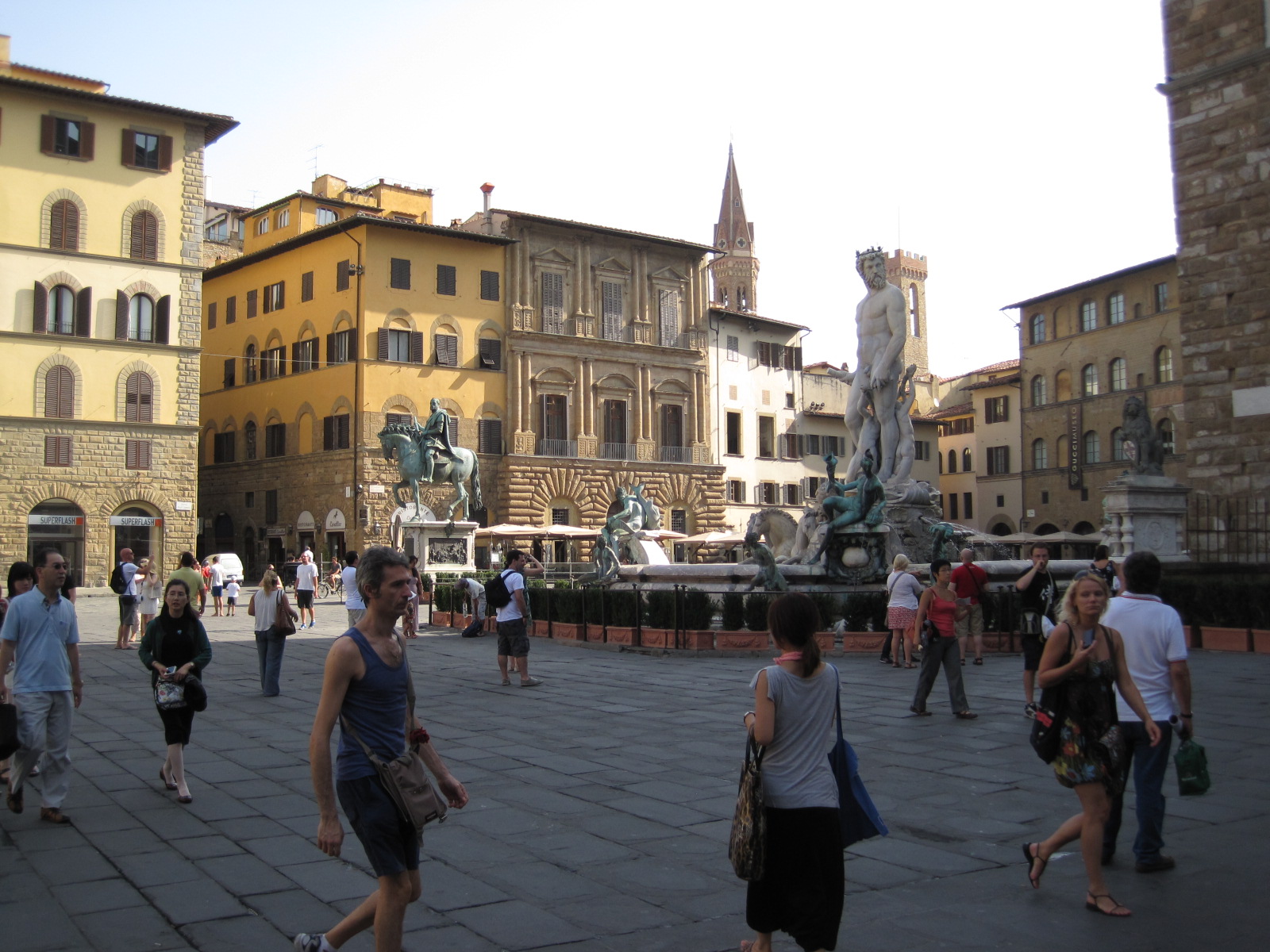
July is hot. Average highs 32°C, overnight lows around 18°C, and heatwaves push well beyond the average. Sunshine about 10 hours per day, and only about 3 days with 1mm or more of rain. The defining July feature is the afternoon heat: plan outdoor sightseeing for the morning and evening, and spend the hottest hours indoors.
Practical adaptations: schedule outdoor activities for 09:00–11:30 and after 19:00. Use mid-afternoons for air-conditioned museums or hotel siesta. Hydrate aggressively (refillable bottle plus city’s nasoni drinking fountains). Wear breathable linen and cotton, wide-brim sun hat, SPF 50+ sunscreen.
August in Florence
Much like July — 32°C highs and dry, with a little less sunshine (about 9 hours a day), around 37mm of rain over four wet days. The bigger differences are social: Ferragosto (15 August national holiday) sees many Florentines leave the city for the coast or the mountains, and some family-run shops, butchers, bakers and small trattorias close for part of the month around mid-August.
Tourist-facing businesses (major museums, big hotels, chain restaurants) remain open. The city’s daily rhythm thins, but the Estate Fiorentina outdoor programming continues. Heat strategies are identical to July.
September in Florence
The transition month. Highs average about 27°C and lows about 15°C, cooling as the month goes on, and rain picks up again after the dry August stretch.
September is reliably warm but increasingly bearable for outdoor sightseeing. Italian schools return in mid-September, and tour groups begin shifting from peak family travellers toward older retirees and culture-focused trips. Hotel rates start dropping in the third week.
October in Florence
October is Florence’s most-recommended month. Highs average about 21.5°C, rain becomes more frequent as autumn sets in, and the Tuscan harvest light is exceptional. Crowds drop noticeably from summer peaks, museum slots need less advance notice than in summer, and hotel rates settle into pre-Christmas low season.
The surrounding Tuscan countryside shifts to autumn colours through October — vineyards turn gold-orange, oak forests russet. Day trips to Chianti, San Gimignano and the Val d’Orcia are at their most photographically rewarding.
November in Florence
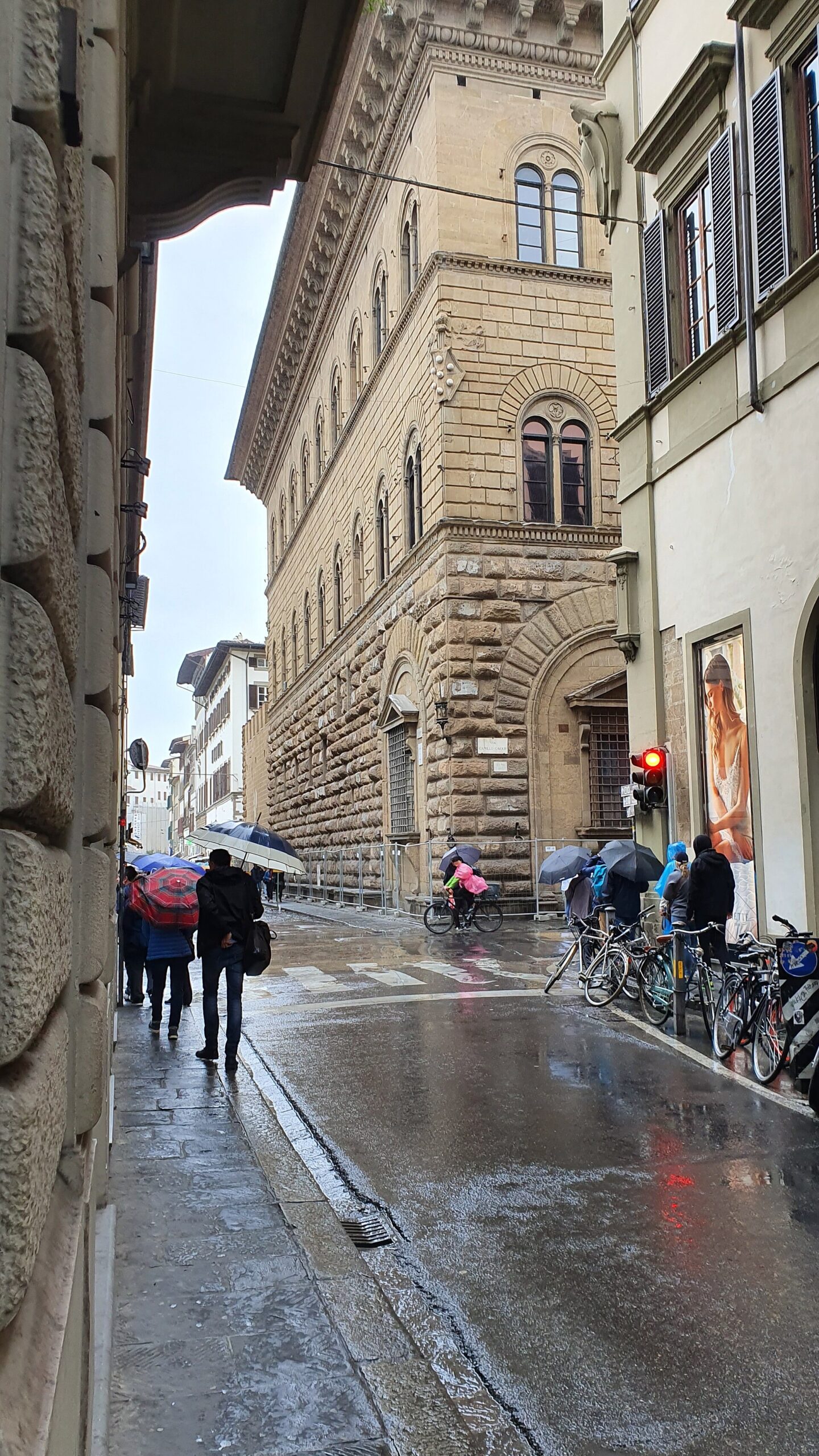
November is Florence’s wettest month — about 115mm of rain across 10 rainy days. Highs average about 16°C, lows about 6°C. By 30 November daylight is down to about 9 hours 12 minutes, with sunrise at 07:27 and sunset at 16:39. Humidity peaks at about 75%, the highest of the year.
Despite the wet, November is excellent for budget travellers — hotel rates sit well below their peak. The new olive oil (olio nuovo) arrives mid-November, the trifle festivals run through the month, and the city’s restaurants shift to hearty seasonal Tuscan cuisine. Pack waterproof boots, an umbrella and a warm jacket.
December in Florence
December is cool and damp. Highs average about 11°C, lows about 3°C, with around 81mm of rain over 10 rainy days. Daylight is shortest in the year — around mid-month the sun rises at about 07:41 and sets at 16:38, just under nine hours later. The Christmas market on Piazza Santa Croce opens in November and runs until 20 December in 2026.
December has two distinct phases: the early weeks are off-season (low crowds, low rates), while the Christmas and New Year holidays into early January are peak season, with rates to match. Snow is rare but possible — January is more likely.
“Feels Like” Temperature: Florence’s Stone Heat Trap
The official temperature reading at the airport doesn’t capture how Florence actually feels at street level. Three local features distort the experience:
- Stone radiation. The historic centre’s pietra forte slabs absorb heat through summer days and re-radiate it for hours after sunset, so a July midday in the centre can feel hotter than the official airport readings suggest.
- Narrow streets. Many medieval streets are narrow lanes between tall buildings, blocking breeze and trapping heat. Squares and the Lungarno embankments are several degrees cooler.
- Limited sea breeze. Florence’s inland-valley position means almost zero coastal moderating effect.
The flip side is winter — the same stone walls hold a damp chill that makes cold days feel colder than the number on the thermometer. Layered wool, scarves and waterproof footwear are necessary in December and January even when the thermometer reads “mild.”
Florence Rain: Patterns and Adaptation
Florence’s rainfall pattern matters more than the totals. Three rainfall types occur:
- Spring/autumn afternoon thunderstorms — heavy showers and storms that come and go. Common in April, May, September, October.
- Multi-day frontal rain — November’s signature pattern: longer spells of steady rain rather than passing showers.
- Light winter drizzle — December and January’s typical “rainy day” is a grey day with light continuous rain rather than dramatic downpour.
Practical adaptations: an umbrella (compact for handbag) is essential gear from October through April. A waterproof jacket is preferable in shoulder season; in winter, layered wool plus waterproof outer is the formula. Don’t reschedule whole sightseeing days for spring/autumn rain — typical morning rain clears by midday.
Extreme Weather Events
Florence experiences several types of extreme weather, each rare but occasionally affecting tourists.
- Heatwaves. July and August can deliver multi-day stretches of severe heat. Italy’s Ministry of Health publishes heat bulletins for Florence with warning levels from 0 to 3, linked from the Civil Protection heatwave page. Take heatwave warnings seriously — schedule outdoor activities only before 11:00 and after 20:00, use air-conditioned spaces during the day, hydrate continuously.
- Flooding. The Arno River last seriously flooded Florence on 4 November 1966, when the water stood more than 5 metres deep in places and devastated the city and its art. Light Arno rises during heavy autumn rain are normal and not dangerous.
- Snow. Snow is occasional, often light or gone before it settles, and some winters have none. Heavy snow (multi-cm accumulation) is a multi-decade event. On 1 March 2018 snow forced the temporary closure of Brunelleschi’s dome and the bell tower for safety.
- Strong wind / hail. Spring and autumn can produce localised hailstorms with golf-ball-sized hail damaging cars and street vendors. Hide indoors when forecast.
Best Month by Weather Priority
- Mildest temperatures: April–May and late September–October.
- Lowest rainfall: July (25mm).
- Sunniest: July (about 10 hours daily) closely followed by June and August (about 9 hours each).
- Coolest: January (11°C high, 2°C low).
- Most dramatic skies for photography: late October to mid-November, and March (variable conditions).
- Most days of sunshine: June through August.
- Least humid: July and August (about 61% relative humidity, August marginally lower).
- Most humid: November (about 75%) and December (about 74%).
- Best garden bloom: spring, with timing that shifts from year to year.
- Best harvest light: late September to early November.
Useful Florence Weather Tools
- 3B Meteo — the most accurate Italian-language weather service, with strong Florence-specific forecasts.
- Il Meteo — competitor service with similar Italian regional accuracy.
- European Centre for Medium-Range Weather Forecasts (ECMWF) — the model behind Yr.no’s forecasts for Florence and available through other apps; how accurate it is depends on what you check and how far ahead you look.
- Comune di Firenze civil protection alerts — official heat, flood and storm warnings.
- Aeroporto di Firenze (Peretola) METARs — current airport weather observations, useful proxy for the city.
Florence Weather FAQ
What is the hottest month in Florence?
July and August are tied — average highs 32°C, regular spikes above 35°C, occasional heatwaves to 40°C. The historic centre’s stone holds the heat, so the streets there can feel hotter than the airport reading suggests.
What is the coldest month in Florence?
January — average high 11°C, low 2°C, with overnight frost common and rare snow possible. Damp humidity makes the felt temperature several degrees colder than the thermometer suggests.
When does it rain most in Florence?
November (115mm, 10 rainy days) is the wettest month, followed by October (105mm, 9 days); April is wet too, at 67mm over 9 days. July is the driest at 25mm.
Does it snow in Florence?
Occasionally, and usually only lightly; some winters pass without any. Heavy snow with multi-cm accumulation is a multi-decade event. Snow on the Cathedral and Ponte Vecchio is photographically dramatic.
How humid is Florence?
Annual average relative humidity around 67%, peaking at about 75% in November and dropping to about 61% in July. Summer humidity is low (Florence is dryer than coastal Italy in summer); winter humidity is high and contributes to the “feels colder than the thermometer” sensation.
What month has the best weather in Florence?
May (24°C high, 8 hours sun, 8 rainy days) and October (21.5°C high, 5 hours sun, 9 rainy days) are our picks for the best weather. Both deliver mild temperatures, manageable rainfall, and exceptional outdoor light.
Should I bring a rain jacket to Florence?
Yes — every month except July and August averages at least five days with 1mm or more of rain, and even those two see a few. A packable waterproof jacket and a compact umbrella are essential year-round.
Do hotels in Florence have air conditioning?
Most 3-star+ hotels and major chains have air conditioning, but what you get varies from one property to the next. If visiting in July or August, verify AC quality before booking — “AC available” is not always the same as “AC reliably cools the room.”
Florence’s climate rewards travellers who plan around it. Mild spring and autumn shoulders deliver the best balance of weather, light and crowd levels; summer requires aggressive heat adaptation; winter offers solitude and Apennine views in exchange for damp cold. Pack for the season, watch for the predictable rain patterns, treat July and August as “morning and evening only” months, and you’ll find a Florence that fits whatever weather profile you prefer.