This article contains advertising. Booking links on this site can be turned into paid links automatically by our partner Travelpayouts: if you book through one, we earn a commission from the provider, at no extra cost to you. It never affects what we recommend. Affiliate disclosure
Florence is a generally safe city for visitors — violent crime against visitors is rare, the historic centre is heavily policed and CCTV-monitored, and walking the city alone at night is comfortable in most areas. The real risks are petty theft and tourist scams: pickpockets on packed buses around Santa Maria Novella station, friendship-bracelet scammers near the Cathedral, restaurant-overcharging in the central piazzas, and a small set of recurring schemes targeting first-time visitors. This 2026 guide covers Florence’s safety profile in detail, the specific scams to recognise, the neighbourhoods to avoid at night, women’s solo-travel safety, family safety, scam-recovery and emergency contacts, and the small daily habits that drop your risk to near-zero.
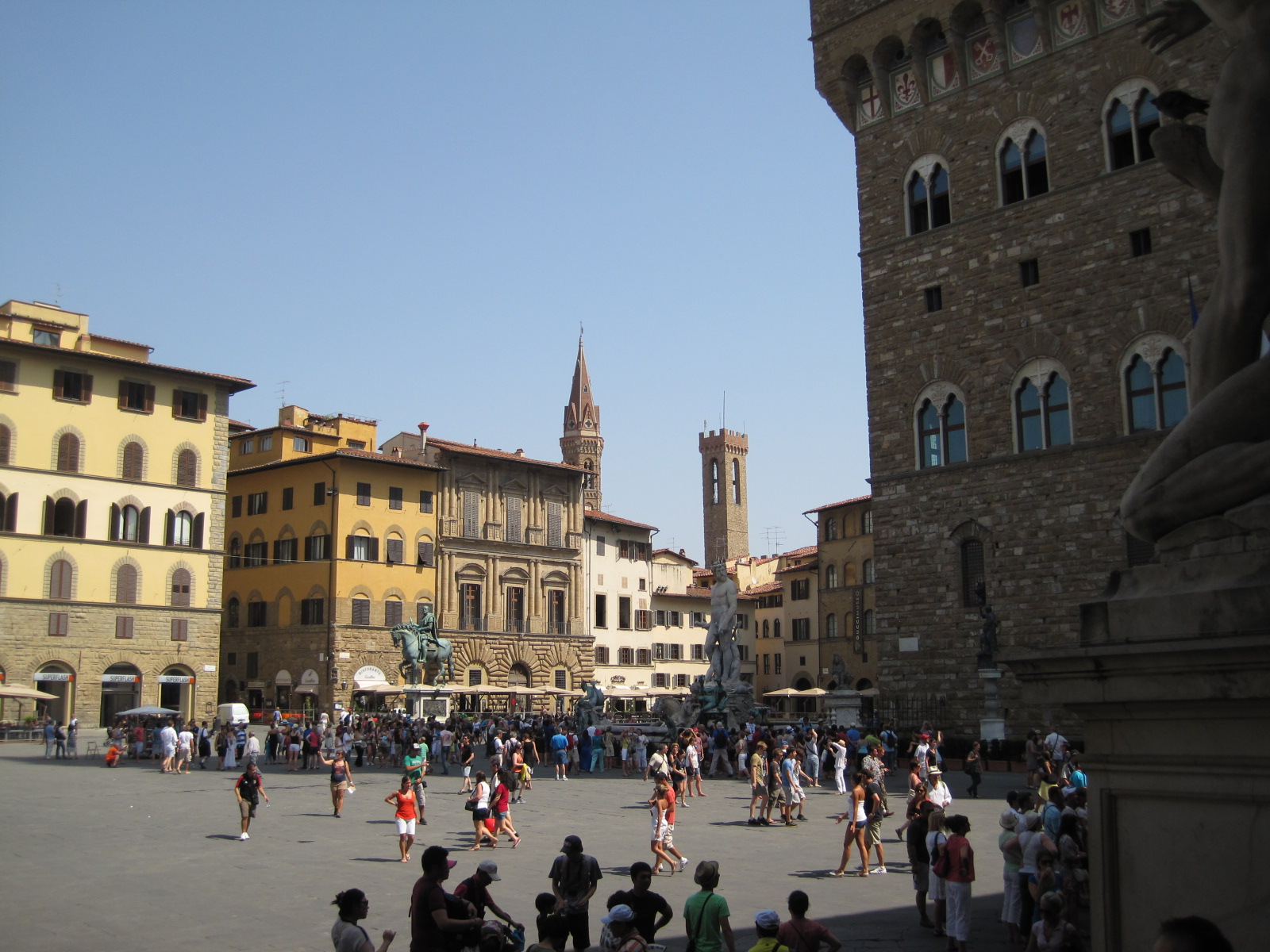
Florence is a low-crime city where the realistic risks are pickpockets and overcharging rather than anything violent. Our 25 things to know before you go, the solo travel guide and the emergency numbers in our pharmacies and emergency guide cover the practical side.
How Safe Is Florence in 2026?
Violent crime against tourists is uncommon to the point of being newsworthy when it happens. The most-recent Italian government and Tuscan regional police statistics show:
- Pickpocketing and bag theft — by far the most common crime affecting tourists, concentrated in five specific zones (covered below).
- Tourist scams — bracelet, petition, painting, and restaurant overcharging — frequent but financially limited (€10–50 typical loss).
- Vehicle theft and break-ins — a risk for parked rental cars; leave nothing on view inside.
- Violent crime against tourists — extremely rare; the most common form is alcohol-related altercations late at night in two specific bar areas.
- Drug-related issues — present but localized; Cascine Park west of the centre and certain corners of Piazza Santa Maria Novella at night.
The single most useful number to remember in Florence is 112 — the EU emergency number, used for police, ambulance and fire service. Operators speak Italian and English. Save it in your phone before arriving.
The Five Pickpocket Zones
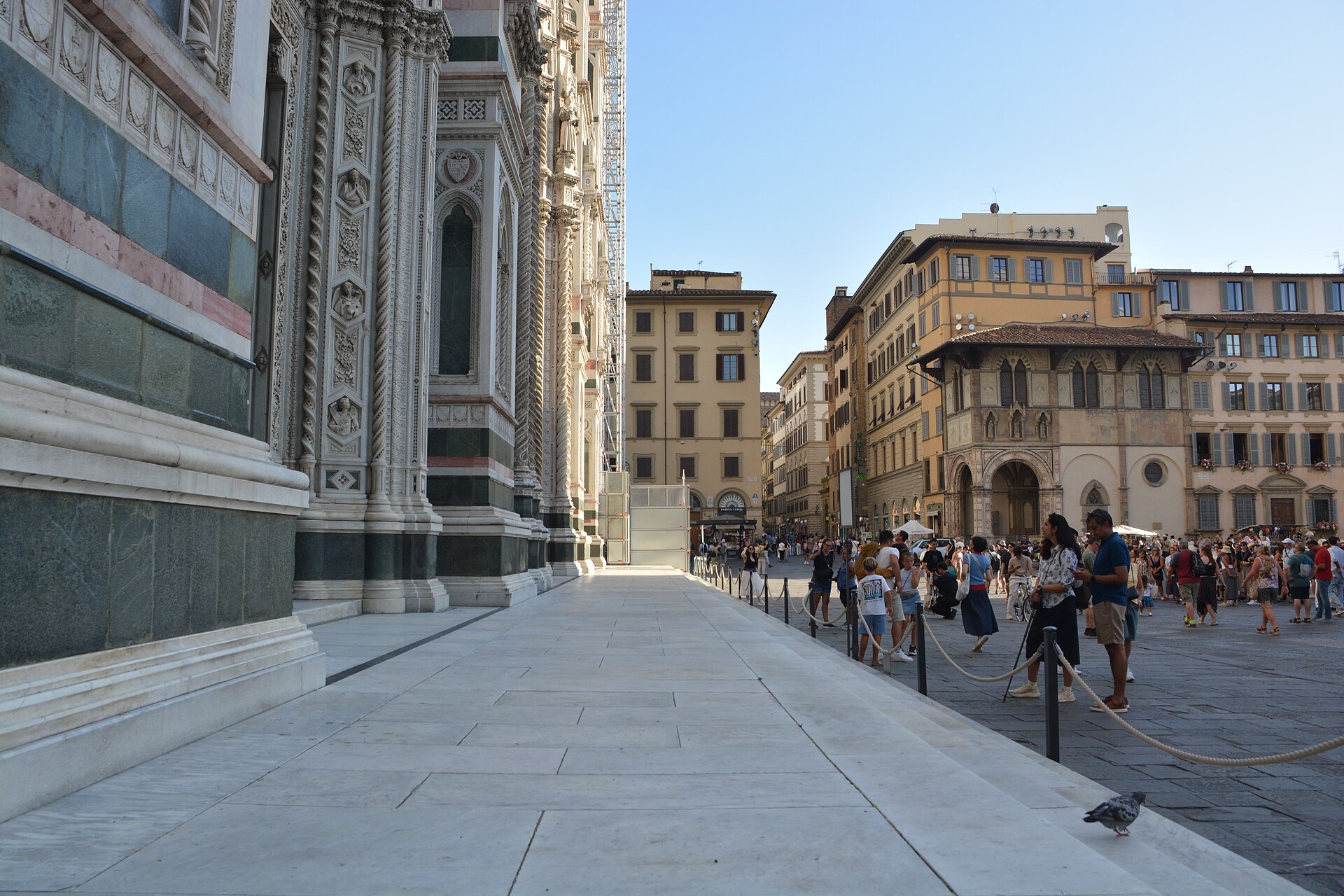
Florence pickpockets concentrate where tourists do, and the geography is predictable. Maintain extra alertness in:
- Santa Maria Novella train station — like any major station, a place to watch your belongings closely, from the arrivals hall and ticket machines to the platforms. Keep luggage between your feet, wallet in front pocket, phone in zipped bag.
- Crowded city buses — run by Autolinee Toscane (formerly ATAF), especially the busy ones linking the tourist areas. Pickpockets work the boarding crush; don’t put anything in back pockets.
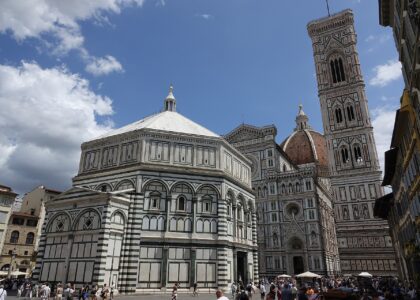
- Piazza del Duomo and the Cathedral entrance queue — the dense pedestrian crowds and distracted tourists make easy marks.
- Ponte Vecchio — the bridge’s permanent shoulder-to-shoulder summer crowds.
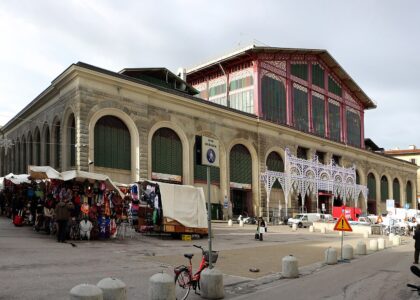
- The Mercato di San Lorenzo open-air leather market — bag-snatching from the back of unzipped totes.
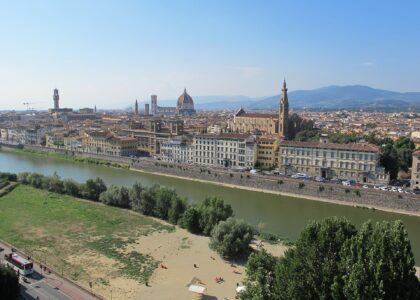
Lower-risk areas (still don’t be careless): residential Oltrarno, San Niccolò, Sant’Ambrogio, Piazzale Michelangelo, San Marco, the Boboli Gardens.
Common Florence Scams (and How to Avoid Them)
The Friendship Bracelet Scam
A man (typically) approaches you in Piazza del Duomo, near the Cathedral steps, around Ponte Vecchio, or on the way up to Piazzale Michelangelo. He grabs your wrist with practised speed and ties a bracelet of coloured cord around it before you can refuse. He then demands €10–20, often dropping the demand to €5 if you push back, but threatening loud public confrontation if you don’t pay.
Defence: keep moving, hands in pockets, decline eye contact. The instant a stranger reaches for your wrist, step back. Once the bracelet is on, the easiest exit is to firmly say “no, grazie“, walk away, and remove the bracelet later — refusing to engage. If anyone takes money or belongings from you, report it to the police; in an emergency, call 112.
The Rose Scam
Variant of the bracelet scam — typically targeting couples. A vendor offers a rose to the woman “for free, a gift”, then demands €10–20 from the man. Defence: don’t accept. If the rose is placed in the woman’s hand, hand it back immediately. If not accepted, drop it on the ground and walk away.
The Petition Scam
A young woman (typically) approaches with a clipboard and a “petition for the deaf” or “petition for orphans”. Two associates work the distraction — one watches your hands, one positions to access your bag while you sign. The petition is fake; legitimate Italian charities don’t solicit signatures on the street.
Defence: say “no, grazie” without slowing down. Don’t touch the clipboard. If they persist, raise your voice firmly — they retreat instantly when noticed.
The Street Painting Scam
Vendors lay paintings on the pavement in narrow streets where pedestrians must walk over or around them. If you accidentally step on or near one, the vendor demands compensation for “damage” — typically €30–50.
Defence: notice paintings on the ground and walk wide around them. If accidentally touched, do not pay — police will not enforce a damage claim of this nature. Walk away firmly.
Restaurant Overcharging
The single most expensive Florence scam, affecting more travellers than pickpocketing. Tactics include:
- “Daily specials” at exorbitant prices — the host or waiter recommends “today’s special fish” verbally without quoting a price; the bill arrives at €60–80 per portion.
- Mysterious “service charges” beyond the standard coperto — €10–20 added “for service” on top of the listed prices.
- Wrong currency conversion — card machines that offer to charge you in your home currency at an unfavourable rate (always select Euro, never your home currency, when paying with a foreign card).
- Wine pricing by glass replaced by bottle pricing at the bill — verify whether you ordered a quartino (250ml carafe) or a full bottle when ordered.
Defence: always read the printed menu (Italian version), confirm prices verbally before ordering anything not listed, and check the bill line by line before paying. The €5–8 schiacciata, €10–14 pizza, and €12–18 pasta benchmarks are reliable; anything dramatically above these in central piazzas is a tourist trap. Always pay in Euros, not your home currency, on foreign-card machines.
Taxi Scams
Florence taxis are generally well-regulated and metered. Watch for:
- “Broken meter” — refuse to ride. Official taxis charge regulated fares, so insist the meter runs on any metered journey.
- A “ZTL charge” or a long detour — licensed taxis may drive into the ZTL traffic-restriction zone, and the published tariff carries no ZTL supplement, so refuse any such extra and keep an eye on the route.
- “Flat fare to the airport” without confirmation — the fixed fare between Florence Airport and the centre inside the ring roads is €28 on weekdays by day, €30 on Sundays and holidays by day and €32 at night (22:00–06:00), plus €1.20 per piece of luggage. Verify before getting in.
Use an official taxi rank, such as those at Piazza della Repubblica and Piazzale Michelangelo, or call 055 4242 for a metered radio taxi. Uber operates in Florence but only in the more expensive Black tier.
ATM Skimming
Free-standing ATMs in tourist areas occasionally have card-skimming devices fitted overnight. Use ATMs attached to bank branches (Intesa Sanpaolo, BNL, Unicredit, Banca Monte dei Paschi di Siena) inside their lobbies during opening hours rather than free-standing machines on tourist streets. Cover the keypad when entering your PIN.
Fake Museum Tickets
People hovering near the Uffizi or Accademia ticket queues sometimes offer “fast-track tickets” at €40+ — these are either invalid or just guided tour tickets disguised as skip-the-line. Buy from the official sites tickets.uffizi.it and firenzecard.it, the Cathedral’s duomo.firenze.it, or reputable resellers (GetYourGuide, Tiqets, Musement, Viator). Don’t buy from people on the street.
Florence at Night
Florence is comfortable to walk at night. Restaurants, bars and gelaterias keep the historic centre lively after dark, and summer brings the city’s Estate Fiorentina programme. Solo travellers, women, and families regularly walk between the centre and Oltrarno after dinner without incident.
Areas with reduced after-dark comfort:
- Cascine Park (the large park west of Santa Maria Novella station) — daytime is fine, but the park becomes problematic after dark with rough sleepers and occasional drug dealing.
- Piazza Santa Maria Novella after midnight — close to the station area, so keep a hand on your bag. Don’t sit on the church steps after 23:00.
- Around the train station perimeter at night — Via Nazionale and the small streets behind Santa Maria Novella station have reduced after-dark feel; not actually dangerous but distinctly less pleasant.
- Cure neighbourhood just north of San Marco — safe by day, lacks after-dark atmosphere.
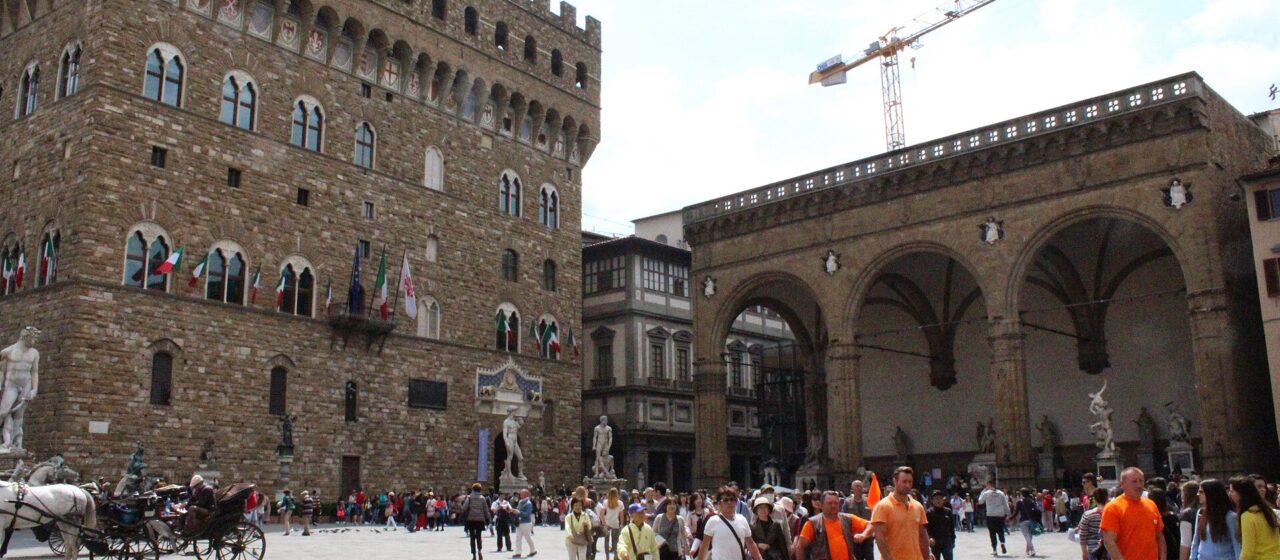
Reliably comfortable areas day and night: the Cathedral block, Piazza della Signoria, the Uffizi-Ponte Vecchio corridor, Santa Croce piazza, San Lorenzo, San Marco, San Frediano, San Niccolò, Sant’Ambrogio, the Lungarno embankments, Piazzale Michelangelo’s surroundings.
Late-night transport: Autolinee Toscane runs night bus routes that change with the season, so check the current night lines on at-bus.it. After midnight a taxi is the simplest way back — call 055 4242, the round-the-clock radio-taxi line, or head to one of the central ranks.
Women & Solo Travel Safety
Florence is widely considered one of the most comfortable European cities for solo women travellers. The historic centre is small, well-lit, animated until late, and the cultural baseline is non-confrontational. Catcalling exists but is markedly rarer than in southern Italian cities.
Solo-traveller-specific tips:
- Trust your instincts. If a street feels off, choose a busier route. Florence’s narrow medieval lanes are not always logical; lit, populated streets are everywhere.
- Hostel and B&B common rooms are reliable places to find solo-traveller company without commitment. Most have nightly social events.
- Walking tours and cooking classes are the most efficient way to meet other solo travellers; both run several times daily.
- Bar and aperitivo culture is solo-friendly. Sitting alone at the bar at Le Volpi e l’Uva or Il Santino, ordering a glass of wine, scrolling your phone — this is a typical Florence evening for any local. Nobody finds it strange.
- Late-night dinner alone at any reputable trattoria is normal and safe; restaurants don’t seat solo women in awkward back corners as some Italian-cliché travel writing suggests.
- Apps like the local Florentine taxi app “AppTaxi” are reliable for late-night rides.
- Drink responsibility: as in any European city, drink-spiking is uncommon but possible at clubs. Watch your drink at busy bars.
For harassment or assault, call the general emergency number, 112.
Family Safety
Children get attention from locals (Italians are warm with children), child-specific scams are rare, and the city’s compact geography means short walks between any two points. Practical considerations:
- Strollers struggle on cobblestones. A baby carrier (front-mount or back-mount) is dramatically more practical for long sightseeing days. Toddlers in strollers will be jostled.
- Crowded museums require child-supervision discipline. The Uffizi and Accademia in summer have moments of pressing crowds; a wrist-tether or hand-holding is sensible.
- Pediatric care is excellent and English-speaking; the Meyer Children’s Hospital is the regional centre. The Farmacia Comunale inside Santa Maria Novella station is open 24 hours.
- Lost-child plan: agree a meeting point at the start of each day’s sightseeing (typically a major piazza). Brief older children on what to do if separated — find a uniformed police officer or shopkeeper, share the meeting point.
- Walking after dark with children is comfortable and standard. Florentine families are out late; gelato at 22:00 with a 6-year-old is a normal Florence evening.
Emergency Contacts
- 112 — EU emergency number (police, ambulance, fire). Operators speak Italian and English.
- 113 — Polizia di Stato (state police, for thefts and accidents)
- 118 — Medical emergency / ambulance
- 115 — Fire service
- 1530 — Coast Guard (mostly relevant for visitors going to coastal Tuscany)
- 055 4242 — Florence radio taxi
- 055 49771 — Florence main police station (Questura), Via Zara 2
- Borgo Ognissanti 48 — Florence Carabinieri (for urgent help, call 112)
- US State Department — after-hours emergency line for US citizens abroad; the current number is on travel.state.gov
- +44 207 008 5000 — UK FCO consular crisis number
The U.S. Consulate General in Florence is at Lungarno Vespucci 38 (055 266 951). British nationals get consular help from the British Embassy in Rome. Both handle passport replacement, lost documents and serious emergencies.
Pickpocket Prevention Habits
Eight habits drop your pickpocket risk to near-zero:
- Crossbody bag worn front-of-body in crowded areas. Backpacks should be worn front-mounted in tight crowds and on buses.
- Zipped pockets only for phone and wallet. Open back pockets and unzipped tote handles are pickpocket targets.
- Phone in zipped bag, not back pocket. The phone-in-back-pocket habit accounts for roughly half of tourist phone thefts.
- Keep cash distributed: a small amount in a daily wallet, the rest in a hotel-safe or money-belt. Don’t carry €500 cash on a sightseeing day.
- Photocopy your passport and keep the photocopy on you; the original in the hotel safe.
- Never put bags on chair backs at restaurants; on the floor between your feet, or with the strap looped around your leg.
- If bumped or distracted (someone “spills” coffee on you, asks for directions, drops something), check your bag and pockets immediately. Distraction is the entry move.
- Use ATMs inside bank branches during business hours, not free-standing tourist-zone machines.
If You’re a Victim of Theft or Scam
Theft of wallet, phone, or documents:
- Report the theft to the police promptly, and check your travel insurance policy for its reporting deadline. Visit Florence’s main Questura at Via Zara 2, the Carabinieri station at Borgo Ognissanti 48, or any police office. English-speaking officers are usually available.
- Get a written police report (denuncia) — the document is essential for insurance and passport replacement.
- Cancel cards immediately via your bank’s app or international hotline.
- Contact your consulate or embassy for passport replacement. A UK emergency travel document is usually ready to collect two working days after you apply; US citizens should ask the U.S. Consulate General about timings.
- If your phone was stolen, log into your Apple/Google account from another device and remote-erase, then change passwords on email and social accounts.
Scam loss (bracelet, painting, restaurant overcharge):
- If small amount and you’ve already paid: chalk it up to experience, though anything stolen can still be reported to the police.
- Restaurant overcharging: if obvious (€60 pizza, etc.), refuse to pay the difference, request the printed menu, and ask for the carabinieri to be called. The restaurant typically backs down rather than face an investigation.
- Unauthorised credit card charges: dispute with your card issuer once back at your hotel; most cards refund disputed travel charges promptly.
2026 Scam Watch List Summary
- Friendship bracelet — Cathedral, Ponte Vecchio, Piazzale Michelangelo
- Rose-for-the-lady — central piazzas at evening
- Petition signers — Cathedral, Uffizi queue, Piazza della Signoria
- Pavement paintings — narrow tourist streets
- Restaurant menu price-switch — Piazza della Signoria, Piazza del Duomo, Lungarno restaurants
- Daily fish “special” — verbally quoted, not on menu, exorbitant
- Foreign-currency conversion at point of sale
- “Skip-the-line” tickets sold by people on the street
- Fake taxi drivers offering rides outside the airport baggage hall
- Pickpockets at Santa Maria Novella station, Cathedral and on crowded city buses
Health & Medical Safety
Florence’s healthcare system is high-quality and accessible. EU citizens with an EHIC/GHIC card receive free or low-cost care at public hospitals. Non-EU travellers should carry travel insurance — emergency care without insurance can run €200–500 for a single ER visit. Our guide to travel insurance for Florence covers what a policy should actually include.
- Tap water is safe and high-quality — drink it.
- Pharmacies (farmacie) dispense most non-prescription medications including basic antibiotics; the green cross signage is unmissable.
- 24-hour pharmacy: the Farmacia Comunale inside Santa Maria Novella station. Farmacia Molteni is at Via Calzaiuoli 7/r.
- Tourist medical services: TouristMedical Service (055 475 411) and CallMD (055 290 220) are English-speaking on-call doctor networks for €100–150 per visit, useful for non-emergency illness.
- COVID-19: check Italy’s current health rules for travellers before you go. Pharmacies still sell rapid antigen tests at €5–8.
- Heat-related illness in summer is the most common medical issue affecting tourists. Hydrate aggressively, avoid midday outdoor sightseeing, and recognise heatstroke symptoms (confusion, hot dry skin, nausea).
Florence Safety FAQ
Is Florence safe for tourists in 2026?
Yes — Florence is a generally safe city for visitors. Violent crime against visitors is rare. The main risks are pickpocketing in five specific zones (Santa Maria Novella station, central buses, Cathedral area, Ponte Vecchio, San Lorenzo market) and a handful of recognisable tourist scams.
Is it safe to walk in Florence at night?
Yes, in the historic centre and adjoining neighbourhoods (Oltrarno, San Niccolò, Sant’Ambrogio, San Marco). Avoid Cascine Park after dark and the immediate perimeter of Santa Maria Novella station after midnight. Solo women, families and elderly travellers regularly walk between the centre and surrounding neighbourhoods after dinner.
How common is pickpocketing in Florence?
Common enough to require basic precautions, but very avoidable. Crossbody bag worn front-of-body, zipped pockets only, phone never in back pocket, vigilance in the five known pickpocket zones — these habits drop your risk to near-zero.
What’s the most common Florence scam?
The friendship-bracelet scam at the Cathedral and major monuments is the most-encountered. Restaurant overcharging in central piazzas affects the most travellers financially (€20–60 typical loss versus €5–10 from the bracelet). Both are easily avoidable with awareness.
What’s the emergency number in Florence?
112 is the EU-wide emergency number, used for police, ambulance and fire service. Operators speak Italian and English. 113 is the state police, 118 medical, 115 fire — but 112 routes to all three.
Is Florence safe for solo women travellers?
Yes. The compact, animated centre, low base rate of catcalling, and strong hostel/restaurant culture make it particularly suitable. Standard precautions (taxi at very late night, drink-watching at clubs) apply.
Is Florence tap water safe to drink?
Yes, completely safe and good-tasting. Refill bottles at hotel taps or at public nasoni drinking-water fountains. Buying bottled water is unnecessary.
Is Florence safer than Rome?
Generally yes — Florence’s smaller historic centre, lower nighttime population, and less concentrated tourist crowds produce a safer-feeling environment. Both cities have similar pickpocket and scam profiles, but Rome has more aggressive street vendors and more concentrated tourist-trap restaurants. Florence’s main risk areas are smaller and easier to avoid.
Florence rewards travellers who treat it as the safe, walkable, animated city it is — not as a vague “Italian city to be cautious in.” Use the predictable pickpocket-zone awareness, recognise the standard scams, choose your restaurant streets carefully, and you’ll have one of the most relaxed urban experiences available in Europe. Save the 112 emergency number, photocopy your passport, wear your bag in front of your body in crowds, and the rest of your time you can give to Botticelli, the Bargello and aperitivo on Piazza Santo Spirito.