This article contains advertising. Booking links on this site can be turned into paid links automatically by our partner Travelpayouts: if you book through one, we earn a commission from the provider, at no extra cost to you. It never affects what we recommend. Affiliate disclosure
Uffizi or Accademia? Which to Book if You Only Do One
Uffizi or Accademia is the question every short Florence trip eventually comes down to, and the honest answer is that they are not really comparable things. One is a vast collection you could spend a week in; the other is a small gallery with the single most famous sculpture on earth in it. If you have one morning, the Uffizi is almost always the better use of it — but there are four situations where that flips completely, and this page is about telling which one you are in.
Whichever you choose, book it properly: our Uffizi tickets guide and Accademia tickets guide cover prices, doors and how far ahead the slots go.
The Short Answer
If you are an ordinarily curious adult with one free morning and no particular attachment to Michelangelo, book the Uffizi. It contains more of what makes Florence matter, it rewards a longer visit, and if you only ever see one Renaissance collection in your life it should probably be this one. Either way, our pillar guide to Florence tours and tickets puts that booking next to everything else competing for the same budget.
If you are travelling with someone for whom seeing the David is the reason they came to Italy, book the Accademia and do not overthink it. Nobody has ever regretted standing in front of that statue, and a morning in the Uffizi will not compensate for having skipped it.
Compared, Line by Line
| Uffizi | Accademia | |
|---|---|---|
| Ticket, booked | €29 (€16 from 16:00) | €24 |
| Ticket, on the day | €25 (€16 afternoon) | €20 |
| Time needed | 2–3 hours | 45–90 minutes |
| Book ahead in season | 2–3 weeks | About a month |
| Size | Around 90 rooms, two floors | One route, effectively one room that matters |
| The headline | Botticelli, Leonardo, Caravaggio, Titian | Michelangelo’s David |
| Free alternative | None — nothing else is remotely like it | Two full-size copies, outdoors, free |
| Closed | Mondays | Mondays |
| Cost per hour | About €12 | About €24 |
That last row is unfair and worth stating anyway, because it is the mathematical version of what people feel afterwards. The Accademia costs nearly as much as the Uffizi for roughly a third of the visit, and the complaints about it almost always reduce to that ratio rather than to anything about the statue.
Time: Two Hours vs Forty Minutes
The Uffizi is a building you have to budget for. Two hours covers the highlights at a reasonable pace — the early Sienese rooms, Botticelli, Leonardo, the Tribuna, down to Caravaggio and Titian on the first floor. Three hours is comfortable. Anything beyond that and gallery fatigue takes over, which it does to almost everyone regardless of enthusiasm.
The Accademia is forty-five minutes if you are efficient and ninety if you take the Prisoners corridor and the plaster-cast gallery seriously. It genuinely cannot absorb more; there is no shame in leaving after an hour and it is not a museum that punishes you for it.

Practically, this means the Accademia fits into a day and the Uffizi shapes one. If your morning has a hard stop — a train, a lunch reservation, a tour at two — the Accademia slots in and the Uffizi does not. If your morning is open, the Uffizi is the one that will fill it well.
Crowds and Booking Pressure
Here is the counter-intuitive part: the Accademia sells out earlier than the Uffizi. Between April and October you should book it about a month ahead against two or three weeks for the Uffizi.
The reason is capacity. The Uffizi is enormous and can absorb a great many people across ninety rooms; the Accademia is a small gallery whose main event is one space, so the timed-slot allocation is much tighter and it fills sooner.
The crowding experience is also different in kind. In the Uffizi the crowd is concentrated in about four rooms — the Botticelli hall above all — and the rest of the building can be almost peaceful at nine in the morning. In the Accademia the crowd is the visit, because everybody is standing in the same tribune looking at the same object.

Both open at 08:15, and in both cases that first slot is worth more than any other advice on this page.
What You Would Actually Regret Missing
Strip away the rankings and ask the useful question: standing at the airport a week later, which absence would nag?
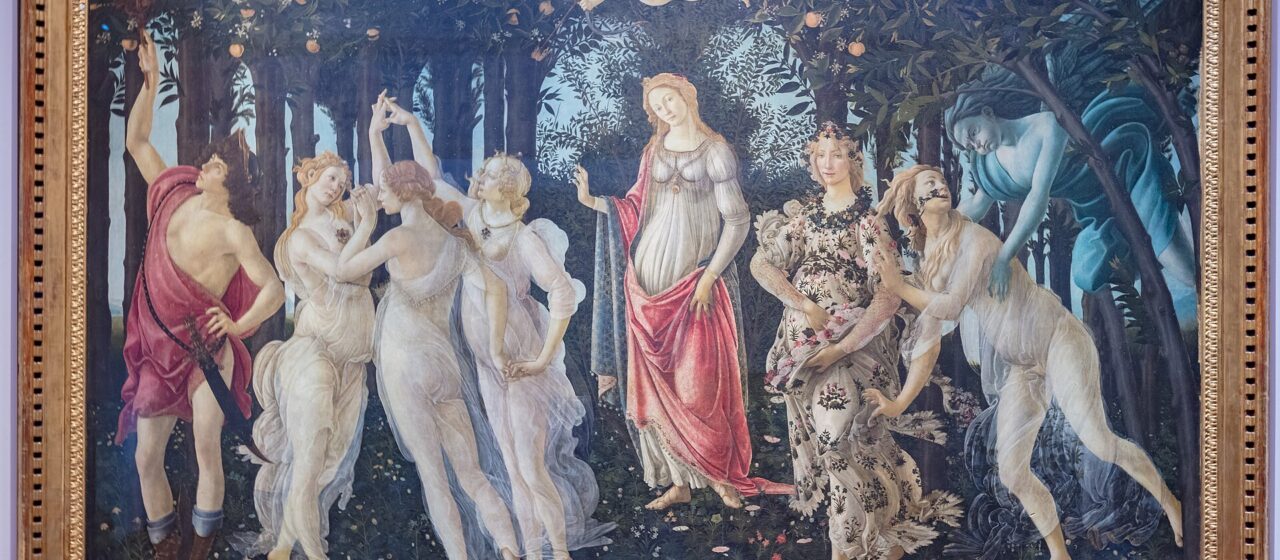
From the Uffizi: Botticelli’s Primavera and Birth of Venus in the same room, at a size photographs never convey. Leonardo’s unfinished Adoration of the Magi, which shows you a mind working. Caravaggio’s Medusa on a shield. Titian’s Venus of Urbino. And the accumulated effect of walking from gold-ground panels of the 1290s to Caravaggio in a single building, which is the clearest demonstration anywhere of what actually happened in those three hundred years.
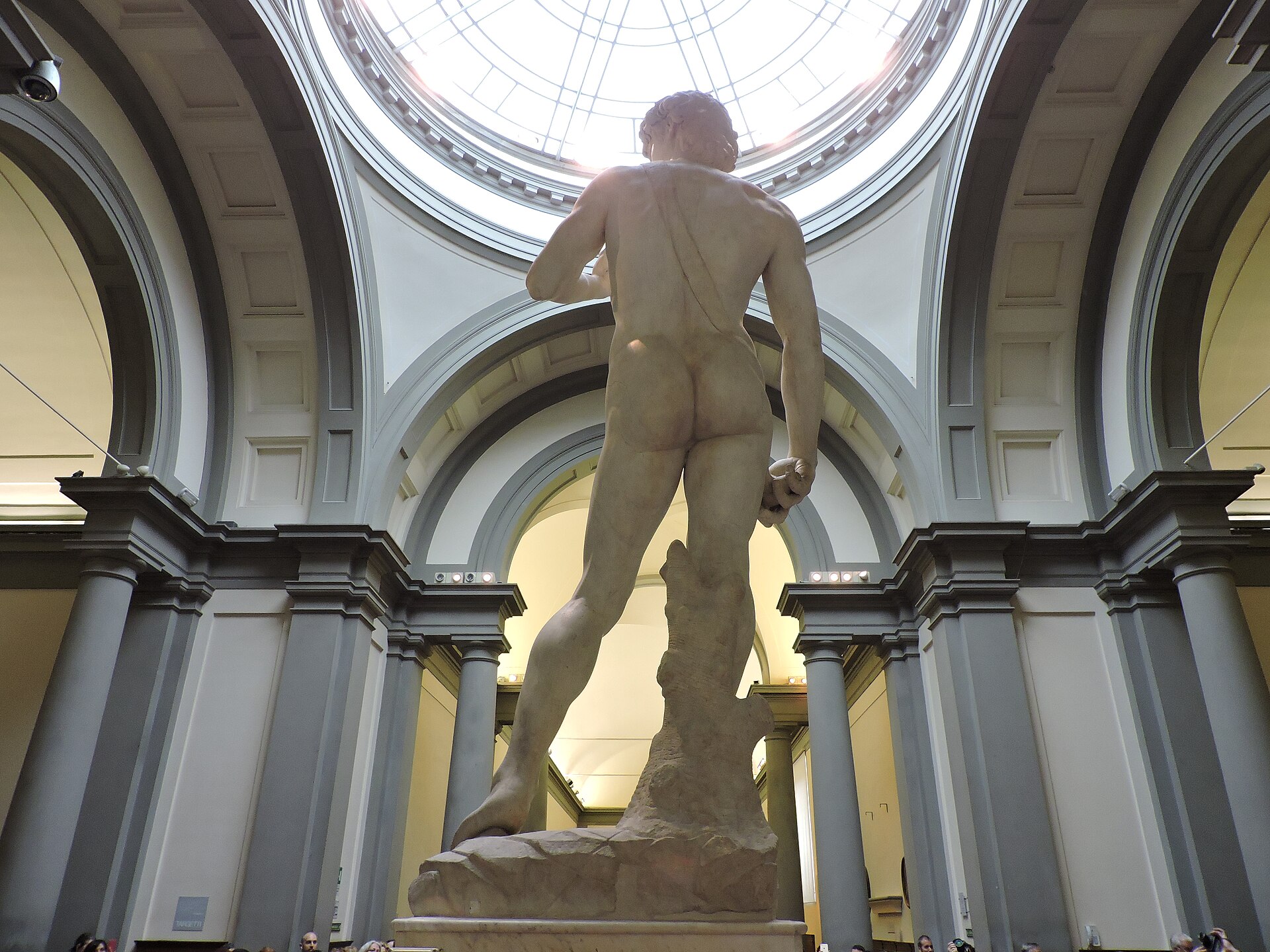
From the Accademia: one thing, and it is a big one. The David is 5.17 metres of marble carved from a single flawed block that two previous sculptors had abandoned, by a man of twenty-six, and the scale of it is the part reproductions cannot give you. The Prisoners corridor leading up to it — four unfinished figures half-emerged from the stone — is genuinely the best introduction to how Michelangelo worked that exists.
The asymmetry is real. The Uffizi has more to miss. The Accademia has one thing that a great many people would rather not have missed.
Four Times the Accademia Wins
The default answer is the Uffizi. Here is when it is wrong.
1. Somebody in your party specifically wants to see the David. Not “would like to” — wants to. This is a surprisingly common and entirely legitimate reason to be in Florence, and no amount of Botticelli substitutes for it.
2. You have children. Ninety rooms of Renaissance panel painting is a long afternoon for a nine-year-old. One enormous naked man is a much easier sell, and forty-five minutes is a realistic attention span. See Florence with kids.
3. You have a fixed and short window. If you have two hours between a train and a lunch, the Accademia fits and the Uffizi will feel like a route march.
4. You have already done the Uffizi. Obvious, but worth stating: on a second Florence trip the Accademia is the one most people have skipped.
And one situation where neither is right: if your budget is genuinely tight and your interest is general rather than particular, skip both, look at the free full-size David copy outside Palazzo Vecchio, and spend the money on the Bargello and a proper lunch. That is not a defeat — see Florence on a budget.
If You Are Doing Both
Three points of sequencing that make a measurable difference.
Do them on different days. Both in one day is possible and it is a bad idea. The second one gets a tired, saturated version of you, and given that between them they cost €53 that is a waste of both the money and the buildings.
Accademia first, chronologically speaking. If you have a preference, seeing the David before the Uffizi gives you a reference point for everything the Uffizi shows you happening around it. Seeing it afterwards works too, and is arguably better if you want the David as a climax.
Book the Accademia first, practically speaking. Its slots go earlier. Fix that date, then build the Uffizi around it.
Consider the combined tickets on each side. The Accademia’s €26 pass adds the Bargello for six euros; the Uffizi’s €40 five-day PassePartout adds Palazzo Pitti and Boboli. Both are better value than the single tickets and neither overlaps the other, because Florence has three separate museum administrations and no pass spans them — our museum ticket comparison maps the boundaries.
The Third Option Nobody Considers
If the framing is “one Florence museum, one morning”, there is a case for neither, and it is the Bargello.
It holds Donatello’s bronze David — the strange, sly, adolescent one that predates Michelangelo’s by sixty years — along with Verrocchio, Michelangelo’s early Bacchus, and the two competition panels that Ghiberti and Brunelleschi submitted for the Baptistery doors in 1401, displayed side by side so you can see exactly what the argument was about. It costs a fraction of the other two, it is reliably half-empty, and a startling number of visitors name it as the best hour they had in Florence.
It is not a substitute for either. It is, however, a better morning than a crowded Accademia at midday, and it is six euros on top of an Accademia ticket if you buy the combined pass.
Frequently Asked Questions
Uffizi or Accademia — which is better?
The Uffizi, for most visitors with one free morning. It is a far larger collection and it shows the whole arc of the Renaissance in one building. The Accademia wins if seeing the David specifically matters to someone in your party, if you have children, if your window is short, or if you have already done the Uffizi.
Can I do both in one day?
Physically yes, sensibly no. Between them they cost around €53 and the second visit gets a tired version of you. Split them across two mornings and take the earliest slot each time.
Which sells out first?
The Accademia, by some margin — book it about a month ahead between April and October, against two or three weeks for the Uffizi. It is a much smaller building, so its timed slots are tighter.
How long do I need in each?
Two to three hours for the Uffizi; forty-five to ninety minutes for the Accademia. The Accademia genuinely cannot absorb more than that, and leaving after an hour is normal rather than a failure of appreciation.
Is the David worth €24 on its own?
For most people, yes — provided you go at the first slot of the day rather than at midday. The scale is the part reproductions cannot convey. If money is tight, there are two free full-size copies outdoors, at Palazzo Vecchio and Piazzale Michelangelo.
Does one ticket cover both?
No. They belong to different institutions, so no single ticket spans them. The Accademia has a €26 combined pass with the Bargello and a €38 five-museum pass; the Uffizi has a €40 PassePartout with Palazzo Pitti and Boboli. The Firenze Card covers both but excludes the Duomo complex entirely.
Where to Go From Here
Once you have decided, book properly: Uffizi tickets and Accademia tickets cover prices, entry doors and booking windows. For what to look at inside, see the Uffizi Gallery guide and the Accademia guide.
Still building the trip? Florence museums covers everything else worth an admission fee, Renaissance art gives you the context that makes both galleries land, and how many days in Florence answers the question underneath this one.