This article contains advertising. Booking links on this site can be turned into paid links automatically by our partner Travelpayouts: if you book through one, we earn a commission from the provider, at no extra cost to you. It never affects what we recommend. Affiliate disclosure
Florence in June: Calcio Storico, San Giovanni & Heat
Florence in June is the month the city stops being comfortable and starts being spectacular. The average afternoon jumps almost five degrees on May — the biggest single step in the Florentine calendar — and in exchange you get the two things Florence does better than anywhere else in Italy: men in Renaissance breeches beating each other senseless on sand in Piazza Santa Croce, and thirty minutes of fireworks over the Arno on the night of the 24th. June is hot, busy and worth it, provided you accept that the middle of the day now belongs to somebody else.
Part of our month-by-month series — the best time to visit Florence compares all twelve, and Florence in May covers the cooler month just behind it.
Three degrees hotter, half the rain and the best free programme of the year. Our guide to Florence in July has the day plan that makes the hottest month workable, and where the open-air cinema sets up.
The Short Verdict
June is the best events month of the Florentine year and the second-hardest to walk around in. Those two facts are not in tension — they just mean June rewards a plan and punishes drifting.
The case for: the city’s entire summer programme opens on 1 June, the free open-air cinema starts in the courtyard of the Uffizi, the Roman theatre at Fiesole begins its season, the Arno boats are running, the evenings go on until half past nine, and on 24 June Florence throws the one genuinely great party in its calendar. Nothing in July or August matches that.
The case against: twenty-nine degrees as an average high, which means low thirties on a bad week, in a city that sits in a bowl and holds heat like a kiln. The queues are at their summer maximum from the middle of the month. And room rates are at the annual peak alongside May and September.
The honest verdict: come in the first half of June if you want the weather to be survivable, or come for the 24th if you want the spectacle and will accept the heat to get it. The worst version of June is a general-purpose sightseeing trip in the last week, when it is hottest, busiest and the city is preoccupied with its own festival.
The Heat Arrives
| Measure | May | June | July |
|---|---|---|---|
| Average high | 24.3 °C | 29.1 °C | 32.3 °C |
| Average low | 11.9 °C | 16.0 °C | 18.4 °C |
| Rainfall | 63 mm | 45 mm | 25 mm |
| Wet days | 7.6 | 5.2 | 2.9 |
| Sunshine per month | 242 hrs | 270 hrs | 313 hrs |
Almost five degrees in one month is the largest step in the Florentine year and you feel every one of them. June is the month where the advice changes from “bring a layer” to “plan around the sun”.
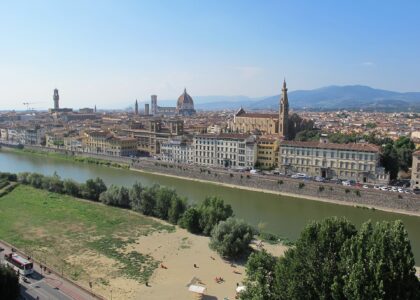
Two things make Florentine heat worse than the number suggests. The city sits in a basin with hills on three sides, so there is very little moving air — a thirty-degree day in Florence is heavier than a thirty-degree day on the coast at Viareggio. And the centre is stone: pale stone that reflects, and dark stone that stores. By six in the evening the streets are giving back what they absorbed at two, which is why the city does not really cool down until well after nine.
The compensation is the evening, and it is a real one. The low is sixteen, sunset is around half past eight and the light hangs on until nine. Rain has effectively stopped being a factor — five wet days, and they arrive as short thunderstorms that break the heat rather than as anything that spoils a day.
Hydrate properly, and know where the pharmacies are
Florence has free public drinking fountains, including the fontanelli that give chilled still and sparkling water, and you will get through far more than you expect. Heat exhaustion in the Uffizi queue is a genuinely common way to lose a day here, and the city’s pharmacies — the green cross — are well stocked, helpful and used as a first port of call for minor problems in the way a British chemist is not. Our guide to restrooms, pharmacies and emergencies in Florence has the addresses of the ones that stay open late.
Calcio Storico
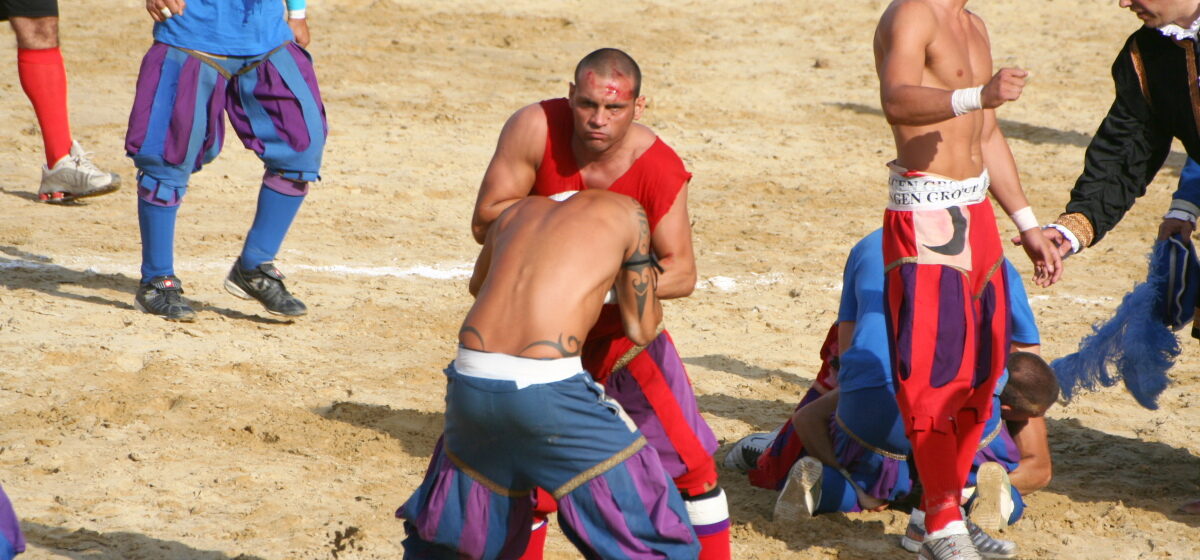
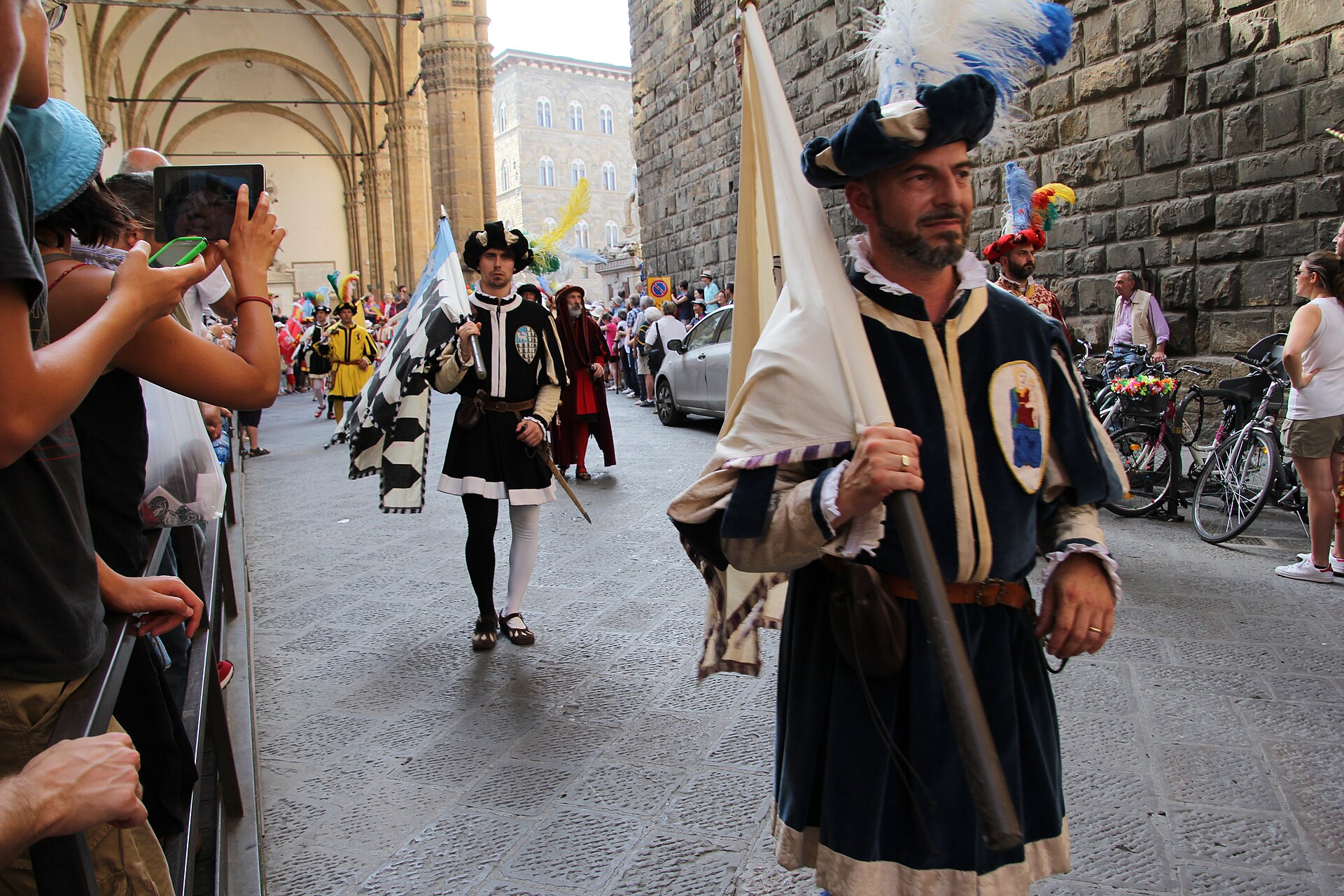
Every June the city lays sand over the flagstones of Piazza Santa Croce and the four historic quarters of Florence send twenty-seven men each to fight over a ball for fifty minutes. The quarters are Santa Croce in blue, Santo Spirito in white, Santa Maria Novella in red and San Giovanni in green, and the colours matter to people here in a way that is difficult to convey.
Calcio Storico is often sold to visitors as “medieval football”, which undersells it considerably. It is closer to rugby with punching permitted, played in Renaissance costume, on sand, in high summer, in front of a packed and extremely partisan square. Players get knocked out. It is not a re-enactment for tourists — the crowd is local, the rivalry is real, and the whole thing is run by the city.
The format: two semi-finals in the middle of June, then the final on 24 June, the feast of St John, at 18:00. Each match is preceded by the Corteo Storico della Repubblica Fiorentina walking in through the streets in full costume, and a display by the Bandierai degli Uffizi flag-throwers — which for many people is the better half of the afternoon.
Tickets are sold and they are limited by the size of the square. They go on sale ahead of the tournament and the final sells out. If you are in Florence in June and want to go, sort it the moment dates are published rather than hoping to buy on the day. The dates, the ticketing mechanics, the history and where the good seats are sit in our dedicated guide to Calcio Storico in Florence.
If you cannot get in, the corteo through the streets is free and worth catching on its own. And a word of honesty: this is a violent event, staged as one, and some people find it genuinely unpleasant to watch. That is a reasonable reaction rather than squeamishness — go in knowing what it is.
24 June: San Giovanni, Hour by Hour
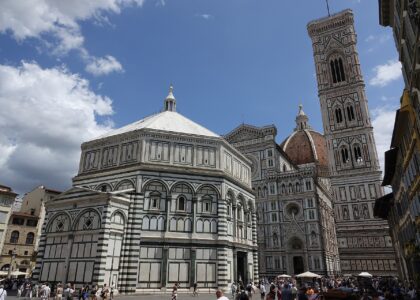
St John the Baptist is Florence’s patron, the Baptistery is his, and 24 June is the city’s own day. It is a local holiday — offices close, many shops do, and the whole centre is given over to it. The running order repeats closely each year:
The programme
- Morning — religious celebrations centred on the Baptistery, with the historic civic offering of candles.
- 15:00 — the Fiorini d’Oro, the city’s Golden Florin honours, awarded in the Salone dei Cinquecento at Palazzo Vecchio.
- 17:00 — the Regata di San Giovanni on the Arno at the Società Canottieri Firenze, Lungarno Anna Maria de’ Medici.
- 18:00 — the Calcio Storico final in Piazza Santa Croce, after the corteo and the flag-throwers.
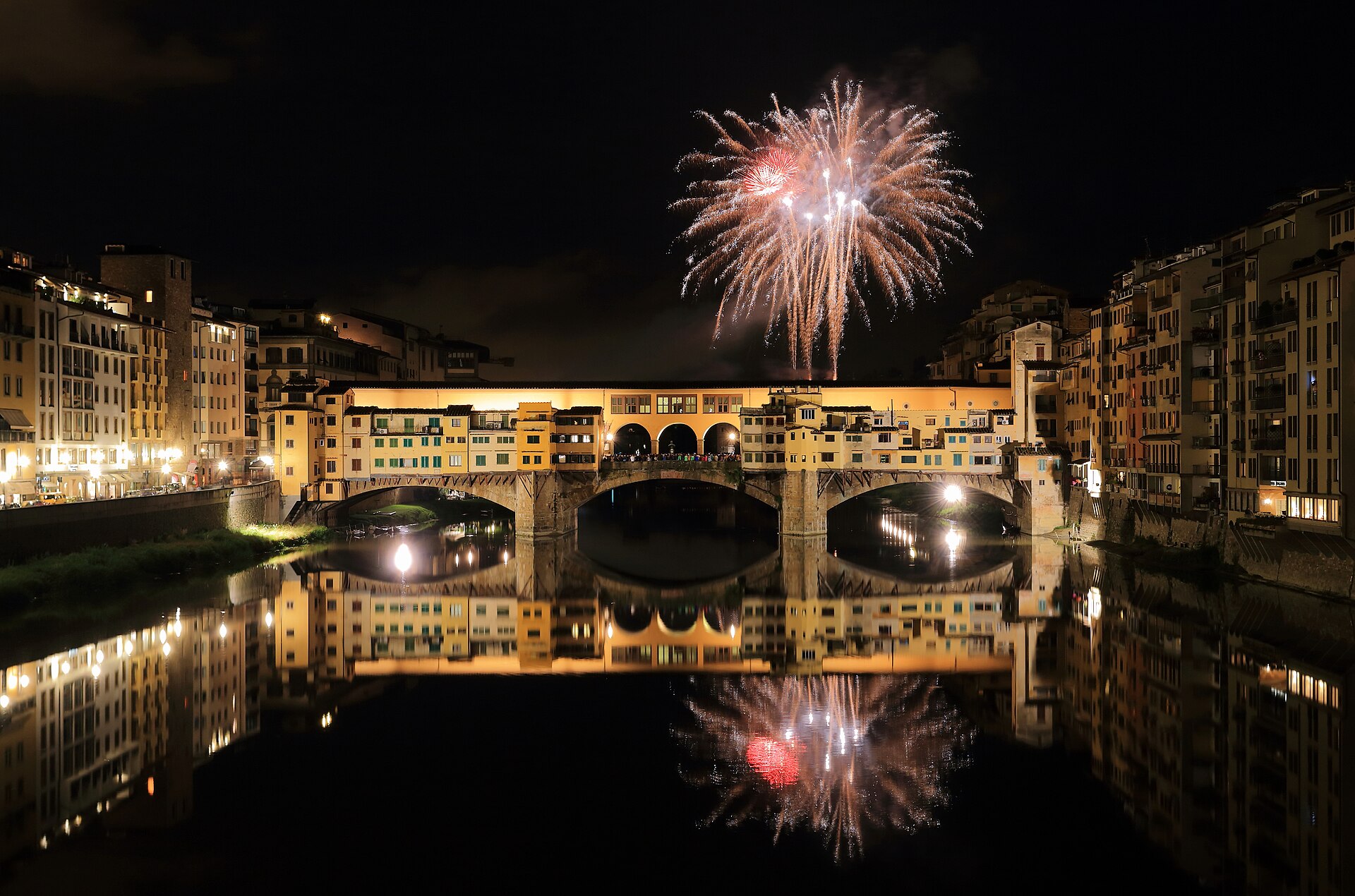
- 22:00 — i fochi, the fireworks. About thirty minutes, launched from Piazzale Michelangelo out over the river and the city.
Do not watch the fireworks from Piazzale Michelangelo
This is the single most common mistake of the Florentine year. The Piazzale is the launch site, not the viewpoint — you are standing underneath them looking up, with the city behind you. The display is designed to be seen from the other side of the river. Get onto the Lungarni, ideally Lungarno della Zecca Vecchia, or the Ponte alle Grazie end of the embankment, and you get the fireworks with the whole city and the dome underneath them. Be in place by about half past nine; by ten the good stretches of parapet are three deep.
The other thing to know about the 24th: this is the one guaranteed official fireworks display of the Florentine year. Not New Year — the city’s Capodanno is built around free concerts in the squares and the pyrotechnics are a much looser affair. If you want to see Florence set fire to the sky, this is the night.
Practically, expect road closures across the centre from mid-afternoon, buses on diversion, and the bridges closed to traffic in the evening. Eat early or eat very late, and book either way.
Estate Fiorentina and the Open-Air Season
On 1 June the city’s umbrella summer programme, Estate Fiorentina, opens and runs to 30 September. It is much bigger than most visitors realise: the 2026 edition carried 1,268 events from 162 different organisers, spread across piazze, gardens, cloisters and outlying districts, much of it free. The programme goes up on the city’s culture site and is worth ten minutes of your planning time.
Three strands are worth knowing by name.
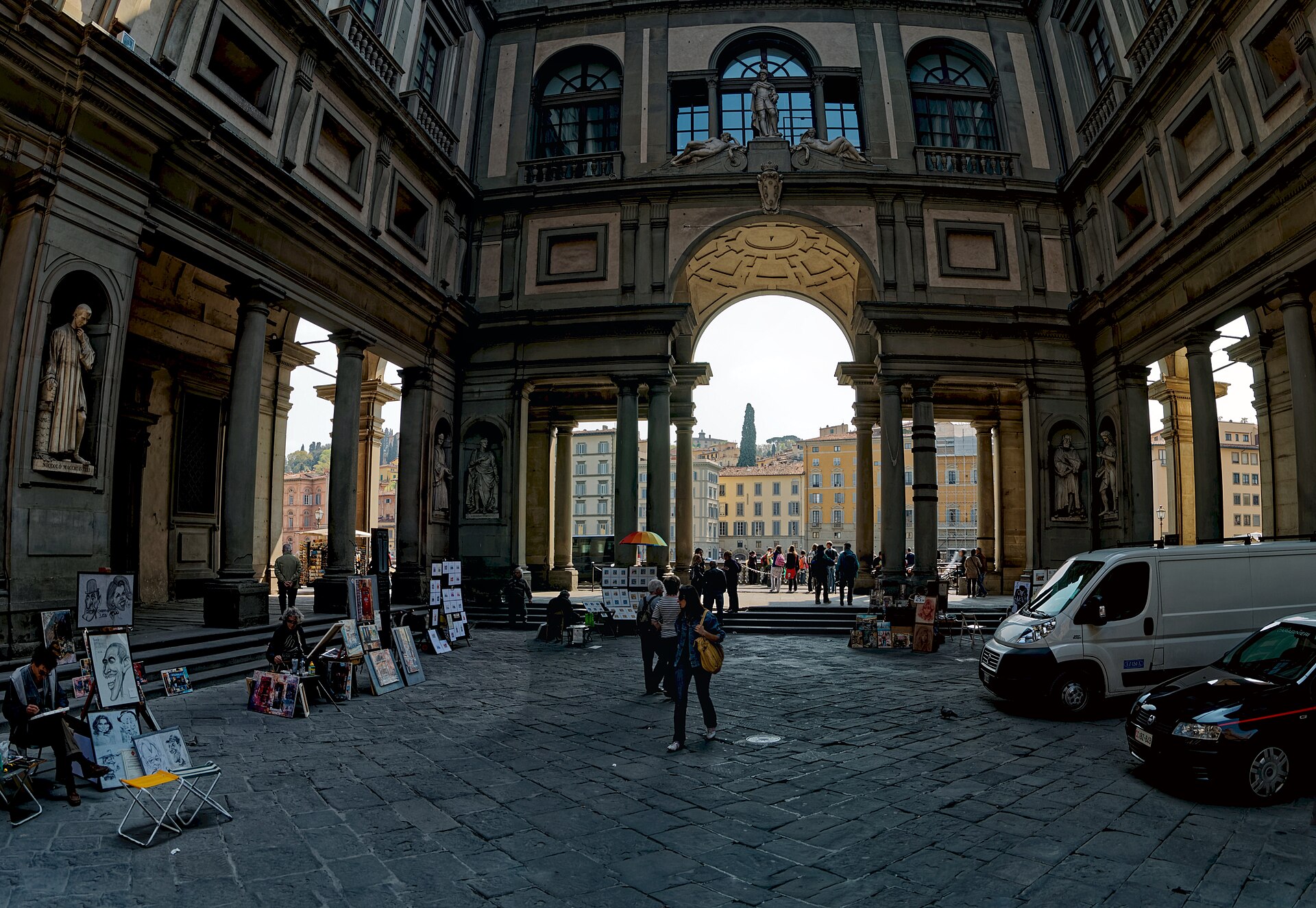
Apriti Cinema puts a screen in the Piazzale degli Uffizi — the courtyard between the two wings of the gallery, with the Palazzo Vecchio tower at one end — and shows films outdoors at 22:00, roughly from the middle of June to the end of July. About two hundred seats, Italian subtitles, and it is free until the seats run out. A second strand runs in Piazza de’ Pitti. Watching a film in that courtyard on a warm night is one of the genuinely great free things to do in Italy, and it costs you nothing but turning up early.
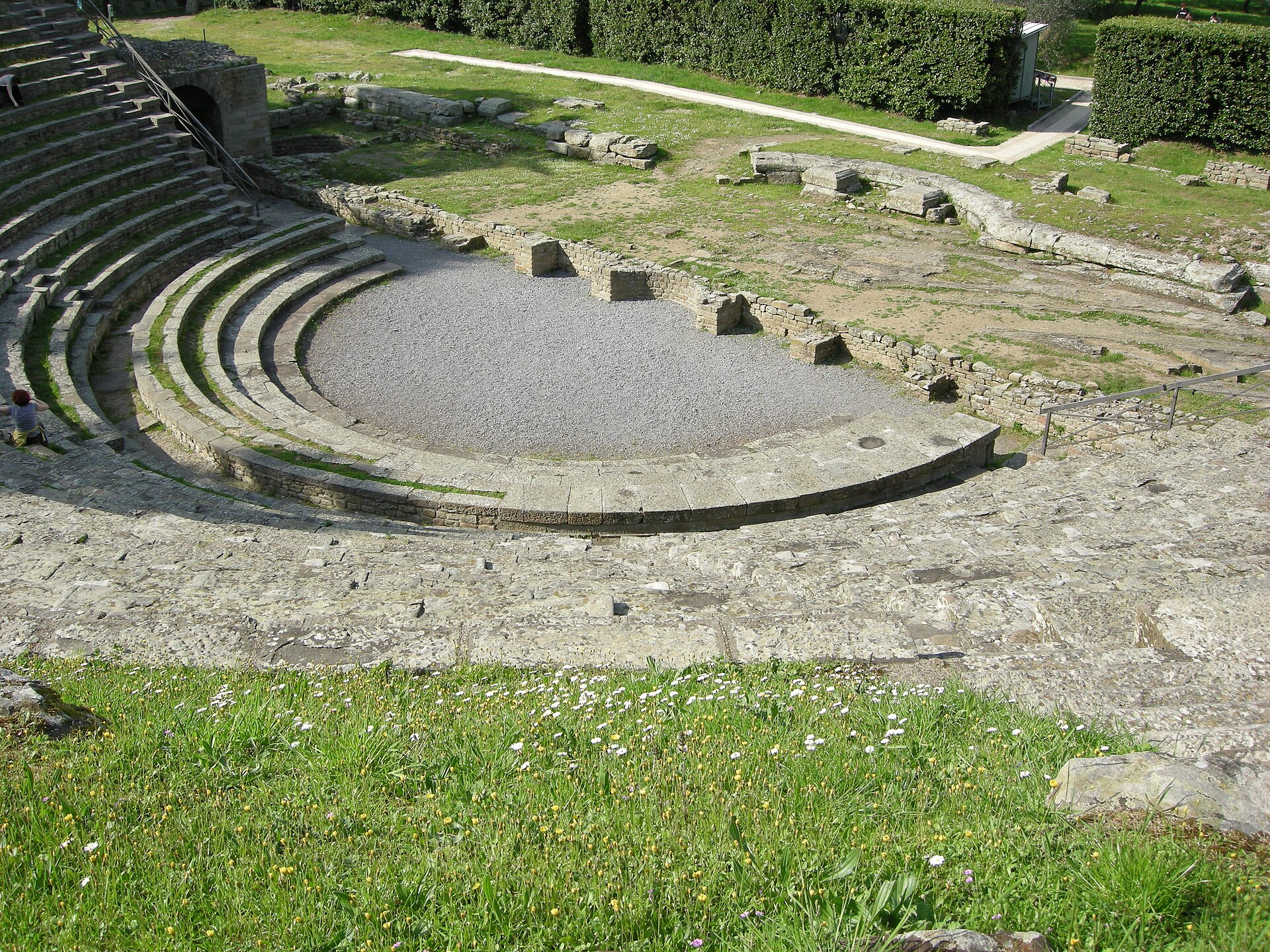
Estate Fiesolana runs from around 21 June into September, mostly in the Teatro Romano di Fiesole — a first-century BC theatre seating about three thousand, cut into the hillside above the city. Music, theatre and dance, plus an open-air cinema season inside the theatre in August. Fiesole is bus 7 from Santa Maria Novella or San Marco, twenty to thirty-five minutes, roughly every twenty, and it is several degrees cooler than Florence. A concert up there on a June evening is the best-value night out in the province.
The Arno boats. The Associazione Renaioli run traditional flat-bottomed barchetti from Piazza Mentana under the Ponte Vecchio, Ponte Santa Trinita and Ponte alla Carraia, May to September, by reservation only, about forty-five minutes. Commercial operators run similar trips with an aperitivo attached from roughly €49 a head.
How to Build a June Day
The shape of a June day in Florence is not negotiable, and it is the shape Florentines use.
- 08:00–11:00 — the hard sightseeing. Uffizi, Accademia and Boboli all open at 08:15. Do the thing with a queue, and do the climbing: the dome is 463 steps with no lift and no air movement, and at nine in the morning it is a challenge rather than a health event.
- 11:00–16:00 — go indoors or go up. Lunch properly, take two hours over it, then use a museum with air conditioning, or a church, or leave the basin altogether for Fiesole. This is not laziness; it is what the city does.
- 16:00–20:00 — the second shift. The afternoon Uffizi ticket exists for exactly this: €16, entry from 16:00. Markets, the Oltrarno workshops, the gardens as the light softens.
- 20:00 onwards — the reason you came. Aperitivo, dinner outside, the passeggiata, an open-air film or a concert in a Roman theatre. June evenings are why people fall in love with this city.
If your dates land a few weeks later, the same logic applies harder — our guide to Florence in July covers the hottest and driest month of the year.
Crowds, Prices and Booking
| What | Book ahead | Price |
|---|---|---|
| Accademia (David) | A month | €20 + €4 booking |
| Uffizi, 08:15 slot | Three to four weeks | €25 day / €29 booked |
| Uffizi, from 16:00 | A week or two | €16 |
| Duomo dome climb | Three weeks; book the first slot | Brunelleschi Pass €30 |
| Vasari Corridor | As far out as it is sold; 25 per group | €43 day / €47 booked, with the Uffizi |
| Calcio Storico | The day tickets are released | Set annually; the final sells out |
| Estate Fiesolana | A week or two for the big names | Varies by act |
| Apriti Cinema | No ticket — arrive early | Free |
| Restaurants, and all of 24 June | Four days; a week for the 24th | — |
Boboli in June closes on the first and last Monday only outside the summer window — through June to October it stays open on those Mondays, which is one of the few scheduling things that gets easier in summer rather than harder. Bardini keeps its first-and-last-Monday closure, so do not assume they match.
Skip the free first Sunday of the month. In June it converts a great museum into two hours of queue and a room you cannot move in. Book a weekday and pay the twenty-five euros.
What to Do
Cool places that are also good
June is the month to be strategic about interiors, and happily several of the best things in Florence are also the coolest.
- The Bargello — thick walls, an internal courtyard, Donatello’s two Davids, and consistently the emptiest major museum in the city. Combined tickets with the Accademia run €26 for 48 hours, or €38 for 72 hours with the Medici Chapels, Orsanmichele and Palazzo Davanzati.
- Santa Maria Novella’s pharmacy on Via della Scala — free, frescoed, cool, and fifteen minutes.
- The Vasari Corridor, reopened in December 2024, is 750 metres of enclosed walkway over the Ponte Vecchio and takes about thirty-five minutes in groups of twenty-five. It is sold only together with the Uffizi, as a combined ticket at €43 on the day or €47 booked. Arrive about two hours before the corridor slot, because you go through the gallery first.
- The Brancacci Chapel — €15 (€10 reduced), ten people per thirty-minute slot, closed Tuesdays, and Masaccio’s frescoes are among the half-dozen most important things in the city.
Out of the city
Fiesole is the obvious June move: twenty minutes on bus 7 and noticeably cooler. Beyond that, the coast finally makes sense — Viareggio and the Versilia beaches are reachable by train via Lucca, and the sea is warm enough to swim in by the second half of the month. Chianti, Siena and San Gimignano all work, though a full day in open Tuscan sun in late June is more demanding than the same trip in April. Our day trips from Florence guide has the times and fares.
What not to do in June
- The dome climb in the afternoon. 463 steps, no lift, stone, no airflow. First slot or not at all.
- The fireworks from Piazzale Michelangelo. You will be under the launch site looking at smoke.
- Arriving on the 24th without a dinner booking. The centre is full and half of it is closed for the festival.
- Planning a full outdoor day trip for the last week. Save the open Tuscan hills for a cooler month, or do them in the morning.
Eating in June
June is when Tuscan food turns cold, and that is a compliment. The two dishes to order are both built on stale bread and both are better in June than at any other point in the year.
Panzanella — bread, tomato, onion, basil, oil, vinegar — arrives properly when the tomatoes do, and June is the first month the tomatoes really deserve it. Pappa al pomodoro is the same idea cooked and served warm or at room temperature, which sounds unpromising and is superb.
Alongside: crostini di fegatini as ever; the last baccelli with pecorino at the very start of the month; courgette flowers fried; and the fruit, which is the real June pleasure — cherries, apricots, the first peaches and melon with prosciutto that has not been sitting under a lamp.
Gelato stops being optional in June. The rule for telling a good gelateria from a bad one is simple and reliable: if the pistachio is bright green and the banana is yellow, walk on. Real pistachio is a dull khaki and real banana is grey. Look for gelato artigianale, metal tubs with lids rather than piled-up pastel mountains, and a short seasonal list.
Book restaurants three or four days ahead, and a week for anything on 24 June. Eating outside at nine in the evening is the whole point of a Florentine June, and by half past eight every table on a decent piazza is taken. Our Florence food guide has where to go, and Italian dining etiquette covers the coperto and the unwritten rules.
What to Pack
- Linen, cotton, loose. Twenty-nine degrees in a stone basin with no breeze is not the same as twenty-nine on a coast.
- A hat and real sunscreen. Nine hours of sun a day and almost no shade in Boboli, on the bridges or at the Piazzale.
- A refillable bottle. The fontanelli give chilled still and sparkling water free.
- Something with sleeves for churches. Shoulders and knees are enforced at the Duomo and Santa Croce, and it is far more annoying in June when you are dressed for the heat. A light scarf solves it — see the church dress code.
- Shoes you can do 463 steps and eight hours of hot cobbles in.
- A thin layer for the evening. Sixteen degrees at midnight after thirty in the afternoon feels colder than it reads.
The full list is in our Florence packing list.
Frequently Asked Questions
Is June a good time to visit Florence?
It is the best month for events and one of the hardest for walking around. Calcio Storico, the San Giovanni fireworks on the 24th, the open-air cinema at the Uffizi and the Fiesole season all fall in June — but so does a five-degree jump in temperature. Come in the first half for the weather, or for the 24th for the spectacle.
How hot is Florence in June?
Average high around 29 °C and average low around 16 °C, with 270 hours of sunshine and only about five wet days. It feels hotter than the number because the city sits in a basin with little moving air and the stone holds heat into the evening. Low thirties in the last week is normal.
When is Calcio Storico held?
Two semi-finals in the middle of June and the final on 24 June at 18:00, all in Piazza Santa Croce on sand laid over the flagstones. Four teams represent the historic quarters — Santa Croce blue, Santo Spirito white, Santa Maria Novella red, San Giovanni green. Tickets are limited by the size of the square and the final sells out.
What happens in Florence on 24 June?
It is the feast of St John the Baptist, the city’s patron, and a local holiday. Religious celebrations in the morning, the Golden Florin honours at Palazzo Vecchio at 15:00, the San Giovanni regatta on the Arno at 17:00, the Calcio Storico final at 18:00, and fireworks at 22:00. Expect road closures across the centre from mid-afternoon.
Where is the best place to watch the San Giovanni fireworks?
The Lungarni on the north bank, particularly Lungarno della Zecca Vecchia and the stretch towards Ponte alle Grazie. Not Piazzale Michelangelo — that is where they are launched from, so you end up underneath the display with the city behind you. Be in position by about 21:30; the good parapet goes three deep by ten.
Is there free entertainment in Florence in June?
A great deal. Estate Fiorentina runs from 1 June to 30 September — over 1,200 events in the 2026 edition, much of it free. Apriti Cinema shows films outdoors in the Piazzale degli Uffizi at 22:00 from mid-June, free until the roughly two hundred seats are gone. The San Giovanni fireworks and the historic processions cost nothing either.
Can you swim near Florence in June?
Yes, from about the middle of the month. The Versilia beaches around Viareggio are reachable by train via Lucca in roughly ninety minutes and the sea is warm enough by mid-June. Florence itself also has several open-air public pools that run through the summer and are a far better use of a thirty-degree afternoon than a museum queue.
June or September in Florence?
June for the events, September for the comfort. They are similarly busy and similarly priced, but September is two degrees cooler, has the grape harvest in Chianti and sheds crowds week by week. June has Calcio Storico and the fireworks, which September cannot match at any price.
Keep Reading
- Florence in May — the same long evenings, five degrees cooler.
- Calcio Storico in Florence — the history, the dates and how to get a ticket.
- Florence summer events — the whole June-to-September programme.
- The best time to visit Florence — all twelve months compared.
- Florence weather by month — the full climate tables.
- Outdoor activities in Florence — the river, the hills and the pools.
- Florence festivals and events calendar — the year at a glance.