This article contains advertising. Booking links on this site can be turned into paid links automatically by our partner Travelpayouts: if you book through one, we earn a commission from the provider, at no extra cost to you. It never affects what we recommend. Affiliate disclosure
Florence in May: The Best Month, and How to Survive It
Florence in May is the month the city is at its absolute best and at its least forgiving. You get 242 hours of sunshine, twenty-four-degree afternoons, light until half past eight, the Rose Garden in full flower and the Arno boats back on the water — and you get all of it in the company of everyone else who read the same thing. May is not a month you can improvise. It is a month you book, start early and plan around the middle of the day, and if you do those three things it is the best week you will ever have in Tuscany.
Part of our month-by-month series — the best time to visit Florence compares all twelve, and Florence in April covers the gentler month just behind it.
The month after brings the biggest temperature jump of the Florentine year and the best fortnight of events in it. Our guide to Florence in June covers Calcio Storico, the San Giovanni fireworks and where to actually stand for them.
The Short Verdict
If someone gives you one week in Florence and no other constraints, take May. The weather is as good as Italian weather gets without becoming a problem: average highs of twenty-four, eight hours of sun a day, warm enough to eat outside every night and not yet hot enough to make the climb to San Miniato an ordeal. The gardens are at peak. The Arno boats are running. The evening lasts until half past eight and the city uses all of it.
That is the case for May, and it is a strong one. Here is the case against, which is equally real.
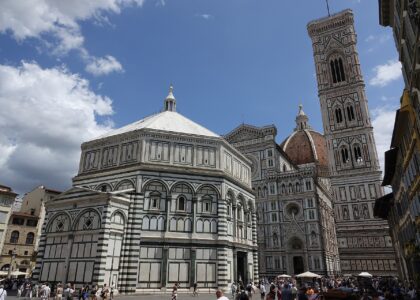
May is the second-busiest month of the Florentine year after September, and unlike July and August it is busy with people who are here to see things rather than to sit in the shade. The queue for the Duomo runs down the side of the cathedral. The Accademia wants a month’s notice and sometimes more. Room rates are at or near their annual peak. The Ponte Vecchio at six in the evening is a slow-moving press of bodies, and Piazzale Michelangelo at sunset is a car park with a view and four hundred people in it.
None of that ruins May. All of it is avoidable, and the avoiding is mechanical rather than clever: get up early, book properly, and treat the hours between eleven and four as time for something indoors, air-conditioned or uphill. Do that and you get the version of Florence that the photographs promise. Ignore it and you spend a beautiful month queuing.
Weather and the Long Evening
| Measure | April | May | June |
|---|---|---|---|
| Average high | 20.0 °C | 24.3 °C | 29.1 °C |
| Average low | 8.1 °C | 11.9 °C | 16.0 °C |
| Rainfall | 67 mm | 63 mm | 45 mm |
| Wet days | 8.7 | 7.6 | 5.2 |
| Sunshine per month | 186 hrs | 242 hrs | 270 hrs |
Twenty-four degrees is the sweet spot and it is worth being specific about why. It is warm enough that a linen shirt is the right answer and a jumper is not, and cool enough that walking uphill in the sun is pleasant rather than punishing. The jump from May to June is the largest of the year — almost five degrees — and it is the jump from comfortable to hot. May sits on the right side of it.
What happens on the other side of that jump, along with Calcio Storico and the San Giovanni fireworks, is in our guide to Florence in June.
The sunshine number does most of the rest of the work: 242 hours, up fifty-six on April, roughly eight hours a day. Sunset moves from about half past eight at the start of the month to nearly nine at the end. The practical effect is that Florence gets a long golden hour and the whole city goes outside for it. That is the best thing about May and, on the Ponte Santa Trinita at eight in the evening, also the most crowded.
Rain has largely stopped being an itinerary problem — seven or eight wet days, but they are short thunderstorms that break the heat rather than days lost. If one arrives, it will usually arrive in the late afternoon and be finished by dinner.
The first genuinely hot days arrive in May
Twenty-four is an average. The last week of May can and does deliver thirty-one or thirty-two degrees, and the Florentine basin holds heat — the city sits in a bowl with hills on three sides and very little moves through it. If you get one of those days, treat it as a July day: the Uffizi at 08:15, lunch and a long sit somewhere cool, out again at five. Do not try to climb the dome at two in the afternoon in thirty-one degrees. People do, and it is 463 steps of regret.
The Gardens at Peak
May is the month Florence’s gardens do what they exist for, and three of the best are free or nearly free.
The Rose Garden
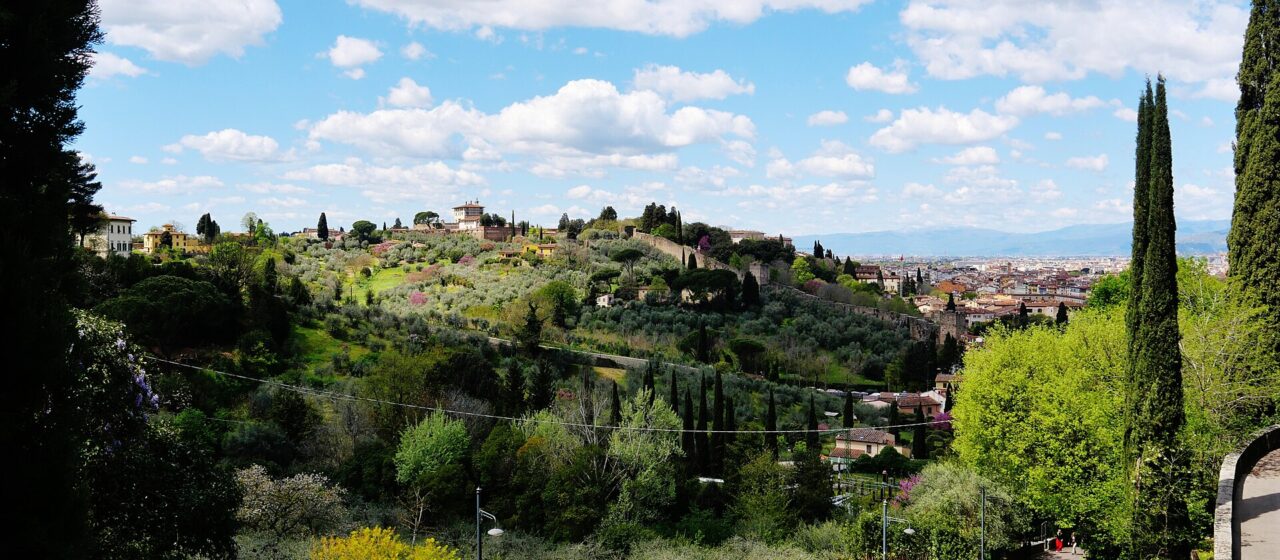
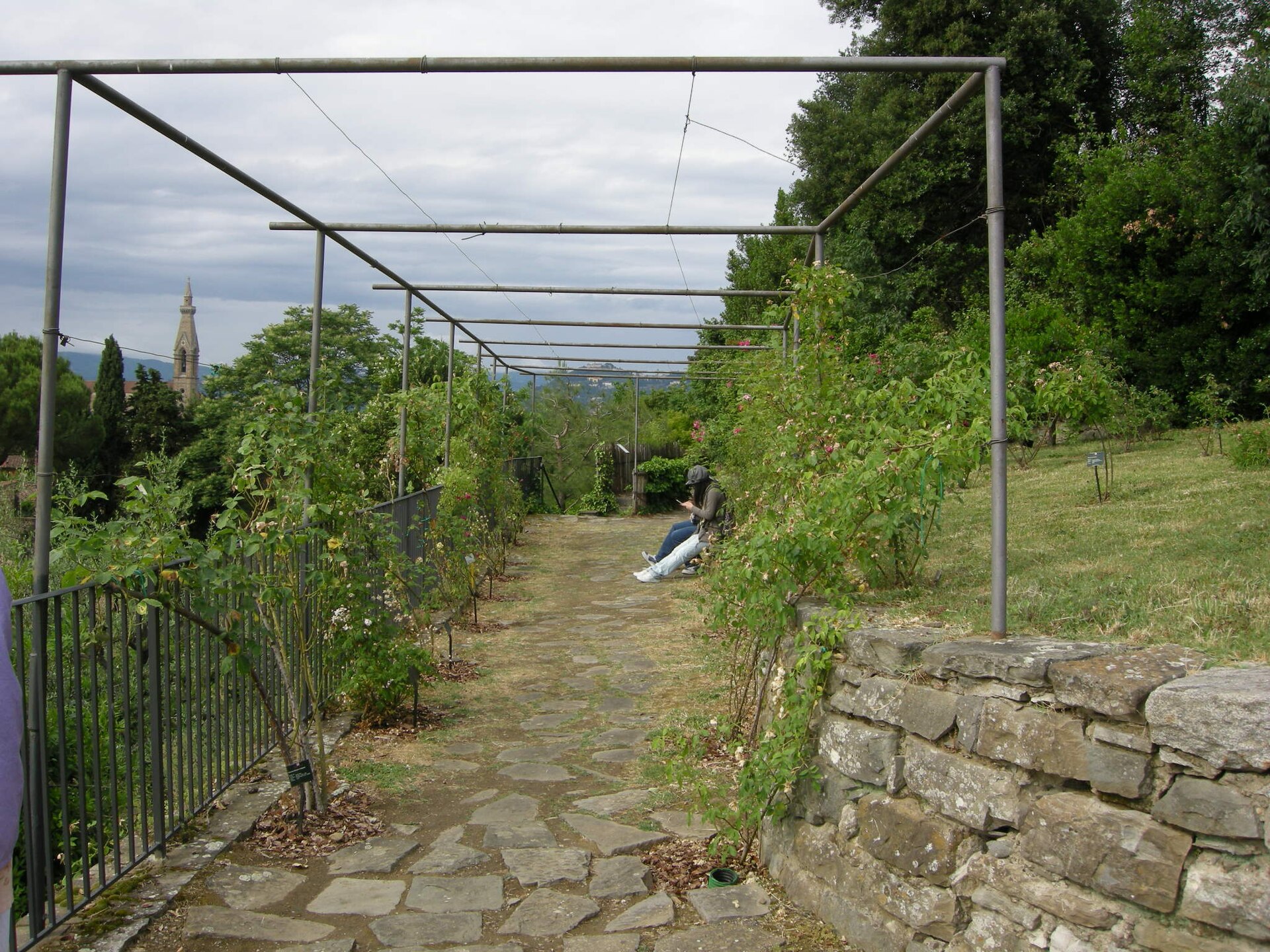
The Giardino delle Rose sits on the slope below Piazzale Michelangelo, between the Rampe and Porta San Niccolò, and it is free and open all year — roughly 09:00 to 20:00 on weekdays, from 10:00 on Sundays and holidays. It holds over four hundred varieties of rose, which flower from May into September with the real transformation running from mid-April to late June.
Two things elevate it above a nice municipal garden. The first is the ten Jean-Michel Folon sculptures set through the terraces — bronze figures on themes of journey, freedom and flight, one of the larger public groups of Folon’s work anywhere, and utterly unexpected in a rose garden in Tuscany. The second is a Japanese garden given by Kyoto, Florence’s twin city, in 1998, designed by the architect Yasuo Kitayama with seven master gardeners on Zen principles. It is small, it is beautifully made, and almost nobody who comes up for the view notices it is there.
The Iris Garden — until about 20 May
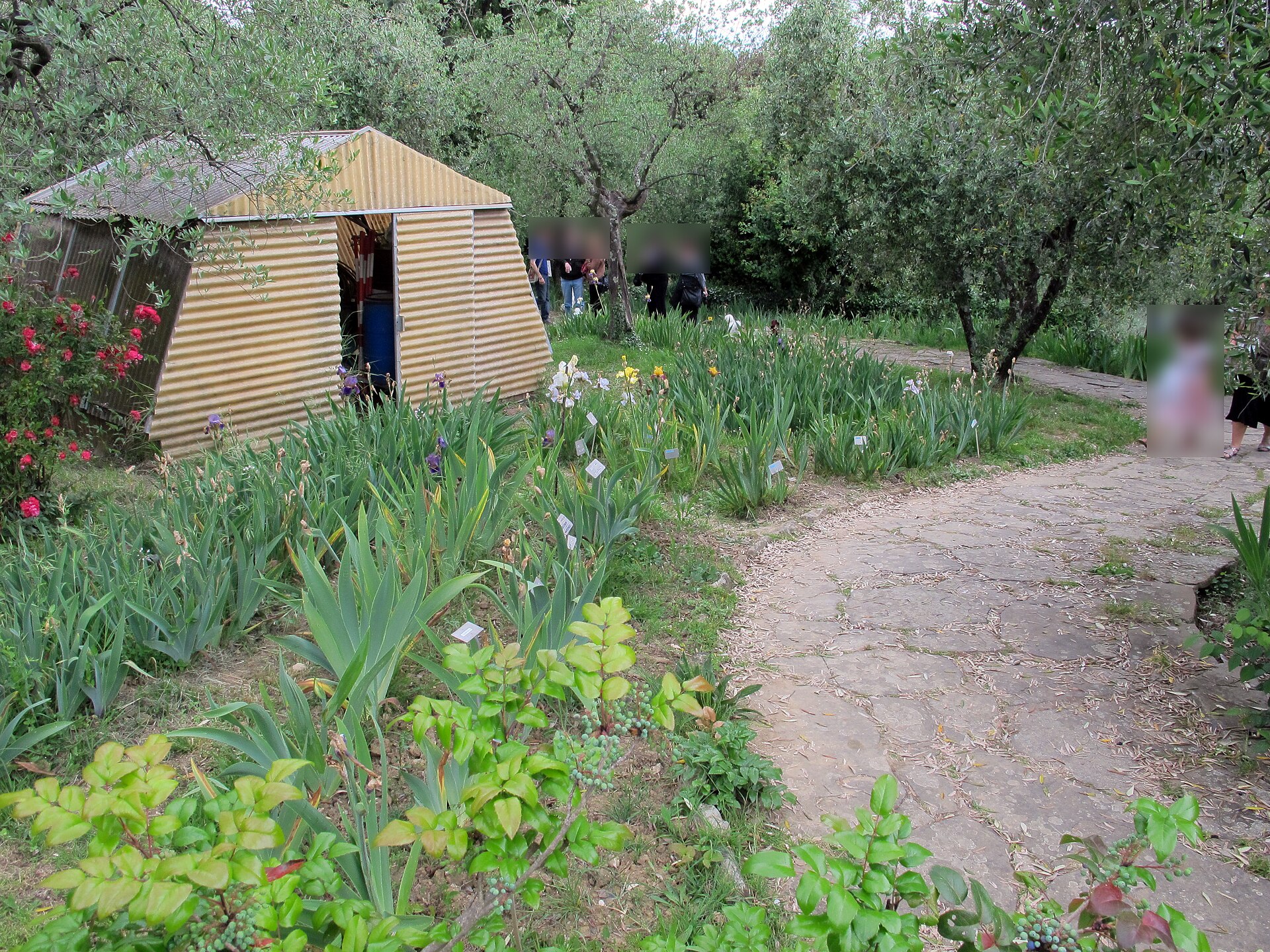
Immediately below Piazzale Michelangelo at Viale Michelangelo 82, the Giardino dell’Iris opens on 25 April and closes around 20 May. Free, daily 10:00 to 18:00 with last entry at 17:30. If you are in Florence in the first three weeks of May this is a genuine now-or-never, and the iris is not decoration: the red giglio on the city’s arms is a stylised iris and has been since the eleventh century.
It is a collection garden rather than a designed one — labelled beds of named cultivars on an olive terrace, run by the Italian Iris Society, and slightly shaggy in the way serious plant collections are. Arrive expecting a hillside of several hundred irises with Florence below it and you will love it.
Bardini and Boboli
The Bardini wisteria runs into about mid-May, though by then it is going over — the peak is April. The €15 combined Boboli-Bardini ticket, sold at the ticket offices only, covers both gardens, which remains the best garden value in the city. Both close the first and last Monday of the month; people get caught by this every week.
Boboli in May wants an early start. It opens at 08:15 and for the first hour you will share eleven acres of Medici garden with a handful of joggers. By noon in May the Viottolone has no shade worth the name.
How to Survive a Florentine May
This is the part that separates a good May from a bad one, and it is entirely about timing rather than money.
The three rules
- Start at eight. The Uffizi and the Accademia open at 08:15, Boboli at 08:15, and all three are civilised until roughly ten. An 08:15 Uffizi slot in May gives you the same gallery that a March walk-up gives you for nothing. This single habit is worth more than every other tip on this page combined.
- Give the middle of the day away. Between eleven and four, every queue in Florence is at its longest and the stone is at its hottest. Eat slowly, sit in a church, use a museum with air conditioning, or go up to Fiesole where it is several degrees cooler. Do not spend it in a line.
- Take the evening seriously. The light lasts until half past eight and the city is at its best in it. This is when you walk, when you cross the river, when you sit outside. Plan the evening first and fit the day around it, not the other way round.
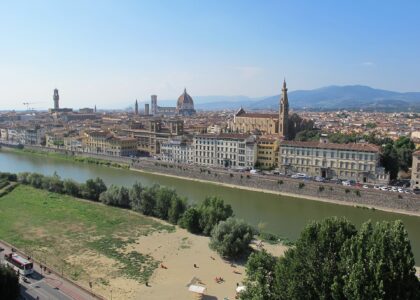
Two specific crowd traps worth naming. Piazzale Michelangelo at sunset in May is genuinely oversubscribed — coaches, hen parties, four hundred phones. The Rose Garden two minutes below it has the same view, more or less, with a fraction of the people, and San Miniato al Monte above it has a better one plus Gregorian vespers most evenings. The Ponte Vecchio between five and seven is not a place to be; cross at Ponte Santa Trinita, which is also the better view of the Ponte Vecchio.
May is also an excellent month to be in Florence on your own — long light, busy streets, a city that eats late and walks after dinner. Our guide to solo travel in Florence covers the practicalities, including which restaurants are comfortable for one.
Cantine Aperte, the Last Weekend
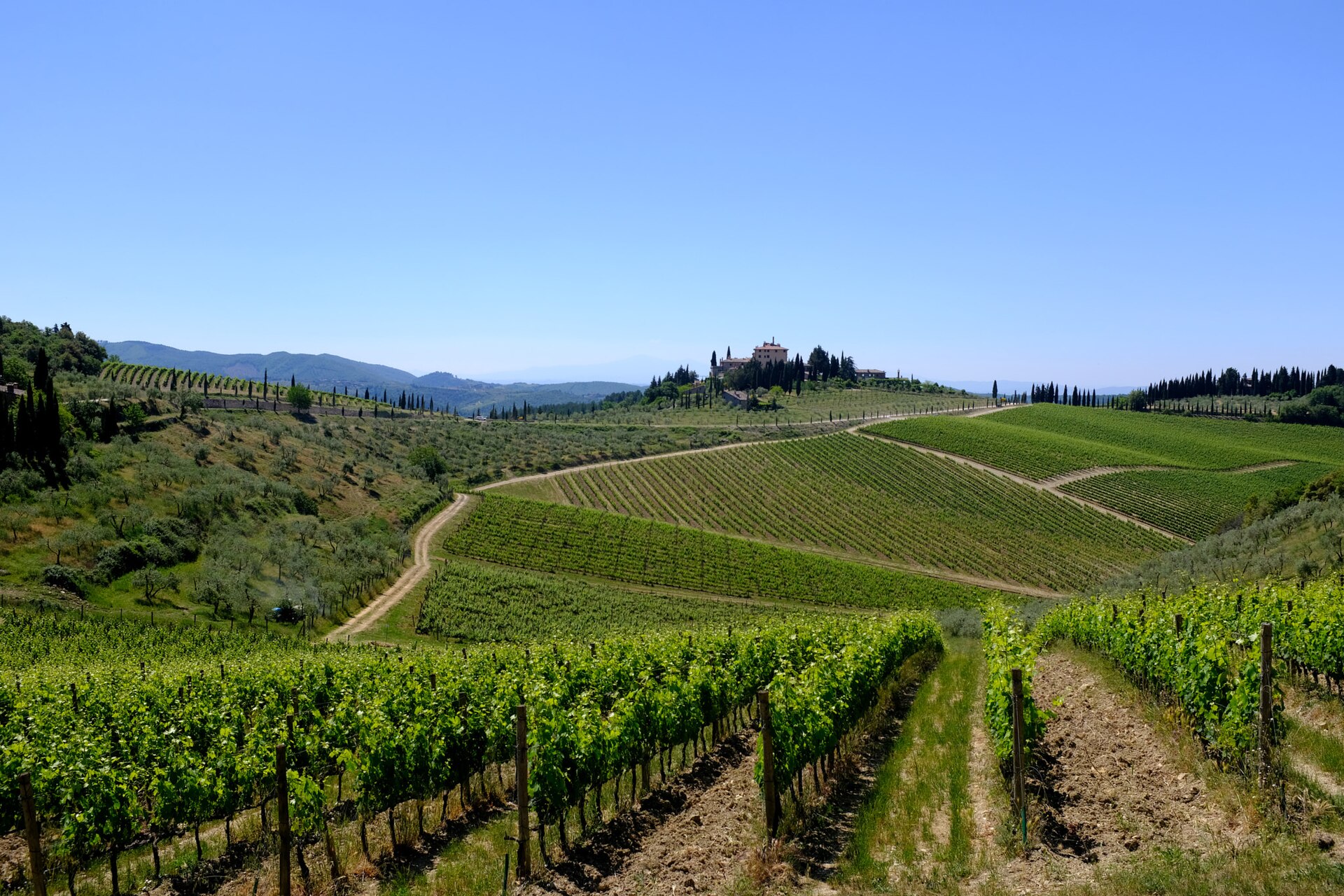
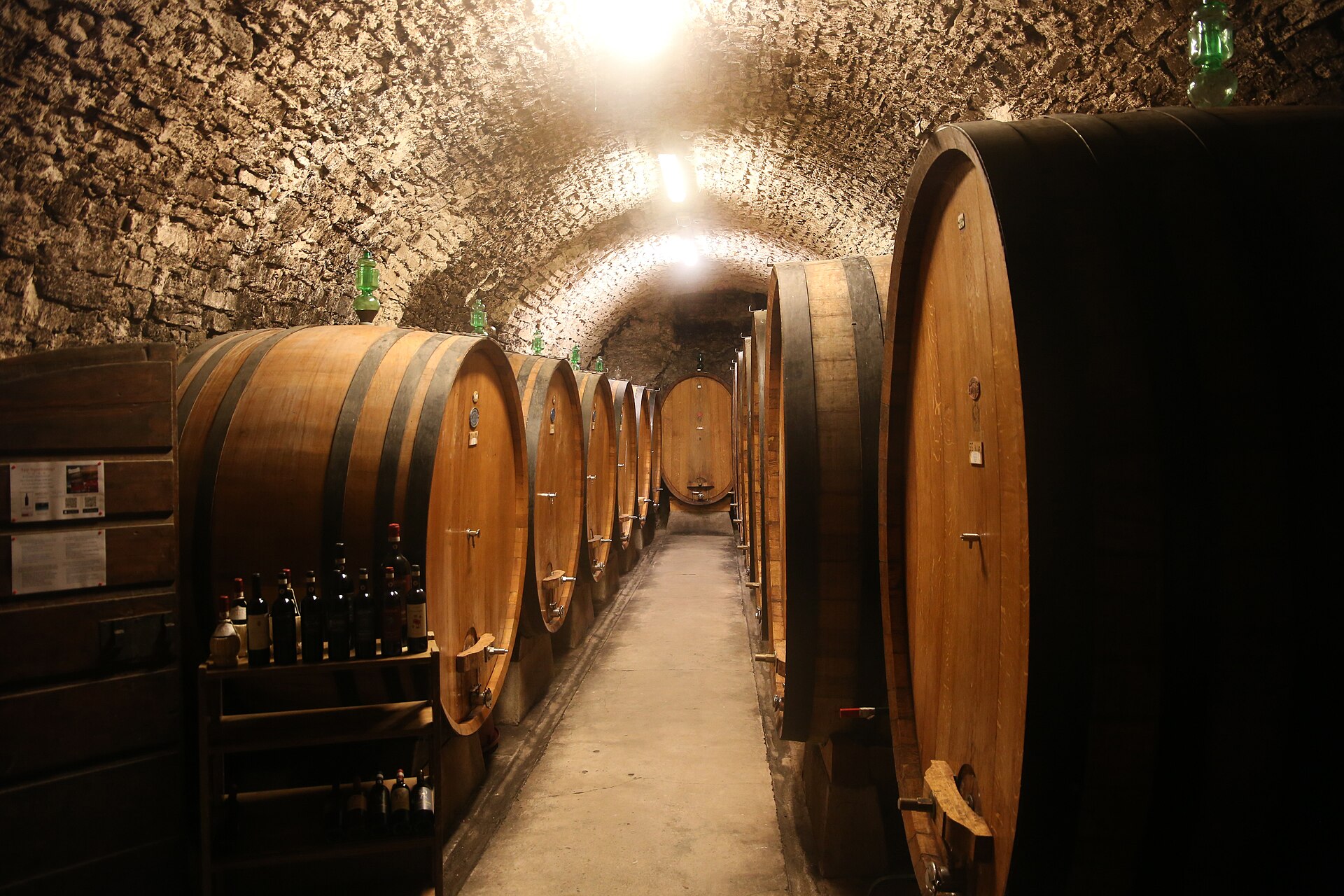
On the last weekend of May — 30 and 31 May in 2026 — wineries across Italy that belong to the Movimento Turismo del Vino open their doors to the public. It is called Cantine Aperte, it is the biggest wine event in the Italian calendar, and Tuscany participates heavily.
For someone based in Florence this is unusually convenient: a substantial share of the participating estates are in Chianti Classico and Chianti Rufina, within an hour of the city. What is on offer goes well beyond a tasting at a counter — vineyard walks, lunches at the estate, picnics between the rows, e-bike and jeep tours through the vines, guided trekking between villages, and in recent years yoga in the vineyard, if that is a thing you want.
Book it, and do not drive it
Individual estates set their own prices and their own booking rules, and the good ones fill weeks ahead — this is not a wander-in weekend despite the name. Book directly with two or three cellars rather than trying to do six. And arrange a driver or a small-group tour: the whole point of the weekend is tasting, the Chianti roads are narrow and winding, and Italian drink-driving limits are lower than the British ones. If you were considering hiring a car, read renting a car in Florence first — the ZTL alone is a good argument against it.
If the last weekend of May does not suit, the Chianti cellars are open all month anyway and May is a lovely time to see them — the vines are in full leaf, the flowering happens around the end of the month, and the landscape is green rather than the bleached gold of August. Our day trips from Florence guide has the routes and the timings.
Maggio Musicale in Its Own Month
The Maggio Musicale Fiorentino has been running since 1933, which makes it the oldest music festival in Italy, and although it opens in April it does spend May doing what its name suggests. The 2026 edition — the 88th — ran from 19 April to 1 July, with Verdi’s Un ballo in maschera opening on 12 May in a new production, and music director Daniele Gatti conducting all nine Beethoven symphonies across four concerts.
Performances are at the Teatro del Maggio on the edge of the Cascine park, about twenty-five minutes’ walk west of the Duomo or a short tram ride. It is a proper international house and the cheaper seats are a genuine bargain against London or Vienna prices. Each year’s programme is announced the previous autumn; book direct rather than through a reseller.
May also brings the start of the Arno boat season. The Associazione Renaioli run traditional flat-bottomed barchetti from Piazza Mentana, under the Ponte Vecchio, Ponte Santa Trinita and Ponte alla Carraia, from May to September, by reservation only — about forty-five minutes on the water. The renaioli were the river workers who dredged sand and gravel out of the Arno for the city’s builders, and the boats are the ones they used. Commercial operators run similar trips with aperitivo attached from roughly €49 a head. It is the one Florentine tourist activity that genuinely shows you something you cannot otherwise see: the city from the waterline.
What to Book, and How Far Out
May is peak season. Treat the booking windows as minimums, not targets.
| What | Book ahead | Price |
|---|---|---|
| Accademia (David) | A month, more at half-term | €20 + €4 booking |
| Uffizi, morning | Three to four weeks for 08:15 | €25 day / €29 booked |
| Uffizi, from 16:00 | A week or two | €16 |
| Duomo dome climb | Three weeks; the slot is timed | Brunelleschi Pass €30 |
| Vasari Corridor | As far out as it is sold | €43 on the day / €47 booked, Uffizi entry included |
| Brancacci Chapel | Two weeks; ten per 30-minute slot | €15 (€10 reduced) |
| Cantine Aperte cellars | Several weeks | Set by each estate |
| Restaurants | Three to four days, more for the well known | — |
| Rose Garden, Iris Garden | Never | Free |
Two notes that save people real money and time. The afternoon Uffizi ticket — €16, entry from 16:00, gallery open to 18:30 — is under-used even in peak season, and two hours in a thinning Uffizi is not a compromised visit. Details in our Uffizi tickets guide.
And the free first Sunday of the month is a trap in May. State museums are free, which in a peak month means hours of queue for a gallery you then cannot move in. Book a Tuesday and pay.
On the Firenze Card question: €85 for 72 hours across 60-plus museums, reservation fees included, breaking even at three or four paid sites. It does not cover the Duomo complex, which is the single most common and most expensive misunderstanding about it, and Uffizi and Accademia slots still have to be reserved. The Florence museums guide works through whether it pays for your particular list.
What to Do
Use the evening
May’s real gift is the three hours between six and nine. The passeggiata is a genuine institution here and not a tourist performance: the city walks, along the Lungarni, across Santa Trinita, around Santo Spirito, and it goes on until the light finally gives out. Aperitivo runs roughly seven to nine, and in May every decent bar has put its tables back on the street.
Do the viewpoints in the evening rather than the middle of the day. San Miniato al Monte is the pick — a genuine eleventh-century Romanesque church, one of the finest in Italy, with the best view in Florence in front of it and, most evenings, Gregorian chant at vespers. It costs nothing and it is a thirty-minute walk up from Ponte alle Grazie.
Out of the city
Day trips are at their best in May because the countryside is at its best and the coast has come alive. Siena, Lucca, Pisa and San Gimignano all work as day trips — see day trips from Florence for times and fares, and the Pisa day trip specifically. Fiesole is bus 7, twenty to thirty-five minutes from Santa Maria Novella or San Marco, roughly every twenty minutes, and it is several degrees cooler than the city on a hot May afternoon — which is precisely what to do with a hot May afternoon.
Chianti in May is green and busy with flowering vines; the Val d’Orcia is at its most photographed for good reason. Full-day small-group tours from Florence run roughly €80 to €140 a head.
What not to do in May
- Piazzale Michelangelo at sunset without a plan. Go to the Rose Garden or San Miniato instead, or get there an hour early.
- The dome at two in the afternoon. 463 steps, no lift, no air movement. Book the first slot of the day.
- Assuming the Bardini wisteria will still be good. By the middle of May it is going over. Check what people are posting that week.
- Leaving the Accademia until you arrive. In May this means the walk-up queue on Via Ricasoli, which is an hour you will not get back.

Eating in May
May is the last month of Tuscan spring cooking before everything turns to tomatoes, and there are two things worth going out of your way for.
Baccelli with pecorino. Young broad beans, raw, podded at the table with a wedge of sheep’s cheese and a glass of something cold. They are on menus from April and gone by the start of summer, and there is no version of this available to you at home. The Florentine way is to order them as an antipasto and take twenty minutes over it.
Panzanella. The tomato-and-stale-bread salad arrives when the tomatoes do, and in May you get the very first and best of them. It is the summer counterpart to winter’s ribollita — both are peasant dishes built on not wasting bread — and a good one is a revelation while a bad one is a bowl of wet crumbs. Order it where the locals are.
Alongside those: artichokes at the tail end, the last wild asparagus, courgette flowers stuffed and fried, the first proper cherries and apricots in the markets, and bistecca alla fiorentina, which is a year-round proposition but considerably more pleasant to eat outdoors at nine in the evening than indoors in February.
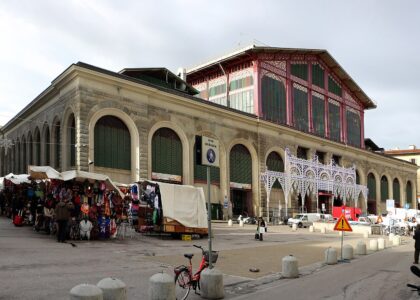
Book. Three to four days is the working rule in May, longer for anywhere with a reputation. Walking in at eight and expecting a table is an April habit that stops working. Sant’Ambrogio market in the morning is still the best food in the city for the least money; the Mercato Centrale upstairs is the convenient version. Our Florence food guide has where to eat, and Italian dining etiquette covers the coperto and the coffee rules.
What to Pack
- Linen and cotton, not synthetics. Twenty-four degrees in a stone city with little air movement is warmer than twenty-four degrees anywhere with a breeze.
- A light layer for the evening. The low is still twelve, and after nine on the Lungarni you will want sleeves.
- Sunscreen and a hat. Eight hours of sun a day. The Boboli avenues and Piazzale Michelangelo have almost no shade.
- A refillable bottle. Florence has free drinking fountains, including the fontanelli that dispense chilled still and sparkling water. You will get through more than you expect.
- Covered shoulders and knees for churches — enforced at the Duomo and Santa Croce, and more irritating in warm weather. A light scarf solves it. See the church dress code.
- Shoes for 463 steps and eight hours of cobbles. Not new ones.
The full list is in our Florence packing list.
Frequently Asked Questions
Is May a good time to visit Florence?
It is the best month for weather and gardens, and one of the two busiest of the year. Twenty-four-degree afternoons, eight hours of sun a day, light until half past eight, the Rose Garden in flower and the Arno boats running. The price is peak room rates, month-long booking windows and real queues. Book early and start each day at eight and it is unbeatable.
How hot is Florence in May?
Average high around 24 °C and average low around 12 °C, with 242 hours of sunshine and seven or eight short wet days. The last week can deliver thirty-one or thirty-two degrees, and the city sits in a basin that holds heat. Treat a hot May day exactly as you would a July one.
Is the Rose Garden in Florence free?
Yes, free and open all year — roughly 09:00 to 20:00 on weekdays and from 10:00 on Sundays and holidays. Over four hundred varieties of rose flowering May to September, ten Jean-Michel Folon sculptures through the terraces, and a Japanese garden given by Kyoto in 1998. It sits just below Piazzale Michelangelo and has almost the same view with a fraction of the crowd.
Is the Iris Garden still open in May?
Until about 20 May. It opens on 25 April and runs roughly four weeks, free, daily 10:00 to 18:00 with last entry at 17:30, at Viale Michelangelo 82 below the Piazzale. If you are in Florence in the first three weeks of May it is worth an hour; after the 20th the gate is shut until the following April.
What is Cantine Aperte?
Italy’s national open-cellar weekend, held on the last weekend of May — 30 and 31 May in 2026 — by the Movimento Turismo del Vino. Member estates open for tastings, vineyard walks, lunches and picnics among the vines, and a large number of them are in Chianti within an hour of Florence. Estates set their own prices and the good ones book out weeks ahead.
How far ahead should I book for May?
A month for the Accademia, three to four weeks for an 08:15 Uffizi slot, three weeks for the timed dome climb, and as far out as it is sold for the Vasari Corridor. Restaurants want three or four days. Accommodation should be the first thing you do — May rates are at or near the annual peak and the good central places go early.
How do I avoid the crowds in Florence in May?
Start at 08:15 when the Uffizi, Accademia and Boboli open, give away the hours between eleven and four to lunch or somewhere indoors, and put the walking and the viewpoints into the long evening. Swap Piazzale Michelangelo for the Rose Garden or San Miniato at sunset, and cross the river at Ponte Santa Trinita rather than the Ponte Vecchio.
May or June in Florence?
May, unless you specifically want Calcio Storico and the San Giovanni fireworks on 24 June. June is nearly five degrees hotter — the biggest month-on-month jump of the year — which changes what you can comfortably do in the middle of the day. May gives you the same long evenings without the heat.
Keep Reading
- Florence in April — cooler, cheaper, and the month the wisteria actually belongs to.
- The best time to visit Florence — all twelve months compared.
- Florence weather by month — the full climate tables.
- Outdoor activities in Florence — the gardens, the walks and the river.
- Day trips from Florence — Chianti, Siena, Lucca and the rest, with times and fares.
- Tuscany wine festivals — the rest of the year’s wine calendar.
- Florence tours guide — which guided options are worth it and which are not.